Garden safety concerns: what is safe to use guide
For edible beds, use a simple screen: confirm the product is labeled for the crop, contact path, and timing, then check the active ingredient, rate, and preharvest interval before it touches soil, leaves, flowers, or fruit. I skip every sales claim until those lines check out, because one bad choice can contaminate harvests, burn plants, harm bees, or break the label. This guide shows how to judge fertilizers, mulches, sprays, and home-mix inputs by crop, exposure route, and days before harvest.
What does safe to use actually mean in an edible garden?
In edible beds, “safe to use” means the input fits the crop, the way it will contact the crop, the timing before harvest, who may be exposed, and the dose applied. I treat those as separate checks, because a product can be fine in bare soil, risky on leaves, and flatly wrong close to harvest.
The five checks that matter
Before I open a bag or mix a tank, I ask five plain questions: what crop is this for, where will it land, how close am I to harvest or bloom, who else can touch it, and what rate actually fits this bed.
- Crop: Is the vegetable, herb, or fruiting plant named on the label, or clearly included under edible crop directions?
- Contact path: Will the product stay in soil, touch leaves, land on flowers, or contact the edible part directly?
- Timing: Is there a pre-harvest interval, a bloom restriction, or a delay before people can re-enter?
- Exposure: Who else gets exposed: pollinators, children, pets, or the person applying it?
- Dose: Does the rate fit the bed volume, crop stage, and product directions?
Why soil-safe, foliar-safe, and harvest-safe are different
A pelletized mineral amendment mixed into empty soil is one type of risk. A foliar spray on lettuce is another. A drench around tomato roots during bloom is another again.
Soil-contact safety asks about salts, pH shift, contamination, and what reaches roots. Foliar-spray safety asks about leaf burn, residues, bee exposure, and whether the label allows that crop. Harvest-safe asks whether the edible part may hold residue, trap dust, or still be inside the pre-harvest interval.
How risk changes by crop type
Leafy greens and herbs punish mistakes fastest. Their edible surface stays exposed, bruises easily, and gets picked often, so anything that spots leaves, leaves residue, or drifts as fine dust becomes a bigger problem than it would on corn or sweet potatoes. Root crops bring a different issue, because the harvest grows inside the treated zone and can pick up soil, salts, or fine particles. Fruiting vegetables usually give you more distance between the input and the part you eat, unless spray lands on flowers or fruit.
Seedlings also have less margin for salt and pH swings than established plants. Containers are less forgiving than in-ground beds because excess salts stay put longer and root volume is limited.
How do I tell if a product is food-safe or only garden-safe?
A product is food-safe for a given use only when the label permits that edible crop, use site, and application method. I ignore broad front-label wording like “garden,” “outdoor,” or “flower and vegetable” until I see the crop listing, rate, timing limits, and any restrictions near harvest or bloom.
Label phrases that permit edible-crop use
Look for explicit edible directions such as named vegetables, herbs, berries, fruiting crops, or broad groups like brassicas or cucurbits. A bag or bottle that says “for gardens” may still only fit ornamentals, lawns, or non-food areas.
Food-crop permission should match the use pattern. A product allowed for soil incorporation may still not be allowed as a foliar spray. A spray allowed on tomatoes may still exclude basil growing nearby.
Restrictions that disqualify a product for vegetables and herbs
Reject the product for edible beds if the label limits it to ornamentals, shrubs, turf, houseplants, or non-crop areas. Also reject it if edible crops are absent and the label gives no food-crop directions, no pre-harvest interval where one would be expected, or no application rate for the crop in question.
Restricted-use warnings, storage language, or disposal rules can also make a product a poor fit for a home vegetable bed even if legal use exists elsewhere.
Where to find rates, pre-harvest intervals, and re-entry directions
Rates are usually listed in the directions section or crop table. Pre-harvest interval may appear as days to wait before picking. Re-entry guidance may appear as a re-entry interval, a drying requirement, or a statement to keep people and pets out until dust has settled or sprays have dried.
OMRI-listed status does not replace the label directions for crop, rate, or use pattern. It can indicate suitability under certain organic production rules, but it does not by itself approve every edible crop, every rate, or every use pattern.
A quick decision tree for any input before first use
Step-by-step screen
- Identify the contact path. I decide first where the material will actually end up, because a soil drench, a side-dress, and a foliar spray can have totally different residue and injury risks on the same crop. Decide whether the product will stay in soil, touch leaves, reach flowers, or contact the edible part directly.
- Check crop listing and use site. Confirm the exact crop or crop group is allowed, and make sure the label permits that use on edible plants rather than general garden areas.
- Check rate and timing. Find the labeled rate, pre-harvest interval, bloom restrictions, and any re-entry guidance.
- Screen soil risks. For amendments, check NPK contribution, pH impact, salt content, and particle size. Fine dusty inputs need more care than coarse stable ones.
- Screen contamination risks. Ask about source material, herbicide carryover, heavy-metal concerns, and whether the product is made from clean feedstocks.
- Screen exposure risks. Check bee toxicity, drift potential, residue on harvestable tissue, dust inhalation risk, and whether children or pets may contact the area soon after application.
- Choose a substitute if needed. If one factor is borderline, switch to a safer fit for the same job, such as compost instead of fresh manure, or a coarse mulch instead of a dusty one.
Borderline products and safer substitutes
A high-salt synthetic feed may be acceptable in a large in-ground bed but rough on seedlings in containers. A safer substitute is a lower-salt input, used at a lighter rate, with watering that flushes the medium.
Fresh manure near harvest is a poor bet for greens and root crops. Finished compost from a clean source is safer. Fine lime or sulfur dust can shift pH fast and expose the applicator; pelletized forms usually reduce dust. Dyed or demolition-wood mulch is weaker than clean untreated wood chips or straw with known source history.
Which soil amendments are safe around edible crops?

Soil amendments are safe around edible crops when the source is clean, the rate fits the bed, the pH effect is known, and the salt load will not stress roots. I’ve used the same product safely in a deep in-ground bed and seen it cause trouble in a seedling tray, simply because the tray had less buffering and dried harder between waterings.
Compost, manure, meals, lime, sulfur, and mineral inputs
Start with source quality. Compost made from yard waste, food scraps, or manure needs a clean feedstock history. Compost or manure contaminated by persistent herbicides can twist tomatoes, beans, and peppers even when the material looks finished.
Manures and meals can add meaningful NPK. That is useful, but it also means dose matters. In small containers, a modest over-application can push soft growth or create salt stress. Lime and sulfur mainly change pH, so safety depends on how much change the bed can absorb.
NPK contribution, pH shift, and salt load by bed type
Raised beds and in-ground beds often buffer mistakes better than containers. Containers hold limited media, dry faster, and accumulate salts sooner. Seedlings need the gentlest rates of all.
Check whether the amendment adds mainly nitrogen, mainly calcium, or a broad nutrient package. Then ask what that means for the crop. Leafy crops can respond fast to nitrogen; herbs can turn soft and lose quality under heavy feeding; fruiting crops often tolerate slower release inputs better than repeated high-salt feeds.
Source quality, particle size, and contamination red flags
Fine powders may drift more and can raise inhalation risk. Coarser materials are easier to place and usually less dusty. Dusty products call for eye protection and a dust mask or respirator suited to the task.
Red flags include unknown waste-derived sources, compost with bits of painted wood or plastic, manure from animals bedded on treated hay, and ash applied without a pH plan. Organic-certification status can help sort products, but it still does not replace crop-specific label directions where those exist.
Compost tea safety rules for edible crops
Compost tea is safe for vegetable gardens only when brewed from fully finished compost, clean water, and applied fresh. Using unfinished compost, sour batches, or manure-based mixes introduces harmful bacteria that can contaminate edible crops. Aerated brewing significantly reduces pathogen risk compared to non-aerated methods.
Treat compost tea as a targeted soil drench rather than a universal foliar spray. A strict decision checklist—verifying compost maturity, brew smell, and application timing—keeps vegetables safe. For the specific parameters that determine whether a batch is suitable for food crops, review these compost tea safety rules before spraying anything on harvestable plants.
What can go safely on leaves, roots, and harvestable parts?
Products can go safely on leaves, roots, or harvestable parts only when the label allows that contact route for that crop and the timing leaves enough margin before harvest. In practice, leaves and soft herbs give me the least room for error, while root drenches and side-dressing bring a different set of concerns around salts and root injury.
Foliar sprays versus drenches versus side-dressing
Foliar sprays place the product directly on edible tissue in many crops. That is why lettuce, spinach, cilantro, dill, and parsley need extra caution. Drenches put the product in the root zone, which lowers direct residue on leaves but can still affect harvest through uptake, salt stress, or splashback.
Side-dressing keeps material off leaves when done carefully. It often gives the cleanest path for fertility corrections in established vegetables.
Pre-harvest interval and residue concerns by crop type
Leafy crops and herbs are usually cut and eaten with little peeling. Root crops can carry soil and may trap fine particles in rough skin. Fruiting crops like peppers and tomatoes often leave more distance between soil treatment and harvest, though direct spray on fruit still matters.
Near-harvest use needs the closest reading of pre-harvest interval language. If a crop is picked every day, a product with a waiting period may be a poor fit even when technically allowed.
When to avoid application
Avoid foliar treatments on seedlings, soft herbs, open blooms, and nearly ready crops unless the label clearly supports that use. Avoid root-zone feeding in dry media where salts can spike. Avoid dusty amendments on windy days when particles can settle on nearby salad beds.
How safe are pest control products for vegetables and pollinators?
Pest control products are safe for vegetables and pollinators only when the active ingredient matches the target pest, the label allows that edible crop, and the timing avoids bee exposure and harvest conflicts. I trust the active ingredient, crop directions, bee toxicity language, and drift risk far more than brand reputation.
Active ingredient first, brand second
Start with the active ingredient. Two bottles sold for “garden insects” may have very different residue patterns, bee hazards, and harvest restrictions. Then check whether the target pest is actually listed. Broad spraying without a target usually raises risk without solving the problem.
Edible-crop directions, re-entry guidance, and bee toxicity
Check the edible-crop label directions line by line. Then read the re-entry guidance. If the label says to keep people out until sprays dry or dust settles, that matters for children, pets, and the gardener doing cleanup.
Bee toxicity language matters even in small home plots. Garden Design says pollinator gardens should create a safe environment, and it includes bee-friendly plants as a way to support bees. That broad advice turns practical here: do not spray open blooms with products carrying bee warnings, and avoid drift into flowering weeds or nearby herbs in bloom.
Drift, bloom timing, and evening-only use cases
Even a product allowed on edible crops can be a poor choice if it drifts easily. Fine sprays, hot weather, and windy conditions increase off-target movement. Some labels direct use when bees are less active, such as later in the day. That timing can reduce exposure, but it does not erase crop-label or harvest restrictions.
Are mulch and growing media safe for raised beds and containers?
Mulch and growing media are safe for raised beds and containers when the source material is clean, the contaminant risk is low, the water-holding pattern fits the crop, and handling does not create a major dust problem. In containers, I watch media quality and salt level closely because roots react faster there than they do in open ground.
Straw, wood chips, compost blends, peat, coir, and bagged mixes
Straw can keep fruit clean and reduce soil splash, but source matters because field residues and persistent herbicides can follow the straw. Wood chips are fine around many vegetable beds when kept off stems and used as surface mulch rather than mixed into the root zone.
Peat and coir behave differently with water and salts. Bagged mixes vary widely in compost level, starter charge, and texture. For seedlings, lighter and cleaner media are usually safer than heavy compost-rich blends.
Persistent herbicide risk and heavy-metal concerns
Herbicide carryover is a commonly missed failure case in edible gardens. Tomatoes, beans, peas, and peppers often show carryover problems first. Ask where compost, manure, straw, or hay came from before spreading it through an entire bed.
Heavy-metal concerns rise with unknown urban fill, ash, demolition wood, and some waste-derived inputs. Clean feedstock history matters more than “premium” language on the bag.
Water retention, decomposition speed, and dust exposure
Fast-decaying mulch can tie up nitrogen at the surface if incorporated by mistake. Slow-decaying coarse mulch is easier to manage in paths and around big fruiting crops. Dusty bagged media can irritate eyes and lungs during filling, especially in enclosed sheds or greenhouses.
When do children, pets, and gardeners need extra protection?
Children, pets, and gardeners need extra protection when an input leaves residue on reachable surfaces, creates airborne dust, has a re-entry delay, or must be stored away from living spaces. Risk drops after clean watering-in or full drying, but I still see most home-garden problems come from sloppy handling, open containers, or tools left dirty.
PPE by product type
Gloves fit almost every input. Eye protection matters for splashes, fine granules, and dusty powders. A dust mask or respirator may be needed for dry amendments, lime, sulfur, peat, or other fine media that become airborne during pouring and mixing.
Application conditions matter. Avoid mixing or spreading dusty products in gusty weather or enclosed unventilated spaces.
Re-entry timing, washing, and tool cleanup
For sprays, the treated area should stay off-limits until the label condition is met, often until dry. For dusts and fine amendments, the practical trigger is when particles have settled and surfaces are no longer transferable by touch.
Wash hands after application. Launder dusty or contaminated clothes separately if needed. Rinse spreaders, scoops, and sprayers before using them for another crop input to avoid unintended mixing.
Storage and disposal
Keep inputs in original containers. Store them dry, closed, and away from feed, seed, and pet supplies. Disposal rules on the label matter because leftover concentrates, dusty residues, and rinse water can create more risk than the actual garden use.
The one-page safe-to-use checklist and scoring table
How to score an input before it goes in an edible bed
Use this sheet before first use. Score each category from 0 to 2. Low totals usually mean the product fits the bed. High totals mean reject it or replace it with a safer option.
| Category | 0 points | 1 point | 2 points |
|---|---|---|---|
| Crop compatibility | Exact edible crop or crop group listed | Edible use implied but crop is broad or unclear | No edible-crop permission or ornamental-only use |
| Soil-contact risk | Low salt, known source, low contamination concern | Moderate salt or unknown pH effect | High salt, fresh manure, unknown source, or contamination risk |
| Foliar risk | No leaf contact or clearly allowed foliar use on that crop | Possible spotting, residue, or drift concern | Leaf contact on tender edibles not clearly allowed |
| Pollinator risk | No bloom exposure and no bee warning relevant to use | Use near bloom with timing limits | Bee warning plus bloom contact or drift likely |
| Re-entry and PPE needs | Gloves only, no special re-entry concern | Eye protection or dust mask needed, basic re-entry caution | Respirator-level dust issue, strict re-entry, or high transfer risk |
| Label restrictions | Rate, timing, and disposal directions are clear | One limit is hard to interpret | Missing crop rate, unclear timing, or restrictive warning |
How to use the score
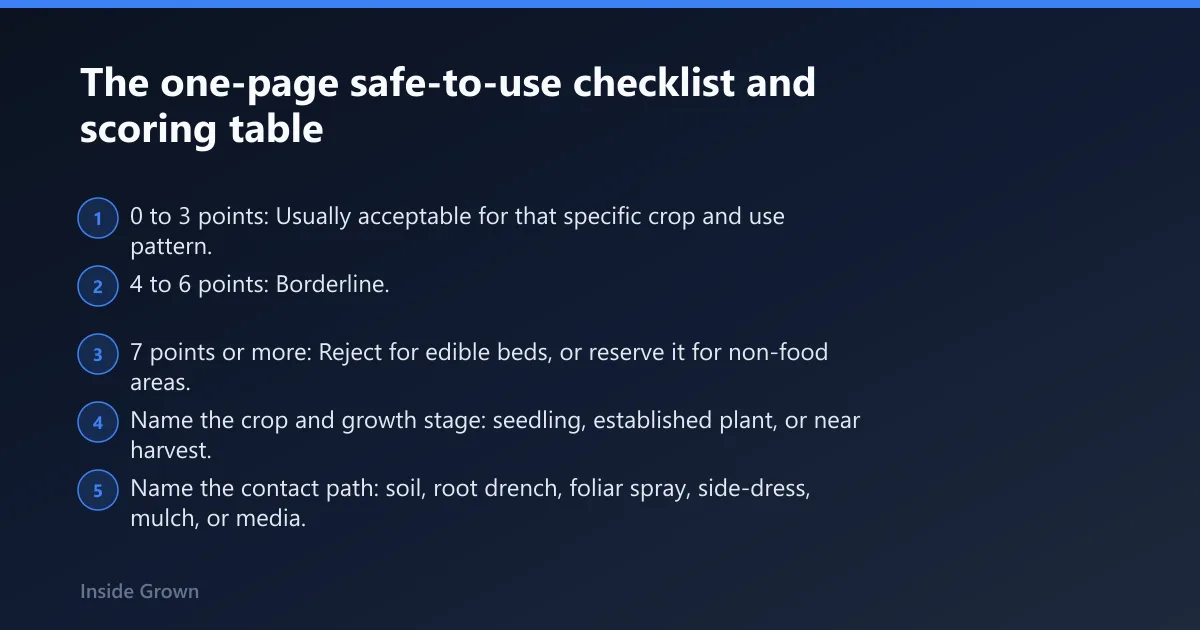
- 0 to 3 points: Usually acceptable for that specific crop and use pattern.
- 4 to 6 points: Borderline. Use only if the label is clear and no safer substitute does the same job.
- 7 points or more: Reject for edible beds, or reserve it for non-food areas.
Checklist for first use
- Name the crop and growth stage: seedling, established plant, or near harvest.
- Name the contact path: soil, root drench, foliar spray, side-dress, mulch, or media.
- Read the edible-crop directions and confirm the use site.
- Write down the rate and any pre-harvest interval.
- Check salt load, pH effect, particle size, and source material.
- Check bee language, bloom status, and drift risk.
- Set PPE, re-entry timing, and storage plan before opening the product.
- If any line is unclear, replace the product.
Frequently asked questions
What is safe to use in a vegetable garden?
Safe use in a vegetable garden means the product is permitted for that edible crop, fits the contact path, and can be applied at the labeled rate and timing without avoidable exposure to people or pollinators. Gardens can be used for growing food crops and fresh vegetables, so crop-specific directions matter more than aisle marketing.
How do I tell if a garden product is food-safe or just garden-safe?
Look for exact edible-crop directions, allowed use sites, application rate, pre-harvest interval, and re-entry guidance. If the label only mentions general garden use, ornamentals, turf, or outdoor areas, that does not make it food-safe. A garden is a planned space usually outdoors for cultivating and enjoying plants, but not every garden product fits edible beds.
Are natural gardening products always safe to use?
No. Natural source alone says little about residue, salt load, pH shift, bee hazard, or whether the product is allowed on herbs and vegetables. OMRI-listed status can help with organic system planning, but it does not overrule crop labels, storage rules, disposal language, or harvest timing limits.
How do I check if a soil amendment is safe for my garden?
Check source material, NPK contribution, pH effect, salt content, particle size, and contamination risk before spreading it. This matters even more in containers and seedling mixes. Gardens can include water features such as ponds, waterfalls, or creeks, so runoff and dust drift also matter when beds sit near those areas.
What garden products are safe for children and pets?
The safer choices are products with low transfer risk after watering-in or drying, clear re-entry guidance, and storage that keeps containers closed and out of reach. Do not rely on “pet-safe” or “kid-safe” front-label wording alone. Dust, sticky residues, and open containers create most home-garden problems.
Is this product safe for vegetables, soil, and pollinators?
Only if all three checks pass at once: edible-crop permission, acceptable soil or foliar risk, and low pollinator exposure at the planned timing. Garden Design groups garden ideas into eco-friendly garden ideas, but edible-bed safety still comes down to active ingredient, crop directions, bloom timing, and who may touch the treated area.