Is Chicken Manure Safe for Vegetable Gardens?
Chicken manure is safe for vegetable gardens only after full composting or proper processing, and raw manure must stay away from edible crops for 120 days before harvest for crops where edible parts touch soil and 90 days for crops where edible parts do not contact soil. Used poorly, it can scorch plants and spread pathogens into soil and harvests. This guide explains which crops can take each form, when to avoid raw manure, and how to choose between raw, aged, composted, and pelleted chicken manure.
Chicken manure safety decision table

This table gives the fastest crop-and-timing rule. If the manure source or processing is uncertain, treat it like raw manure and keep it away from edible crops until you can verify how it was handled.
| Form | Pathogen risk | Burn risk | Best use case | Crops to avoid | Minimum time before harvest |
|---|---|---|---|---|---|
| Raw | High; may contain Salmonella, E. coli, and Campylobacter | High if applied fresh or heavy | Not recommended for edible crops; only if managed as raw manure before planting and fully incorporated | Leafy greens, root crops, and any crop where edible parts touch soil | 120 days for crops where edible parts touch soil; 90 days where edible parts do not contact soil |
| Aged | Lower than fresh if handled well, but not automatically safe | Moderate | Pre-plant soil improvement when the pile has aged properly and the rate is controlled | Roots and low leafy crops if timing is short or the material is only partly aged | Follow raw-manure timing if safety is uncertain |
| Composted | Lower when compost reaches and holds high heat | Lower when finished and applied lightly | Before planting or as a light top-dress away from plant stems | Direct contact with edible leaves, crowns, and roots | Use a conservative buffer if the composting process was not verified |
| Pelleted | Varies by processing; do not assume pathogen-free unless the label says so | Lower than raw when used at label rate | Measured fertility boost for beds, transplants, and side-dressing | Any crop if the application rate is unknown or too heavy | Use the label and keep edible parts clean; timing still matters |
Is chicken manure safe for vegetable gardens?
Chicken manure can be safe for vegetable gardens, but safety depends on processing, crop type, and harvest timing. Fresh manure is risky. Fully composted manure is the safer choice when you keep it off edible surfaces and follow the waiting period for the crop you grow. Some pelletized products can also work when the label is clear.
What makes chicken manure useful
Chicken manure is a high nitrogen source, and it also contains phosphorus and potassium. That makes it useful for feeding hungry plants and improving soil that needs organic matter. Heavy feeders such as corn, tomatoes, peppers, and squash may benefit most when the product is properly processed and applied at the right rate.
What makes it risky
Fresh chicken manure may contain pathogens such as Salmonella, E. coli, and Campylobacter. It can also burn plants because of ammonia and concentrated nitrogen. If the source or treatment is unknown, risk goes up, because you cannot tell whether the manure has been aged, composted, or pelletized enough to reduce contamination.
The quick yes-or-no rule
Use chicken manure only when three things line up: the manure is processed well, the crop can tolerate it, and the harvest window is long enough. If any one of those is uncertain, do not use it on edible plants. That rule matters most for root crops, leafy greens, and anything that sits close to the soil.
Raw vs aged vs composted vs pelleted
These four forms are not equal. Raw manure is the riskiest. Aged manure may be safer than fresh manure, depending on how it was stored and how long it was aged. Composted manure is the preferred garden form when the compost process is complete. Pelleted manure is convenient, but you still need the label and rate.
Fresh chicken manure
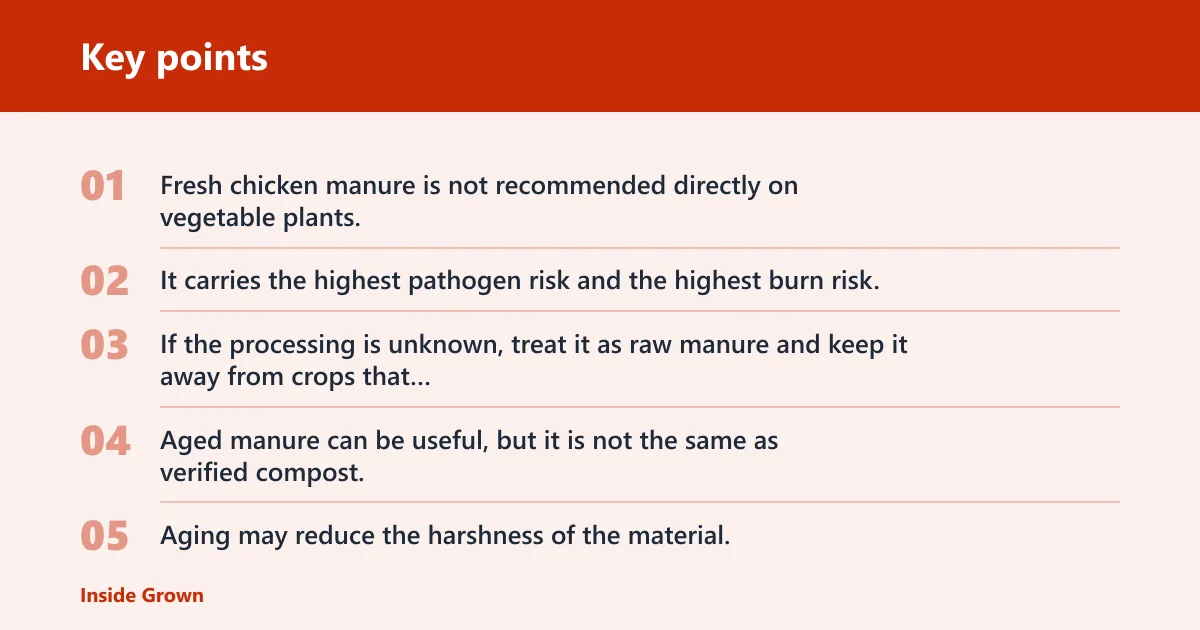
Fresh chicken manure is not recommended directly on vegetable plants. It carries the highest pathogen risk and the highest burn risk. If the processing is unknown, treat it as raw manure and keep it away from crops that will be eaten soon.
Aged chicken manure
Aged manure can be useful, but it is not the same as verified compost. Aging may reduce the harshness of the material, yet it does not guarantee pathogen kill steps. Use it cautiously and only before planting, with enough lead time and a soil test to keep the rate in range.
Composted chicken manure
Composted chicken manure is generally safer than fresh manure when the compost pile has enough carbon material, moisture, air, and heat. Finished compost is usually dark, earthy, and crumbly. It works well as a soil amendment before planting.
Pelleted chicken manure
Pelleted manure is processed and easier to handle, but it is not automatically pathogen-free. Use the product label, because rates vary by manufacturer and processing standard. Measure by weight when the label gives pounds, and do not guess at the amount in a small raised bed.
Composting can make chicken manure safer, but only if the pile is built correctly. The manure needs carbon material, moisture, air, and heat. Without all four, the pile may sit too wet, too dry, or too cool to reduce risk the way gardeners want it to.
Carbon materials to mix
Mix manure with carbon-rich material such as dry leaves, straw, shredded paper, or wood shavings in a balanced pile. The carbon helps control odor and supports the composting process. Plain manure alone is too concentrated and too wet for reliable composting.
Moisture, air, and heat
The pile should be moist like a wrung-out sponge, not soggy. Turn it so air reaches the center. Heat is the kill step people care about most, because high temperature helps reduce pathogens. If the pile never heats up, it is not finished enough for food crops.
The 130°F target
Finished compost should look dark and crumbly, not like raw bedding or fresh droppings. If the process was not monitored, use extra caution.
Picture a small backyard pile made from coop cleanout, straw, and leaf mold. If it stays damp and lukewarm, it may break down, but that is not the same as verified hot composting. In that case, keep it out of beds for edible crops until the material is clearly finished.
How do you use chicken manure safely?
Use chicken manure before planting whenever possible, keep it off harvestable plant surfaces, and choose a form that matches the crop. If the source is unknown, skip it or treat it as raw manure. Safety comes from timing, placement, and rate control, not from manure alone.
Before planting
For bed preparation, work processed manure into the soil well before the crop goes in. USDA timing for raw manure is 120 days before harvest when edible parts touch soil, and 90 days when edible parts do not contact soil. That timing applies to soil incorporation, so plan backward from harvest.
Suppose a 4 × 8 ft raised bed will hold tomatoes. A gardener with verified composted chicken manure can mix it into the bed before transplanting, then keep the material below the mulch line and away from stems. That gives the roots access to nutrients without coating the fruiting zone.
As a light top-dress
Keep the layer thin and spread it around, not against the stem. The goal is slow feeding, not a thick blanket that traps moisture or touches edible surfaces.
When source or processing is unknown
If you do not know whether the manure was composted, aged, or pelletized under a verified process, do not assume it is safe. Treat it as raw manure. That is the practical home-garden rule for manure from your own flock, a neighbor’s coop, or an unlabelled bag.
- Check whether the product is raw, aged, composted, or pelleted.
- Match the form to the crop and harvest window.
- Keep raw manure away from crops harvested within 120 days when edible parts touch soil.
- Keep raw manure away from crops harvested within 90 days when edible parts do not contact soil.
- Use extra caution with root crops and leafy greens.
- Keep manure off leaves, fruit, crowns, and exposed roots.
- Wear gloves and wash hands after handling it.
- Use a soil test before deciding the amount.
Which vegetables can take it?
Crop type matters as much as manure type. Fruiting vegetables usually have less direct contact with the soil than root crops or low leafy greens, so they are often the best fit for properly processed chicken manure. When the crop touches soil, the safety margin gets narrower.
Heavy feeders: corn, tomatoes, peppers, squash
These crops can benefit from chicken manure because they use a lot of nitrogen and other nutrients during active growth. They still need correct timing and a measured rate. Tomatoes, peppers, and squash should not get raw manure right before harvest, and corn still needs soil incorporation far ahead of picking.
Leafy greens
Leafy greens need the most caution because their edible parts sit close to the soil and are handled often at harvest. Use only well-composted or otherwise verified processed manure, and keep it well ahead of harvest. Avoid direct contact with leaves that will be eaten raw.
Root crops
Root crops are the most sensitive category here because the edible portion develops in the soil. Carrots, beets, radishes, and similar crops should not receive raw manure close to harvest. If the product is not clearly processed, keep it out of the root bed.
How much chicken manure should you apply?
Start with the soil test, then read the product label. Chicken manure is nutrient-dense, so too much can create phosphorus buildup, salt injury, and overly lush foliage with weak fruiting. For manure products, rate control matters as much as timing.
Use a soil test first
A soil test helps guide application rate and reduces the chance of excess phosphorus and nitrogen. That matters in small gardens, where repeated additions can stack nutrients faster than plants can use them. It is especially useful before using manure in raised beds or in a backyard plot year after year.
Read the product label
Use the label whenever it is available, because products vary. Some manufacturers list application by pounds, so measure by weight rather than by eye. If the package gives a bed-prep rate and a top-dress rate, do not mix them up; those are not the same job.
Bed prep vs top-dress rates
For in-ground bed preparation, one published guide gives 20–30 lb per 100 sq ft. For raised beds, another lists 6–10 lb per 4 × 8 ft bed for a refresh. Those are not universal rules. They are examples of why you should match the rate to the product, bed size, and soil need.
Common safety checklist for home gardeners
Use this simple check before spreading any chicken manure in an edible garden. It keeps the decision tied to the three things that matter most: product processing, crop contact, and harvest timing.
- Confirm whether the manure is raw, aged, composted, or pelleted.
- If the source is unknown, treat it as raw manure.
- Keep raw manure away from crops harvested within 120 days when edible parts touch soil.
- Keep raw manure away from crops harvested within 90 days when edible parts do not contact soil.
- Use extra caution with root crops and leafy greens.
- Keep manure off leaves, fruit, crowns, and exposed roots.
- Wear gloves and wash hands after handling it.
- Use a soil test before deciding the amount.
Frequently asked questions
Is composted chicken manure good for vegetable gardens?
Yes. Composted chicken manure can be a good soil amendment before planting if it is finished, crumbly, and applied at a controlled rate. It is safer than fresh manure, but it is still not a blank check. Keep it off edible parts and follow the label or soil test.
Can I use chicken manure in my vegetable garden?
You can, if the manure is processed properly and the crop timing works. Use it before planting, not right before harvest, and avoid raw manure when you do not know the source or treatment. For best results, reserve it for heavy feeders and keep it away from soil-touching edible parts.
How do you use chicken manure in a vegetable garden?
Work it into the soil before planting when possible, or use finished composted manure. Measure the amount, read the label, and keep it off stems and leaves. If the manure is raw or the source is unclear, do not use it on edible crops.
Is fresh chicken manure safe for vegetable gardens?
No, fresh chicken manure is not safe to use directly on edible crops. It may contain pathogens and can burn plants because of ammonia and concentrated nitrogen. Treat it as raw manure and keep it away from crops close to harvest.
What manure is best for vegetable gardens?
For most home vegetable beds, well-composted manure is the best fit because it is easier to handle and safer when finished correctly. Pelleted products can also work well when the label is clear. Raw manure is the least suitable for edible crops because timing and contamination risk are harder to control.