Do Botanical Gardens Allow Professional Photo Shoots?
Some botanical gardens allow professional photo shoots, and advance permission plus a fee may be required for special-occasion or commercial sessions; casual visitor snapshots are often the only category that does not require a permit. Skip the policy check, and staff can stop the shoot, move it, or charge a higher on-site rate. This guide helps you sort casual, portrait, wedding, and commercial shoots before you contact the garden.
Do botanical gardens allow professional photo shoots?
Often, yes. The garden decides what counts as a permitted professional shoot, where it may happen, and whether you need approval before you arrive. Some gardens allow photo, television, and special occasion shoots, while others limit them to set spaces, set hours, or preapproved groups.
The safest assumption is simple: casual snapshots are usually treated differently from posed or paid work. A visitor taking phone photos of flowers is one thing. A photographer arriving with a client, lighting gear, and a planned set is another.
Why the answer depends on the garden
Botanical garden access rules can vary by location, by season, and by shoot type. One garden may allow engagement portraits in certain areas only. Another may require a commercial permit for any paid session, even if the setup is small. A third may route private event photos through events staff instead of visitor services.
That is why the official policy page matters more than general advice. If the page is unclear, contact the garden’s visitor services, events office, or photo permit contact before you book.
What triggers a permit?
A permit is often required when the shoot is staged, posed, commercial, or tied to a paying client. Botanical garden photo permits are commonly required for staged shoots and are usually meant to be secured before entering or setting up. If the garden flags the session as special-occasion photography or commercial film and photography, expect a policy review before you get approval.
Staged shoots and posed subjects
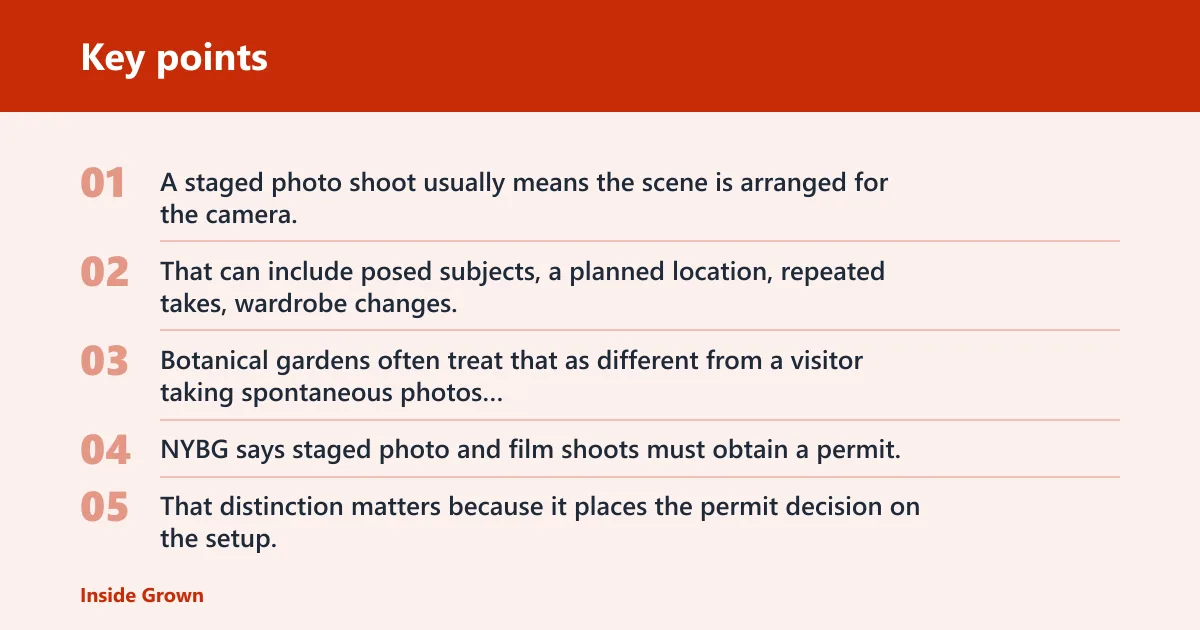
A staged photo shoot usually means the scene is arranged for the camera. That can include posed subjects, a planned location, repeated takes, wardrobe changes, props, and equipment placed to shape the image. Botanical gardens often treat that as different from a visitor taking spontaneous photos while walking the grounds.
NYBG says staged photo and film shoots must obtain a permit. That distinction matters because it places the permit decision on the setup, not only on whether someone is holding a camera.
Tripods, lights, props, and crews
Gear can change the classification fast. A tripod, light stand, reflector, backdrop, or assistant can signal that the session is not a casual visit. Even a small crew can trigger access checks if the work needs more space, more time, or a controlled backdrop.
Do not assume a tripod is automatically allowed. Some gardens permit it in public areas and restrict it in houses, glassrooms, or narrow paths. Others prohibit setups that block walkways or disrupt other visitors.
Paid clients, brands, and editorial work
Commercial film and photography permits are often required for brand work, editorial work, and production work. If money changes hands, a client is involved, or the images will support a product, publication, or campaign, the garden may classify the shoot as commercial even if the crew is small.
That category often comes with extra conditions. Space may be limited. Timing may be fixed. Certain garden areas may be off-limits. Approval is often required in advance.
Botanical garden permit table
| Shoot type | Likely permit need | Common extras to check and who to contact first |
|---|---|---|
| Casual visitor snapshots | Usually no permit, if the garden allows general photography | Check whether tripods, flash, and blocked paths are restricted; contact visitor services or the posted general information line |
| Special occasion photography | Often permitted with advance approval or a dedicated policy page | Check private portrait limits, time blocks, and guest counts; contact visitor services or the special-occasion page contact |
| Commercial film and photography | Usually requires a commercial permit and prior approval | Check insurance, releases, space access, and timing restrictions; contact the commercial photo or film office first |
| Private events photography | Often governed by event-specific rules | Check wedding or celebration coordination, reserved areas, and setup timing; contact events staff first |
| Staged photo shoot | Permit commonly required before entering or setting up | Check props, lights, tripod use, subject count, and entry approval; contact the photo permit office first |
Special occasion or commercial?
Special occasion photography and commercial photography are not the same category. Special occasion photography often covers private portrait sessions such as engagement, wedding, or family sessions. Commercial film and photography usually covers brand, editorial, or production work. Many gardens separate those policies so the rules, fees, and booking path are different.
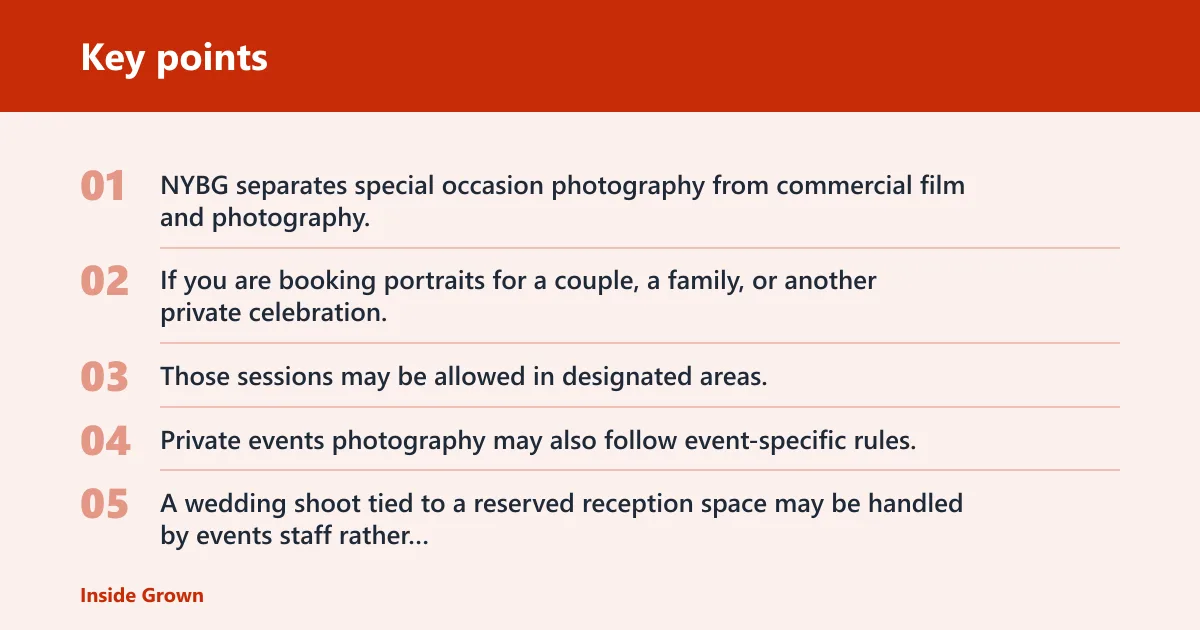
NYBG separates special occasion photography from commercial film and photography, which is a useful model to watch for on other garden policy pages.
Private portrait sessions
If you are booking portraits for a couple, a family, or another private celebration, look for a special-occasion page first. Those sessions may be allowed in designated areas, but the garden may still require advance approval, a reservation window, or a specific contact form.
Private events photography may also follow event-specific rules. A wedding shoot tied to a reserved reception space may be handled by events staff rather than the general photography contact.
Engagements, weddings, and celebrations
Engagement photos are often allowed, but not as open-ended free access. The garden may define where the session can happen, how many people can attend, whether formal attire changes are allowed, and whether the shoot must stay within a reservation block.
Suppose a couple arrives with a photographer, a helper, and two outfit changes. That may still count as a special-occasion session, but it is more likely to need approval than a quick portrait stop with no gear and no staging.
Brand, editorial, and production shoots
Commercial work is the category most likely to trigger a permit, insurance review, and preapproved schedule. Editorial shoots can fall into this bucket if the garden treats them as a professional production rather than a casual editorial visit. Brand shoots almost always deserve a permit check before you book the date.
The same source describes the garden as a venue for photo, television, and special occasion shoots. That wording signals that professional access is possible, but only under the right policy path.
What to check before booking
Before you reserve a client or crew, check lead time, fee rules, insurance requirements, release forms, and any space restrictions. Some gardens require advance approval days or weeks ahead of the shoot date. Others may limit the number of people, the hours you can enter, or the areas you can use.
Ask who approves the shoot, what the approval covers, and whether the permit must be in hand before you step inside. Botanical garden photo permit rules can be stricter than general visitor photography, especially for staged shoots.
- Read the official photography policy page for the exact garden.
- Identify the shoot type: casual, special occasion, commercial, or private event.
- Check whether tripods, lights, reflectors, props, or extra people are allowed.
- Confirm lead time, fee structure, insurance, and any release requirements.
- Ask which office handles approval: visitor services, photo permits, commercial film and photography, or events staff.
- Wait for written confirmation before you arrive with gear or clients.
A common first-timer mistake is booking the session before reading the policy page, then arriving with a tripod and a reflector only to learn that the space is restricted. That usually creates a delay at the gate or a forced reschedule.
Arrival-day turn-away risks
The biggest risk on arrival is assuming the garden will sort it out at the gate. If the permit is missing, the gear is not allowed, or the space is reserved for another use, staff may stop the shoot before setup begins. Some gardens can also treat a last-minute change in equipment or group size as a new approval issue.
Unapproved gear and staging
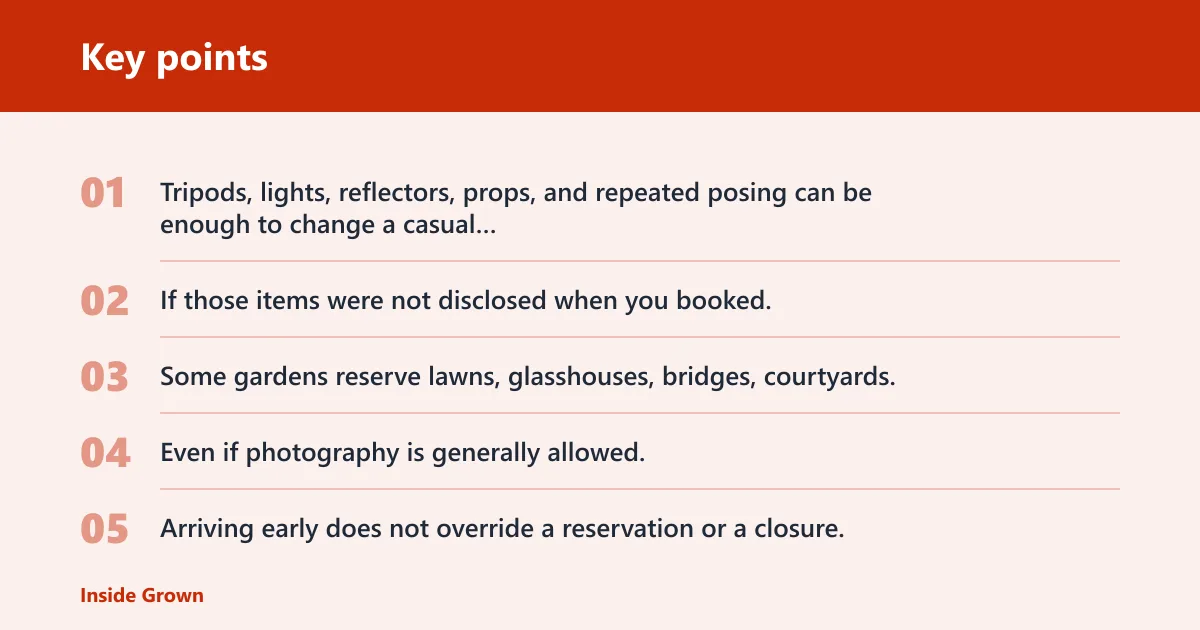
Tripods, lights, reflectors, props, and repeated posing can be enough to change a casual visit into a regulated shoot. If those items were not disclosed when you booked, the garden may deny access or move you to a different category with a different fee.
Restricted spaces and time blocks
Some gardens reserve lawns, glasshouses, bridges, courtyards, or display areas for events, maintenance, or visitor flow. Even if photography is generally allowed, a specific area may be off-limits or time-limited. Arriving early does not override a reservation or a closure.
Missing permit, fee, or confirmation
Bring proof of approval, not just an email thread in your head. If the permit was supposed to be issued before entry, but you do not have it, the garden may treat the session as unapproved. If a fee is due before access, unpaid booking status can also stop the shoot.
Picture a two-person engagement session with a tripod, two light panels, and a bouquet prop. If the garden allows portraits only in a designated area and the couple walks in through a different entrance without permit confirmation, staff may redirect them before the first frame is taken.
Frequently asked questions
Do you need a permit for a professional photo shoot at a botanical garden?
Often, yes. Botanical garden photo permits are commonly required for staged shoots, and they usually have to be arranged before entering or setting up. If the session includes props, lighting, multiple subjects, or a paying client, assume you need to check the permit path first.
What counts as a staged photo shoot at a botanical garden?
A staged shoot usually involves posed subjects, planned composition, or equipment that changes the setting. Props, tripods, lights, reflectors, wardrobe changes, and repeated setups are all common triggers. Gardens often separate that from spontaneous visitor photography because it affects access, timing, and space use.
Can you do commercial photography in a botanical garden?
Often, yes, but commercial film and photography usually requires advance approval and a permit. Brand campaigns, production work, and some editorial sessions may face space limits, timing limits, and insurance or release requirements. Check the commercial policy first, not the general visitor rules.
Do botanical gardens charge for photo permits?
Many do, but fees vary by garden and by shoot type. Special-occasion photography, commercial film and photography, and private event sessions may each have different pricing or approval steps. Do not assume the permit is free; confirm the fee structure before you book the client or crew.
Can I bring a tripod for a professional shoot?
Maybe, but only if the garden allows it. A tripod can be treated as part of a staged or commercial setup, especially when paired with lights, reflectors, or props. Check the policy page first, because some spaces or events may restrict equipment even when general photography is allowed.