What Is Phototropism and Why Plants Bend Toward Light?
Shoots bend toward light because light is sensed first, auxin shifts to the shaded side, and those cells elongate faster. Ignore that cue, and houseplants grow lopsided, stretch weakly, and spend energy chasing a window. This guide explains light sensing, hormone movement, uneven cell growth, and how to tell phototropism from low-light stretch, gravity, or a crooked pot.
This guide is part of our Plant physiology basics series.
What phototropism means
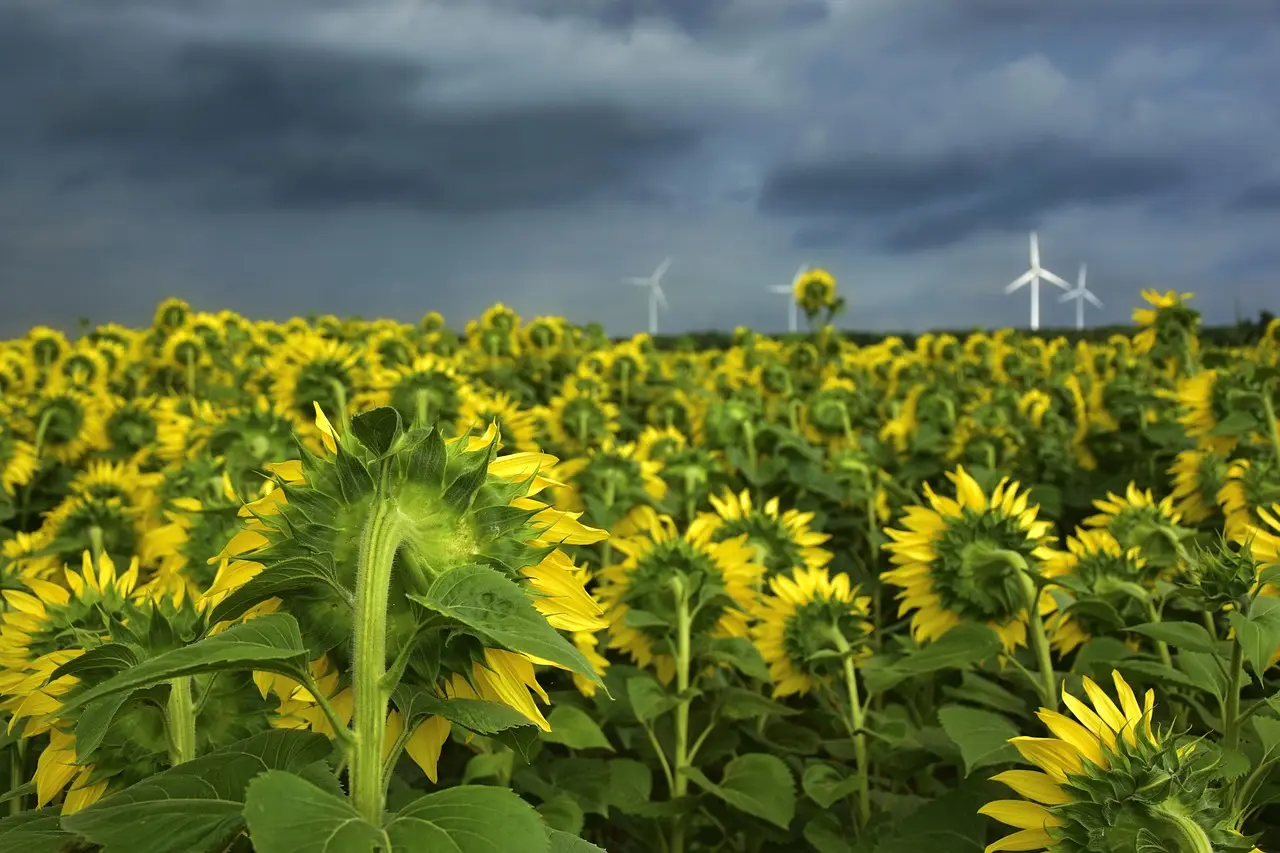
Phototropism is growth that turns in response to light direction. In familiar cases, shoots show positive phototropism and curve toward a light source, while roots often show negative phototropism and grow away from light. The response is distinct from skototropism, which is growth away from light. (Wikipedia)
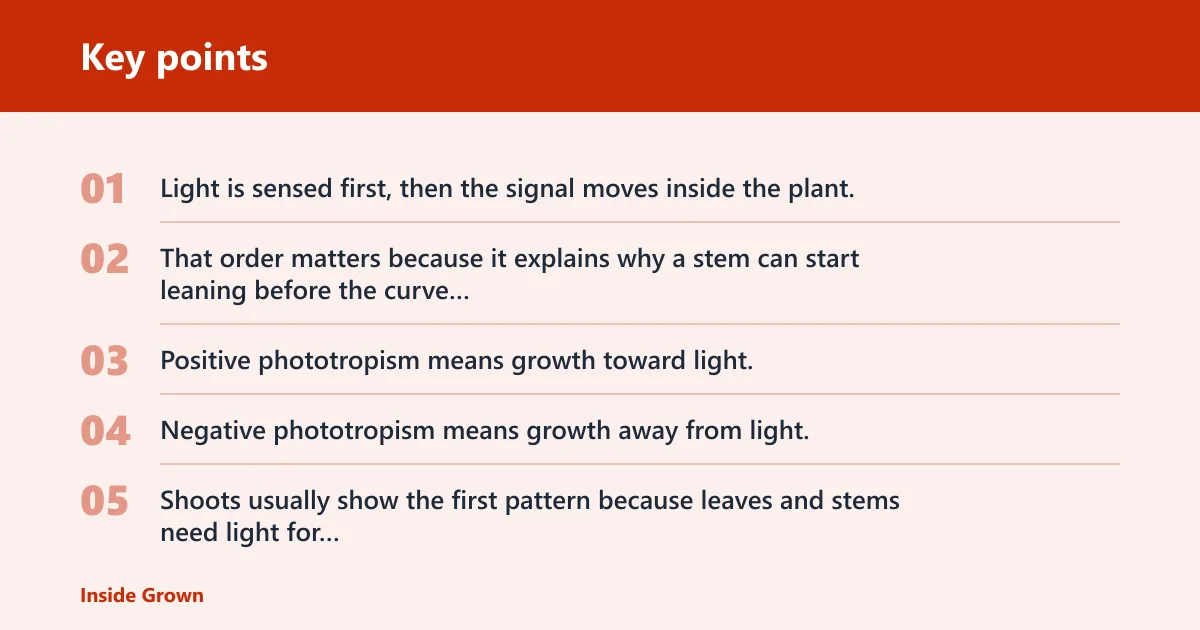
The bend does not appear all at once. Light is sensed first, then the signal moves inside the plant, then one side of the organ grows faster. That order matters because it explains why a stem can start leaning before the curve looks dramatic.
Positive and negative forms
Positive phototropism means growth toward light. Negative phototropism means growth away from light. Shoots usually show the first pattern because leaves and stems need light for photosynthesis. Roots often show the second pattern, though their growth also responds strongly to gravity.
That split helps beginners read the plant correctly. A stem leaning toward a window is not the same thing as a root avoiding the surface. Different organs can read the same cue in different ways.
How does phototropism work?
Phototropism happens in three linked steps: light is sensed, the growth signal shifts to the shaded side, and cells on that side elongate more. The result is curvature toward the light in shoots, or away from it in some roots. Blue light is the main trigger in the classic explanation.
Step 1: light is sensed
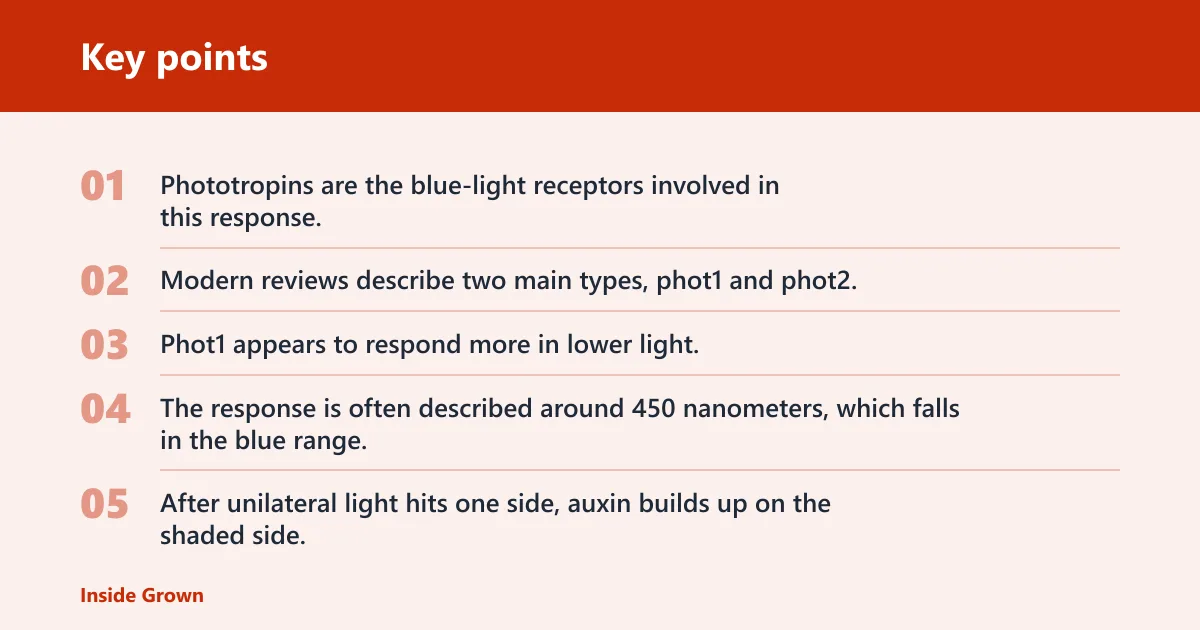
Phototropins are the blue-light receptors involved in this response. Modern reviews describe two main types, phot1 and phot2, and they differ in light sensitivity. Phot1 appears to respond more in lower light, while phot2 may matter more under stronger light. The response is often described around 450 nanometers, which falls in the blue range.
Step 2: auxin is redistributed
After unilateral light hits one side, auxin builds up on the shaded side. That hormone shift is central to curvature. It is not a loose “growth chemical” floating around at random; the plant changes where auxin is concentrated so the shaded side receives more of the signal.
Step 3: shaded-side cells elongate
Cells on the shaded side elongate more than cells on the lit side. Wall loosening and turgor pressure allow that extra expansion. Because one side gets longer faster than the other, the organ bends toward the light.
A common first-timer mistake is to expect the bend to appear evenly from base to tip. In reality, indoor seedlings may look stretched first, then curve more clearly later if the light stays one-sided.
Why do plants bend toward sunlight?
Plants bend toward sunlight because that improves light capture. More light on leaves usually means more energy for photosynthesis, so the response supports survival. In crowded conditions, that advantage matters even more because nearby leaves, shelves, or a windowsill can block part of the light stream.
Say your 12-inch basil sits beside a bright window and starts leaning hard to one side. That bend is not random. It is a growth response that helps the plant put more leaf area where the light is strongest.
Auxin, PIN proteins, and cell elongation
Auxin drives much of the bending response, but auxin does not move alone. PIN proteins are auxin efflux carriers that help redirect hormone flow through the tissue. PIN3 and PIN7 are often implicated in curvature.
That relocalization matters because it shifts auxin toward the shaded side. Once auxin builds there, cells on that side elongate more than cells on the lit side. The bend follows the uneven growth, not the light beam itself.
Why the shaded side stretches more
Auxin promotes cell expansion by supporting wall loosening and water uptake. With enough turgor pressure, the shaded side extends faster. The lit side still grows, but more slowly. That difference creates the curve.
Blue light and phototropins
Blue light is the key wavelength range for phototropism in most explanations. Phototropins receive that light and start the signaling chain. The often-cited region around 450 nanometers is a practical way to think about the cue, though plants respond through receptor systems rather than a single magic wavelength.
Phot1 and phot2 do not act identically. Phot1 is especially important when light is weak, while phot2 becomes more important as intensity rises. That split helps explain why a plant may still respond under dim indoor light, even if the bend looks subtle.
Why wavelength matters
Not all light colors act the same way. A warm lamp can light a room without giving the same directional signal as blue-rich light. That is one reason a plant under a bright-looking lamp may still lean oddly or respond slowly.
Phototropism diagnostic table
This table helps separate phototropism from other reasons a plant may lean. Use the quick check before you assume the window is the only issue.
| symptom | likely cause | quick check |
|---|---|---|
| Stem curves toward one side with leaves larger on the light-facing side | Phototropism | Turn the pot 90 degrees and watch whether new growth reorients toward the strongest light |
| Whole plant is tilted in the pot, including the base | Gravitropism | Check whether the tilt stays fixed after rotating the container; gravity does not change with pot position |
| Long internodes, pale leaves, and weak stems | Low-light stretch | Look for distance between leaves rather than a clean curve toward one side |
| Leaves keep opening or closing on a schedule | Photoperiodism | Note whether the change tracks day length or dark period, not direction of light |
| Stem leans after wind, touch, or a brush from a pet | Mechanical leaning | Compare the lean with recent movement, contact, or a top-heavy stem |
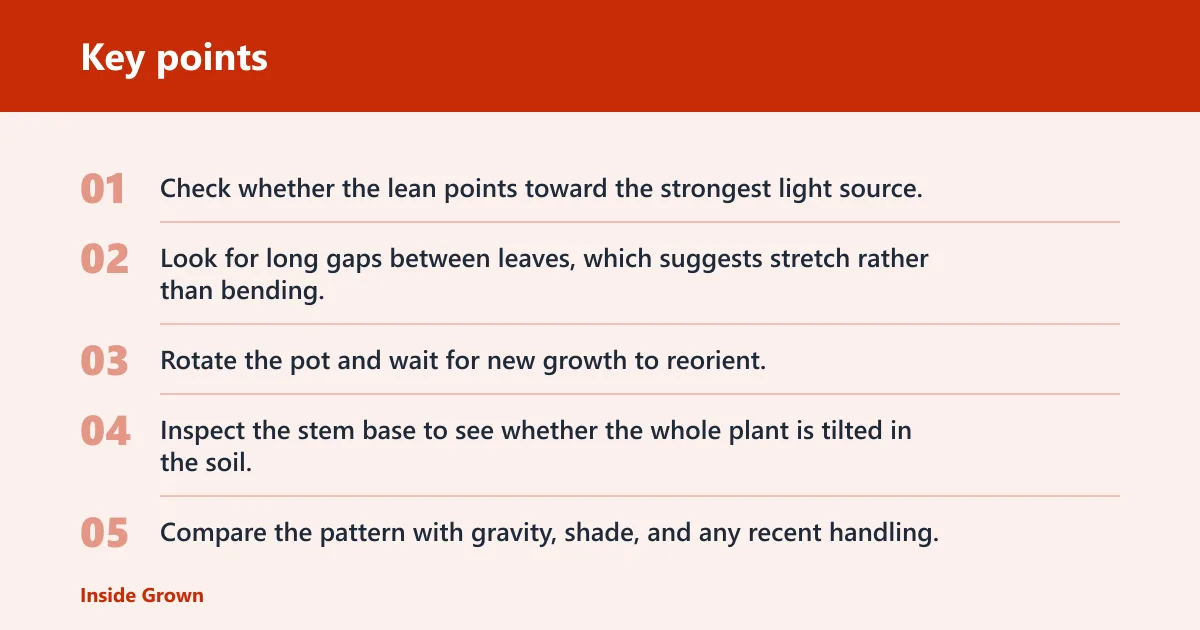
- Check whether the lean points toward the strongest light source.
- Look for long gaps between leaves, which suggests stretch rather than bending.
- Rotate the pot and wait for new growth to reorient.
- Inspect the stem base to see whether the whole plant is tilted in the soil.
- Compare the pattern with gravity, shade, and any recent handling.
Weak light can hide phototropism instead of stopping it. Overhead grow lights can reduce obvious bending because the cue comes from above rather than from one side. Crowded canopies do the same thing by scattering and blocking the light, so the plant may look straight while still adjusting growth internally.
Suppose a 6-inch seedling sits under a shelf light that hangs directly overhead. If it still starts to stretch, that is more likely low-light elongation than a clean sideways bend. If the same seedling sits by a bright window, a smaller but clearer lean toward that window points more toward phototropism.
What is the difference between phototropism and gravitropism?
Phototropism is a growth response to light direction. Gravitropism is a growth response to gravity. They can overlap in the same plant, and that is why a stem may curve toward light while also correcting its vertical position. They are related, but they are not the same cue.
For indoor gardeners, that difference matters. A plant can lean because one side gets more light, because the pot was set crooked, or because the shoot is still correcting itself against gravity. The fix depends on which signal is dominant.
Do roots show phototropism too?
Yes. Roots can show phototropism, and many examples are negative, meaning they grow away from light. That behavior fits their job: roots usually stay hidden, where moisture and mineral uptake are more reliable. A modern review also notes that roots and some organs can grow away from light.
Roots also interact with gravitropism, so light is not the only instruction they read. In a bright propagation tray, exposed roots may curve away from the light while still pulling downward. That makes the pattern look more complicated than a simple “toward or away” rule.
Frequently asked questions
How does phototropism occur in plants?
Phototropism occurs in three steps. Blue light is sensed by phototropins, mainly phot1 and phot2. The plant then shifts auxin toward the shaded side through transport changes that involve PIN proteins. Cells on that side elongate more, and the shoot curves toward the light.
What causes phototropism in plants
Phototropism is caused by directional light, especially blue light, plus the plant’s internal hormone and transport system. Auxin accumulates on the shaded side, and that unequal distribution triggers different growth rates across the organ. Phototropins start the response by detecting the light direction.
How is phototropism helpful to a plant?
Phototropism helps a plant capture more light. Shoots that bend toward stronger light place more leaf area in a better position for photosynthesis. That improves energy capture and can matter even more when plants grow among other leaves, shelves, or window frames.
What is the difference between phototropism and gravitropism: phototropism is a growth response?
Phototropism is a growth response to light direction, while gravitropism is a growth response to gravity. A stem leaning toward a window may be following light, but a stem correcting upright after a pot is tipped is responding to gravity. The two responses often act together.