Auxins, Gibberellins, and Cytokinins Explained Simply
Auxins are commonly described as being made mainly in shoot tips and helping direct growth, gibberellins are commonly described as forming in young tissues and helping with germination and stem elongation, and cytokinins are commonly described as forming mainly in roots and helping drive cell division. Miss the roles, and you misread why a plant bends, sprouts, or stalls. This guide maps each hormone across the plant life cycle, from seed to shoot, so you can remember them as direction, germination, and division.
This guide is part of our Plant physiology basics series.
What plant hormones do
Plant hormones are internal chemical signals that act at very low concentrations. They work at tiny concentrations, yet they control growth, development, defense, stress tolerance, and reproduction. They are not bulk food or fertilizer. They tell cells when to elongate, divide, rest, branch, or age.
Plants move these signals by diffusion, cytoplasmic streaming, phloem, and xylem. That movement is why a signal made in one tissue can change growth in another. Balance is the key: a small shift can alter a stem, a bud, or a seed.
What makes a hormone different from a nutrient?
A nutrient supplies building material or energy. A hormone gives instructions. Nitrogen can help build proteins, but a hormone tells cells when to expand, split, or stop. That is why hormone problems often show up as shape, timing, or branching changes rather than simple hunger symptoms.
How plant hormones move through a plant
Some signals move short distances by diffusion. Others travel farther in xylem or phloem, or shift within tissues by cytoplasmic streaming. The route matters because the place where a hormone is made is often not the place where its visible effect appears first.
Auxins: direction and elongation
Auxins are the first plant hormones discovered, and they are made mainly in shoot tips and young leaves. They direct growth by encouraging stem elongation, maintaining apical dominance, and guiding responses to light and gravity. In low concentrations, they can also support root development.
Where auxins are made
Auxins are produced mainly in shoot tips and young leaves. From there, they influence nearby growing tissues and help set the plant’s main axis. That is why the top of a plant often controls the growth of buds below it.
How auxins affect phototropism, gravitropism, and apical dominance
Auxins control phototropism and gravitropism. In shoots, uneven auxin distribution causes cells on one side to elongate more than cells on the other side, so the stem bends. They also help maintain apical dominance, which keeps the main shoot growing more strongly than side buds.
Picture a basil plant with its top pinched off. Side buds that were held back can start growing because the main auxin source is reduced. That is why pruning often changes branching so quickly. The same hormone logic helps explain why a bent seedling does not keep growing straight without a new light source.
Why low auxin levels can help roots
Auxins are not “good” or “bad” by themselves. Root tissues often respond best to lower auxin levels than shoots do. That is why rooting powders and cuttings rely on careful dosing: too little may do nothing, while too much can slow root formation instead of helping it.
What do gibberellins do?
Gibberellins act first in the seed-to-seedling stage. They break seed dormancy, support germination, and promote stem and internode elongation. They also help mobilize stored food in seeds, and some plants use them as a flowering signal. Bioactive forms include GA1, GA3, GA4, and GA7. (Wikipedia)
Where gibberellins act first in the life cycle
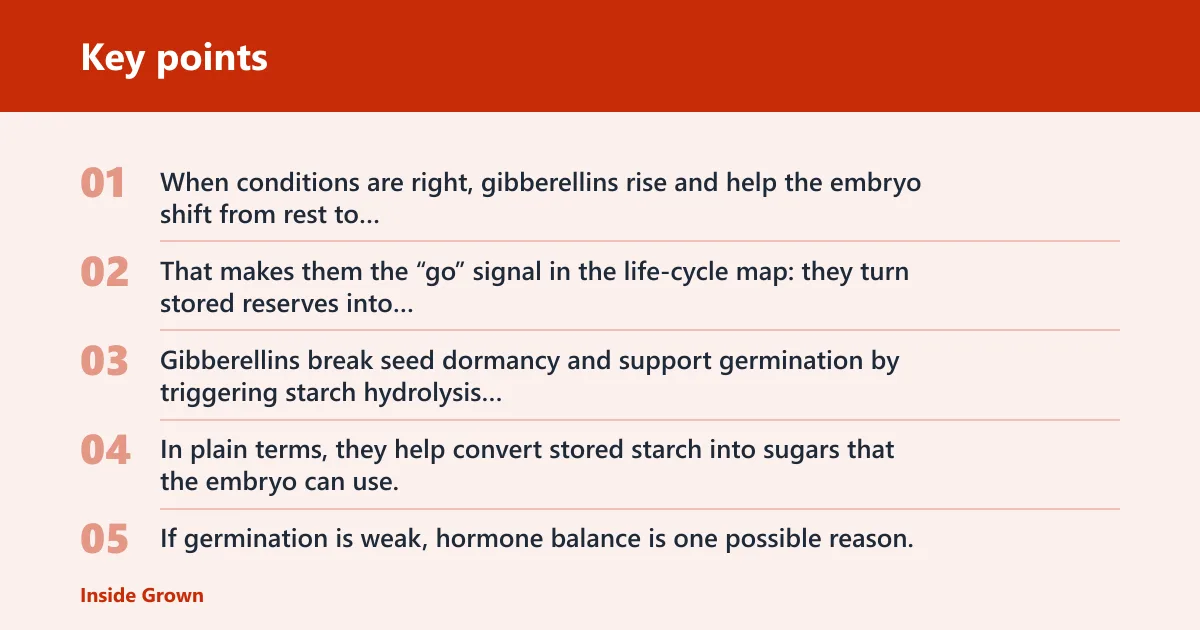
The first clear effect is often in the seed. When conditions are right, gibberellins rise and help the embryo shift from rest to growth. That makes them the “go” signal in the life-cycle map: they turn stored reserves into usable fuel for a new seedling.
How gibberellins break dormancy and drive germination
Gibberellins break seed dormancy and support germination by triggering starch hydrolysis in seeds. In plain terms, they help convert stored starch into sugars that the embryo can use. If germination is weak, hormone balance is one possible reason, especially when seeds are old, deeply dormant, or kept too dry or too cold.
Suppose a tray of lettuce seed stays flat for days even though moisture is steady. If temperature and seed quality are both reasonable, weak gibberellin response may be part of the problem. The visible result is delayed sprouting, not a nutrient shortage in the soil mix.
Why gibberellins matter for stem growth and flowering
Gibberellins promote stem and internode elongation. That makes them important when seedlings stretch upward quickly, but it can also create leggy growth if light is poor. In some plants, gibberellins also stimulate flowering, so their effect is not limited to the seed stage.
What do cytokinins do?
Cytokinins drive cell division, support shoot growth, slow leaf aging and senescence, and help regulate bud growth and branching. They are formed in root tips and transported upward through the plant, so they often act as a counterweight to auxin’s top-down control.
Where cytokinins are made and how they move
Cytokinins are formed in root tips and move upward. That upward flow matters because roots can signal the shoot about resource status and growth conditions. When cytokinin supply is strong, buds are more likely to break and new shoots are more likely to develop.
How cytokinins drive cell division and shoot growth
Which plant hormone helps cells divide? Cytokinins do. They drive cell division, especially in tissues that are actively building new growth. That is why they are tied to shoot activity, bud break, and branching rather than to seed elongation or bending responses.
How cytokinins slow leaf aging and affect branching
Cytokinins delay leaf aging and senescence, so leaves can stay functional longer. They also help regulate bud growth and branching. When cytokinin influence drops relative to auxin, side buds stay quiet; when the balance shifts, branching increases.
Hormone matrix for beginners
Use this one-page map to track where each hormone acts first. The order is the point: direction comes first in the growing shoot, germination comes first in the seed, and division comes first in the root-to-shoot signaling pattern.
| Hormone | Where it is made | Main action | Visible plant result | Common confusion |
|---|---|---|---|---|
| Auxins | Shoot tips and young leaves | Stem elongation, apical dominance, phototropism, gravitropism | Top growth bends toward light; side buds stay quieter | People often think auxin “makes roots only,” but low concentrations can support root development while higher shoot signals direct bending |
| Gibberellins | Young tissues, including seeds and shoots | Break dormancy, support germination, promote stem elongation, mobilize stored food | Seeds sprout; stems and internodes lengthen | They are often mistaken for general growth hormones, but their first big role is the seed-to-seedling switch |
| Cytokinins | Root tips | Cell division, shoot growth, branching, delayed senescence | New shoots and buds appear; leaves stay active longer | They are not “root hormones only”; they travel upward and push shoot activity |
| Root vs shoot balance | Auxin is stronger in shoots; cytokinin is stronger in root-to-shoot signaling | Auxin favors apical control; cytokinin favors bud release and branching | More top dominance with auxin; more lateral growth with cytokinin | The mistake is treating them as opposites in every context. They are partners whose ratio changes the plant’s shape |
Mnemonic for the three hormones
Use this simple cue: direction, germination, division. Auxins direct growth. Gibberellins start germination. Cytokinins drive division. If you want a plant-life-cycle map, think shoot tip, seed, root tip.
How the three hormones work together
These hormones rarely act alone. The first signal in one stage often sets up the next stage. A seed needs gibberellins to wake up, a seedling needs auxin to orient growth, and an established plant needs cytokinin balance to keep buds, leaves, and shoots in the right pattern.
Seedling stage
Gibberellins act first by breaking dormancy and mobilizing stored food in seeds. Then auxin helps the new shoot elongate and orient toward light. If light is weak, gibberellin-driven elongation can outpace support, and seedlings stretch thin.
Leafy growth stage
Auxin and cytokinin interact most clearly here. Auxin from the tip keeps the main stem dominant, while cytokinin from the roots supports side growth and cell division. When the balance shifts, pruning effects and branching patterns become easier to predict.
Flowering and branching stage
Gibberellins can stimulate flowering in some plants, while cytokinins help buds break and branches form. Auxin still matters because strong apical dominance can suppress side buds. Gardeners often see the whole system at once: more top growth, more branching, or more delay in flowering depending on which signal is strongest.
Common gardener takeaways
- For pruning: removing the shoot tip reduces auxin’s hold on side buds.
- For cuttings: low-dose auxin can support root development.
- For germination problems: weak or stalled sprouting points to dormancy, moisture, temperature, or gibberellin-related timing.
- For leggy seedlings: too little light can magnify elongation responses and produce weak stems.
- For poor branching: a strong apical tip with limited cytokinin effect can keep buds quiet.
Why do seedlings bend toward light?
Seedlings bend toward light because auxin distribution becomes uneven. Light changes where auxin builds up, and the shaded side of the stem elongates more than the lit side. That uneven growth turns the shoot toward the light source, which is phototropism.
What gardeners can infer from bending stems
A leaning seedling is often a light signal, not a disease sign. If the stem is stretching and curving at once, the plant is telling you light is coming from one side or not strongly enough. Moving the light or rotating the tray can reduce the uneven pull on growth.
Frequently asked questions
What are auxins, gibberellins, and cytokinins?
They are plant hormones, meaning internal chemical messengers that work in very low concentrations. Auxins direct growth and bending, gibberellins trigger germination and stem elongation, and cytokinins drive cell division and shoot growth. Together, they help control how a plant develops from seed to flower.
How are plant hormones different from nutrients?
Nutrients provide raw materials or energy for growth, while hormones send instructions. A plant can have enough fertilizer and still grow badly if hormone balance is off. That is why a problem may show up as poor branching, weak germination, or odd bending instead of simple yellowing.
Where are auxins, gibberellins, and cytokinins produced in a plant?
Auxins are made mainly in shoot tips and young leaves. Gibberellins are associated with young tissues and seeds, where they help start germination and elongation. Cytokinins are formed in root tips and transported upward, which links root activity to shoot growth and bud behavior.
What is the difference between auxins and cytokinins?
Auxins mainly keep the top of the plant in control, direct elongation, and shape responses such as phototropism. Cytokinins mainly drive cell division, support shoot growth, and encourage branching. The simplest way to remember them is that auxin favors top dominance, while cytokinin favors bud activity.
How do hormones affect seed germination?
Gibberellins are commonly linked to germination. They break seed dormancy and help mobilize stored food by driving starch hydrolysis in seeds. If seeds stay dormant too long, the issue may be moisture, temperature, seed age, or a weak hormonal signal that never fully turns on.
What do auxins do in plants?
Auxins stimulate stem elongation, control phototropism and gravitropism, and help maintain apical dominance. They are made mainly in shoot tips and young leaves. In low concentrations, they can also support root development, which is why they matter in cuttings as well as in upright growth.