Is Diatomaceous Earth Safe Around Bees?
No. Diatomaceous earth is not safe for bees on direct contact; use it only where bees do not forage, and only when flowers are absent or fully protected. Misapplied dust can injure foragers, reduce pollination, and leave you with the pest problem plus fewer bees. This guide explains where, when, and how to use DE around pollinator plants with the least exposure.
Where you place DE determines bee safety
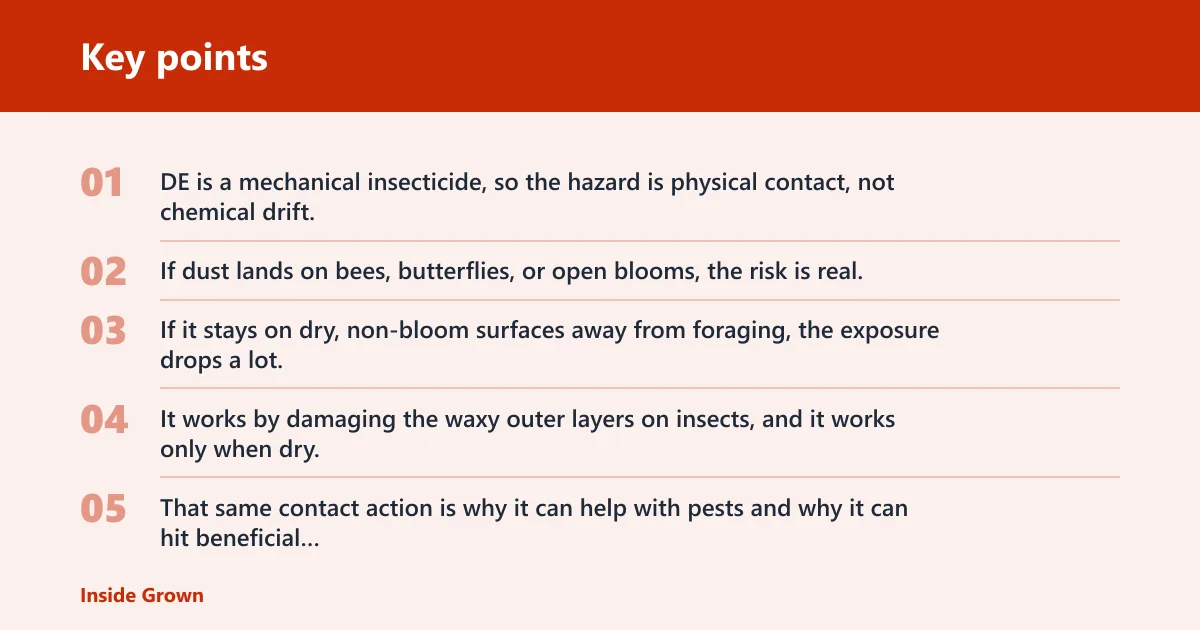


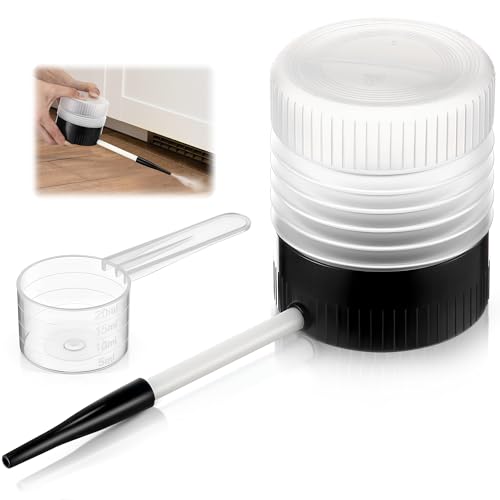
Only in the right place. DE is a mechanical insecticide, so the hazard is physical contact, not chemical drift. If dust lands on bees, butterflies, or open blooms, the risk is real. If it stays on dry, non-bloom surfaces away from foraging, the exposure drops a lot.
What makes DE different from contact sprays
DE is made from fossilized diatoms. It works by damaging the waxy outer layers on insects, and it works only when dry. The target has to crawl through the powder. That same contact action is why it can help with pests and why it can hit beneficial insects that move across treated surfaces.
When the answer changes in the garden
The answer changes with exposure. A light layer on a path edge is not the same as dusting a zinnia bed in bloom. Honeybees visit flowers and flowering crops, so the highest-risk zone is any area with active bloom. Butterflies and other beneficial insects face the same non-selective contact risk.
How diatomaceous earth works
DE kills insects mechanically, not chemically. It is commonly used in gardening and pest control against pests such as aphids on contact when dry, and registered products are also used for fleas, bedbugs, cockroaches, ticks, spiders, and crickets. Dry conditions matter because wet powder loses the contact effect.
Why dry conditions matter
DE only works when dry. Rain, irrigation, heavy dew, and high humidity can reduce performance because the powder may clump or wash off exposed surfaces. If treated surfaces get wet, the product usually needs to be reapplied after everything dries. That affects pest control and pollinator safety at the same time.
What rain and humidity do to performance
Wet weather does two things at once. It cuts the pest control effect and can move powder to places you did not intend, including stems, mulch, and the ground under flowers. That matters because a dry residue on a leaf edge can still contact a bee later, while a washed-off residue may be ineffective.
Suppose you dust a row of pepper plants on a calm morning, then an afternoon shower wets the bed. The next day, the powder is patchy and clumped. That is a sign to wait until the foliage dries completely before deciding whether any reapplication is needed at all.
Food-grade vs. pool-grade DE
Food-grade DE is the garden-use grade that many labels point to for pest control. Pool-grade, also called filter-grade, is not for garden pest control use and contains crystalline silica. For bees, the bigger issue is still contact, but the wrong grade adds an extra product-safety problem before you even get to placement.
Why pool-grade or filter-grade is not for pest control
Filter-grade DE is not safe to use as an insecticide. That matters because a garden bag that looks similar on the shelf can be the wrong product for the job. Pool-grade and filter-grade material belong with filtration uses, not on crop beds, flower borders, or any area where pollinators move.
How to check the label before you buy
Look for a label that clearly says food-grade or garden-use DE. Check that it is intended for pest control, not filtration. If the package mentions pool, spa, or filter use, put it back. If the label is vague, treat it as the wrong choice until the manufacturer’s listing confirms otherwise.
Bee safety decision table
This table uses exposure, not theory, to answer the bee question. The closer the powder gets to bees, blooms, and foraging routes, the higher the risk. If you cannot keep DE off those surfaces, choose a different control instead.
| Application scenario | Risk level | Why it matters | Safer alternative action |
|---|---|---|---|
| Direct spray or dusting on bees | High | Direct contact can injure bees and other pollinators immediately. | Stop application, wait until foraging ends, and use a bee-safer control away from pollinators. |
| Dust on open flowers | High | Flowers are the highest-risk zone because honeybees and butterflies visit them. | Skip DE on blooms and choose hand removal, traps, or another non-floral treatment. |
| Dust on non-bloom foliage | Moderate | Lower risk than flowers, but bees and beneficial insects can still contact treated leaves. | Apply only to pest-heavy leaf surfaces, late in the day, and keep it off nearby blossoms. |
| Perimeter or soil-only application | Lower | Less likely to hit foraging insects if kept outside bloom zones and off active pathways. | Use a narrow band, keep it dry, and check that bees are not using the spot for nectar or pollen access. |
Can you use DE near flowering plants?
Yes, but only with strict limits, and often the better answer is no. Flowering plants are the highest-risk area because bees, butterflies, and other beneficial insects concentrate there. If the plant is blooming, direct dusting is the wrong move unless the flowers are fully absent or physically protected.
Why blooms are the highest-risk zone
Bees visit flowers and flowering crops for pollen and nectar. If DE lands on petals, anthers, or nearby leaves, foragers can pick it up as they move through the plant. Butterflies face the same exposure on blossom clusters, so a bloom-heavy bed is the least forgiving place to apply any dust.
Better timing than daytime spraying
Apply only when pollinators are not active and blooms are not open on the target surface. Late evening is better than midday if the plants must be treated, because foraging drops after dark. Even then, keep the application off flowers and target only non-bloom areas that truly need pest control.
When to skip DE entirely
Skip DE if the pest pressure is inside an actively flowering bed, if the infestation is on pollinator-facing blooms, or if a nearby crop cannot be treated without drift. In those cases, a non-dust option is safer for bees and usually easier to place exactly where the pest is.
Say your 3-by-6-foot herb bed has basil in flower and a few aphids on the lower stems. Dusting the whole bed would put DE on bloom clusters where bees are feeding. A better move is to remove the flowers if appropriate for the crop, then treat only the non-bloom foliage if the label allows it.
What pests DE can control
DE can help with ants, fleas, roaches, and aphids, and registered products are also used against bedbugs, ticks, spiders, and crickets. It fits best as a narrow, dry-surface tool in an integrated pest plan. It does not solve every garden pest, and it should not be the first choice where pollinators are active.
Where DE fits in an integrated pest plan
Use DE when the pest is moving across dry, exposed surfaces and you can keep the powder out of bloom zones. That often means cracks, path edges, the undersides of non-bloom foliage, or a soil barrier away from flowers. It does not belong on every plant bed just because pests are present.
When another control is better for pollinator safety
If the pest is on blossoms, inside a pollinator patch, or on a plant that bees use heavily, choose a safer option. Hand removal, pruning, traps, or a targeted treatment with a different mode of action may fit better. The key test is simple: if bees must touch it, do not dust it.
How do you apply DE without harming pollinators?
Target dry, non-bloom surfaces only, use the smallest effective amount, and keep the product off open flowers. Apply when bees are not active, avoid windy conditions, and stop if you cannot place the powder with precision. Reapply only after rain or watering has dried the treated surface and the bloom area is still protected.
Target non-bloom surfaces only
Focus on stems, leaf undersides, cracks, and soil borders away from flowers. Do not broadcast dust across the bed. A narrow application is easier to keep off petals and easier to inspect later. If the target plant is in bloom, move the treatment point away from the bloom or choose another method.
Use the minimum amount that still reaches the pest
A visible film is enough; thick piles are not the goal. Too much powder is harder to keep away from bees and more likely to blow or wash where you do not want it. If the label gives a rate, follow it. If it does not, a conservative spot application is safer than coating the whole plant.
Reapply only after dry conditions return
Because DE only works when dry, reapplication should wait until the surface is fully dry again. That timing matters for both control and bee safety. If rain has moved the powder or if humidity keeps it damp, the product is not doing its job and may need a fresh, carefully placed application later.
- Identify the pest and confirm it is on a dry surface, not on blooms.
- Check whether the plant is flowering and whether bees are foraging nearby.
- Choose food-grade DE only if the label supports garden pest control.
- Apply a narrow layer to non-bloom surfaces, cracks, or soil edges.
- Avoid petals, open flowers, and any area that pollinators are using.
- Recheck after rain or watering and reapply only after surfaces dry.
Frequently asked questions
Is diatomaceous earth safe for bees?
No, not on contact. DE can injure bees if it lands on them or on the flowers they use. It is best kept off blooming plants, off foraging routes, and off any surface that bees are likely to touch while collecting nectar or pollen.
Is diatomaceous earth safe for bees and butterflies?
Only with tight placement control. Butterflies are also vulnerable to non-selective dust contact because they visit flowers. If DE reaches blossoms or nearby foliage where pollinators land, both bees and butterflies can be affected. Use another control when the pest is in an active pollinator zone.
Is food-grade diatomaceous earth safer around bees than pool-grade?
Food-grade is the better garden choice, but it is not bee-safe on contact. Pool-grade or filter-grade DE is not for pest control use and contains crystalline silica. So the answer is two-part: choose the correct garden grade, then keep it off bees and blooms.
Does rain change how diatomaceous earth affects bees?
Yes. Rain reduces DE performance because the powder only works when dry, and wet weather can move residue into places you did not intend. After surfaces dry, you may need to reapply. If the treated area includes flowers or bee pathways, that is the point to stop and reassess.
How do you apply diatomaceous earth without harming pollinators?
Keep it off flowers, apply only to dry non-bloom surfaces, and work when bees are not active. Use a narrow, targeted application instead of broad coverage. If you cannot separate the pest from the pollinator zone, choose another control. Precision matters more than quantity here.
What pests can diatomaceous earth control in a garden?
It can help with aphids on contact when dry, and registered products are also used for ants, fleas, roaches, bedbugs, ticks, spiders, and crickets. That still does not make it a fit for every garden bed. Use it where the target is exposed and the bees are not.