Are Pest Control Granules Safe Near Edibles?
Pest control granules are safe near edibles only when the label allows food-crop use and the product stays outside harvestable plant parts, usually on soil at the labeled distance. Placing them wrong can contaminate produce, waste the treatment, or break the label. This guide explains where granules can go, where they must not, and when a different pest control method is the better choice.
Placement rules and label limits for edible crops
They can be, but only in narrow conditions. Placement matters more than ingredient type. If a granular product is labeled for vegetables or herbs, and you keep it off leaves, fruit, and harvestable stems, it may fit a perimeter or border role. If the label is unclear, treat it as a no for edible zones.
What makes a granule safe or unsafe near food crops
Granules work by sitting on or in soil and releasing an active ingredient over time. That makes it a placement product. Broadcast application covers a wide area and raises the chance of contact with edible foliage, while spot application keeps the material in one place and lowers the chance of contamination.
Safety near food crops depends on the label, the crop, and the target zone. Leafy greens and herbs sit close to the soil and are harvested whole or in parts, so direct contact matters more than it does for a tall perimeter planting. Fruiting crops can be less exposed than lettuce, but blossoms, low fruit, and mulch lines still create contact points.
Why label language matters more than ingredient style
Not all pest control products are the same. One product may be allowed around edible beds, while another with a similar look is not. Label language controls the decision, not the scent, source, or marketing phrase.
Direct contact with edibles should be avoided unless the label explicitly allows it. That includes leaves, crowns, fruit, and any soil or mulch that will touch harvested parts. If the label does not mention vegetables, herbs, or edible gardens, use a different method.
When the answer is yes, no, or maybe
Yes when the product is labeled for edible-garden use and you can keep it outside harvestable plant parts. No when the label forbids edible crops, when the bed will be directly treated, or when the granules would sit on produce. Maybe when the product is labeled for general yard use only and the bed is nearby, but not within the treated zone.
Say your tomato bed sits about 2 feet from a fence line where ants are active. A labeled perimeter treatment may fit along the fence, but a blanket spread through the tomato row does not. The same product, same yard, different placement.
Granule placement guide
This table turns the safety question into a placement decision. Use it to match crop type with exposure risk and a fallback option when the label or layout makes the choice uncertain.
| Crop type | Granule placement zone | Exposure risk | Safer fallback option |
|---|---|---|---|
| Leafy greens | Outside the bed, not on the soil that touches leaves | High; harvestable leaves catch residue and splash | Use a product labeled for edible beds, or a spot treatment away from the row |
| Herbs | Perimeter only, well outside cutting and picking areas | High; many herbs are harvested by leaf or stem | Hand removal, targeted bait, or a labeled edible-garden alternative |
| Fruiting vegetables | Border or perimeter zone, not under branches or fruit clusters | Moderate to high; low fruit and mulch can catch material | Use a non-granular method such as soap spray or neem oil where the pest fits the label |
| Raised beds | Outside the bed frame unless the label allows in-bed use | High if granules can wash into the bed soil | Use perimeter placement on adjacent ground, or choose a labeled edible-bed product |
| Container vegetables | Not on container soil unless the label specifically allows it | High; limited soil volume means more direct exposure | Use a spot treatment on nearby hardscape, or another pest control method |
| Perimeter-only treatment | Along the outer edge of the structure or bed, away from harvestable foliage | Lower if kept outside the crop zone | Confirm the label and keep the treated strip separate from edible soil |
Perimeter treatment versus bed interior
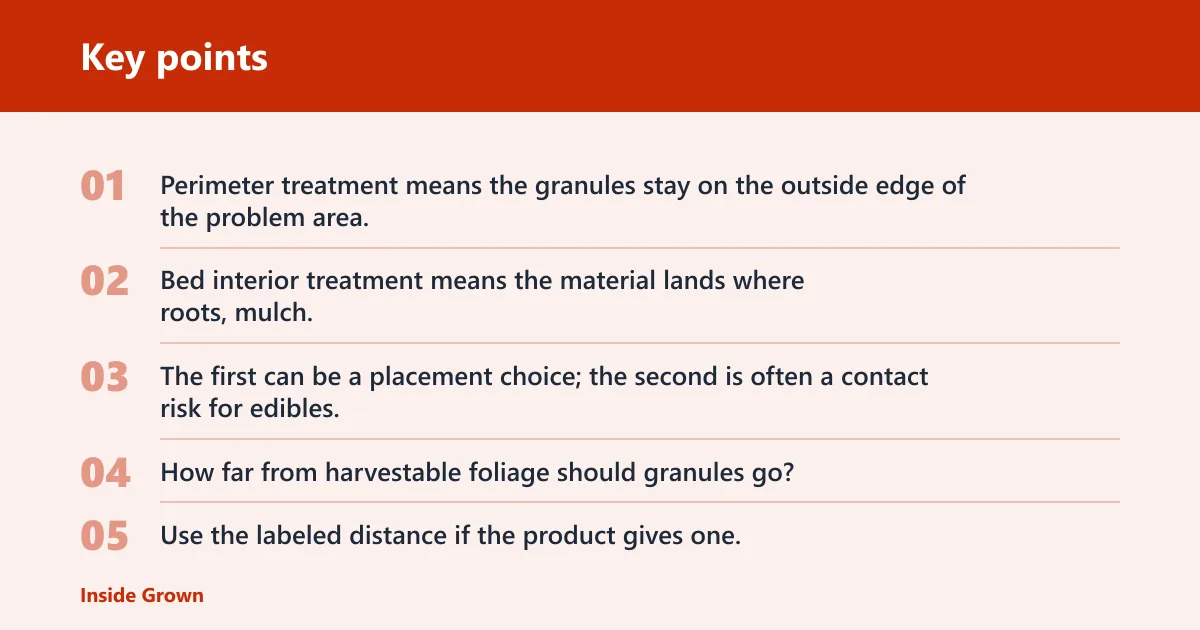
Perimeter treatment means the granules stay on the outside edge of the problem area. Bed interior treatment means the material lands where roots, mulch, and harvestable foliage are already in play. Those are not equivalent uses. The first can be a placement choice; the second is often a contact risk for edibles.
How far from harvestable foliage should granules go? Use the labeled distance if the product gives one. If it does not, keep the treated strip outside the crop area and away from any area where soil or mulch can move onto edible parts. Direct contact is the line to avoid.
Can you use them around herbs and lettuce?
Herbs and lettuce raise the contact risk because both are harvested for parts that grow close to the soil surface. Granules near these crops can land on leaves, sit in mulch, or move by splash and irrigation. If the label is not explicit about edible use, choose another method for those beds.
Why leafy crops raise contact risk
Leafy crops are the hardest case because the part you eat is also the part most likely to catch residue. Loose leaves, folded crowns, and low stems create surfaces that collect dust and splash. That makes broadcast granules a poor fit inside the row.
A common first-timer mistake is treating the aisle between lettuce beds as if it were outside the garden. If watering throws mulch and soil back into the row, the gap is no longer a clean boundary. In that situation, a spot treatment on the far side of the bed or a labeled edible-garden product is the better call.
Raised beds and container crops
Raised beds and containers deserve extra caution because the treated soil sits close to the edible root zone. A granule dropped into a container cannot spread out the way it might on open ground. Rain or watering can move material through a small soil volume and bring it closer to roots.
For container vegetables, perimeter-only treatment around the pot base may be acceptable when the label allows it and the product stays off the potting mix. Inside the container, the margin for error is much smaller. If the pest target can be handled with soap sprays, neem oil, or another non-granular option, that is often the cleaner fit for edible containers.
When to choose another method
Choose a different control method when the product label is unclear, when the crop is harvested frequently, or when the bed has low foliage that cannot be kept separate from the treated zone. For edible crops, label language controls the choice. If the product is not approved for that use, skip it.
What rain and watering change
Rain and irrigation can move granules after placement. That matters because movement can carry material into garden soil, toward roots, or onto foliage. Water does not make a misplaced application safer; it can widen the contact zone and change where the product ends up.
Wash-off and runoff risk
Heavy rain can wash granules out of a border strip and into a bed. Overhead watering can do the same on a smaller scale, especially if the treated area sits on a slope or beside a raised bed. If the product is meant to stay in place, treat it as a dry-placement product and keep water off it unless the label says otherwise.
Soil-contact behavior also matters. Some granules sit on the surface, while others break down or move downward with water. That mobility can put them closer to root crops, shallow herbs, or the soil line where harvested stems begin.
Reapplication timing and label limits
Reapplication should follow the label, not a fixed guess. If rain or irrigation moved the product out of place, do not automatically add more. Check the product instructions before adding more. If the product has washed into the edible zone, remove visible material where possible and switch methods rather than doubling down.
Suppose a roughly 4-by-8 raised bed of parsley gets sprayed by sprinklers right after a perimeter treatment. The treated strip on the outside fence line may still be fine, but any material that splashed into the bed is now part of the edible-soil question. The safer response is to keep harvest off that area until the label instructions are met and the bed can be evaluated cleanly.
Which granules are safer near food crops?
For edible gardens, the safer choice is the product that is explicitly labeled for that use and can be kept out of harvestable plant parts. Botanical ingredients are not a free pass. Cedar-based granules may be a perimeter option in some settings, but they are still placement products, and the label decides whether they belong near food crops.
Red cedar oil and cedar-based granules
Red cedar oil is the active ingredient in some cedar granules. Cedar products are often sold for repellent use, not for direct contact with edibles. Cedarcide natural pest control granules are described as having high concentrates of aromatic red cedar oil and as being made of red cedar hardwood from east central Texas. The application method described is to sprinkle the granules in desired areas.
Those details matter, but they do not make the product automatically suitable for herbs or vegetables. Cedar-based granules may be placed around a garden edge where they can work as a barrier-style treatment. That is different from putting them into the bed where lettuce, basil, or tomatoes are harvested.
The product is described as helping with fleas, mosquitoes, roaches, flies, scorpions, and other pests. It also says the product has been tested and declared safe. Even so, edible-crop use still depends on the label and on whether the granules touch the harvest zone.
Why botanical does not mean edible-safe
Botanical source and food-crop compatibility are not the same thing. A cedar-based product can still leave residue, move with water, or collect on leaves. A synthetic granular insecticide can also be unsuitable near edibles for the same reasons. The practical difference is not “natural versus chemical”; it is whether the label permits the placement you need.
For organic gardens, look for label language that specifically addresses edible use or garden-bed use. If the label is vague, choose a product labeled for edible use. Neem oil spray can fit some active infestations on certain crops when used according to its label, while a preventative schedule may fit lower-pressure situations when the label calls for it. Rubbing alcohol is best kept as a spot treatment, not a broad-bed substitute.
Frequently asked questions
Are pest control granules safe to use near vegetable beds?
They can be, but only when the product label allows use near edible crops and the granules stay outside harvestable plant parts. Keep them on perimeter soil, not in the bed interior. If the label does not clearly permit vegetable use, choose another control method for that bed.
Can I use granules around herbs and lettuce?
Use extra caution. Herbs and lettuce are harvested close to the soil, so contact risk is high. Granules around the outside edge may be acceptable if the label allows edible-garden use, but in-bed placement is a poor fit. If the label is unclear, use a different product.
How far from edibles should granules be applied?
Follow the label distance if it gives one. If it does not, keep granules outside the crop area, away from harvestable stems, and off any soil that can splash onto food. The safe answer is a placement zone, not a guessed inch count. Direct contact should be avoided.
Do rain and watering make granules move into garden soil?
Yes. Rain, irrigation, and runoff can move granules after application and carry them into soil that feeds edible plants. That is why perimeter placement matters. Water does not improve safety; it can widen exposure. Check the label for reapplication instructions before adding more product.
Which pest control granules are safer for organic gardens?
The safer choice is the one specifically labeled for edible gardens or organic use, with placement instructions that fit your crop. Cedar-based products may be useful on perimeters, but botanical ingredients alone do not make them edible-safe. If the label is unclear, use a product labeled for edible use.
What should I do if granules get on edible leaves or fruit?
Remove visible granules right away and do not harvest the contaminated parts until you check the product label. If the label does not allow contact with edibles, discard any affected produce. For future use, switch to a perimeter-only application or a different method that stays off the crop.
Are cedar-based granules safer than chemical granules?
Not automatically. Cedar-based granules may have a different active ingredient profile, but they still need correct placement and label permission near edibles. Safety near food crops depends on contact, movement, and label language. A botanical product can still be wrong for an herb bed or lettuce row.
How long should I wait to harvest after applying granules nearby?
Do not use a universal wait time. Harvest timing depends on the specific label, the crop, and whether the product touched edible parts. If the label gives a pre-harvest interval or similar instruction, follow that exactly. If it does not, treat the crop as off-limits until you have a product that is clearly approved for that use.