How to Fertilize Ornamental Plants in a Botanical Garden
Fertilize mixed ornamental beds by plant function and risk level: feed heavy bloomers and vigorous foliage plants with a balanced, slow-release product in spring, and give shrubs, bulbs, and sensitive perennials only light or targeted nutrients after soil testing. Overfeeding causes weak growth, poor flowering, salt injury, and wasted budget. This guide explains a botanical-garden workflow for grouping plants, choosing fertilizer types, timing applications, and avoiding damage in mixed beds.
Why botanical garden beds need a feeding plan



Botanical garden beds are not single-crop borders. They often mix annuals, perennials, shrubs, foliage plants, newly planted specimens, and container displays, each with different root depth, growth rate, and water access. A fixed monthly schedule treats those plants as if they all use nutrients at the same pace, which they do not.
Public-facing beds also need low-visibility methods. Granules spilled on paving, foliar spray on labeled accessions, or a strong feed applied near drought-tolerant plants can create avoidable problems for visitors and staff. Use plant performance, planting history, and soil status to set timing instead of the calendar alone.
Start with a soil test
A soil test should guide fertilizer choice, rate, and timing before any application. It shows nutrient status and helps you avoid adding phosphorus or nitrogen where the bed already has enough. In public collections, that matters because repeated guesswork can cause uneven growth, burn, or excess leaf flush that obscures flowers.
Use the test with irrigation history, rainfall, and bed location. A sandy, irrigated display bed needs a different rate from a shaded shrub border with mulch and limited growth. Compost can help soil structure, but it does not replace a nutrient plan for mixed ornamental plantings.
What fertilizer does to ornamental plants
Fertilizer supplies plant nutrients that drive stem growth, leaf color, root growth, flower set, and bloom size, depending on the nutrient mix. NPK are the three primary macronutrients named in the guide. In flower gardens, feeding usually starts in spring, when roots resume growth and shoots begin to expand.
Nitrogen, phosphorus, and potassium
Nitrogen supports leaf and stem growth and drives green color. It is often lower in bloom-stage fertilizer because too much nitrogen can send a plant into leafy growth at the expense of flowers. Phosphorus supports roots and flowers, so it matters most at planting and during bloom support. Potassium supports flowers and fruit, aids water regulation, and helps overall plant health.
That balance matters in ornamental beds. A foliage coleus display needs a different nutrient mix than a tulip bed finishing bloom. A shrub border with established roots may need less phosphorus than a newly planted annual block.
Which fertilizer type should you choose?
Choose the type that fits the bed’s growth rate, visibility, and need for correction. Gardeningetc identifies two main fertilizer types: organic and inorganic. Organic fertilizers are slightly slower to take effect. Inorganic fertilizers tend to be stronger and quicker to act.
Organic fertilizer in display beds
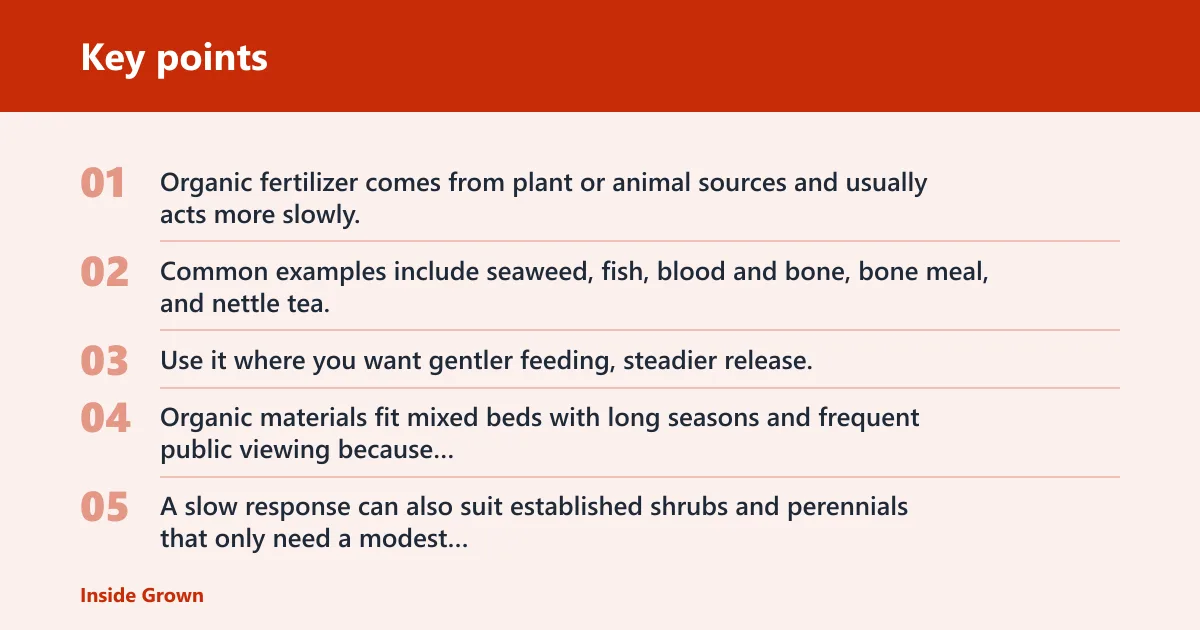
Organic fertilizer comes from plant or animal sources and usually acts more slowly. Common examples include seaweed, fish, blood and bone, bone meal, and nettle tea. Use it where you want gentler feeding, steadier release, and less risk of a sudden flush in a sensitive bed.
Organic materials fit mixed beds with long seasons and frequent public viewing because they are less likely to force abrupt growth. A slow response can also suit established shrubs and perennials that only need a modest nutrient lift after a soil test.
Inorganic fertilizer for quick correction
Inorganic fertilizer is synthetic or mined mineral nutrients. Examples include Miracle-Grow, Growmore, and Sulphate of Ammonia. Use it when a soil test or visible deficiency calls for a faster correction, or when container displays need a more immediate response.
These products are useful, but they demand tighter control. Watering on fertilizer can scorch foliage if it gets on leaves, and concentrated products can burn roots at the edge of a dry bed. Follow the label rate, and keep fertilizer off foliage unless the product is made for that use.
Controlled-release and slow-release products
Controlled-release fertilizer uses small granules that release nutrients gradually as they get wet. It is generally inorganic and works well for beds where staff need predictable feeding with less handling. Slow-release fertilizer is commonly described as breaking down slowly over time, sometimes with microbial activity involved.
For a botanical garden, those two formats reduce labor and help keep application uniform in labeled displays. They are especially useful where repeated top-ups would disturb mulch, visitors, or accession labels.
When should you feed flowering ornamentals?
Feed flowering ornamentals when growth resumes, not by a fixed monthly routine. Spring is usually when feeding starts for flower gardens, and top dressing at the start of the season is a common first application. After that, the plant’s stage and the weather should guide any second feeding.
Spring startup and top dressing
Top dressing is fertilizer added to soil around plants at the start of the season. It suits established beds, especially where you want to avoid digging around crowns or shallow roots. Apply it to moist soil, then water it in if the product requires that step.
For newly planted flowers, the guide recommends a balanced fertilizer. That is the safest starting point because young roots need even support rather than a high-phosphorus push or a nitrogen-heavy flush.
Bloom-stage feeding limits
During bloom, keep nitrogen lower unless a deficiency is clear. A fertilizer with moderate phosphorus and potassium is usually a better fit than a strong leaf-growth formula. If flowers are already open and the bed looks healthy, a heavy feed can do more harm than good.
Picture a mixed annual bed with petunias, salvia, and dusty miller. If the petunias fade after rain and the foliage stays pale, a light, targeted feed may help. If the border is already lush and dark green, more nitrogen may just add leaves.
Rain, irrigation, and dry spells
Rain and irrigation change how much fertilizer reaches roots. In wet weather, nutrients move faster, so lighter rates often make more sense. In dry spells, do not spread dry fertilizer onto thirsty soil and expect safe uptake; water first unless the label says otherwise.
Say your courtyard bed dries out under drip irrigation and the soil test shows low potassium. A modest top dressing before the next irrigation cycle is safer than a strong broadcast feed on hot, dry soil.
Ornamental bed fertilizer matrix
This decision table gives a botanical-garden workflow for mixed beds. It separates plant group, growth stage, fertilizer type, application method, frequency, and red-flag risks so you can feed by need rather than by a blanket schedule.
| Plant group | Growth stage | Fertilizer type | Application method | Frequency | Red-flag risks |
|---|---|---|---|---|---|
| Flowering annuals | Active growth and bloom | Balanced inorganic or controlled-release | Top dressing, then water in | At planting, then after soil test or visible need | Too much nitrogen, soft growth, fewer flowers |
| Perennials | Spring emergence | Organic or slow-release | Light top dressing around crowns | Once at startup, then only if test or symptoms justify it | Burn on new shoots, excessive leaf growth |
| Shrubs | Early spring or post-establishment | Slow-release or low-rate balanced product | Broadcast over root zone, keep off stems | Lightly, not every month | Salt injury, weak rooting, poor bloom set |
| Foliage plants | Active leaf expansion | Balanced inorganic or diluted organic liquid | Soil drench or watering on | As needed after soil test | Leaf scorch, floppy growth from excess nitrogen |
| Newly planted specimens | Establishment | Balanced fertilizer with modest rates | Light top dressing near root zone | At planting, then only after rooting begins | Root burn, delayed establishment, drought stress |
| Container displays | Rapid growth and flowering | Controlled-release plus light liquid feed if needed | Top dressing for granules; drench for correction | Short intervals based on irrigation and plant response | Salt buildup, root burn, uneven uptake |
Rare specimens and drought-tolerant plants are often placed in the caution column. Feed them lighter than vigorous border plants unless a soil test shows a clear need. Overfeeding a slow-growing aloe, silver-leaf shrub, or newly installed accession can do more damage than underfeeding it for one season.
Can you foliar feed ornamental plants safely?
Yes, but only as a correction tool. Foliar feeding is applied directly to leaves to address nutrient deficiencies, and it generally works best on young, tender leaves. It is not a default method for all ornamental beds, and it should not replace root feeding in established plantings.
When foliar feeding fits deficiency correction
Foliar feeding suits visible, localized problems such as chlorosis or a confirmed trace deficiency when roots are not absorbing well. Use it when quick correction matters, especially on foliage plants or young growth that can take up spray more readily than mature, waxy leaves.
Do not expect foliar sprays to feed a whole mixed bed for long. They are short-term tools. They also fit poorly on dusty leaves, tough evergreen foliage, or beds with open visitor access where drift could stain paving or nearby labels.
When to avoid foliar sprays
Avoid foliar sprays in heat, bright sun, or windy conditions. Avoid them on stressed, drought-hit, or newly transplanted plants unless the label specifically allows it. Keep spray off flowers whenever possible, because visible residue can matter in display beds.
For public gardens, low-visibility application matters as much as nutrient choice. A soil drench or top dressing is usually safer than a spray in a formal bed near walkways.
How do you avoid burn and deficiency?
Burn and deficiency are both signs that the feeding plan does not match the plant or the soil. Fertilizer burn usually shows on leaf edges, tips, or roots after a heavy application or dry-soil feeding. Deficiency shows as pale color, weak stems, poor bloom, or stunted new growth.
Reading symptoms before you apply more
Do not repeat fertilizer just because a plant looks weak. Pale foliage can come from poor drainage, root damage, cold soils, or drought, not only from low nutrients. If the bed was fed recently, check moisture, root health, and irrigation before adding more product.
A common first-timer mistake is to see slow bloom and add a stronger feed the same day. If the soil is already rich, that second application can turn a mild problem into salt injury.
Protecting new plantings and drought-tolerant specimens
Newly planted specimens need a lighter hand. The guide recommends a balanced fertilizer for newly planted flowers, but the rate should stay modest and close to the root zone. Drought-tolerant plants need even more caution, because they often prefer leaner soil and can react badly to excess nitrogen.
Use the smallest effective dose and keep fertilizer away from dry stems and crowns. In dry beds, water first, then feed only if the soil test or symptoms justify it.
When to retest soil instead of repeating fertilizer
If the same deficiency shows up again after a correct application, retest the soil rather than doubling the rate. Repeat problems can point to pH trouble, irrigation loss, root damage, or a nutrient lockup that extra fertilizer will not fix.
That is especially important in mixed collections with labeled accessions. One bed can be short of nitrogen while the next has enough phosphorus for the season. A second blanket application can worsen the bed that was already balanced.
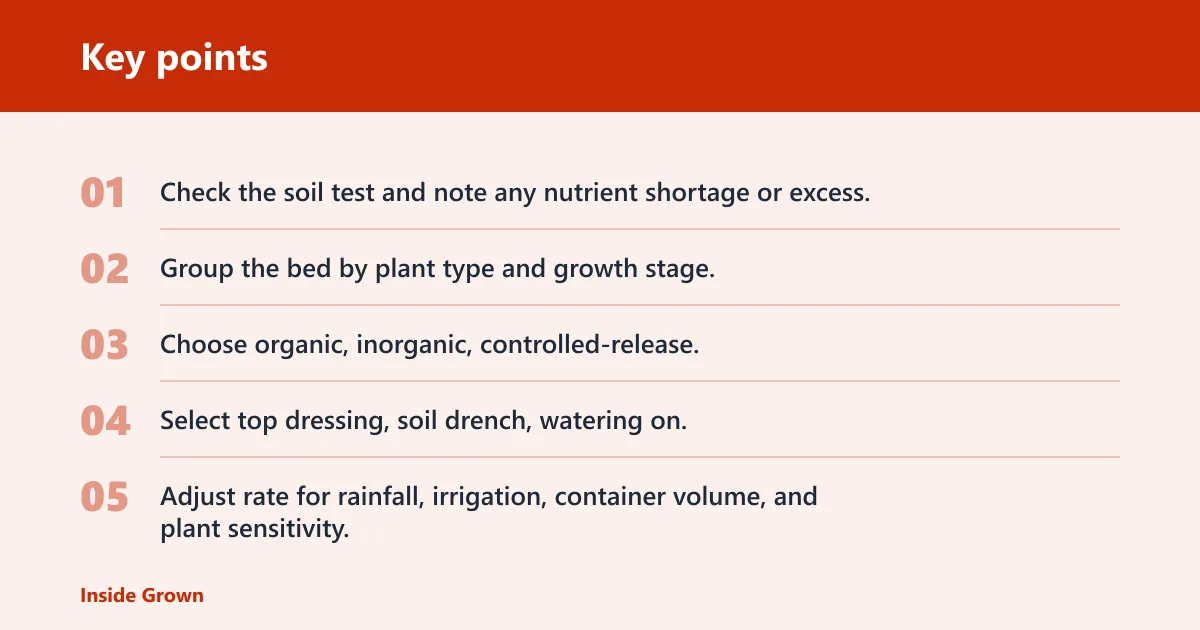
- Check the soil test and note any nutrient shortage or excess.
- Group the bed by plant type and growth stage.
- Choose organic, inorganic, controlled-release, or slow-release fertilizer to match the need.
- Select top dressing, soil drench, watering on, or foliar feeding only when that method fits the plant and the site.
- Adjust rate for rainfall, irrigation, container volume, and plant sensitivity.
- Recheck symptoms before repeating the application.
Frequently asked questions
How do you fertilize ornamental plants without burning them?
Start with a soil test, then use the lightest effective rate. Apply fertilizer to moist soil, keep granules off leaves and stems, and water in only when the product calls for it. Slow-release or controlled-release products are often safer in mixed beds because they reduce sudden nutrient spikes.
When is the best time to fertilize flowering ornamental plants?
Spring is usually the best starting point for flower gardens, especially when new growth begins. After that, feed only if the plant stage, soil test, rainfall, or irrigation pattern justifies it. Blooming plants often need less nitrogen and more careful timing than foliage plants.
What fertilizer should be used for perennials in a botanical garden?
Perennials usually do best with a modest, balanced product or a slow-release option, especially at spring emergence. Avoid heavy feeding unless a soil test shows a real shortage. Many perennials in botanical gardens prefer fewer applications and less nitrogen than annual display beds.
Should ornamental plants get organic or inorganic fertilizer?
Either can work. Organic fertilizers are slower and often gentler, which suits sensitive display beds and established borders. Inorganic fertilizers act faster and are useful for quick correction. The right choice depends on the soil test, the plant group, and how visible the bed is to visitors.
How often should garden borders and beds be fed?
Do not use a fixed monthly schedule for every bed. Feed according to plant group, soil test results, irrigation, and growth stage. Many botanical garden borders need only a spring application plus a targeted follow-up if symptoms or test results show a clear need.
What NPK ratio is best for flowering ornamental plants?
No single ratio fits every flowering bed. Early growth and newly planted flowers often need a balanced formula, while bloom-stage feeding usually favors lower nitrogen and adequate phosphorus and potassium. Soil test results should guide the exact product, because excess phosphorus or nitrogen can be as harmful as too little.
How do you correct nutrient deficiencies in ornamental beds?
Confirm the deficiency with a soil test when possible, then match the correction to the missing nutrient and the plant group. Use a light top dressing, a soil drench, or foliar feeding only when that method fits the problem. If symptoms persist, retest instead of repeating the same feed blindly.