Is Sulfur Fungicide Safe for Vegetable Gardens Today?
Yes. Sulfur fungicide is generally safe for vegetable gardens when you follow the label, keep it off heat-stressed plants, avoid spraying above 85°F, and leave 2 to 3 weeks between sulfur and an oil spray. Misuse can burn leaves, stunt tender crops, and waste a treatment right as powdery mildew starts to spread. This guide gives crop-by-crop guidance, temperature limits, and a simple yes/no decision rule for edible beds.
This guide is part of our Garden safety concerns: what is safe to use series.
Sulfur is an elemental contact fungicide. It works on the plant surface, so timing matters more than cure claims. Vegalab says sulfur has been registered since the 1920s, and it works only when applied before powdery mildew appears. That makes it a preventive tool, not a rescue spray after heavy infection.
Is sulfur fungicide safe for vegetable gardens?


How sulfur fungicide works on garden diseases
Powdery mildew is the main target in vegetable beds. Sulfur can also help with some insect and mite pests, but its best-known use is disease prevention on foliage. Coverage matters because contact products only protect the plant tissue they reach.
That is why leaf undersides, crowded canopies, and new growth need attention. If mildew is already coating the leaves, sulfur may slow spread, but it should not be treated as a curative fix. Resistant varieties, spacing, pruning, and sanitation often do more than a late spray.
📊 Sulfur should not be applied near or above 90°F. Source: Vegalab.
Which vegetables can you treat with sulfur?
Sulfur can be used on several common vegetables, but not all crops tolerate it equally. Tomatoes are usually a reasonable fit, many leafy and fruiting vegetables are conditional, and some cucurbits can burn or show injury, especially in heat. The crop matters as much as the disease.
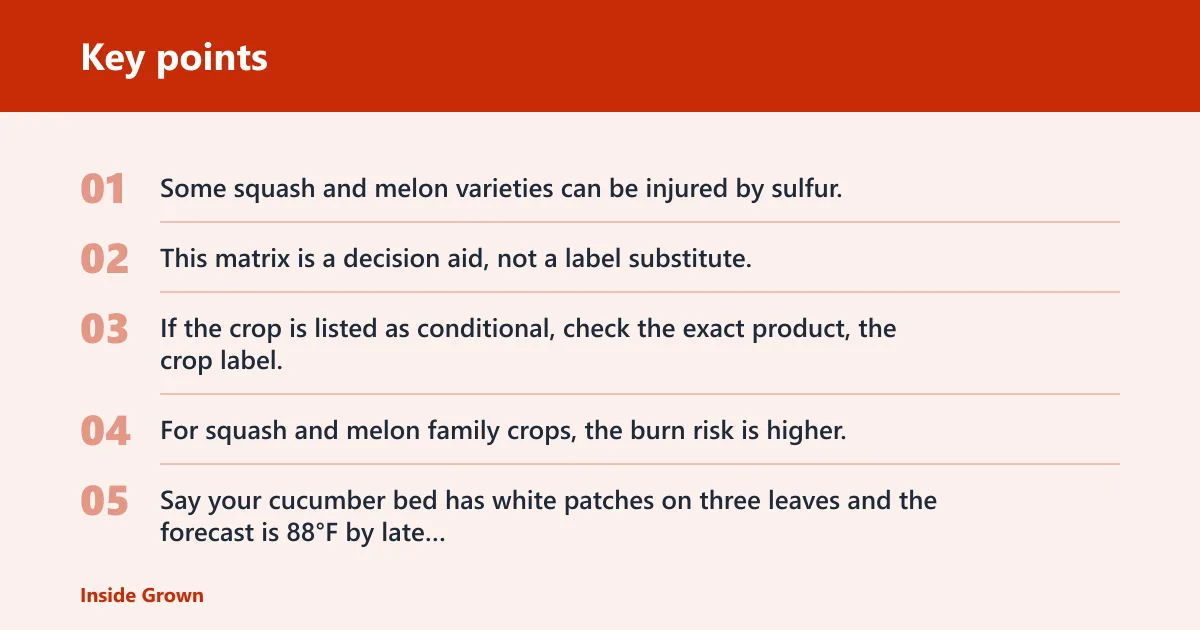
Use a compatibility check before spraying. Some squash and melon varieties can be injured by sulfur, and that warning should move them out of the default-safe column unless the product label and crop label both support use.
Sulfur compatibility matrix for 12 vegetables
| Vegetable | Status | Max temp for use | Oil-spray wait | Powdery mildew use |
|---|---|---|---|---|
| Tomato | Safe | 85°F | 2 weeks | Yes |
| Cucumber | Conditional | 85°F | 2 weeks | Yes |
| Summer squash | Avoid in heat | 85°F | 2 weeks | Yes |
| Winter squash | Conditional | 85°F | 2 weeks | Yes |
| Melon | Avoid in heat | 85°F | 2 weeks | Yes |
| Pumpkin | Conditional | 85°F | 2 weeks | Yes |
| Pea | Safe | 90°F | 2 weeks | No |
| Bean | Conditional | 90°F | 2 weeks | No |
| Lettuce | Safe | 85°F | 2 weeks | No |
| Spinach | Safe | 85°F | 2 weeks | No |
| Strawberry | Conditional | 85°F | 2 weeks | Yes |
| Onion | Safe | 90°F | 2 weeks | No |
This matrix is a decision aid, not a label substitute. If the crop is listed as conditional, check the exact product, the crop label, and the day’s temperature before you spray. For squash and melon family crops, the burn risk is higher, so the margin for error is smaller.
Say your cucumber bed has white patches on three leaves and the forecast is 88°F by late morning. That is a poor sulfur day. A better move is to wait for a cooler morning, or choose another control if the crop is already heat-stressed.
When to mark a crop as conditional instead of safe
Use conditional when the crop can tolerate sulfur in some situations, but the risk rises with heat, variety, or spray history. Strawberries and caneberries often need lower temperature limits than the main garden guide, and cucurbits deserve extra caution because some varieties react badly even at moderate temperatures.
Conditional also fits beds that have been treated with oil recently, or plants that are young, drought-stressed, or already showing leaf scorch. In those cases, sulfur may be the wrong tool even if the crop is not a hard no.
How hot is too hot to spray sulfur?
Avoid spraying sulfur in hot weather, and some garden guides use a lower cutoff as the safer choice. When sources differ, the practical home-garden rule is simple: if the forecast may reach the upper 80s after sunrise, skip the spray or wait for a cooler day. Heat plus sulfur can scorch leaves fast.
Cucurbits need extra caution because squash and melon leaves are often tender and broad, which raises injury risk. Morning application only helps if the day stays cool. If the plant is already wilted from sun, drought, or transplant shock, do not spray at all.
A simple morning-or-skip rule for home gardeners
- Check the forecast for the whole day, not just the morning low.
- If the day may reach 85°F, treat the spray as conditional.
- If the day may reach 90°F, skip sulfur.
- If the crop is cucurbit, lower the threshold again and be stricter.
- If leaves are drought-stressed, hold the spray.
Picture a bed of zucchini that looked fine at 7 a.m. but curled by noon. That crop should have been left alone. A preventive spray only works when the plant can tolerate it long enough to keep a dry film on the leaf surface.
What is the difference between sulfur dust, wettable sulfur, and lime sulfur?
Wettable sulfur is the preferred garden form for powdery mildew. Sulfur dust is harder to use and drifts easily, while lime sulfur is a liquid sulfur product used for the same broad disease and pest purposes. All three can irritate skin, eyes, and airways, so PPE matters.
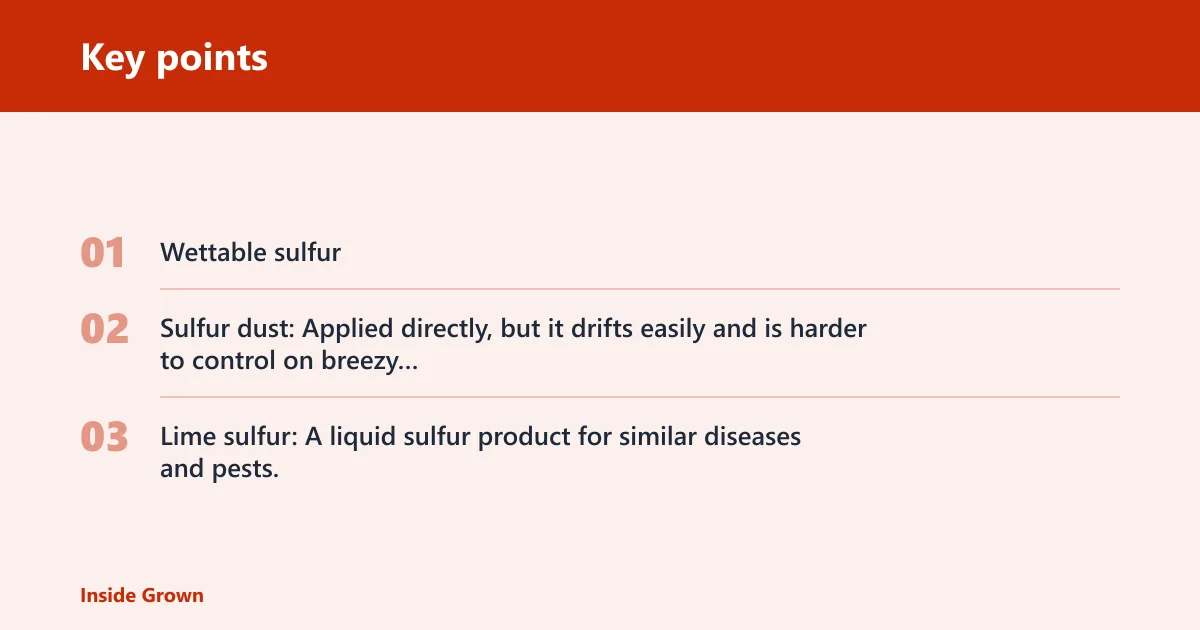
For most home vegetable beds, wettable sulfur is the first form to consider. It is sprayed as a foliar preventive and can benefit from a surfactant for coverage. That makes it better suited to leaf surfaces than dust, which can blow off target and leave uneven protection.
Wettable sulfur, dust, and lime sulfur compared
- Wettable sulfur: Best fit for foliar preventive sprays on vegetables, especially powdery mildew.
- Sulfur dust: Applied directly, but it drifts easily and is harder to control on breezy days.
- Lime sulfur: A liquid sulfur product for similar diseases and pests; it is less soil-acidifying than regular sulfur.
Dust is the least forgiving form near edible beds. It can spread beyond the target row and irritate skin and eyes while you apply it. Wettable sulfur still needs caution, but the spray pattern is easier to aim and cover evenly.
Lime sulfur belongs in a separate decision bucket. It is not the default home-vegetable choice for mild powdery mildew pressure. Use it only when the label fits the crop and the pest or disease really calls for that product type.
Can I use sulfur fungicide after neem oil?
Not right away. Sulfur and oil sprays should not be used within 2 weeks of each other, and some labels stretch that window longer. Neem oil and horticultural oil both count as oils, so the separation rule applies to them too. Mixing them, or spraying too close together, can injure foliage.
That waiting period is one of the biggest mistakes in home gardens. A foliar film of oil can react with sulfur and leave leaf burn that looks like disease damage but is actually spray injury. If the label is stricter than 2 weeks, follow the label.
How long should you wait between sulfur and oil sprays?
Use the longer label interval when product directions differ. The safe general rule is at least 2 weeks between sulfur and any oil spray, including neem oil and horticultural oil. When a product label gives a waiting period, follow that interval between sulfur and oil sprays. Product type and crop sensitivity can change the interval.
A common first-timer mistake is to spray neem for insects, then switch to sulfur a few days later for mildew. That is too close. If both pests are in play, choose one path and schedule the other for later, or pick a different control option that does not conflict.
Is sulfur safe for bees, pets, and people?
Sulfur has a relatively low acute oral toxicity profile in EPA categories, but that does not make it harmless. Eye irritation and inhalation are real concerns, especially with dust. Reentry guidance is often about a day, and edible crops still need label-compliant harvest timing before picking.
For bees and other pollinators, the main rule is spray safety: apply when bees are not active, avoid direct contact with open blooms when the label says so, and never treat as if a garden spray were automatically pollinator-safe. For pets, the best protection is to keep them off treated beds until the label interval has passed and the surface is dry.
Protective equipment for dust and spray applications
- Wear gloves.
- Use eye protection.
- Use respiratory caution with dust or fine spray.
- Follow the label for reentry and harvest intervals.
Dust forms call for even more care because particles drift into your face and onto nearby plants. Sprays also need caution around wind and overspray. If the label calls for a 24-hour reentry interval, treat that as the minimum time before people or pets return to the treated area.
What vegetables should not be treated with sulfur fungicide?
Do not treat sulfur-sensitive crops, heat-stressed crops, or vegetables that are too close to an oil application. Some squash and melon varieties can be injured by sulfur, so those crops often belong in the avoid or conditional column. When the crop has no mildew pressure, no spray may be the better answer.
Also skip sulfur if the disease problem is not powdery mildew and the plant already has a better fit for another product. Baking soda-based products can fit some mildew situations. Copper can fit certain diseases better than sulfur. Resistant varieties and cultural controls may solve the problem with less risk.
When sulfur is the wrong choice
- The forecast is hot.
- The crop is a sulfur-sensitive cucurbit.
- You used neem or another oil recently.
- The disease is advanced and coverage would be poor.
- A resistant variety or nonchemical control fits the problem better.
Suppose a melon patch already has sunscald on older leaves and the forecast says 91°F. That is a clear no-spray day. In that case, shading, watering at the root zone, and removing the worst foliage may do more good than forcing a sulfur application.
What is the difference between sulfur dust and wettable sulfur?
Wettable sulfur is usually the better vegetable-garden choice because it is made for foliar preventive spraying and stays where you put it more reliably than dust. Sulfur dust is harder to use and drifts easily, which raises inhalation, eye, and coverage problems. Lime sulfur is a different liquid sulfur product.
If you are choosing between dust and spray, the spray form usually gives better control on edible beds. Dust may fit very specific uses, but it is not the easiest path for a first-time gardener trying to prevent powdery mildew on vegetables.
Frequently asked questions
Can I use sulfur fungicide on tomatoes and cucumbers?
Tomatoes are usually a good fit, while cucumbers are more conditional. Tomatoes commonly tolerate sulfur better, but cucumbers can still suffer if it is hot, if the plants are stressed, or if the crop has been treated with oil recently. Check the label and the forecast first.
How hot is too hot to spray sulfur fungicide?
Do not apply sulfur near or above 90°F, and many garden guides use 85°F as the safer practical limit. If the day may warm into the upper 80s, skip the spray. Cucurbits need an even wider safety margin because their leaves are easier to injure.