Are botanical gardens good for kids? Age-by-age guide
In practice, botanical gardens can work well for kids if you match the visit to their age and attention span: toddlers may do best with short sensory walks, ages 4 to 6 with a simple quest, and ages 7 to 10 with longer, more self-guided visits. A poorly timed visit can mean meltdowns, bored kids, and a trip that feels longer than it should. This guide breaks down what works for each age band, how long to stay, and which garden features keep a child engaged.
This guide is part of our Botanical garden guide series.
What Botanical Gardens Offer Kids Beyond Pretty Flowers



A botanical garden is a documented living plant collection used for scientific research, conservation, display, and education. Many are partly open to the public, and some include guided tours, public programming, workshops, courses, educational displays, art exhibitions, open-air performances, glasshouses, and shadehouses. (usbg.gov)
For children, that means more than “looking at flowers.” Large gardens often label plants with botanical names and extra information, which turns a walk into a label-reading game for older kids and a simple picture-matching activity for younger ones.
Common features kids may notice
Paths, ponds, shaded seats, water features, and enclosed plant houses can hold attention because they change the pace of the visit. A child does not need a full science lesson to get something from the experience. A short stop at a bright flower bed or a greenhouse can be enough.
Typical family activities and public programs
Public programming may include guided tours, family days, craft tables, planting activities, and story-based events. Gardens that schedule activities by age, such as toddler story sessions or school-age planting workshops, usually work better for children than an open-ended walk that depends on long attention and a steady pace.
📊 NYBG has a children’s gardening program for ages 3 to 12. Source: For Families.
Are botanical gardens good for kids?
Yes, but the answer depends on the child’s age, stamina, and how the visit is structured. A general garden walk can work for some children, while others need a children’s program or a dedicated kids’ area to stay engaged. The best fit is the one that matches attention span and mobility.
Botanical gardens can work well when the visit has concrete things to point at, touch, count, or compare. They tend to work less well when parents expect a long, quiet walk from a preschooler or a self-directed visit from a toddler.
When a general walk works best
A general walk fits children who can move at a steady pace and follow a simple goal, such as finding three flowers or spotting leaves in different shapes. Ages 7 to 10 often handle this best, especially if the route is short and includes a clear stop or two.
When a structured program is the better choice
If a child gets restless quickly, a scheduled family program is usually the safer bet. Storytime, crafts, guided activities, and planting sessions give the visit a beginning and end, which helps children who struggle with open-ended wandering.
How old should a child be for a botanical garden visit?
There is no single best age, but different ages tend to handle different types of visits. Ages 2 to 3 may need short, caregiver-led experiences. Ages 4 to 6 can often manage simple guided tasks. Ages 7 to 10 may do well with longer visits, observation games, and more independent exploration.
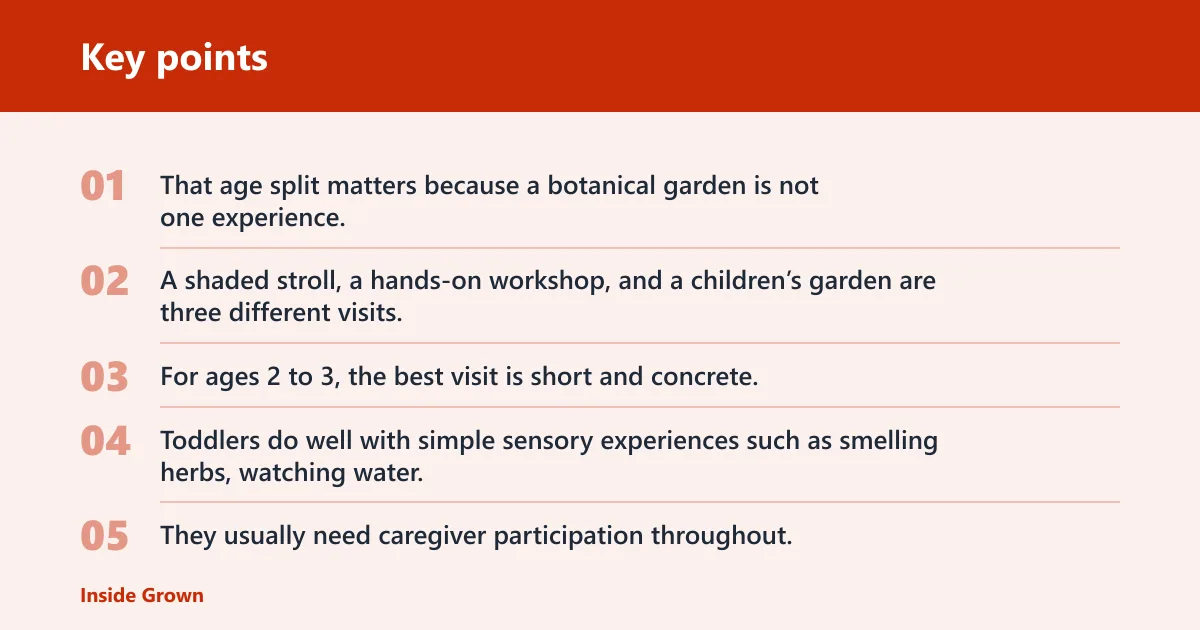
That age split matters because a botanical garden is not one experience. A shaded stroll, a hands-on workshop, and a children’s garden are three different visits, and children should be matched to the one they can actually complete without frustration.
Ages 2 to 3
For ages 2 to 3, the best visit is short and concrete. Toddlers do well with simple sensory experiences such as smelling herbs, watching water, touching safe textures, and stopping at one or two clear points. They usually need caregiver participation throughout.
Ages 4 to 6
For ages 4 to 6, short guided tasks work better than a long walk. Storytime, crafts, counting petals, following picture prompts, and group participation suit this range because the child can respond to instructions but still needs frequent direction and clear transitions.
Ages 7 to 10
For ages 7 to 10, a longer visit can work if the route has a purpose. Scavenger-style observation, plant labels, garden maps, and hands-on learning hold attention better than an aimless stroll. This age group can often handle more structure and more walking.
Age to experience guide: what works best at each stage
The best garden visit is the one that matches age, stamina, and activity type. A toddler does not need a full tour. A school-age child may enjoy a much larger route, especially if there is a task to complete or a garden space built for families.
| Age band | Best garden features | Visit length | Best activity type |
|---|---|---|---|
| 2 to 3 | Short paths, shade, one or two sensory stops, stroller-friendly areas, simple displays | 30 to 60 minutes | Caregiver-led sensory play, pointing, naming, short guided activities |
| 4 to 6 | Story spaces, craft tables, easy loops, family programming, resting spots | 60 to 90 minutes | Storytime, crafts, guided tasks, group participation, simple planting |
| 7 to 10 | Label-rich collections, mapable paths, children’s gardens, activity stations, guided tours | 90 minutes to 2 hours | Observation games, scavenger-style tasks, plant ID, hands-on learning |
Say your 3-year-old likes to walk for ten minutes, then asks to be picked up. That child is a better fit for a short loop with one greenhouse stop than for a full afternoon program. A 9-year-old who enjoys spotting differences between leaves may be ready for a longer route with a worksheet or family challenge.
Which kids’ programs are worth looking for?
The strongest children’s programs have a clear age range, a clear format, and a clear end point. Look for storytime, crafts, guided family activities, planting and harvesting sessions, and food education. Seasonal schedules matter because many programs are offered only on certain dates or during certain months.
Storytime, craft, and guided family activities
These are often the best entry point for ages 4 to 10 because they give children a task while keeping the setting simple. A craft plus a short garden walk can work better than a long, passive tour for children who want to use their hands.
Planting, harvesting, and food education
Programs that include planting, digging, watering, or tasting make the visit feel more active. NYBG’s Dig! Plant! Grow! includes digging, sowing, and watering, and Fresh from the Garden Tastings are family-friendly and taught by staff. Those details show what to look for elsewhere: a clear task, not just a stroll.
How seasonal schedules change what is available
Many family programs change by season or date, so a promising activity may not be running on the day you want to visit. Check the schedule before you go. A closed program calendar is a common reason a child-friendly plan falls apart.
What can kids actually do at a botanical garden?
Kids can do a lot at a botanical garden if the visit is planned around them. The most useful activities are simple and visible: spotting colors, finding shapes, following labels, watering plants, hearing a story, making a craft, or joining a short guided family activity.
Hands-on plant activities
Hands-on activities include planting seeds, watering, digging, sowing, and sometimes harvesting. These are useful because they turn plant learning into movement. Children who resist a long explanation often engage more quickly when their hands are busy.
Garden-to-table learning
Food education connects plants to something a child already understands. Edible Academy is an example of the kind of program that combines growing and food learning. A child who can plant herbs, watch them grow, and taste them later is more likely to remember the visit.
Passive and active choices
A botanical garden visit can be passive, active, or mixed. Passive works for a short stop with flowers, ponds, and shaded paths. Active works better for children who need tasks. Mixed visits usually work best overall because children can walk, then do, then rest.
What should parents check before bringing kids to a botanical garden?
Check the age range, the schedule, the route length, and whether the visit is guided, timed, or drop-in. Also check shade, restrooms, stroller access, weather, and any mobility needs. Those details matter more than the garden’s general reputation for being family-friendly.
- Confirm the age range and whether caregiver participation is required.
- Check the exact date and time, since many family programs run on a set schedule.
- Look at the route length and whether the visit includes hills, stairs, or long walking stretches.
- Check for shade, restrooms, stroller access, and places to stop.
- Find out whether the program is self-guided, guided, timed, or drop-in.
- Choose one main goal for the visit so the day does not become too long.
A common first-timer mistake is planning too much
Suppose a parent schedules a two-hour visit, a gift shop stop, and a picnic for a 2-year-old with a 20-minute patience window. The child may melt down before the main activity even starts. One planned stop and one backup rest break is usually enough for younger children.
Examples of child-focused garden spaces and programs
Some gardens build child-friendly spaces and family programming into the site itself. Those examples are useful because they show what a strong kid visit can look like: clear activity design, age-aware programming, and a reason to stay beyond a simple walk.
Everett Children’s Adventure Garden as a model for kid-focused programming
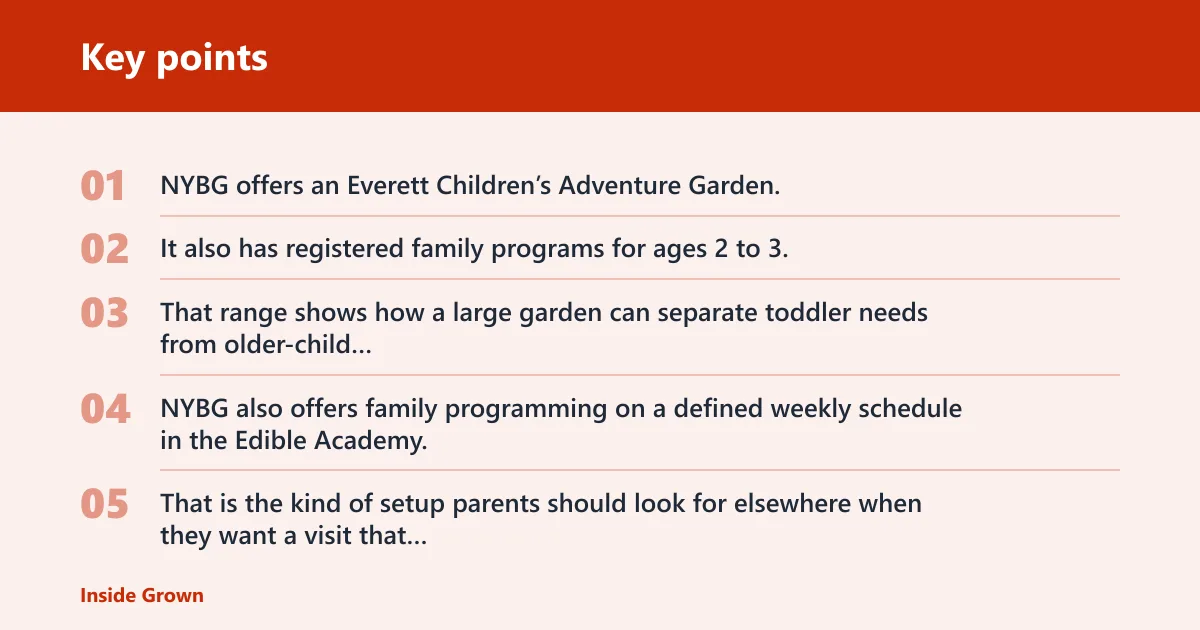
NYBG offers an Everett Children’s Adventure Garden, and NYBG positions family visits as an everyday adventure for kids and families. It also has registered family programs for ages 2 to 3, a children’s gardening program for ages 3 to 12, and recommended activities for families with children ages 4 to 10. That range shows how a large garden can separate toddler needs from older-child programming.
Edible Academy as a model for garden-to-table learning
NYBG also offers family programming on a defined weekly schedule in the Edible Academy. That is the kind of setup parents should look for elsewhere when they want a visit that is more than a walk: a planned activity, a clear age fit, and a real hands-on outcome.
What these examples tell parents to look for elsewhere
Look for a child-specific area, a stated age range, a schedule, and a task children can finish. A garden that offers only a map and a broad promise of family fun may be fine for older children, but it is not enough for every age.
Frequently asked questions
Are botanical gardens good for toddlers?
They can be, but toddlers usually need short visits and caregiver-led activities. Ages 2 to 3 do better with sensory stops, simple movement, and quick changes in scenery. Long self-guided walks are usually too much for that age band.
What age is best for a botanical garden visit with kids?
There is no single best age. Ages 4 to 6 often do well with storytime, crafts, and guided family activities, while ages 7 to 10 can handle longer routes and more observation. Toddlers can still enjoy a visit if it is kept brief and simple.
How long can kids stay engaged at a botanical garden?
Engagement time depends on age and activity type. Toddlers often need a 30 to 60 minute visit, while ages 4 to 6 may manage 60 to 90 minutes with structure. Ages 7 to 10 can often stay engaged longer if the visit has a clear goal.