How Plants Know When to Flower
Plants flower when internal signals say reproduction has the best odds, usually after the plant measures day length or night length, enough warmth, a cold period, and sometimes crowding. If those cues are off, flowering can start too early, too late, or never, which cuts bloom and seed set. This guide explains the main triggers and how they combine into one final yes-or-no switch.
Flowering cue checklist
| Cue | What the plant is measuring | What you can observe | Common failure signs |
|---|---|---|---|
| Photoperiod, long-day type | Whether nights are short enough for the species | Flower buds appear after longer spring days | Healthy leaves, but no buds while nights are still too long |
| Photoperiod, short-day type | Whether nights are long enough for the species | Bloom starts as days shorten in late summer or autumn | Leaf growth continues but buds stall under long summer days |
| Phytochrome signal | Red and far-red light information | Plants stretch differently in open sun, shade, or crowded beds | Leggy stems, delayed buds, or poor timing under altered light quality |
| Vernalization | Whether a cold period has already happened | Flowering starts after winter or a long chilling period | Vigorous growth with no bloom after mild winters or skipped chilling |
| Temperature | Seasonal warmth or cold history | Spring flowering starts when warmth follows winter | Delayed bloom after unusual heat, cold snaps, or warm winters |
| Crowding and shade avoidance | Nearby-plant far-red cues and competition | Stems elongate before flowering in dense stands | Long, weak stems with buds that form early but stay small |
| Hormone signal, including gibberellins | Internal growth and flowering status | Some species flower sooner after hormonal shifts | Species-specific failure: one plant responds, another ignores the same treatment |
Why do plants flower at all?
Plants flower to make seeds through sexual reproduction. That sounds simple, but the timing is not simple at all. A plant has to wait for the season that gives its pollen, ovules, and seed-filled fruit the best odds of success.
Seed formation is the endpoint
Flowering is the switch from vegetative growth to reproductive growth. Leaves, stems, and roots build reserves first. Then the plant shifts resources into flowers, pollination, and seed set. If it switches too soon, seed production can fail. If it waits too long, the season may close before seeds mature.
That timing matters differently for different species. Many spring flowers bloom when water, warmth, and sunlight are readily available. Other plants wait until later, when the species’ pollinators, seed dispersers, or soil conditions are more favorable.
Why timing matters for survival
Plants have no nervous system and no eyes, but they still detect environmental cues. They read a mix of light, temperature, and internal status. The goal is not to bloom at the first warm day. The goal is to bloom when reproduction is most likely to work.
Say your lettuce bolts after a cool spell turns into a warm, bright stretch. That shift is not random. The plant has combined multiple cues and decided that flowering now gives seed a better chance than staying leafy.
What light signals tell a plant to flower?
Photoperiod is a major flowering cue because it helps the plant track seasonal change, and the useful signal can be day length or night length depending on the species. Light quality also matters. Plants compare red and far-red information through phytochrome, which helps them read seasonal change and nearby competition.
Day length and night length are read differently by species
Photoperiod lets plants measure day length and night length accurately. Short-day plants flower in autumn as days shorten and nights lengthen. Long-day plants flower when nights are short enough. Those are opposite responses, so one simple rule does not fit every species.
That also means the same calendar date can produce different outcomes in different plants. One plant may be ready to bloom after midsummer. Another may be waiting for shorter days, even if it looks perfectly healthy.
Phytochrome reads red and far-red light
Phytochrome is the light-sensing system that helps plants compare red and far-red light information. It is the pigment system plants use to detect seasonal change. Far-red light plays a major role in flowering, and the balance between red and far-red light can shift plant timing.
Do not treat that balance as a universal rule. A high red-to-far-red ratio promotes flowering in many plants, but not all. The response is species-dependent, so the same light environment can push one species toward bloom and leave another unchanged.
Why light quality matters indoors and outside
Indoor plants can still receive natural daylight from windows, and outdoor plants also respond to cloud cover, canopy shade, and nearby vegetation. Stable indoor light schedules can delay or prevent flowering in some species because the plant never receives the seasonal change it expects. Light duration, light quality, and even the order of day and night all matter.
A common first-timer mistake is giving a plant strong brightness but ignoring the schedule. A grow light left on for the wrong number of hours can keep a short-day plant in leaf mode, or keep a long-day plant from ever reaching its flowering threshold.
How do plants turn cues into blooms?
Plants turn environmental readings into flowering through mobile signals and integrator genes. Florigen, often discussed through FT, is the flowering signal made in leaves and sent to the shoot tip. Gibberellins can also help, but their effect is species-dependent.
Florigen moves the signal from leaves to the shoot tip
FT and SOC1 are described as integrator genes in flowering control. The basic idea is that leaves read the environment, then send information to the growing tip where flowers form. Florigen is the mobile flowering signal in that chain. It connects the environmental cue to the actual shift in growth pattern.
That is why the leaf can be the sensor while the shoot tip becomes the site of visible change. Buds do not need to read the whole sky on their own. They receive the message from elsewhere in the plant.
Hormones help, but they do not act the same way in every species
Gibberellins can promote flowering in some species. In others, they matter less or act in a different context. That species dependence is important. A hormone that speeds flowering in one plant may do little in another, especially when photoperiod or vernalization is still missing.
How multiple signals combine
Think of flowering as a final switch. Light cues, temperature, cold history, and internal growth signals all feed that switch. If enough inputs line up, flowering begins. If one major input is wrong, the plant may keep growing vegetatively instead.
Suppose a basil plant sits under a lamp on a fixed 16-hour schedule, but the room drops sharply at night in early autumn. The plant may still grow leaves, but the mix of light timing and temperature can keep flower initiation slower than expected. That is a cue stack problem, not a mystery.
Why do some plants need winter first?
Some species will not flower until they have had a cold period. Vernalization means flowering after cold exposure. This winter conditioning is common in some plants, and when the cold cue is missing, flowering may stay blocked even if everything else looks fine.
Cold history can act like a gate
Vernalization is not the same as a brief cold snap. It is a developmental cue that tells the plant winter has passed or that winter has been experienced in the right way. Some plants also produce abscisic acid before winter to stay dormant, which helps them wait through the season safely.
Sugar beets are examples of plants that require vernalization. Without that cold history, they may keep building leaves and never reach the normal flowering transition on schedule.
What happens when the cold cue is missing
If a vernalization-requiring plant never gets enough chill, it may look healthy but stay vegetative. That can confuse gardeners because the plant is not failing in a visible way. It is waiting for a signal it never received.
Cold exposure also helps explain why some species bloom in one region and stall in another. A mild winter may be enough for a few plants and not enough for others. The species decides, not the gardener’s calendar.
Long-day and short-day plants
Long-day plants flower when nights are short enough. Short-day plants flower as nights lengthen. Those are opposite photoperiod responses, and they explain a lot of spring-versus-autumn bloom timing.
Long-day plants and short nights
Long-day plants often bloom in spring or early summer, once the night length drops below their threshold. The key point is that the plant is not reading “more daylight” in a simple sense. It is responding to whether the night has become short enough for its own flowering program.
That difference matters for planning. If a long-day species stays leafy in early spring, the light period may still be too short, even if the days are bright.
Short-day plants and long nights
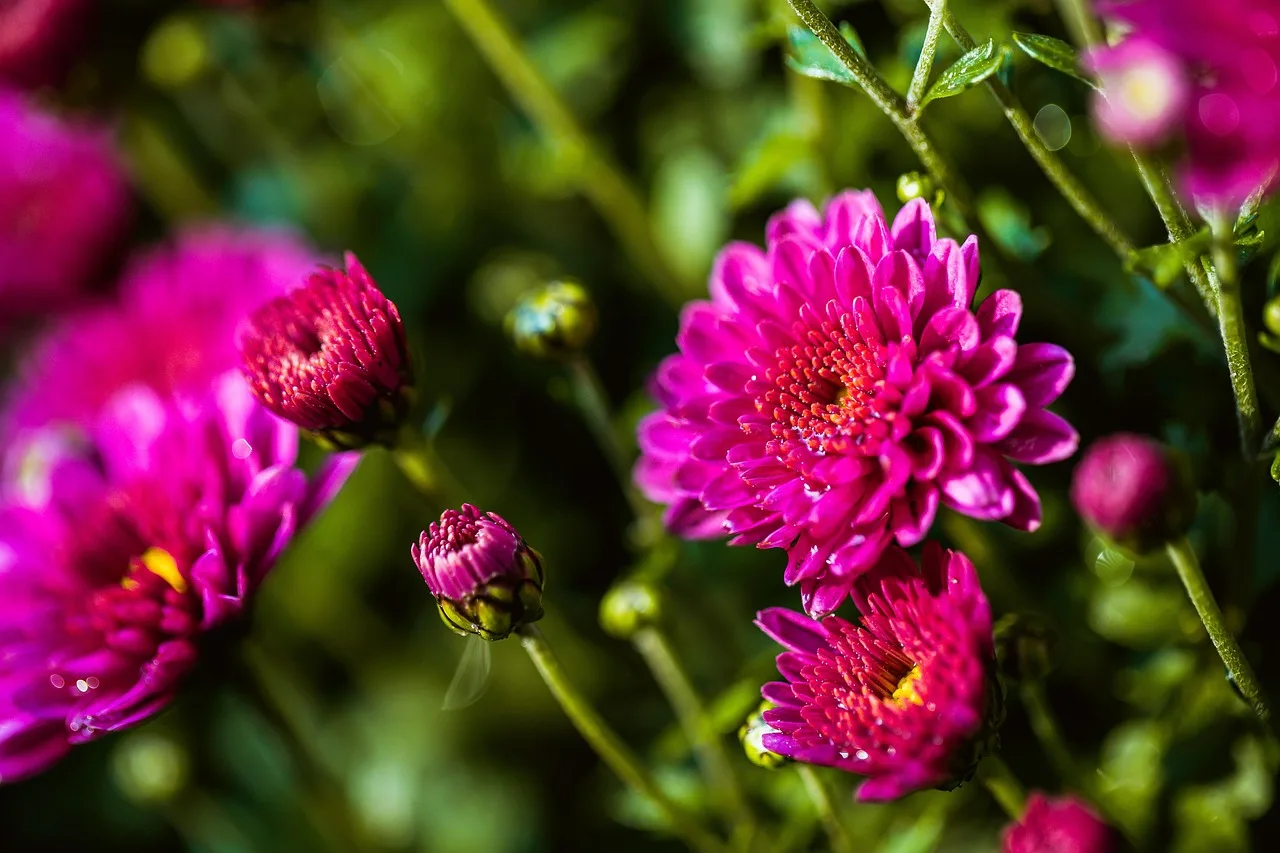
Short-day plants flower in autumn as days shorten and nights lengthen. Chrysanthemum is often used as a garden example of a short-day plant. The plant is not waiting for cold first in every case. For many short-day species, the night cue comes first.
That is why a greenhouse or porch light near the plant can delay bloom. A brief light interruption can break the night-length signal and keep the plant in vegetative growth.
Why the same cue does not fit every species
Different species use different combinations of cues, so flower timing is not explained by one rule. Some plants care mostly about day length. Others care more about cold exposure or temperature. Some use several inputs at once.
That is also why two healthy plants can act very differently in the same yard. One may be a long-day plant. Another may be short-day, vernalization-dependent, or partly day-neutral with additional temperature sensitivity.
Shade avoidance and crowding
Some plants flower early when they sense competition from neighboring plants. This is the shade avoidance response. Nearby leaves change the light quality reaching the plant, especially through far-red light, and that signal can push stems to stretch before flowering.
Far-red as a nearby-plant signal
When plants grow close together, their leaves alter the red and far-red balance. Phytochrome detects that shift. The result is often early stem elongation, a search for more light before the plant commits to flowers.
This is not the same as “more light equals more bloom.” In crowded conditions, the plant may choose speed over compact growth. The visible sign is often a taller, thinner plant with longer internodes.
What crowding can look like in a garden
Shade avoidance can show up as leggy growth, weak stems, and flowers forming on a stretched framework. It can also show up before bloom, which makes the plant look “healthy but weird.” The leaves may be fine. The stem architecture is the clue.
How to know where to plant flowers? Start with the species’ light and spacing needs, then match the bed or container to those needs. A crowded border may trigger shade avoidance even if the plant gets enough total brightness on paper.
How do indoor plants know when to bloom?
Indoor plants read the same biology, but the signals can be less predictable. They may receive window light, a timer-driven grow light, room temperature changes, and even seasonal cues from drafts or sunlight angle. That mix can either satisfy flowering thresholds or block them.
Indoor timing often depends on schedule stability
Stable indoor light schedules can delay or prevent flowering in some species because the plant never experiences the seasonal change it expects. A lamp that is always on for the same number of hours can flatten the natural cue. For a short-day plant, that can be a problem. For a long-day plant, the issue may be the reverse.
Temperature matters too. A warm room can substitute for spring warmth in some plants, but it can also interfere with species that need a winter cue first. Indoor care is not only about brightness. It is about the cue stack.
A simple diagnosis path
- Check whether the plant is a long-day, short-day, day-neutral, or vernalization-dependent species.
- Compare the current day or night length to that species’ known threshold.
- Look for crowding, shade, or stretched stems that suggest far-red competition signals.
- Ask whether the plant has had the required cold exposure.
- Review temperature swings and whether the plant is still building vegetative growth instead of buds.
Frequently asked questions
How do plants know when to flower?
Plants know when to flower by combining environmental cues into one reproductive decision. They can read day length, night length, temperature, cold history, and nearby-plant signals through phytochrome and other pathways. The balance of cues varies by species, so one plant may bloom while another stays leafy.
Does cold weather make plants flower?
Cold weather can help some plants flower, but only if the species needs vernalization or uses cold history as part of its timing system. Other plants flower after warmth returns, and some are slowed by cold. So cold is a cue for certain species, not a general rule.
What is florigen in plants?
Florigen is the mobile flowering signal made in leaves and sent to the shoot tip. FT is commonly discussed as part of that signal system, and FT and SOC1 are described as integrator genes. The leaf senses the cue, then the tip receives the command to switch growth modes. (Wikipedia)
Why do plants flower when days get longer?
Some plants are long-day species, which means they flower when nights are short enough. Longer days shorten the night interval, and that can release flowering in spring or early summer. The plant is responding to the species-specific threshold, not to brightness alone.
How tall should plants be before switching to flower?
There is no fixed height that applies across plants. Flowering is controlled by cues, not by a universal size target. Some species bloom when small if the photoperiod and temperature are right. Others need to build enough leaves, store enough energy, or finish vernalization first.