Why Botanical Gardens Label Plants So Carefully
Botanical gardens label plants carefully because each tag should identify the plant to the lowest verified taxon, tie it to an accession record, and give visitors a dependable name. If labels are vague or wrong, visitors learn bad information, staff lose track of living collections, and conservation data becomes unreliable. This guide explains the label system, what each field means, and why plant signs function as ID tags, records, teaching tools, and conservation metadata.
Why plant labels matter
Plant labels do more than name a plant. A visitor can match the sign to the plant in front of them, staff can track a living collection, and researchers and curators can connect the plant to a record that can be searched later. One small sign can do all three jobs at once, but not every field appears on every label.
Visitor reading and collection management are different jobs
Some labels are built mainly for education. Others are built mainly for collection control. A visitor-facing label may favor a clear name, family, and a short note about origin. A collection-management label may prioritize accession data, source notes, and database links. Those jobs overlap, but they are not identical.
A common first-timer mistake is to assume every missing field means the staff forgot something. More often, the label is doing a different job. Space limits, policy, and the plant’s status in the collection all affect what appears in print.
How to read a garden label fast
Start with the scientific name. That is usually the most reliable anchor, especially when common names vary by country or language. Then look for the accession number, which links the plant to the garden’s record. After that, scan for family, cultivar, provenance, and native range if those fields are present.
- Find the scientific name first.
- Check whether the name includes a hybrid marker or cultivar name.
- Look for the accession number, if shown.
- Read family, provenance, and native range only after the core name.
- If a QR code is present, use it as a supplement, not a substitute.
A plant label is easiest to decode in layers. The name tells you what the plant is called in the collection. The accession number tells you which record it belongs to. The extra fields tell you how the plant originated, how it was classified, and how much confidence the garden has in the identification.
| Label element | What it means | Why it appears | What to do when it is missing |
|---|---|---|---|
| Common name | The everyday name visitors may already know | Useful for quick recognition and visitor comfort | Use the scientific name instead; common names vary by region |
| Scientific name | The Latinized genus + species name, sometimes with extra rank information | Provides the most consistent identification across languages | Look for the database record or ask staff for the verified name |
| Family | The broader plant group above genus | Helps visitors compare related plants and supports education | Use the genus and species; family is helpful but not essential |
| Cultivar | A cultivated selection written in capitalized words in single quotation marks | Identifies a selected garden or nursery form | Check whether the label instead uses only the species name |
| Accession number | A unique record number tied to one plant record | Links the label to the collection database and source history | Ask staff or check a nearby label if the plant seems mislabeled |
| Provenance code | A short code for wild origin or cultivated origin | Summarizes where the plant came from | Read the accession record or interpret the label without source detail |
| Distribution / native range | Where the plant grows naturally | Gives ecological context and helps visitors compare habitat and origin | Use the scientific name to look up range information elsewhere |
| QR code | A scannable code that opens a digital record | Can add more text than a small printed label allows | Read the printed label; QR access depends on a phone and internet |
Why scientific names appear first
Scientific names appear first because they are the most stable label anchor for a global audience. A genus-and-species structure gives visitors and staff the same reference point even when common names shift by language, region, or habit. Chicago Botanic Garden notes that scientific names are universal worldwide, and that is the main reason they sit at the core of plant labeling.
Why common names are not enough
Common names are useful, but they are weaker for exact identification. One species may have several common names, and one common name may apply to different plants in different places. A label that relies only on a local name can confuse visitors from another region and can blur the record for staff.
Common names are often secondary to the scientific name on purpose. They help visitors enter the label quickly, while the scientific name carries the formal identification. That balance matters in gardens that welcome international visitors, because the Latinized name reduces dependence on local language.
When a hybrid marker appears
The multiplication sign × signals hybrid origin. It tells you the plant has mixed parentage, which matters for both identification and record-keeping. A hybrid may be labeled in a way that looks slightly different from a straight species because the plant is not a pure wild type. (Wikipedia)
Say your label reads Salvia × sylvestris. The × means the plant is a hybrid, so the name is not pointing to a single wild species in the usual way. If the label also omits native range, that may be deliberate rather than an error, because some systems leave that field off hybrid labels.
What accession numbers do
An accession number is not a plant name. It is a collection record identifier that links the label to the garden’s database and source history. Cambridge uses a unique accession number linked to its plant database, and that is the pattern many collections follow: one number, one record, one living accession.
Why gardens use unique IDs
Living collections change over time. Plants die, are divided, are replanted, or are reidentified. A unique accession number helps the garden keep the record intact even when the plant itself changes location or the displayed name changes after review.
In some systems, the accession number may include a year and a sequence number. That makes it easier to sort records and trace when material entered the collection. It also helps staff distinguish one batch of plants from another, even if the labels look similar to visitors.
How accession numbers help curation
Accession numbers help staff connect the label to source notes, planting history, and taxonomic updates. They are part of the collection-management layer, not the visitor layer. If a label is damaged, the number can still lead staff back to the correct plant record.
The same source says it has stored more than 45,000 plant labels in its label room and has produced close to 10,000 labels a year. That scale shows why a numbered system matters: a garden cannot keep thousands of living records organized by memory alone.
What garden labels contain
Label content depends on the garden, the plant, and the sign’s purpose. A standard label may include family, cultivar, origin, and distribution, but a garden may leave some of those out for space, policy, or because the plant is a cultivar or hybrid. The label is a selective record, not a complete file.
Family, cultivar, and native range
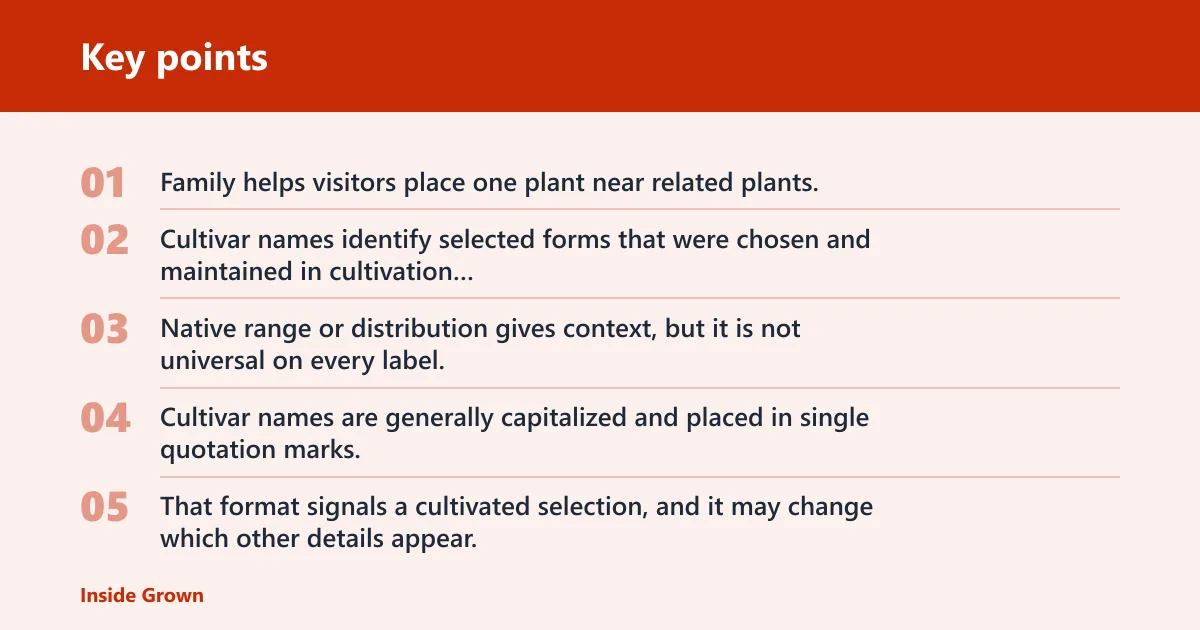
Family helps visitors place one plant near related plants. Cultivar names identify selected forms that were chosen and maintained in cultivation rather than found as wild populations. Native range or distribution gives context, but it is not universal on every label.
Cultivar names are generally capitalized and placed in single quotation marks. That format signals a cultivated selection, and it may change which other details appear. In some labels, a cultivar name can take the place of a native-range note because the plant’s garden identity matters more than its wild distribution.
Provenance codes and source notes
Provenance codes can show whether a plant came from the wild or from cultivation. Cambridge uses letter codes such as W, Z, G, and U on labels. Those short codes compress source information into a small space, which is useful when the sign has to stay compact and weather-resistant.
Not every garden uses the same code set. In plain text; others keep them in the database only. If provenance is missing from the sign, it may still exist in the accession record.
Why some fields are missing
Missing fields usually reflect space, policy, or collection status. A small herbaceous label cannot carry as much text as a larger woody-plant label. A cultivar may not need a native-range field. A hybrid may need a different naming structure than a straight species.
Suppose a 2×5 inch herbaceous-plant label has room for the scientific name, family, and accession number, but not a long note on origin. That is not a failure of the system. It is the garden balancing legibility, durability, and record density on one small sign.
Label materials and QR codes
Outdoor labels need materials that survive light, rain, handling, and temperature swings. The same source says it prints labels on photosensitive anodized aluminum. NYBG uses brown plastic with a white under-layer for standard labels, with woody-plant labels sized at 3×5 inches and herbaceous-plant labels at 2×5 inches. Different gardens choose different materials, but durability is the shared goal.
Why durability matters outdoors
A label that fades, cracks, or peels can mislead visitors and staff alike. A garden sign is not a temporary placard; it is part of the collection record. If the text fails, the record becomes harder to trust on the ground.
NYBG has maintained plant records since 1891, and it produces labels in-house through the Plant Records Department. That kind of internal control helps keep label text aligned with current records, not just printed once and forgotten.
Printed text versus QR codes
QR code labels can supplement printed text or, in some gardens, carry extra detail that does not fit on the sign. They are useful when a garden wants to add notes, photos, or a longer record. They are not a complete substitute for printed text, because they depend on a phone and internet access.
That dependence matters for accessibility. A QR code can help some visitors, but a visible scientific name and key printed details still help people without data service, without a compatible phone, or with limited digital comfort. The best labels do not force a single reading path.
Label changes and limits
A plant label is a current record, not a permanent truth. Plants get reclassified, names change, labels get damaged, and records get updated. A sign that looks authoritative may still lag behind the latest taxonomic decision if the database has been updated more recently than the physical label.
Reclassification and name updates
When a plant is reclassified, the label may need to change. That can happen after taxonomic review, revised identification, or a database update. The scientific name on the sign should reflect the garden’s current accepted record, not an old one that was printed years earlier.
This is another reason accession numbers matter. The accession remains the same while the name can change, so the record stays linked even when the label text is revised. The label points to the plant as currently understood.
Damaged or outdated labels
Faded print, broken stakes, soil splash, and sun exposure can all make a label hard to read. A damaged label may still be legible enough for a visitor, but it may no longer be reliable for staff if the text is incomplete or outdated. That is one reason gardens keep the database behind the sign.
Labels can also mislead when they are placed near the wrong plant after a swap or dieback. A label may be accurate in the database and wrong in the bed if the physical tag was moved. Visitors usually cannot see that failure mode, which is why collection staff have to audit signs regularly.
How garden databases keep labels organized
Plant databases sit behind the label system and keep the collection aligned. BG-Base at NYBG and IrisBG at Cambridge are examples of systems used to store records tied to labels. The database holds the field structure, and the label is the short public view of that record.
From database to label text
Staff pull the current plant record, select the fields that fit the label format, and print the sign in a size and material suited to the site. NYBG’s in-house label workflow and Cambridge’s accession-linked records show the same logic at different scales: database first, label second.
That process helps keep thousands of records aligned. It also explains why gardens sometimes omit a field that visitors expect. If a field does not fit the template, or if the record does not support it with confidence, it may stay in the database rather than on the sign.
How labels support education
Labels cut through language barriers by giving visitors a stable scientific name that does not depend on local common usage. They also create a fast route from observation to verified information. A visitor can stand in front of a plant, read the sign, and compare the label to what they see without needing a guide in hand.
That educational value is strongest when the label is accurate and readable. A clear sign lets a visitor move from “What is this?” to “What family is it in, where did it come from, and how is it classified?” in a few seconds. That is a small sign doing serious work.
Frequently asked questions
Why do botanical gardens label plants with scientific names?
Scientific names give the most consistent label anchor across languages and regions. They use a genus-and-species structure, so they are more reliable than local common names when the goal is exact identification. Gardens place them first because they are the shared reference point behind the collection.
What information is usually on a plant label at a botanical garden?
A label often includes the scientific name, common name, family, accession number, and sometimes cultivar, provenance, or native range. Not every garden uses the same fields. Some labels are built for visitors, while others are built mainly to support collection management.
Why do botanical gardens use accession numbers on labels?
Accession numbers connect a plant to its database record and source history. They are unique identifiers, not plant names. Gardens use them so staff can track living collections even when a label changes after reclassification or a plant is moved, divided, or replaced.
Why are common plant names not enough in a botanical garden?
Common names vary by region, language, and habit, so they can be unclear or misleading outside one local context. A scientific name is more dependable for identification. Common names still help visitors, but they are usually secondary to the formal name on the label.
How do botanical gardens make plant labels weatherproof?
They use outdoor-durable materials such as photosensitive anodized aluminum or plastic labels with a contrasting under-layer. The goal is to keep text readable through sun, rain, and handling. Durable material matters because the label is part of the living collection record, not just a sign.
Why do some botanical garden labels include QR codes?
QR codes can add information that does not fit on a small printed label, or they can supplement a brief sign with a longer digital record. They depend on a phone and internet access, so they work best as an extra layer rather than the only source of information.