Are Deer Repellents Safe for Vegetable Gardens? Guide
Most deer repellents are safe around vegetable gardens only if the label allows food-crop use and you keep them off edible parts; if a product lacks that guidance, don’t use it on vegetables. Used carelessly, sprays or granules can leave residue on leaves, contaminate harvests, or trigger label violations. This guide sorts deer repellents by ingredient type and format, then shows which options are safest near tomatoes, beans, herbs, and other edibles.
Are deer repellents safe for vegetable gardens?


Yes, some are, but only when the label explicitly allows use around edible crops and the product is applied exactly as directed. “Safe around plants” is not the same as safe on food. The main job is to keep repellents off harvested parts and follow any harvest or waiting guidance on the label.
That difference matters because gardeners often mix up plant safety with food safety. I’ve seen formulas that are mild on leaves and still wrong for salad greens because the label never permits direct contact with food crops. “Natural” does not answer that question.
What “safe around vegetables” actually means in practice
In practical terms, the label should tell you where the product can go, how it should be applied, and whether direct contact with edible plants is allowed. If the label says not to spray food crops, keep it off the vegetable bed. If it allows direct use, follow the timing and coverage directions closely.
That also means the application boundary matters. A repellent that is fine on fence lines or ornamentals may still be a poor fit inside a bed you harvest weekly. For vegetables, the safer choice is usually the product with the clearest edible-crop language, not the strongest smell.
According to 6 Best Deer Deterrent Sprays for Vegetable Gardens That Actually Work — Another page lists Deer Stopper II as a ready-to-use 32-ounce trigger bottle.
Which deer repellent ingredients are safest near food crops?

The safest ingredient family is the one with the clearest food-crop label and the least chance of landing on harvestable parts. Among common odor-based repellents, mint and peppermint formulas are often easier to live with, while egg- and garlic-based products can be effective but more intrusive near a kitchen garden.
Ingredient family matters because smell, residue, and reapplication burden differ a lot. A product can work on a fence line and still be a poor choice beside lettuce. For edible beds, label comfort comes first, then odor, then how often rain or irrigation will force a reset.
Putrefied egg solids: effective smell barrier, low comfort for many gardeners
Putrefied egg solids are a common odor-based deer deterrent ingredient. They work by making the area smell wrong to deer, which can help at the edge of a garden. The tradeoff is obvious: the odor can be hard to tolerate close to herbs, salad greens, or seating areas.
These formulas are usually better when smell is less important than deterrence, such as along a boundary or in a spot where people do not spend much time. Around vegetables, the label has to be especially clear, because a product that smells acceptable in a catalog may still be a poor fit beside harvestable crops.
Garlic oil and garlic-based blends: common, weather-sensitive, widely used
Garlic oil and garlic-based repellents create a scent barrier that deer often dislike. They are common in mixed formulas, sometimes paired with egg solids. Their weakness is consistency: wet weather, overhead watering, and strong deer pressure can shrink the effect quickly.
These are usually best as part of a rotation or as a short-term layer around beds, not as the only defense. If a garden gets frequent irrigation, the repellent can lose its edge sooner than the label’s marketing language suggests. Reapplication after rain is normal, not a failure.
Mint and peppermint oils: often easier to live with near edible beds
Mint and peppermint botanical oils are often preferred when odor burden matters. They are still deterrents, not perfume, but many gardeners find them easier to tolerate near edibles than egg-based products. That makes them worth a look for beds close to patios or kitchen doors.
Even so, “plant-friendly” does not mean automatic food-crop approval. The label must still permit use around vegetables. A peppermint formula that smells cleaner can still be the wrong choice if it lacks edible-crop instructions or requires application only to nonfood plants.
What to look for on the label before you spray or spread anything
Look for direct language about food crops, edible plants, or harvest guidance. If the label says safe for use around vegetables when used as directed, that is useful. If it says nothing about food crops, treat that as a warning sign and keep it out of the bed.
Also check where the product may be applied. Some formulas are meant for borders, some for foliage, and some for perimeter-only use. The label should tell you whether direct contact with leaves, buds, or new growth is allowed, and whether harvest timing matters.
How do sprays, granules, and pouches compare in a vegetable garden?
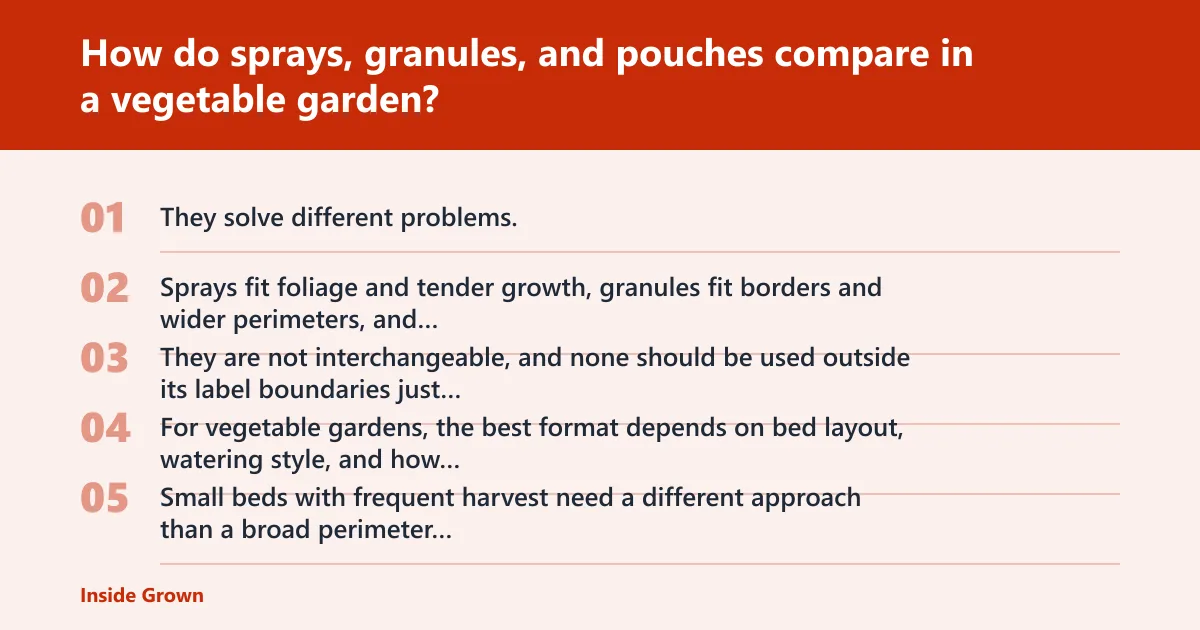
They solve different problems. Sprays fit foliage and tender growth, granules fit borders and wider perimeters, and pouches or stations work as low-maintenance deterrence around beds. They are not interchangeable, and none should be used outside its label boundaries just because it seems convenient.
For vegetable gardens, the best format depends on bed layout, watering style, and how much labor is realistic. Small beds with frequent harvest need a different approach than a broad perimeter planting. If deer pressure is high, format choice should be part of a layered plan, not the whole plan.
Deer repellent spray: where it belongs and where it does not
Deer repellent spray is the format most gardeners think of first. Ready-to-use versions are simple; concentrates require mixing and more care. Sprays are useful when the label allows direct application to leaves, buds, and new growth, because deer often target those tender parts first.
The downside is exposure. Sprays land on the plant, so the label has to be clear about edible-crop use. Rain and overhead irrigation also shorten their useful life. A ready-to-use trigger bottle is commonly recommended in guides, and some products are described as safe for pets, people, pollinators, plants, and the environment when used as directed.
Deer repellent granules: best for borders and larger perimeters
Granules are often used as a perimeter tool. They are better around bed edges, paths, and outer borders than inside a bed with regular watering. Bonide Repels-All is presented as a granular product for broad deterrence, which is the right kind of use case for this format.
Granules face wash-off risk from rain and irrigation. They can be practical around larger areas because they are quick to place and less likely to coat edible leaves, but they need careful spacing and regular checks after wet weather. In small beds, they can become more maintenance than help.
Deer repellent pouches and stations: low-maintenance deterrence around beds
Pouches and stations are often the least hands-on format. They hang or sit near beds and release odor over time, which makes them useful where spraying every week is annoying. They are a seasonal deterrence tool, especially for borders, walkways, and entry points deer use repeatedly.
The tradeoff is weaker placement control. They do not protect every leaf or bud the way a directed spray can, and they may not be enough under high deer pressure. They work best when the goal is to add a scent cue without putting much material on edible plants.
Ready-to-use vs concentrate: what changes for safety and application control
Ready-to-use products are generally simpler and can reduce mixing errors. Concentrates can be better for larger spaces because they stretch farther, but they also require more attention to dilution and coverage. A peppermint-based concentrate is often positioned for larger garden areas, which makes sense when the perimeter is long.
For food crops, control matters more than economy. A ready-to-use spray can be easier to keep on target around tomatoes or herbs. A concentrate may be useful, but only if the label allows the intended use and the sprayer can deliver even coverage without soaking harvestable parts.
Decision matrix: which ingredient family fits your garden?
This matrix compares common ingredient families for edible-garden use, focusing on label comfort, smell, rain durability, reapplication burden, and where each type may fit best. The best choice is usually the one that matches the bed layout and the watering pattern, not the one with the loudest promise.
| Ingredient family | Food-crop label comfort | Smell intensity | Rain durability | Reapplication frequency | Best use case |
|---|---|---|---|---|---|
| Mint / peppermint oils | High when the label allows edible-crop use | Low to moderate | Moderate | After rain and on a regular schedule | Small vegetable beds near living spaces |
| Garlic oil / garlic blends | Moderate; depends heavily on label language | Moderate to strong | Moderate to low | More often in wet weather | Mixed garden edges and rotating deterrence |
| Putrefied egg solids | Moderate; label must allow food-crop use | Strong | Moderate | Frequent after rain or irrigation | Perimeters where odor burden is acceptable |
| Granular blends | Lower inside beds; better at borders | Variable | Low to moderate | Often after heavy rain | Garden edges, larger areas, fence lines |
| Pouches / stations | Moderate when placed outside harvest zones | Low to moderate | Moderate | Seasonal checks and replacement | Low-maintenance deterrence around beds |
How often should you reapply deer repellent around vegetables?

Reapply after heavy rain, after repeated irrigation, and whenever new growth becomes the most attractive target. There does not seem to be a one-size-fits-all reapplication schedule for deer repellent around vegetables. The safe rule is to watch the plant, the weather, and the label together, then refresh before deer pressure rises again.
Rain-resistant formulas can buy time, but they do not eliminate reapplication. That matters in vegetable gardens because irrigation is common and leaves are constantly renewing. A product that lasts longer on paper can still fail quickly in a bed watered from above every few days.
Rain and irrigation change the schedule
A formula can resist wash-off better than another and still need replacement after heavy rain. The safer way to think about rain-resistant claims is “longer protection,” not “no maintenance.” If a competitor recommends reapplying after heavy rain, that is the kind of instruction gardeners should expect.
For irrigated beds, drip systems are easier on repellents than overhead watering. Sprays on foliage lose effectiveness fastest when water hits the treated surfaces directly. Granules at the perimeter also need inspection because repeated wetting can move or dilute them.
New growth, buds, and tender leaves need the closest watch
Deer prefer the newest, softest plant tissue. That means sprouts, new leaves, buds, and flowers need tighter monitoring than older foliage. If a spray is used, those are the areas most likely to need fresh coverage once the first coating fades.
This is where format choice matters. A spray can protect the plant surfaces deer browse first, while a pouch or granule may only signal the area from a distance. For vegetables that keep producing tender growth, a repellent plan should expect repeat applications.
When repeated washing means it is time to switch tactics
If rain, irrigation, or deer pressure keeps beating the repellent down, it is time to add another control. That may mean fencing, netting, a tighter crop layout, or a different perimeter tool. Repellent failure is often a site problem, not a product problem.
Small beds are especially vulnerable because deer can strip them quickly once they break the scent barrier. If a gardener is reapplying constantly and still seeing browsing, a scent repellent alone is the wrong tool for the job.
What can you put in your garden to keep deer away besides repellent?
Fencing and netting are the first-line fixes when deer pressure is heavy. Repellents help, but they are easier to overwhelm than a physical barrier. In small vegetable beds, layout changes and access control often do more than any scent product alone.
A layered defense works best. Use repellent where it fits, then add a barrier or spacing strategy so deer face more than one obstacle. That approach is especially useful where browsing is frequent or where a bed sits close to woods or open field.
Fencing and netting as the first-line fix under heavy pressure
When deer are persistent, fencing is the reliable answer. Netting can protect smaller beds or specific crops, while taller barriers are better for broader garden spaces. The point is simple: if deer can reach the leaves, odor alone may not hold them off for long.
For edible beds, a barrier also reduces the risk of residue on harvestable parts. That is a food-safety advantage as well as a deer-control advantage. Repellents can then become a supporting layer instead of the only defense.
Using repellents with physical barriers
Repellents still have a place when paired with fences, hoops, or mesh. They can help keep deer from testing weak spots, especially at entry points or near corners where fencing is harder to keep tight. This is often where sprays and pouches earn their keep.
The best combination depends on size and layout. A tiny raised bed may need a simple cover plus a safe-to-use spray on the outside edges. A larger plot may do better with perimeter granules outside the fence and a few pouch stations at approach routes.
Crop layout and access control for small edible beds
Small beds benefit from tighter planting and simpler access. Put the most vulnerable crops inside the most protected area. Keep walkways clear, because clutter can hide browse damage and make reapplication uneven.
If deer pressure is high, avoid assuming any scent product will stand alone. The smarter move is to make the bed harder to reach and less attractive at first glance, then use the repellent label that best matches the crop and format.
Frequently asked questions
what deer repellent is safe for vegetable gardens
The safest choice is a product whose label explicitly allows edible-crop use and gives clear application directions for vegetables. A “safe around plants” claim is not enough. If the label does not mention food crops, keep it away from the bed and choose a product with better label comfort.
how to keep deer out of vegetable garden
Use a layered approach: fencing or netting first, then a repellent format that fits the bed. Sprays work on foliage, granules work around borders, and pouches add low-maintenance odor cues. Under heavy pressure, a barrier does more than scent alone, especially after rain or new growth appears.
how to keep deer from eating vegetable garden
Protect the most tender growth first, since deer target new leaves, buds, and flowers. Apply a label-approved repellent to the right surfaces, refresh it after wet weather, and back it up with a physical barrier when deer are active. If browsing continues, switch from repellent-only to layered control.
what can you put in your garden to keep deer away
You can use sprays, granules, pouches, fencing, and netting, but they are not interchangeable. Sprays are for direct coverage, granules for borders, and pouches for low-touch scent. For edible beds, the safest additions are the ones whose labels clearly allow use around vegetables.
how often should I reapply deer repellent around my vegetable garden
Reapply after heavy rain, after repeated irrigation, and whenever new growth becomes the most attractive target. There is no fixed universal schedule. A rain-resistant formula may last longer, but it still needs monitoring in vegetable beds, especially where overhead watering or strong deer pressure is common.
can I use deer repellent in a garden where pets or kids also play
Yes, if the label says it is safe for people and pets when used as directed and you keep children and animals away during application and drying. Do not rely on marketing alone. Check access, timing, and any harvest guidance, because edible-crop safety and family safety are separate questions.