Gardening Techniques for Interplanting Vegetables
Design interplanting by pairing a tall or slow crop with a short, fast one, matching deep roots with shallow roots, and using one harvest window gap so each square foot stays productive. Break those rules and you crowd leaves, slow roots, invite disease, and cut yields. This guide shows how to choose vegetable combinations by height, root depth, and harvest timing for tighter spacing without choking the bed.
This guide is part of our Gardening techniques series.
What is interplanting in vegetable gardens?


Interplanting means growing two or more crops in the same area, either at the same time or in sequence. It is a spacing strategy, not a single recipe. In many garden guides, intercropping is the broader term, and it includes row planting, mixed intercropping, and relay planting.
How interplanting differs from intercropping
Interplanting is the hands-on garden move: set a second crop where the first will not fill the space, or tuck a quick crop between slower plants. Intercropping is the umbrella term. Row planting means at least two vegetable types with at least one in rows. Mixed intercropping uses two crops together with no rows. Relay planting adds the second crop before the first crop is fully finished.
When interplanting makes sense in a home bed
Use it when the bed has open soil between young transplants, when a fast crop can finish before a slow one expands, or when one crop can live under another crop’s canopy. It works in small beds, but only if you keep airflow, light, and root space intact.
How do you choose crops that fit together?
Choose crops using checks like height at maturity, root depth, and harvest timing. Tall or upright plants belong beside short or low plants. Taprooted crops can share space better with fibrous-rooted crops. Fast maturers can leave before slow crops reach full size. That simple filter prevents most crowding problems.
Match plant height and canopy shape
Put the tallest crop where it will not shade everything beside it. Upright plants and bushy plants behave differently. A tall, narrow crop can sit beside a lower, spreading crop if the lower crop does not need the same sun layer. A broad-leaved crop beside another broad-leaved crop usually needs more room than seed packets suggest.
Pair root types to reduce competition
Root structure matters as much as leaf shape. Fibrous roots tend to feed near the surface, while taproots push deeper. Pairing a shallow feeder with a deeper feeder helps each crop use a different part of the soil profile. That lowers direct competition for water and nutrients.
Use maturity timing to harvest one crop before the other peaks
Plant a fast-maturing crop where it can be harvested before the slower crop needs the room. Lettuce between tomato transplants is a standard example. The lettuce finishes while the tomatoes are still small, then the tomatoes take the space. That sequence keeps the bed productive without forcing both crops to peak together.
Which vegetables work best in the same bed?
Beginner-safe combinations usually mix a slow crop with a faster one, or a tall crop with a short one. Cool-season crops such as lettuce, spinach, kale, carrots, and beets work well under or after warm-season crops. Warm-season crops such as corn and tomatoes can act as nurse crops or support crops if the bed is planned around their final size.
Beginner-safe pairings for cool-season crops
Try lettuce under tomatoes early in the season, spinach beside slower brassica transplants, or carrots between wider-set beets if the row spacing leaves room. These pairings work because the cool-season crop matures quickly or stays small enough to avoid crowding the larger plant.
Warm-season pairings that leave room for quick crops
Corn can support climbing beans, and squash can cover the soil between those taller stems. Tomatoes can host a short-lived crop early on, then take over once the quick crop is removed. Intercropping can also mean planting a second crop after the first harvest, which fits summer-to-fall succession well.
Three sisters planting and why it works
The three sisters planting uses corn, pole beans, and squash together. Beans fix nitrogen in the soil. Corn gives the beans a stalk to climb. Squash can deter animals and shade the ground. This is a classic intercropping pattern because each crop fills a different role instead of repeating the same one.
Picture a 4×8 bed planted in three sisters style. The corn occupies the center and back half, the beans climb the stalks, and the squash spreads near the edges. If the squash is allowed to sprawl too early, it can smother the base of the corn, so spacing still matters.
How do you lay out a 4×8 bed for interplanting?
Start with the mature spread of each crop, not the seed packet density. Place the tall crop on the north side when possible so it shades less of the bed. Then decide whether the bed should use row interplanting, mixed intercropping, or relay planting. The right layout depends on whether you want early harvests, season-long yield, or a clean handoff from one crop to the next.
Use spacing by mature size, not seed packet density
Seed packets often describe sowing density, not the final footprint of a mixed bed. Leave the in-between distance that each crop needs at maturity, then add room for airflow and access. If two mature canopies meet in the center, the bed is likely too tight.
Choose the right interplanting pattern
- Row interplanting: use rows when you need access for thinning, harvest, or trellising.
- Mixed intercropping: use no-row mixtures only when both crops stay low or one finishes quickly.
- Relay planting: sow or transplant the second crop before the first crop fully ends, so the bed never sits empty.
A simple bed-design method
- List the main crop and its final height.
- Mark whether its roots are shallow or deep.
- Choose one companion with a different harvest window.
- Put the taller crop to the north side if sun direction allows.
- Leave aisle space so leaves do not pack together at maturity.
- Reserve an open slot for a second sowing if the first crop finishes early.
What should you avoid when interplanting vegetables?
Avoid combinations that turn the bed into a solid wall of leaves or a tangle of roots. The main failure points are crowding, poor airflow, nutrient competition, and shared disease pressure. Interplanting can reduce disease and pests when done in proper combinations, but it can also make both problems worse if the bed is packed too tightly.
Crowding that cuts airflow and raises disease risk
When leaves overlap heavily, moisture hangs around longer and disease spreads more easily. Dense canopy layers also make scouting harder. If you cannot see soil between stems once the crops are established, the spacing is probably too tight for a mixed bed.
Bad matches for nutrients, water, or canopy size
Two heavy feeders planted shoulder to shoulder can exhaust the same soil zone. Two thirsty crops can dry a bed quickly. Two wide crops can fight for the same light and block one another. A common first-timer mistake is pairing crops that each need the same space at the same time.
Pairs that compete for the same harvest window
Do not mix two crops that both peak in the same week unless the bed is oversized. If both need full sun, full root depth, and full canopy width at once, they are not companions in practice. They are competitors.
- Tomatoes beside full-size potatoes in a tight bed
- Large cucurbits packed with full-size brassicas
- Two sprawling crops that both need wide spacing
- Two shallow, thirsty crops with no succession plan
How can interplanting help with weeds, pests, and fall succession?
Interplanting helps most when it keeps soil covered without blocking growth. Fewer open gaps can reduce weeds because less light reaches the soil surface. Mixed plantings can also make pests work harder to find host plants. In empty beds, fall interplanting lets you keep harvesting instead of leaving unused space after an early crop ends.
Why fewer open gaps can reduce weeds
Weeds depend on bare soil and sunlight. When a bed is filled with staggered plant sizes, the open patches close sooner. That does not eliminate weeding, but it lowers the number of exposed spaces that invite new growth.
How mixed plantings can lower pest pressure
Intercropping can make pests work harder to find host plants, especially when the preferred crop is broken up by another species. That can help reduce pest pressure in some beds, and the effect is stronger when the layout keeps the main crop from forming a solid block.
Fall interplanting after an early harvest
Replanting empty spots with fall vegetables is an easy method, and it fits beds cleared by onions or beets. Cool-season crops such as lettuce, spinach, kale, carrots, and beets can follow warm-season harvests or fill holes left by earlier crops. That keeps the bed active as temperatures shift.
Suppose a 4×8 bed loses its onions in midsummer. Instead of leaving the soil bare, the gardener can set in lettuce or spinach in the open spaces. The new crop shades the soil, slows weeds, and produces another harvest before hard frost.
Interplanting planning table for a 4×8 bed
Use this table as a quick planning sheet for a standard 4×8 bed. The height tier and root depth help you avoid overlap, and the days-to-harvest column helps you sequence crops so one finishes before the other expands. Risk level here means crowding, airflow, and competition risk for a beginner layout.
| Pairing | Height tier | Root depth | Days to harvest | Spacing approach in a 4×8 bed | Risk level |
|---|---|---|---|---|---|
| Lettuce between tomato transplants | Short under tall | Shallow under deeper | Fast crop before tomato peak | Place lettuce in gaps between tomato starts, then remove at harvest | Low |
| Spinach under trellised peas | Short under upright | Shallow under moderate | Fast crop before pea canopy thickens | Use the north side for peas if possible; keep spinach in the lighter edge band | Low |
| Carrots beside onions | Low with low | Taproot with shallow bulb | Midseason with staggered pulls | Alternate narrow bands; thin early so roots do not twist | Low |
| Beets with loose-leaf lettuce | Low with short | Taproot with shallow | Fast lettuce, midseason beets | Put lettuce as a temporary filler between beet rows | Low |
| Kale with radish | Medium with short | Moderate with shallow | Radish first, kale later | Sow radish in open gaps while kale is still small | Low |
| Tomatoes with basil or lettuce | Tall with short | Deep with shallow | Lettuce fast, basil longer | Use a north-side tomato row and keep companions at the bed edge | Moderate |
| Corn with pole beans | Tall with climbing | Deep with moderate | Beans follow support growth | Plant corn in blocks, then add beans after stalks are sturdy | Moderate |
| Corn, beans, and squash | Tall, climbing, low | Deep, moderate, shallow | Staggered across the season | Use a block layout, not a single crowded row | Moderate |
| Onions after early beets | Short with short | Shallow with taproot | Beets first, onions later | Use emptied holes after beet harvest for a fall crop | Low |
| Swiss chard with carrots | Medium with low | Moderate with taproot | Chard longer, carrots earlier | Leave wider centers for the chard leaves to expand | Moderate |
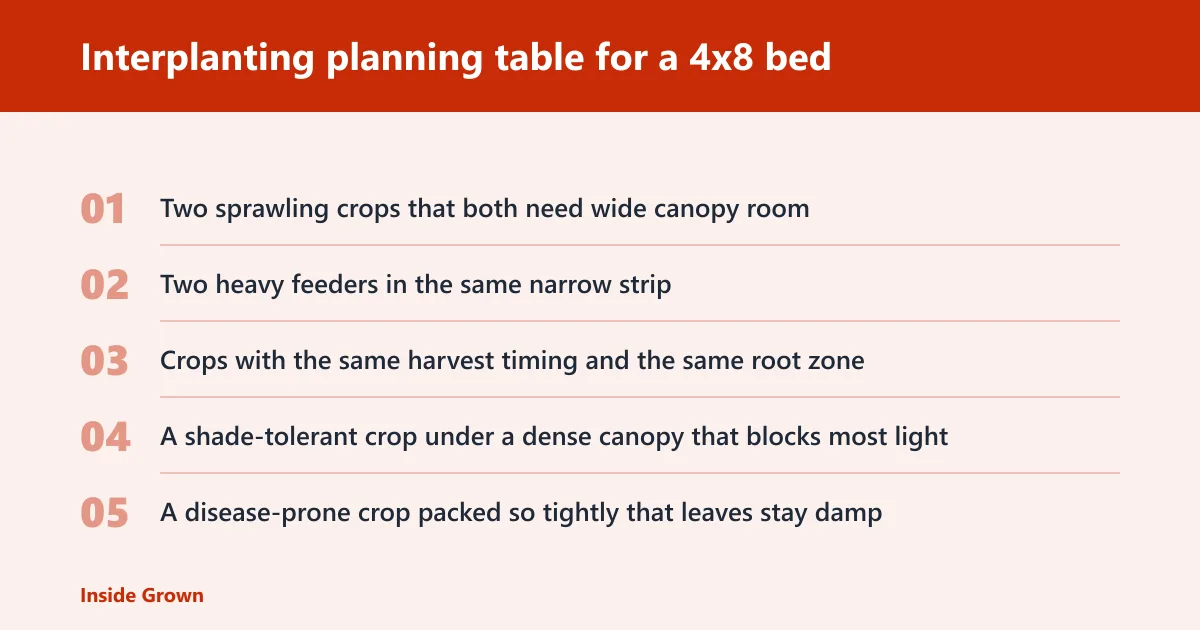
Do-not-pair list for beginner gardeners
- Two sprawling crops that both need wide canopy room
- Two heavy feeders in the same narrow strip
- Crops with the same harvest timing and the same root zone
- A shade-tolerant crop under a dense canopy that blocks most light
- A disease-prone crop packed so tightly that leaves stay damp
How to use the table to choose a layout fast
Start with the crop you most want to harvest, then pick a companion that finishes sooner or grows lower. Match deep roots with shallow roots, and keep the tall crop on the north side when practical. If the pair needs the same canopy space at maturity, use relay planting instead of mixed planting.
Frequently asked questions
How do you interplant vegetables without overcrowding?
Use mature size, not seed density, as the spacing rule. Pair a tall crop with a short one, a deep root with a shallow root, and a fast crop with a slow one. Leave enough room for air movement and access. If leaves touch too early, thin or remove the fast crop.
Which vegetables grow well together in the same bed?
Beginner-friendly pairs include lettuce with tomatoes, spinach with peas, carrots with onions, and radishes with kale or beets. These combinations work because they differ in height, root depth, or harvest timing. The best match is the one that gives each crop a different layer of the bed.
Can you interplant vegetables in fall gardens?
Yes. Fall interplanting works well after early crops finish, especially in spaces left by onions or beets. Cool-season crops such as lettuce, spinach, kale, carrots, and beets can fill those openings. The main goal is to keep the soil covered and productive until colder weather ends the season.
What is the difference between interplanting and intercropping?
Interplanting is the act of growing two or more crops in the same area at the same time or in sequence. Intercropping is the broader term used in many garden guides. It includes row planting, mixed intercropping, and relay planting, so interplanting is one practical form of intercropping.
How far apart should vegetables be when interplanted?
Space them according to their mature spread, not their early seedling size. Keep enough room for full leaves, harvest access, and airflow. The exact distance varies by crop, but the rule is simple: if two mature plants will touch hard at the same time, the pairing is too tight for a small bed.
How can interplanting reduce weeds and pests?
Fewer open gaps mean less light reaches the soil, so weeds have fewer places to start. Mixed plantings can also confuse pests by breaking up large blocks of host plants. That does not eliminate pest pressure, but it can make infestations less direct and easier to manage.