Are Beneficial Nematodes Safe for Vegetable Gardens?
Yes, beneficial nematodes are safe for vegetable gardens when you match the species to the pest and apply them to moist soil; they do not harm vegetable plants. Used poorly, they can miss the pest, waste product, and leave root-feeding insects active longer. This guide separates plant safety, human and pet safety, and garden-community safety, then gives you a vegetable-bed checklist for deciding when nematodes fit.
This guide is part of our Garden safety concerns: what is safe to use series.
What beneficial nematodes
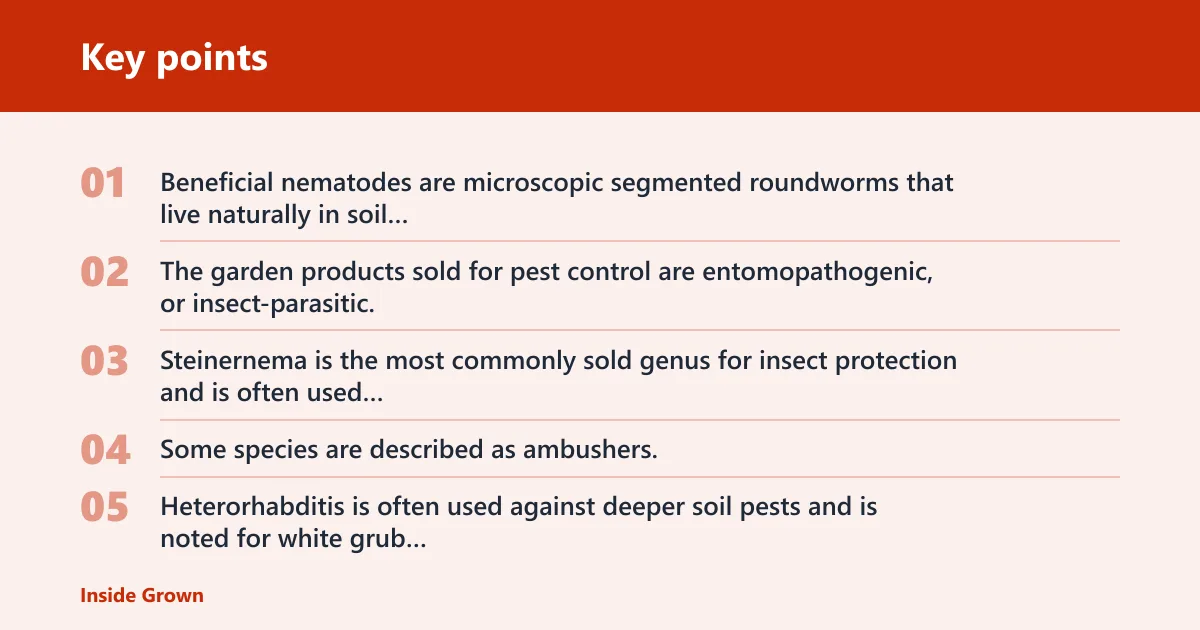


Beneficial nematodes are microscopic segmented roundworms that live naturally in soil around the world. The garden products sold for pest control are entomopathogenic, or insect-parasitic, types that attack soil-dwelling insect pests rather than vegetable plants.
Steinernema and Heterorhabditis
Steinernema is the most commonly sold genus for insect protection and is often used against soil pests. Some species are described as ambushers, meaning they wait near the pest and attack when contact happens. Heterorhabditis is often used against deeper soil pests and is noted for white grub control; these are often described as cruisers because they move through soil searching more actively.
The infective juvenile stage
The active pest-searching stage is commonly described as the infective juvenile, the third juvenile stage. It is also the most resistant stage under stress, which matters because application, storage, and soil conditions can all weaken performance before the nematodes ever reach a pest.
What you’ll need
- A hose-end sprayer, backpack sprayer, or pump sprayer that keeps particles moving.
- Clean water and a measuring container.
- The label directions for the product you bought.
- A way to water the bed immediately after application.
- A refrigerator for storage before use.
- Shade or late-day cloud cover for application timing.
Are beneficial nematodes safe for vegetable gardens?
Beneficial nematodes are generally considered safe for vegetable gardens when the species matches the pest and the soil is moist. They target insects in the soil, not plant tissue, so seedlings, transplants, leafy crops, and root crops are not the target. Safety is still conditional: the soil must be moist, the pest must be in the soil zone, and the product must still be viable.
Plant safety, human safety, and pet safety are different questions
For crops, the key question is whether the nematode species matches a soil pest and whether the pest is in reach. No special PPE or mask is generally needed, and they are commonly considered safe around pets and people. The EPA waived the need for them to be registered for pest management.
What they affect in a garden community
Beneficial nematodes are host-specific enough that they are used against insect pests, not all soil life. That means they are far less likely to affect the wider insect community than broad-spectrum insecticides, but they are still meant to kill insects. If your goal is to protect pollinators, lady beetles, or other above-ground beneficials, keep the application in the soil zone where the pest lives.
Apply them to damp soil in cool weather, mix them exactly as the label directs, and water them in right away. The soil has to give them water-filled gaps to move through, and heat, dry soil, or pooling water can cut down the result. Use them soon after purchase and do not let mixed product sit around.
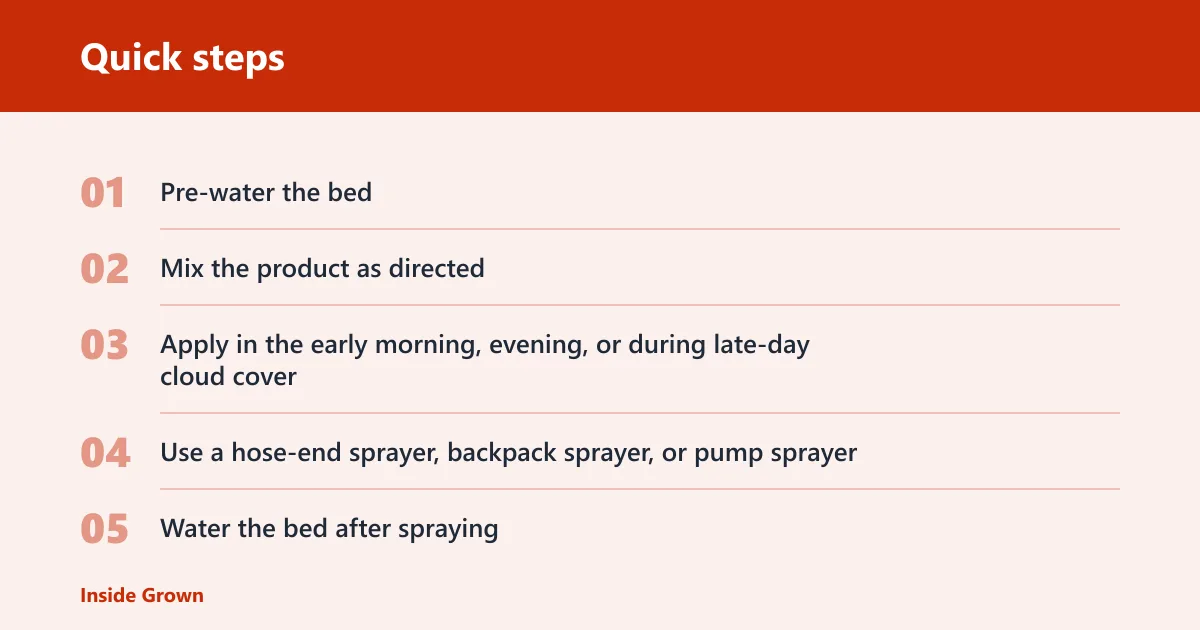
- Pre-water the bed. Moisture should reach the root zone, but stop before standing water forms.
- Mix the product as directed. Keep the solution agitated so the infective juveniles stay suspended.
- Apply in the early morning, evening, or during late-day cloud cover. Avoid temperatures of 90°F and up.
- Use a hose-end sprayer, backpack sprayer, or pump sprayer. Keep the nozzle and lines clear so the product can pass through.
- Water the bed after spraying. This washes nematodes off foliage and into the soil where pests live.
- Check the soil again after application. If the surface dried fast, add about 1/8 inch of water and recheck moisture in the root zone.
Say your raised bed has lettuce seedlings and fungus gnat larvae in the top few inches of damp potting mix. A late-day application can fit well because the pests are near the surface and the soil stays evenly moist. A hot, dry afternoon would work against both movement and survival.
Suppose an in-ground carrot bed has wireworms or other root-feeding larvae, but the soil is compacted clay and dry a finger-width down. Pre-water first and wait until the bed is evenly moist before spraying. Without that step, the nematodes have too little water movement to find the pest.
Vegetable garden nematode safety checklist

| Crop type | Pest type | Soil moisture | Temperature window | Application method | Go/no-go verdict | Failure-recovery note |
|---|---|---|---|---|---|---|
| Raised bed with seedlings | Fungus gnat larvae, soil larvae near roots | Evenly damp, never pooling | Early morning or evening; below 90°F | Backpack sprayer or pump sprayer, then water in | Go | If the top inch dries fast, water lightly and recheck the next day. |
| In-ground root crops | Wireworms, cutworm larvae, grubs | Moist through the root zone | Cool, cloudy light preferred; avoid hot sun | Hose-end sprayer or pump sprayer | Go | If soil is compacted clay, irrigate first and wait for infiltration before applying. |
| Heavily mulched beds | Grubs or larvae under mulch layer | Moist below mulch, not dry crusted soil | Evening preferred | Remove or part mulch briefly, then spray and water in | Go, with prep | If mulch is shallow and dry, pull it back so water reaches the soil, then replace it after watering. |
| Leafy greens just before harvest | Above-ground caterpillars | Moist soil is not the limiting factor | Any cool window | Soil application only | No-go | If the pest is on leaves, choose a different control; nematodes are not a fit for that problem. |
| Any vegetable bed with standing water | Soil pests present or suspected | Pooled | Any | Wait, drain, then apply | No-go | If you overwatered, pause until the surface drains and the soil is damp but not saturated. |
When is the best time to apply beneficial nematodes?
The best time is early morning or evening, and late-day cloud cover is a good fallback when the soil stays cool. Avoid temperatures of 90°F and up. Use refrigerated product before it ages out, and plan to apply it soon after purchase so the infective juveniles stay active.
Storage basics
Most labels and extension guidance keep the storage window short. Refrigerate the product, do not freeze it, and aim to use it within about two weeks to a month. Warm storage shortens viability, and old product can look fine while still having weak pest-finding ability.
Common mistakes
Dry soil is the most common failure point. So are hot-weather applications, chlorine-heavy water, and mixed product that sits too long before spraying. Pooling irrigation can also push nematodes out of the active root zone, while shallow mulch or compacted clay can block even distribution.
- Do not spray into dry soil. Pre-water until the topsoil and root zone are damp.
- Do not apply in heat. Move the job to early morning, evening, or a cloudy window.
- Do not let mixed product sit. Spray promptly after mixing and keep the tank agitated.
- Do not assume every nematode is harmful. Beneficial species are chosen because they attack insect hosts, not vegetables.
- Do not expect help above ground. These products are for soil pests, not leaf pests.
Frequently asked questions
Are nematodes safe for vegetable gardens?
Beneficial nematodes are safe for vegetable gardens under the right conditions, but not as a blanket solution for every bed. They need damp soil, a soil-dwelling insect host, and fresh product. If the pest is on leaves or the bed is dry, choose another control.
How do you apply beneficial nematodes to a garden?
Pre-water the bed, mix the product as the label directs, and spray it with a hose-end sprayer, backpack sprayer, or pump sprayer in cool light. Then water the bed again so the nematodes move into the soil where pests live.
Do beneficial nematodes harm people, pets, or beneficial insects?
No special PPE or mask is needed, and they are considered safe around pets and people. Their target is insect pests in the soil, so the main risk is poor targeting, not toxicity. Keep them in the root zone and away from unnecessary broad-area spraying.
Which pests do beneficial nematodes control in vegetable beds?
They are used against more than 200 soil-dwelling pests, including grubs and other insect larvae that feed below ground. In vegetable beds, that often means white grubs, wireworms, fungus gnat larvae, and similar pests. They do not control above-ground feeders on leaves.
How long do beneficial nematodes last after mixing with water?
Use them promptly after mixing. Once they are in water, they should not sit around while you do other chores, because time, heat, and poor agitation lower viability. A fresh mix and immediate spraying give you the best odds of reaching the pest.
Can you use beneficial nematodes with a hose-end sprayer?
Yes. Hose-end sprayers, backpack sprayers, and pump sprayers are all commonly used, as long as the equipment keeps the suspension moving and the nozzles do not clog. Rinse the sprayer afterward so residue does not dry inside the lines.