Is Fill Dirt Safe for Vegetable Gardens?
Fill dirt is not safe as planting soil in a vegetable bed. Use it only as a buried base layer below the planting zone, and only if it is clean, uncontaminated, and fully capped with clean growing soil. Put it in the wrong place, and you can get poor drainage, shallow roots, nutrient problems, or contamination of edible crops. This guide shows when fill dirt is acceptable, when it is a hard no, and what to use instead for the planting zone.
Is fill dirt safe for vegetable gardens?


Fill dirt is generally not safe as the growing layer in a vegetable garden. It is subsoil-based material with low organic matter, and it may contain rocks, construction debris, or contaminants. In a food bed, that makes it a poor choice for the root zone, even if it looks clean at first glance.
What fill dirt is made
Fill dirt usually comes from lower soil layers, not the biologically active top layer. Because it has little organic matter, it does not feed plants well on its own. It is commonly used for grading, leveling, and backfill, jobs that do not depend on root health or crop quality.
The key difference is simple: fill dirt is for shape and support, while the planting layer is for roots. If you bury fill dirt deep enough that roots never enter it, it may be acceptable as a structural base. If roots grow through it, the bed is no longer a clean food-growing zone.
Why the planting zone is different from the base layer
Vegetable roots need air, water movement, and enough organic matter to move nutrients through the bed. Fill dirt can compact, drain poorly, and limit root spread. That is a bad fit for beds where you want steady growth through the season and repeated harvests over many years.
A common first-timer mistake is to fill a 4-by-8-foot raised bed almost entirely with fill dirt because it is cheaper. The bed may hold its shape, but the crop layer ends up dense, low in nutrients, and hard for roots to penetrate.
When fill dirt is acceptable below grade
Fill dirt may be acceptable below the planting zone in some limited cases. Use it for low spots, berm bases, grading, or the lower portion of an in-ground bed when you plan to cap it with clean growing soil. Keep it buried, screened if possible, and separated from the root zone. Leave enough clean soil above it to account for settling, and refresh the cap if the bed sinks or the fill shifts so roots do not reach the buried layer.
Vegetable bed decision table
| Use case | Safe material | Unsafe material | Contamination risk | Recommended replacement mix |
|---|---|---|---|---|
| Raised beds | Screened topsoil plus compost and an aeration material | Fill dirt in the root zone | High if imported soil source is unknown | Topsoil, compost, and a drainage ingredient mixed for the full planting depth |
| In-ground beds | Native soil amended with compost, or imported screened topsoil on top | Construction fill or debris-laden backfill | Medium to high if the site has old paint, rubble, or chemical residue | Tested native soil with compost worked into the top layer, or a clean topsoil cap |
| Low spots | Clean fill dirt below grade, capped with growing soil | Fill dirt exposed in the planting zone | Medium if the fill source is not verified | Fill dirt as a buried base, then screened topsoil above it |
| Garden leveling | Fill dirt for contour correction only | Anything mixed into beds meant for edible roots | Medium to high if the source is mixed waste | Use fill dirt for shaping, then install a clean growing layer separately |
When fill dirt is a hard no
Fill dirt is generally not a good choice anywhere roots are expected to grow through it, especially when the source history is unclear. That includes raised bed planting zones, in-ground vegetable rows, and any bed that may contain construction debris or chemical residue. If you would eat the crop, the growing layer should not be guesswork.
Unknown source material
Unknown fill is the biggest problem. A load can include rocks, wood fragments, broken concrete, asphalt bits, or residues from past site use. If you cannot verify where it came from, do not use it in the root zone of an edible bed.
Suppose a homeowner gets a truckload from a cleanup project and spreads it into a new tomato bed because it looks dark enough. Even small amounts of rubble or contaminated dust can stay in the bed for years, especially in the top layer where roots and harvestable crops interact with the soil.
Construction debris and chemical residue risk
Soil contamination can include heavy metals such as lead, plus construction waste and chemical residues. Old painted surfaces, treated materials, and mixed-site excavation can leave behind material that does not belong near food crops. The danger is not always visible, which is why source history matters.
Why edible roots need cleaner soil
Carrots, beets, onions, and potatoes grow through the full depth of the bed. If that zone contains gravel, trash, or contaminants, the crop quality and food safety can suffer. Even shallow-rooted crops still benefit from clean soil, because the top layer is where most feeding roots spread.
Is topsoil safe for vegetable gardens?
Topsoil can be safer than fill dirt for vegetable gardens, but it is not automatically safe. Screened, source-verified topsoil is often a better starting point for edible beds because it typically has more organic matter and fewer large debris pieces. Unscreened or unknown topsoil still needs caution and, in some cases, testing.
Topsoil versus fill dirt
Topsoil is the upper soil layer. It usually contains more organic matter than fill dirt, which makes it more suitable for plant growth. Fill dirt is built for shaping and support; topsoil is the material you build around when you want roots, moisture, and nutrients to work together.
Screened versus unscreened topsoil
Screening or sieving removes rocks and debris and helps standardize particle size. Screened topsoil is easier to work into beds and less likely to leave voids around roots. Unscreened material may still be usable, but it is more variable and may need extra checking before you plant food crops.
What source quality means
Source quality means knowing where the soil came from and whether it was handled cleanly. Even good-looking topsoil can vary from one supplier or site to another. If the source is unclear, treat the material as unverified until you inspect it and, when needed, test it.
What to fill a vegetable bed
For edible beds, use a raised bed soil mix made from topsoil, compost, and an aeration material. This gives you a planting layer that supports drainage, fertility, and root growth. Do not use fill dirt as the main ingredient in the top layer of a vegetable bed.
A basic raised bed soil mix
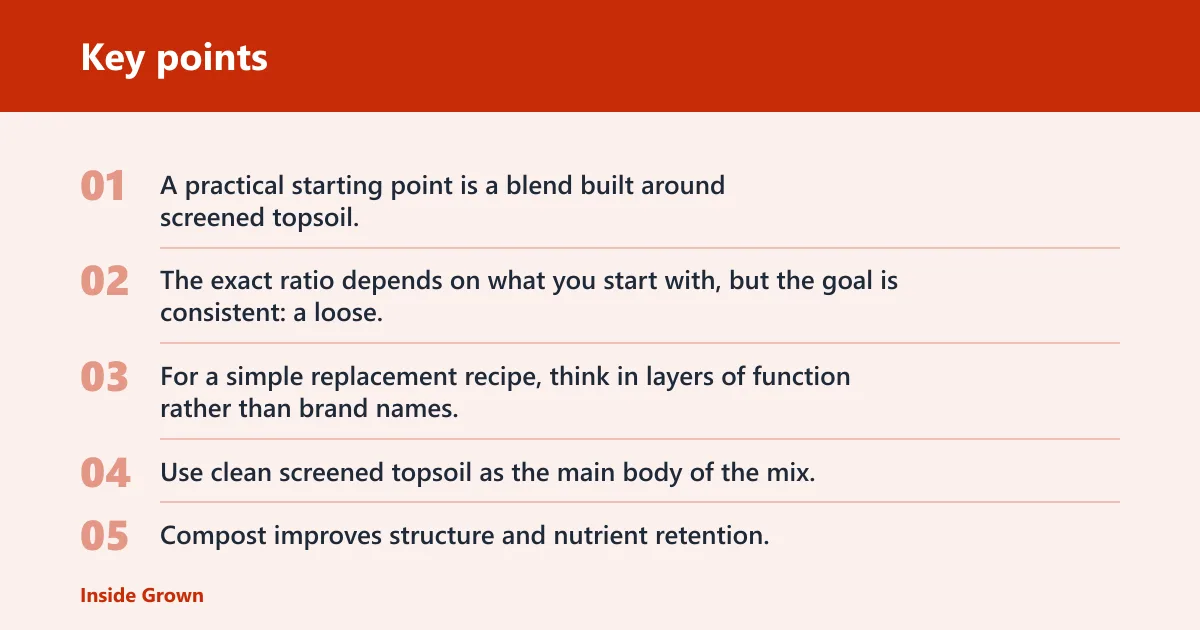
A practical starting point is a blend built around screened topsoil, with compost added for organic matter and a drainage ingredient for air space. The exact ratio depends on what you start with, but the goal is consistent: a loose, fertile mix that does not compact into a hard mass.
For a simple replacement recipe, think in layers of function rather than brand names. Use clean screened topsoil as the main body of the mix, add compost for nutrient retention and structure, and include an aeration ingredient such as perlite, pumice, or rice hulls to help keep pore space open.
How compost fits into the mix
Compost improves structure and nutrient retention, but it is usually mixed into topsoil rather than used alone. Pure compost can be too rich, too light, or too moisture-holding for some beds. Blended with topsoil, it helps feed plants and supports better soil texture over time.
When to add aeration material
Use an aeration material when your soil stays wet, packs down, or lacks pore space. Sand can improve drainage in some soils, but it should not be added blindly to clay. Texture balance matters. The wrong addition can make a dense soil even harder to work.
How to check imported soil
Imported soil should be inspected before it goes into a food bed. Look for weeds, rocks, and debris, then use screening or sieving if the material seems coarse or mixed. If the soil source is unclear, a soil test is worth the time before you plant edible crops.
- Spread a sample of the material on a clean surface.
- Check for glass, wire, plastic, treated wood, asphalt, and concrete pieces.
- Break apart clods and look for odd colors, odors, or oily residue.
- Screen or sieve the material if you need a finer planting mix.
- Test the soil before growing food if the source history is uncertain.
When a soil test is worth doing
A soil test helps check pH and contaminants and can guide amendment choices for vegetable crops, but standard fertility tests often do not include heavy metals unless you order that analysis specifically. It is especially useful when soil comes from an unknown site, a former construction area, or a property with old paint or dumped material. If there is any doubt, test before planting food.
How to reduce contamination risk
Reduce risk by starting with a known source, using clean imported soil only where needed, and keeping suspect material out of the grow zone. For edible beds, source history matters as much as texture. If you cannot verify where the soil came from, do not trust it with the root zone.
Lead and other heavy metals
Lead is one of the main concerns in old garden soil, especially near older buildings, roads, or renovation sites. Other heavy metals can also be an issue. A soil test is the practical way to check for contamination when the site history raises questions.
Source history before planting food
Ask where the soil came from, what was on the land before, and whether the material has been screened. If the answer is vague, treat it as a warning sign. Clean gardening soil is easier to manage than a bed you later have to excavate and replace.
Testing before edible planting
Test before you plant if the bed is new, the fill source is unknown, or the site may have old paint, fuel, treated lumber, or demolition debris nearby. A soil test does not solve every problem, but it gives you a much better basis for deciding whether to grow food there.
Frequently asked questions
Is topsoil good for vegetable gardens?
Yes, if it is clean and suitable for planting. Topsoil has more organic matter than fill dirt and works well as the base of a vegetable bed when blended with compost and, when needed, an aeration ingredient. For edible beds, verify the source first.
What to fill vegetable garden bed with?
Fill a vegetable bed with screened topsoil, compost, and an aeration material that suits the soil texture. Keep fill dirt out of the planting layer. If you need a buried base for leveling, use clean fill below the grow zone, then cap it with fertile soil.
Can I use fill dirt in a raised vegetable bed?
Only as a buried sub-base, never as the root zone. In a raised bed, the top layer should be a clean growing mix with topsoil, compost, and good drainage. If fill dirt reaches the planting depth, it can limit roots and add contamination risk.
How do I know if garden soil is contaminated?
Look for warning signs such as debris, odd odors, construction rubble, oily residue, or a site history that includes old buildings or dumping. Those signs do not prove contamination, but they justify a soil test. Testing is the reliable way to check pH and contaminants before you grow food.