How Roots Absorb Water and Nutrients
Roots take in water by osmosis through root hairs, while mineral ions often enter by active transport and, for some ions, through channels down electrochemical gradients. The endodermis and Casparian strip help control what reaches the xylem. If this system fails, plants wilt, run short of minerals, and grow poorly. This guide explains each step, including mycorrhizae, in plain language.
What happens at the root surface?
The root system does two jobs at once: it anchors the plant and takes up water and mineral salts from the soil. Much of that intake starts near the root tips, where branches spread into a dense network and thousands of root hairs sit just behind the tips. In basic botany, this is the first step in moving resources from soil water into the plant body.
Those root hairs matter because they add a lot of absorbent surface area. They reach into thin films of soil water where dissolved mineral ions are available, so they give the root more contact with the soil solution than the smooth root surface alone.
Soil water and the first contact point
Water and nutrients do not enter as a solid mass of “soil.” They enter from soil water, which carries dissolved substances. That means the root can only absorb minerals that are already in soluble form. In plant physiology, the relevant dissolved particles are ions in the soil solution, not intact soil particles.
A common first-timer mistake is to water a pot well but still see slow growth. If the potting mix is compacted or the root hairs are damaged, the soil may hold less air and offer less working surface for uptake, so the plant still struggles even when moisture is present. That example is illustrative rather than proof of a single cause; poor aeration, weak root growth, and low nutrient availability can overlap.
How does water enter roots?
Water enters root cells by osmosis, movement across a membrane from a region with more water to a region with less free water. Inside root cells, dissolved substances create that concentration difference, so water moves in without the plant having to pump it. This is standard plant physiology: water moves passively down a water potential gradient, while mineral uptake may require energy.
This is not the same as mineral uptake. Water moves because of a concentration difference. Minerals usually need a different process, because ions do not simply drift into cells in useful amounts.
From soil solution to cortex
After water crosses a root hair, it can move through the cortex, the living tissue between the outside of the root and the central vascular region. The cortex acts as a passage zone before water reaches the stele and the xylem. Botanists commonly describe two major inward routes here: the apoplast pathway through cell walls and the symplast pathway through cytoplasm connected by plasmodesmata.
Picture a container plant in dry indoor air. The top layer of mix dries quickly, root hairs near the rim lose contact with water, and uptake drops even though the center of the pot still feels damp. This example is only illustrative; the key point is that when soil water becomes patchy, root-hair contact is reduced and osmosis slows.
How do roots take up mineral ions?
Mineral ions enter root hairs mainly by active transport. This process uses energy from sugars made in photosynthesis to move ions into the root against their natural gradient, which is why mineral uptake is more than passive soaking. Root membranes are selective transport surfaces that use pumps and carriers to accumulate ions efficiently.
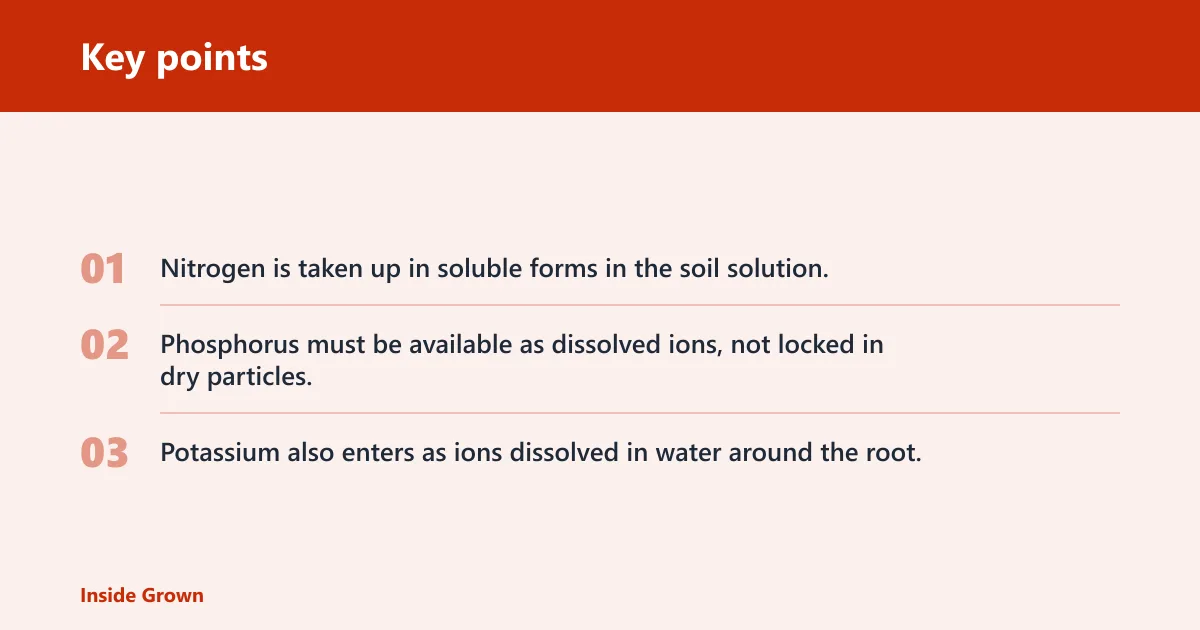
Plants need soluble mineral ions, not solid particles. Nitrogen, phosphorus, and potassium are three key soil nutrients, and roots absorb them in ion form when they are dissolved in soil water. For example, nitrogen is commonly taken up as nitrate and ammonium, phosphorus as phosphate, and potassium as K+.
Why plants need energy for this step
Active transport lets roots pull in ions even when the soil solution is dilute. That helps explain why a plant can still show nutrient deficiency in apparently moist soil: water may be present, but the needed ions may be scarce, locked away, or blocked by poor root function. In the literature, this is a classic distinction between passive water movement and metabolically driven nutrient uptake.
Root hairs are a major uptake zone for this process. Damage to root hairs reduces water and dissolved nutrient uptake, so transplant shock, root pruning, or repeated drying can quickly show up as slowed growth and pale leaves.
Minerals in usable form
Plants can use minerals only when they are dissolved in water. In practice, that means the nutrients must be present as soluble ions in the soil solution before the root can absorb them. The usable form is chemical, not simply physical: roots take up ions, not whole pieces of fertilizer granules or rock fragments.
- Nitrogen is taken up in soluble forms in the soil solution.
- Phosphorus must be available as dissolved ions, not locked in dry particles.
- Potassium also enters as ions dissolved in water around the root.
What does the endodermis control?
The endodermis surrounds the stele and helps control entry into the vascular tissue. It does not let everything pass freely. Instead, it forces water and dissolved substances to cross living cells before they can enter the xylem. Botany references describe this as a central checkpoint for selective uptake, because the endodermis limits uncontrolled flow from cortex to stele.
This control point matters because the root is not an open pipe. It is a selective intake system, and the endodermis is where the plant checks what gets through.
Casparian strips as a barrier
Casparian strips are hydrophobic barriers in the endodermis. They seal the gaps between endodermal cells, so water and solutes cannot simply slip between cells and bypass the control layer. This barrier is widely described in plant anatomy texts as lignin- and suberin-rich, which blocks apoplastic flow around the cells.
That means the route into the xylem is filtered. Water and dissolved ions must pass through cell membranes, where the plant can regulate what enters the vascular system and limit unwanted substances.
Why the path through cells matters
That forced route helps explain why root function is selective rather than passive. If the endodermis is damaged or bypassed, the plant loses part of its filtering control, and the balance of water and minerals reaching the shoot can change. In other words, the Casparian strip shifts movement from the apoplast to the symplast at a critical point.
From there, the xylem carries water and dissolved nutrients from roots to shoots. Xylem transport is driven largely by transpiration pull and cohesion of water molecules, with dissolved mineral ions moving upward in the transpiration stream.
How do mycorrhizae help roots?
Mycorrhizae are symbiotic fungi that are commonly associated with roots. They extend the absorptive reach of the root system, which helps plants take up mineral nutrients more efficiently, especially in poor soils. This is a well-established mutualism in plant science literature: fungal hyphae explore fine soil pores and increase the volume of soil from which nutrients can be gathered.
They are helpful partners, not a replacement for roots. The plant still depends on its own root hairs, endodermis, and xylem pathway, but fungal threads can explore tiny soil spaces that roots alone may miss.
Why they matter in poor soils
In low-fertility ground, fungal partners can improve access to mineral ions that are otherwise hard to reach. That is especially useful when phosphorus is limited or when soil structure makes diffusion and root contact less effective. Mycorrhizae are especially important for phosphorus uptake, because phosphate moves slowly through soil and can be depleted around the root surface.
Say a tomato grows in a tired container mix with little available phosphorus. If mycorrhizal fungi are present, the plant may absorb nutrients more efficiently than a nearby plant without that fungal partnership, even though both still depend on dissolved ions. That example illustrates a known mechanism; it is not a substitute for actual soil testing or diagnosis.
How do nonvascular plants take up water?
How this differs from typical roots
In vascular plants, root hairs, cortex, endodermis, and xylem create a directed intake system. In nonvascular plants, there is no comparable internal transport network moving water and dissolved nutrients from roots to shoots, because the structure is different from the start.
That difference is why soil quality, root damage, and drought matter more in rooted vascular plants. Their whole absorption chain depends on intact root tips, active root hairs, and a working vascular pathway.
What enters the root, where it moves, and what can block it
| Step | Structure | Mechanism | Pathway | What is absorbed | Nutrient examples by ion form | Common failure point | Failure symptoms |
|---|---|---|---|---|---|---|---|
| 1 | Root hairs | Large surface area increases contact with soil water | Apoplast and symplast begin here at the root surface | Water and dissolved mineral ions first enter from the soil solution | Nitrate (NO3–), ammonium (NH4+), potassium (K+), phosphate (H2PO4–/HPO42-) | Root-hair damage, drying, transplant shock | Wilt, slowed growth, pale foliage, patchy uptake |
| 2 | Cortex | Water and solutes move inward through living root tissue | Apoplast moves through cell walls; symplast moves through living cells | Water continues inward toward the center of the root | All dissolved ions carried in soil solution | Compacted soil reduces oxygen and limits new root growth | Stunted roots, weak top growth, poor vigor |
| 3 | Endodermis / Casparian strip | Hydrophobic barrier blocks gaps between cells and forces passage through cells | Apoplastic flow is blocked; symplastic control is enforced | Only regulated water and solutes reach the stele | Selective uptake of nitrate, ammonium, phosphate, potassium, and other ions | Bypass is prevented; damage reduces control over entry | Imbalanced mineral delivery, irregular shoot growth, stress sensitivity |
| 4 | Xylem | Conducting tissue moves water upward from roots to shoots | Bulk flow upward through vascular tissue | Water and dissolved nutrients move into the shoot | Nitrate, ammonium, phosphate, potassium and micronutrients in transpiration stream | Low uptake upstream means less supply to leaves and stems | Leaf scorch, chlorosis, weak stems, slow expansion |
| 5 | Compacted soil, root damage, drought | Limits root contact, root growth, and available soil water | Both pathways are restricted by poor access to the soil solution | Uptake of both water and minerals falls | Reduced availability of all ions in the soil solution | Dry mix, root pruning, dense soil, wilt and pale growth | Wilting despite watering, nutrient deficiency symptoms, root decline |
Step-by-step flow you can picture
- Soil water holds dissolved mineral ions.
- Root hairs just behind the tip contact that soil solution.
- Water enters root cells by osmosis.
- Mineral ions enter root hairs by active transport.
- Water and solutes move through the cortex.
- The endodermis and Casparian strip regulate what passes into the stele.
- The xylem carries water and dissolved nutrients upward to the shoot.
When uptake goes wrong
Compacted soil cuts down pore space, so roots get less oxygen and less room to expand. Root-hair damage removes the main absorption zone. Drought lowers the soil water needed for osmosis and makes dissolved ions less available.
Those three problems often show up together in containers and in dry garden beds. A plant may look hungry, but the first issue is often a broken intake system rather than a lack of fertilizer alone. These are common failure modes, not the only causes of poor growth.
Frequently asked questions
How do roots absorb water and nutrients from the soil?
Roots absorb water through root hairs by osmosis and take up mineral ions mainly by active transport. The absorbed water and dissolved nutrients move through the cortex, pass the endodermis, and enter the xylem, which carries them upward to the shoot.
Why do root hairs help plants absorb water and nutrients?
Root hairs increase surface area and sit just behind the root tips, where new growth meets the soil first. That extra surface gives the root more contact with soil water and dissolved mineral ions, so uptake is faster and more efficient.
What is osmosis in roots?
Osmosis in roots is the movement of water into root cells across a membrane. Dissolved substances inside the cells create a concentration difference, and that difference pulls water inward from the soil solution without the plant needing to spend energy on the water itself.
What is active transport in plant roots?
Active transport is the energy-requiring movement of mineral ions into root hairs. The plant uses sugars made in photosynthesis to power that movement, which lets roots absorb nutrients even when the soil solution is dilute or the ions need to move against a gradient.
How do mycorrhizal fungi help roots absorb nutrients?
Mycorrhizal fungi live with roots and extend the absorptive reach of the root system. They help roots take up mineral nutrients more efficiently, especially in poor soils, but they do not replace the root hairs, endodermis, or xylem pathway.
How do nonvascular plants absorb water and nutrients?
Nonvascular plants do not have true roots or the same internal transport system as vascular plants. They absorb water across their surfaces and rely on short-distance movement within the plant, so their uptake differs from the root-hair-to-xylem route used by vascular plants.