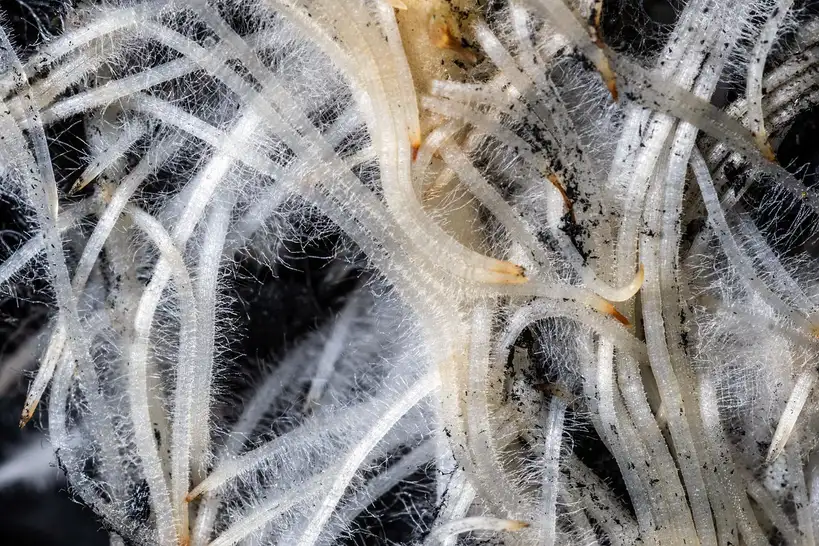
Root Hairs: Small Structures with a Big Job
Root hairs are tiny, single-cell projections on young roots that absorb most water and minerals, especially from the top few centimeters of soil. If they dry out, get crushed by compaction, or face low nutrients, plants struggle to drink and feed. This guide explains where root hairs are found, how they work, and why dry, compacted, or poor soil stops them from doing their job.
What are root hairs?
Root hairs are single-celled outgrowths from the root epidermis, the outer cell layer of the root. They appear on young roots and give the root a much larger absorbing surface. Because they are tiny and numerous, they act like the plant’s intake points for water and dissolved mineral ions. (Wikipedia)
They are not a separate organ. Each one is a thin extension of one epidermal cell, formed on the part of the root that handles absorption. That makes them different from the thicker tissues inside the root, which support, move, and store materials.
Where are root hairs found on a root?
Root hairs usually form in the root hair zone, also called the maturation zone. This zone is generally behind the root elongation zone rather than at the very tip. The root tip keeps pushing forward while new root hair cells appear a little farther back, where the root surface is ready for absorption.
The root cap is at the very tip of the root and protects the growing end as it moves through soil. Behind that is the root meristem, where cells divide rapidly to make new root tissue. Root hairs belong to neither of those parts; they develop farther back, in the zone where cells finish expanding and start specializing.
That difference matters. If a gardener pictures the tip as the main absorbing region, the picture is incomplete. The tip is built for growth and protection. The maturation zone is where the plant gets most of its intake surface.
How do root hairs help plants grow?
Root hairs help plants grow by increasing surface area, which drives absorption. More surface area means more contact with soil water and more chances to take up dissolved mineral ions. Without those thin extensions, the root would have far less area touching the soil solution.
Water enters root cells by osmosis, the movement of water from soil into root tissue across a membrane when moist soil stays in close contact. Dry soil breaks that contact. Compacted soil can do the same by squeezing out pore spaces that normally hold water and air.
Mineral ions such as nitrate, phosphate, potassium, and magnesium are taken up from the soil solution. Some can move with concentration gradients, while many are absorbed with the help of transport proteins in root cell membranes. Root hairs matter here because they place those transport systems right where the soil solution is available.
Say your seedling is growing in loose potting mix but the top layer dries between waterings. The plant may still look green for a while, yet the newest leaves slow down because root hairs in the dry layer cannot maintain the moist contact needed for water uptake.
Why surface area matters
A larger surface area gives the root more points of contact with the soil. Root hairs greatly increase absorptive area without making the root thick and bulky. That design lets a young root explore a small volume of soil efficiently while the plant keeps growing into new ground.
Do root hairs absorb water or nutrients?
They absorb both. Water moves into root cells by osmosis, and mineral ions move in through membrane transport processes. The plant depends on both flows at once, because water carries dissolved nutrients through the soil solution and into the root system.
How is a root hair specialised?
A root hair is specialised by being very thin, very short-lived, and made from a single epidermal cell. That shape gives the plant a huge exchange surface with little building cost. Its job is local and temporary, so the structure stays delicate instead of becoming thick or woody.
The root epidermis supports that job by producing the hairs and protecting the underlying tissues. Because the epidermis is the outer layer, it is the first tissue to meet the soil solution. In the maturation zone, some epidermal cells extend into root hairs while others remain regular surface cells.
Why being tiny and thin helps absorption
Thin cells have a high surface-to-volume ratio, which favors exchange with the environment. A root hair can sit between soil particles and contact water films that a thicker root could miss. That is why many plants rely on thousands of these tiny extensions rather than one larger absorbing surface.
Why root hairs are delicate and short-lived
Root hairs are short-lived because they are tied to young tissue. As the root keeps growing, old hair-bearing cells age, drop off, or stop functioning, and new hairs form farther back in the maturation zone. That constant replacement is normal, not a sign of failure.
Because they are fragile, root hairs can be damaged by drying, crushing, salt stress, or sudden changes after transplanting. Once damaged, they do not keep working as if nothing happened. The plant often needs time to rebuild new hair-bearing zones on fresh root growth.
When root hairs struggle
Root hairs fail when the soil stops giving them the water, air, or nutrient conditions they need. The result is not abstract. It shows up as wilting, slow growth, pale leaves, or a plant that does not respond well to fertilizer. This table links the soil problem to the likely symptom and fix.
| Soil condition | What happens to root hairs | Visible plant symptoms | Most likely correction |
|---|---|---|---|
| Dry soil | Soil particles stop making close contact with root hairs, so water uptake drops fast. | Leaves droop, growth slows, and new shoots may look limp in the heat of the day. | Water deeply and evenly so moisture reaches the root hair zone. |
| Compacted soil | Dense soil crushes root hairs and leaves too little pore space for water and air movement. | Stunting, weak roots, and patchy chlorosis are common. | Loosen compacted soil and add organic matter where appropriate. |
| Overwatering or low oxygen | Roots sit in oxygen-poor conditions, and root hairs lose normal function or die back. | Yellowing leaves, slow growth, and a weak, tired look even when soil is wet. | Improve drainage and let the root zone dry slightly between waterings. |
| Transplant shock | Root hairs are torn, exposed to air, or lost during moving and replanting. | Temporary wilting and slowed top growth after transplanting. | Water in well, shade briefly if needed, and avoid disturbing the root ball more than necessary. |
| Salt build-up | High salt levels pull water away from root hairs and can injure their cells. | Leaf edge scorch, dry-looking tips, and stunting. | Flush excess salts with clean water and reduce overfertilizing. |
| Low-fertility soil | Root hairs may be present, but there are too few available mineral ions in the soil solution. | Pale leaves, weak growth, and poor response to feeding. | Use a balanced fertilizer or improve the soil with compost and other suitable amendments. |
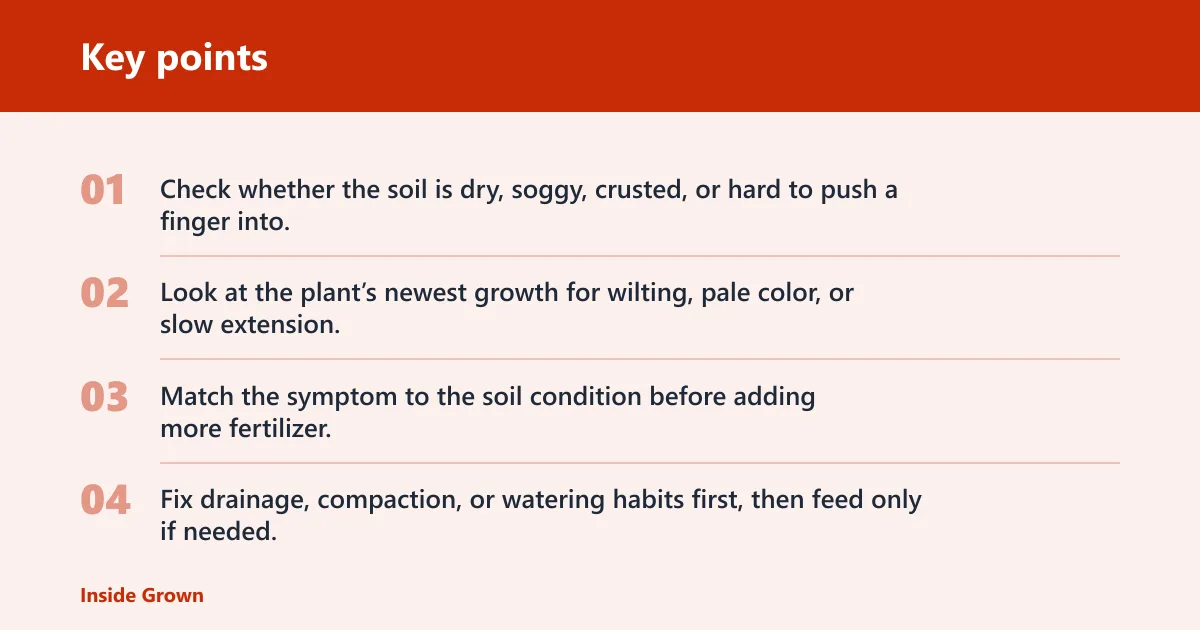
- Check whether the soil is dry, soggy, crusted, or hard to push a finger into.
- Look at the plant’s newest growth for wilting, pale color, or slow extension.
- Match the symptom to the soil condition before adding more fertilizer.
- Fix drainage, compaction, or watering habits first, then feed only if needed.
Suppose a tomato in a container turns pale and stops growing after a week of heavy rain. The soil is wet but airless, so the root hair zone cannot exchange water and minerals normally. In that case, more fertilizer usually adds stress instead of helping.
What happens if root hairs are damaged?
Damaged root hairs reduce the plant’s intake area, so water and mineral uptake fall quickly. Above ground, that often shows up as wilting, slowed growth, smaller leaves, or pale foliage. If the damage is severe, the plant may look underfed even when the soil contains enough nutrients.
Fertilizer may seem ineffective because the roots cannot absorb minerals well enough to use it. That is common after compaction, drought, transplanting, or salt stress. The correction is not always more feed; it is often better soil moisture, better aeration, or less salt pressure.
New root hairs can recover if the root tip keeps growing and the soil conditions improve. Fresh root growth will produce new hairs in the maturation zone. The plant’s recovery depends on whether the root system can keep extending into workable soil.
Frequently asked questions
What is a hair root?
People sometimes say “hair root” when they mean root hairs, but the term can be confusing. Root hairs are the tiny projections on roots, not a separate root part or the root tip itself. The better term is root hair, which avoids mixing it up with other root tissues.
Why do plants have root hairs?
Plants have root hairs to absorb more water and mineral ions than a smooth root surface could manage. The extra surface area is especially useful in the topsoil, where many nutrients and much of the available water are found. That intake supports growth, leaf production, and overall plant function.
Are root hairs the same as root tips?
No. Root hairs are not the root tip, the root cap, or the root meristem. The root tip is the growing end, the root cap protects that end, and the meristem makes new cells. Root hairs appear farther back, in the maturation zone behind the elongation zone.
How long do root hairs live?
Root hairs are short-lived. They last only while the root segment that bears them remains active, and they are replaced as the root grows onward. Because of that lifecycle, healthy plants keep producing fresh root hair zones instead of relying on one permanent set.