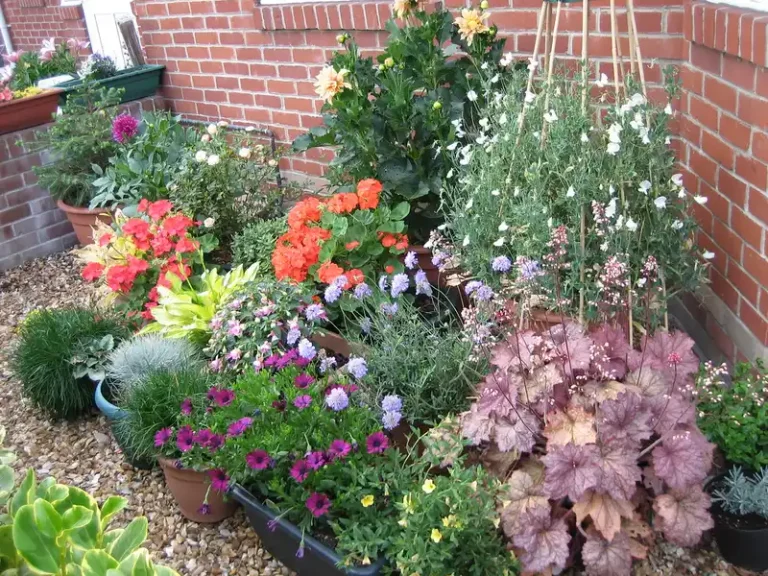
How minerals from soil support plant growth: what they do
Soil minerals feed plants by releasing potassium, calcium, magnesium, sulfur, and trace metals as rocks weather. If a plant already lacks one of those nutrients, that release is usually too slow to correct the problem. Miss that timing, and leaves yellow, roots stall, and yields drop. This guide shows which minerals supply which nutrients, how fast they become available, and when you need a faster fix.
This guide is part of our Plant physiology basics series.
What minerals do plants need from soil?
Plants need a specific set of essential elements to finish their life cycle. Three come from air and water: carbon, hydrogen, and oxygen. The other elements usually come mainly from soil or soil-derived minerals, and they include the macronutrients, secondary nutrients, and micronutrients that support growth, flowering, and seed set.
The 17 essential elements
The macronutrients are generally nitrogen, phosphorus, and potassium. Plants need these in larger amounts. Secondary nutrients are generally calcium, magnesium, and sulfur. Micronutrients include boron, chlorine, copper, iron, manganese, molybdenum, nickel, and zinc.
That split matters because soil minerals do not feed plants the same way. Some release ions directly as they weather. Others act as storage pools that let nutrients out slowly. Quartz, for example, is common in the Earth’s crust, but it is not a useful nutrient source for garden plants.
What each group does
Nitrogen drives chlorophyll production and supports leaves, stems and branches. Phosphorus supports root growth, flower development and fruit set. Potassium helps CO2 absorption and feeds developing plants. Calcium helps move nutrients from roots and build strong cell walls. Magnesium helps activate growth stages and supports photosynthesis. Boron helps plants absorb calcium and form cell walls.
📊 Plants require 17 essential elements for growth. Source: The Role of Rocks & Minerals in Plant Growth.
How do soil minerals become plant-available?
Soil minerals become plant-available through weathering, which breaks rocks into forms roots can absorb. Physical weathering fractures particles. Biological weathering uses roots, microbes, and organic acids to speed dissolution. Heat, freeze-thaw cycles, rainfall, acidity, and time all shape how much nutrient is released and how fast it happens.
Why release is slow
Weathering happens at the mineral surface. A coarse rock fragment has little surface area compared with finely ground material, so it usually releases nutrients more slowly. Climate matters too. Warm, wet conditions usually speed chemical weathering. Cold or dry soils usually slow it down.
Soil texture changes the result. Sandy soil drains quickly and often stores fewer nutrient ions. Clay soil can hold more ions on particle surfaces and swap them back into soil water as roots take them up. Microbial activity also matters because microbes can shift acidity and help break down mineral surfaces.
What pH changes
Soil pH can make a mineral-rich soil act nutrient-poor. Iron, manganese, zinc, and copper often become less available at higher pH, even when the soil contains them. Calcium and magnesium from carbonates may be abundant in alkaline soil, but iron deficiency can still appear because the plant cannot access enough usable iron.
Which common minerals release which nutrients?
Common rock-forming minerals release different nutrients at different speeds. Feldspar can supply potassium, calcium, copper and manganese. Micas also provide magnesium, iron, zinc, nickel and copper. Clay minerals can retain and release potassium, magnesium, iron, and calcium. Carbonates provide calcium and magnesium and store those elements.
How to think about these minerals
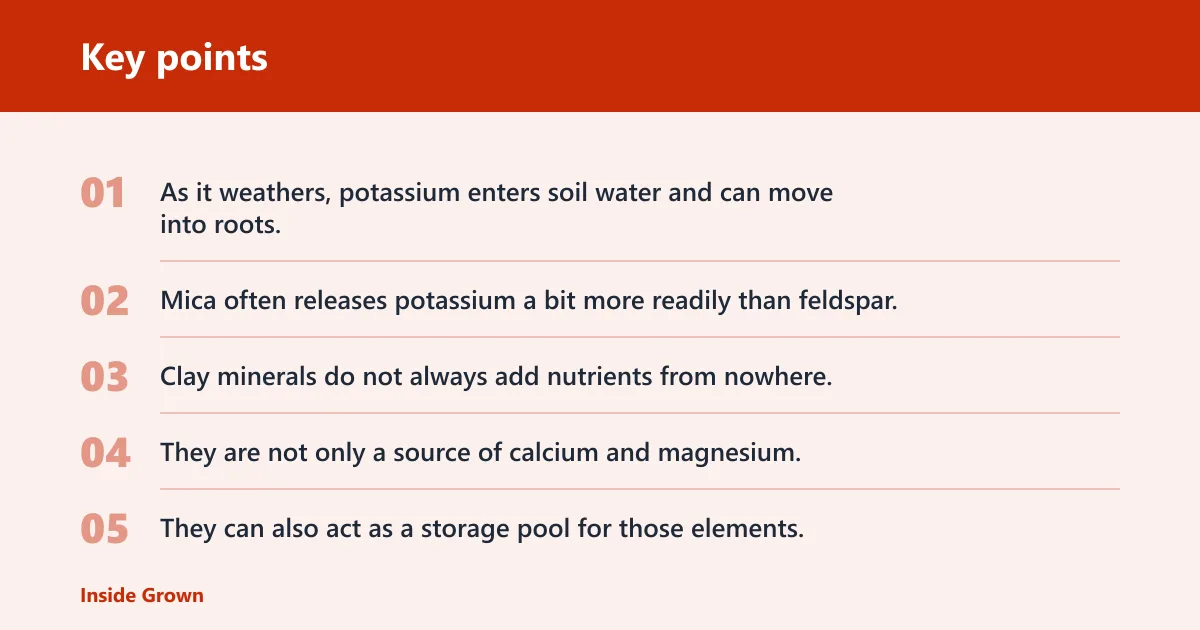
Feldspar is a slow potassium source. As it weathers, potassium enters soil water and can move into roots. Mica often releases potassium a bit more readily than feldspar, depending on the specific mica type and how weathered it already is. Clay minerals do not always add nutrients from nowhere, but they help hold them in the root zone.
Carbonates are different. They are not only a source of calcium and magnesium. They can also act as a storage pool for those elements, which means they may buffer shortages in some soils and create high-pH conditions in others. That is why a carbonate-rich soil can still need iron management.
Basalt and other rock-derived amendments
Basalt and similar rock-derived amendments can add nutrients slowly to soil. They fit long-term mineral input, not a quick correction. Their effect depends on grind size, soil moisture, acidity, and the biology around the roots. They are not fast fixes for visible deficiency.
| Common mineral | Nutrients released | Likely release speed | Common deficiency signs when those nutrients are lacking |
|---|---|---|---|
| Feldspar | Potassium, calcium, copper, manganese | Slow | Weak growth, scorched leaf edges, poor flowering, chlorosis on older leaves |
| Mica | Potassium, magnesium, iron, zinc, nickel, copper | Slow to moderate, depending on weathering | Yellowing leaves, low chlorophyll formation, stunted growth, weak stems |
| Clay minerals | Potassium, magnesium, iron, calcium | Moderate storage and release | Patchy yellowing, slow growth, poor fruiting, calcium-related tip damage |
| Carbonates | Calcium, magnesium | Moderate to slow, but often persistent | Blossom-end rot risk, weak new growth, leaf distortion, magnesium chlorosis |
| Basalt or rock dust | Mixed trace nutrients, with some potassium, calcium, magnesium, and micronutrients depending on source | Slow | General poor growth over time, but usually not a fast visible fix |
Use that table as a timing guide, not a promise. A mineral can contain the right element and still fail to correct a problem quickly if the particles are large, the soil is dry, or the pH blocks uptake.
Why do some soils supply nutrients faster than others?

Some soils supply nutrients faster because they store and exchange ions more effectively. Clay particles and organic matter carry electrical charges that hold nutrient cations such as potassium, calcium, and magnesium. That storage keeps nutrients near roots instead of letting them wash away.
Cation exchange and storage
Cation exchange is the soil’s swap system. Roots release ions, and soil particles trade stored ions back into solution. Clay minerals matter here because they can retain and release potassium, magnesium, iron, and calcium. Carbonates also matter because they can hold calcium and magnesium as a reserve.
Soil texture shapes that process. A sandy soil usually has less exchange capacity than a loamy or clay-rich soil, so mineral release may be less useful unless the soil is managed carefully. Fine particles also weather differently from coarse fragments because they expose more surface area to water and acids.
How pH changes availability
pH can help or block nutrient availability. In acidic soil, some metals become more available, but calcium and magnesium may leach faster. In alkaline soil, calcium and magnesium may be present yet iron, zinc, and manganese can become harder for plants to absorb. The mineral is there, but the plant cannot use it well enough.
Picture a raised bed with a pH near 8 and yellowing young leaves on tomatoes. Carbonates may be supplying calcium and magnesium, but iron can still be tied up. Adding more limestone would usually make the iron problem worse, not better.
When will minerals not fix a plant problem quickly?
Minerals will not fix a plant problem quickly when the plant needs immediate nutrition, when the soil chemistry blocks uptake, or when the symptom is not from mineral shortage at all. In those cases, fertilizers, pH correction, or pest and water management may matter more than rock-based amendments.
When a fast response matters
If a crop shows severe yellowing, stalled growth, or weak stems during active growth, a soluble fertilizer can supply missing nutrients faster than feldspar, mica, basalt, or rock dust. Soil minerals work on weathering time, not on a rescue schedule. That is the core limit gardeners should remember.
When the problem is not a shortage
Deficiency-like symptoms can come from overwatering, root damage, compacted soil, cold roots, salt injury, or disease. For example, stunted plants in waterlogged soil may have enough nutrients present, but roots cannot absorb them well. Adding more minerals would not correct the main issue.
A common first-timer mistake is spreading rock dust across a pot of basil after yellowing starts, then expecting a change in a few days. If the mix is compacted and alkaline, the mineral release will be slow and uptake may be poor. A quick nutrient source and better drainage usually matter more.
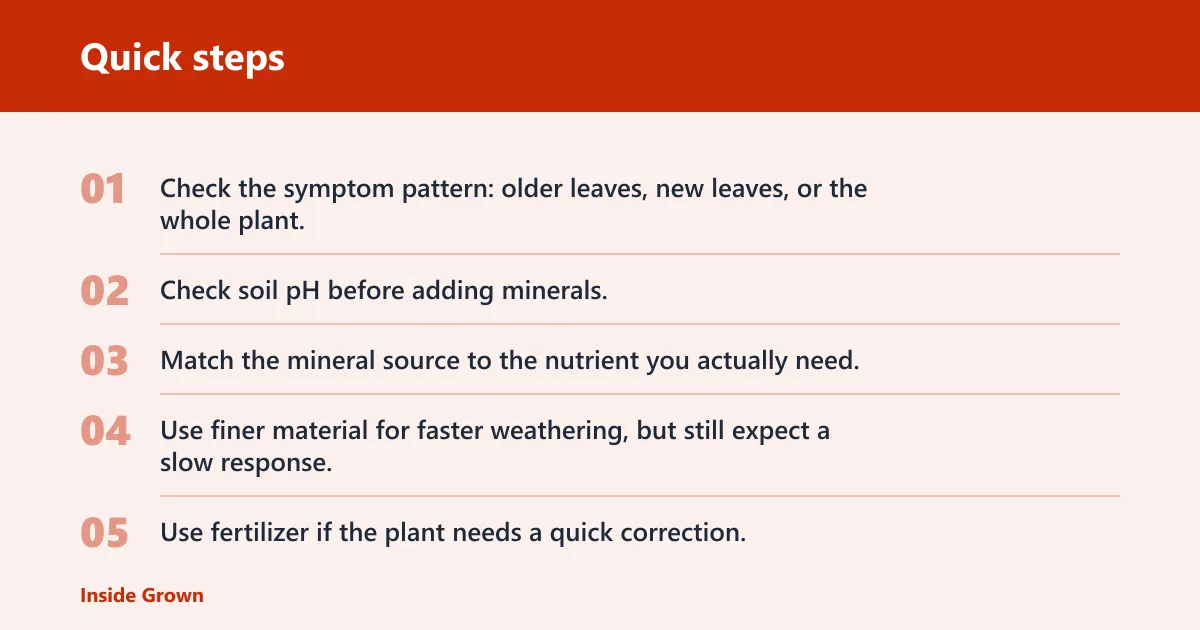
- Check the symptom pattern: older leaves, new leaves, or the whole plant.
- Check soil pH before adding minerals.
- Match the mineral source to the nutrient you actually need.
- Use finer material for faster weathering, but still expect a slow response.
- Use fertilizer if the plant needs a quick correction.
- Recheck soil texture, drainage, and watering before adding more amendment.
How to add minerals to garden soil?
Add minerals to garden soil by matching the amendment to the nutrient need, soil pH, and timeline. Rock-derived materials can support long-term fertility, but they usually act slowly. If you need calcium, magnesium, or potassium fast, a soluble amendment is often the better tool.
Practical steps
Start with a soil test if possible. Then choose the amendment type carefully. Limestone or other carbonate sources can raise pH and supply calcium or magnesium. Feldspar- and mica-bearing rock products may add potassium and some trace nutrients over time. Basalt can add a broad mix of nutrients slowly.
Use minerals as a long-term soil strategy, not a rescue plan. Mix them into the root zone where weathering and root contact can do the most work. Keep in mind that particle size matters: finer material usually weathers faster, but it still does not act like a water-soluble fertilizer.
How to read mineral products
Check what the product actually contains. “Rock dust” is not a nutrient statement by itself. Different rocks start with different mineral mixes, and those mixes change with climate, grind size, and soil pH. The same amendment can work differently in a sandy raised bed and a clay garden bed.
Frequently asked questions
What minerals do plants need to grow?
Plants need 17 essential elements to finish their life cycle. Three come from air and water: carbon, hydrogen, and oxygen. The remaining 14 come mainly from soil or soil-derived minerals and include nitrogen, phosphorus, potassium, calcium, magnesium, sulfur, and several micronutrients.
What minerals does a plant need?
A plant needs macronutrients, secondary nutrients, and micronutrients. The macronutrients are nitrogen, phosphorus, and potassium. Secondary nutrients are calcium, magnesium, and sulfur. Micronutrients include boron, chlorine, copper, iron, manganese, molybdenum, nickel, and zinc, each needed in very small amounts.
What nutrients do plants get from soil?
Soil mainly supplies the 14 essential elements that do not come from air and water. These include nitrogen, phosphorus, potassium, calcium, magnesium, sulfur, and the trace elements plants still need to complete normal growth, flowering, and reproduction. Soil minerals and soil solution both matter here.
How do minerals get into soil for plants?
Minerals enter soil as rocks break down through weathering. Water, roots, microbes, temperature swings, and acidity all help turn solid rock into ions plants can absorb. The process is slow, and it depends on mineral type, particle size, climate, time, and soil biology.
How to add minerals to garden soil?
Add minerals by choosing the right amendment for the nutrient and timeframe. Carbonates can supply calcium and magnesium, while feldspar, mica, and basalt products may add potassium and trace nutrients slowly. If plants need a quick correction, use a fertilizer that supplies the missing nutrient faster.
What minerals are needed by plants?
Plants need minerals that supply nitrogen, phosphorus, potassium, calcium, magnesium, sulfur, boron, chlorine, copper, iron, manganese, molybdenum, nickel, and zinc. They do not need every rock mineral in soil. They need specific elements in forms roots can absorb, at the right time and pH.