Is Potassium Nitrate Safe for Vegetable Gardens?
Potassium nitrate is generally safe in vegetable beds when used at the label rate and watered in. If you overapply it, salts can burn roots, push excess nitrogen, and contaminate runoff. This guide separates plant safety from gardener safety and shows when potassium nitrate is a smart fertilizer choice and when a safer option makes more sense.
What potassium nitrate
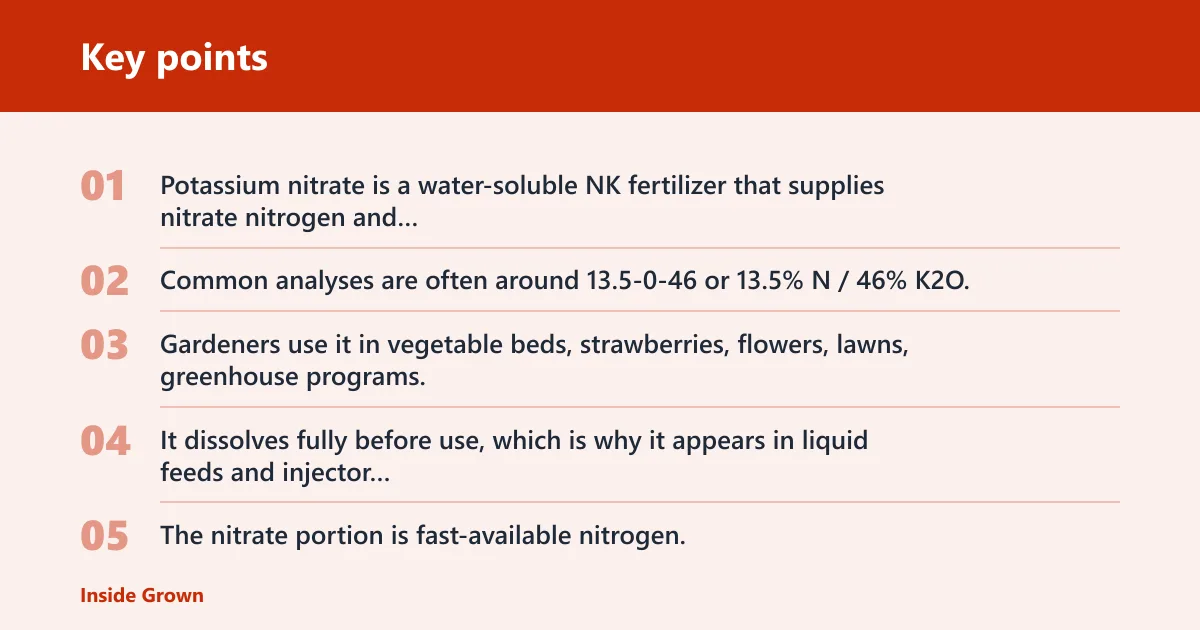


Potassium nitrate is a water-soluble NK fertilizer that supplies nitrate nitrogen and soluble potash in one product. Common analyses are often around 13.5-0-46 or 13.5% N / 46% K2O, and some labels list about 13.5% nitrate nitrogen with about 46% potassium oxide or 46.2% soluble potash.
Gardeners use it in vegetable beds, strawberries, flowers, lawns, greenhouse programs, fertigation, drip irrigation, foliar feeding, soil drench, and hydroponics. It dissolves fully before use, which is why it appears in liquid feeds and injector programs rather than slow-release blends.
Nitrate nitrogen and soluble potash
The nitrate portion is fast-available nitrogen. That matters when plants need a quick green-up or a short correction in low-nitrogen media. The potassium portion, usually listed as K2O on the label, helps with flowering and fruiting, especially in crops that are already pushing fruit or setting fruit clusters.
Because both nutrients are immediately available, potassium nitrate fits programs where speed matters more than long-term feeding. It is less useful when the bed already has enough nitrogen, because extra nitrate can push soft growth and raise the chance of leaf burn or nitrate runoff.
Where gardeners use it
It fits best in high-value crops that respond quickly to soluble feeding: tomatoes, peppers, cucumbers, strawberries, herbs in containers, and hydroponic greens. It also appears in greenhouse programs where irrigation water and nutrient concentration can be controlled closely.
It is a poor match for a bed that already has strong vegetative growth and a recent history of heavy nitrogen feeding. In that case, adding more nitrate can give you more top growth than you want and less root-to-shoot balance.
Is potassium nitrate safe for vegetable gardens?
Yes, when you keep plant safety and gardener safety separate. For plants, potassium nitrate is usually safe at label rates and is often useful in edible beds. For people, it is a dry salt that can irritate skin, eyes, and lungs, so safe handling matters as much as correct dosing.
The plant side is about fit: crop type, soil test, and current nitrogen status. The gardener side is about dust, mixing, storage, and keeping granules away from children, pets, and harvest surfaces. Those are different risks, and they should be treated that way.
When it is a good fit
Use it when a soil test or a crop cue points to low available nitrogen and potassium, especially in a fast-growing vegetable bed. It is also a practical choice when you need a water-soluble source for fertigation, drip lines, foliar feeding, or a light soil drench.
It makes sense for fruiting vegetables and strawberries when the goal is to keep growth steady without adding chloride. It also fits hydroponic systems where nitrate and potassium can be monitored closely and adjusted in small steps.
When to skip it
Skip it if the bed already has strong vegetative growth, if the bed is salt-sensitive, or if the crop is already dark green and pushing soft growth. In those cases, extra nitrate can do more harm than good. A balanced fertilizer, compost-based amendment, or a different potassium source may be safer.
If you are unsure about the bed’s status, test first. That matters especially in raised beds, where salts can build faster than in open ground, and in containers, where irrigation water may leave behind concentrated residues.
Can you use potassium nitrate on tomatoes and other vegetables?
Yes. Tomatoes and many other vegetables can take potassium nitrate well, especially fruiting crops that need potassium during flowering and fruit fill. Leafy greens can use it too, but they are easier to overfeed with nitrogen, so the rate should stay lower and the timing should be tighter.
For tomatoes, peppers, cucumbers, squash, and strawberries, it is often a practical choice in a soluble feeding program. For lettuce, spinach, kale, and other greens, use more caution because excess nitrate can make the crop overly lush and raise the risk of soft tissue and tip burn.
Fruit crops versus leafy greens
Fruiting crops usually need more potassium relative to nitrogen as they move into flowering and fruiting. That makes potassium nitrate a useful tool when a plant has set fruit but still needs a modest nitrogen bump.
Leafy greens often need less nitrogen than gardeners expect in some beds, especially if the bed was already amended with compost or a complete fertilizer. In those beds, a lower rate or a different fertilizer may be a better fit.
Beds with high nitrogen already
If the bed has a recent history of heavy nitrogen feeding, adding potassium nitrate can create excess vegetative growth and wash more nitrate into runoff. That is a safety issue for the bed and for the wider yard, especially after heavy watering or rain.
A common first-timer mistake is feeding a dark green tomato bed “just to be safe.” If the plant already has strong foliage and no clear deficiency, pause and recheck the nutrient plan instead of adding more nitrate.
Containers and raised beds
Containers and raised beds need tighter control because salts accumulate faster. Use smaller doses, water evenly, and do not let dry fertilizer sit against stems or leaves. If runoff appears salty or white crust forms on the surface, stop and flush with plain water.
In a 10-gallon container, a little overshoot matters more than in ground soil. Picture a patio tomato that already has strong growth and pale leaf edges after a hot week; the correct response is a modest, measured feeding, not a heavy drench.
Potassium nitrate is usually applied as a foliar spray, fertigation solution, light soil drench, or hydroponic nutrient ingredient. It must dissolve completely before use, and mixed solutions should be made with clean water and used soon after mixing when the label or program calls for it.
Foliar spray rates
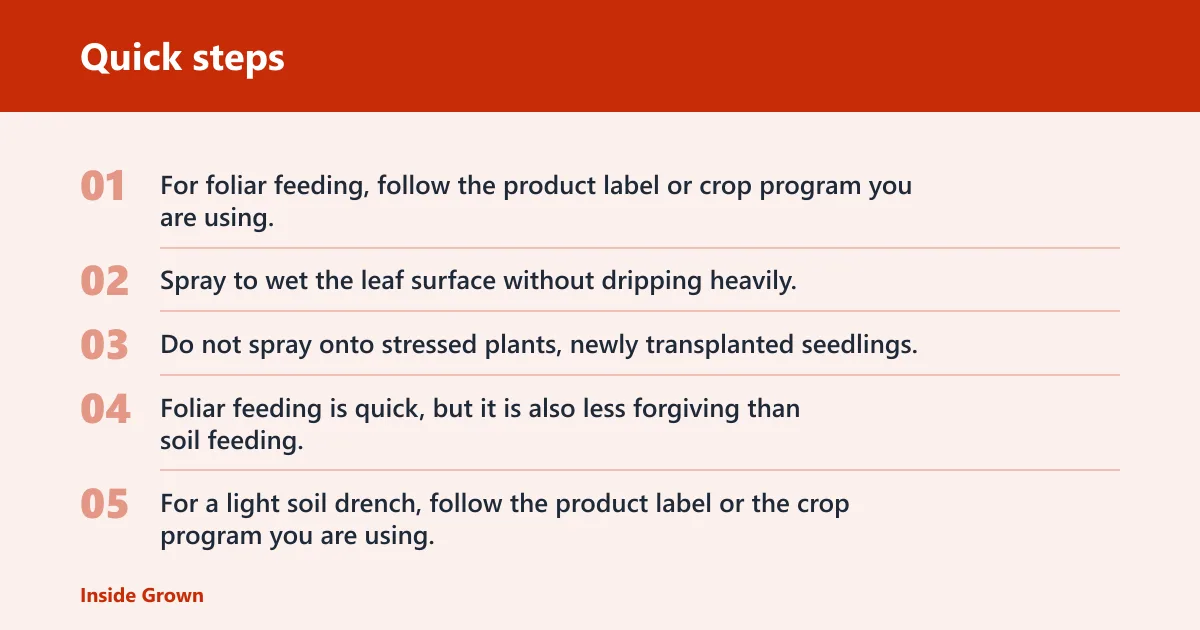
For foliar feeding, follow the product label or crop program you are using. Spray to wet the leaf surface without dripping heavily, and apply in cool parts of the day to reduce leaf scorch.
Do not spray onto stressed plants, newly transplanted seedlings, or crops already showing burn on the margins. Foliar feeding is quick, but it is also less forgiving than soil feeding.
Soil drench and fertigation
For a light soil drench, follow the product label or the crop program you are using. In fertigation and drip systems, the goal is even distribution rather than high concentration in one spot. Keep the solution fully dissolved so emitters do not clog.
When used in complete fertilizer programs, potassium nitrate is often paired with calcium nitrate and magnesium nitrate. In injector programs, follow the fertilizer program’s stock-solution separation instructions before combining ingredients, because unfamiliar mixes should be checked for compatibility before they go into a tank or injector.
Hydroponic target ranges
In hydroponics, follow the nutrient program for the crop and monitor pH and EC along the way. Nutrient stock solutions should be diluted according to the injector setup.
Hydroponic crops respond quickly to small errors, so start low and adjust slowly. If potassium rises too far, you can run into nutrient imbalance, especially when calcium or magnesium is already on the edge.
| Crop type | Soil-test status | Current nitrogen level | Safest application method | Red-flag situations where to avoid it |
|---|---|---|---|---|
| Tomatoes, peppers, cucumbers | Low to moderate potassium; no salt buildup | Low or not yet corrected | Light soil drench or fertigation; foliar only at label rate | Already dark green, weak fruit set, or soil test shows high nitrogen |
| Lettuce, spinach, kale | Low potassium; loose, well-drained soil | Low | Lower-rate soil feeding or very mild foliar use | Leafy growth already lush, tip burn present, or bed is salt-sensitive |
| Strawberries | Moderate potassium need; even moisture | Low to moderate | Fertigation or soil drench in small doses | Dry roots, heat stress, or mixed spray not yet tested for compatibility |
| Containers and raised beds | Any sign of salt crust or restricted drainage | Low only | Small measured dose with thorough watering in | White crust, runoff, recent overfeeding, or poor drainage |
| Hydroponic vegetables | Solution management only | Managed in stock tank | Measured stock solution with EC and pH checks | Unknown injector ratio, drifting pH, or no way to verify ppm |
Potassium nitrate
Use this table as a quick yes-or-no screen before you mix a batch. The safest choice depends on crop type, the current nutrient status, and whether the bed can handle a soluble salt without building up residue.
Should you use potassium nitrate in this vegetable bed?
Use it when the crop needs fast nitrogen and potassium, the bed is not salt-sensitive, and the soil or solution is not already high in nitrogen. Avoid it when the crop is already lush, the bed is compacted or salty, or you cannot control the dose well enough for the setting.
What to know about mixing and handling
Handling safety starts with dust control and careful mixing. Avoid breathing the powder, keep it out of reach of children and pets, and store it sealed in a cool, dry place. Avoid contact with skin and eyes, and wash exposed skin after handling.
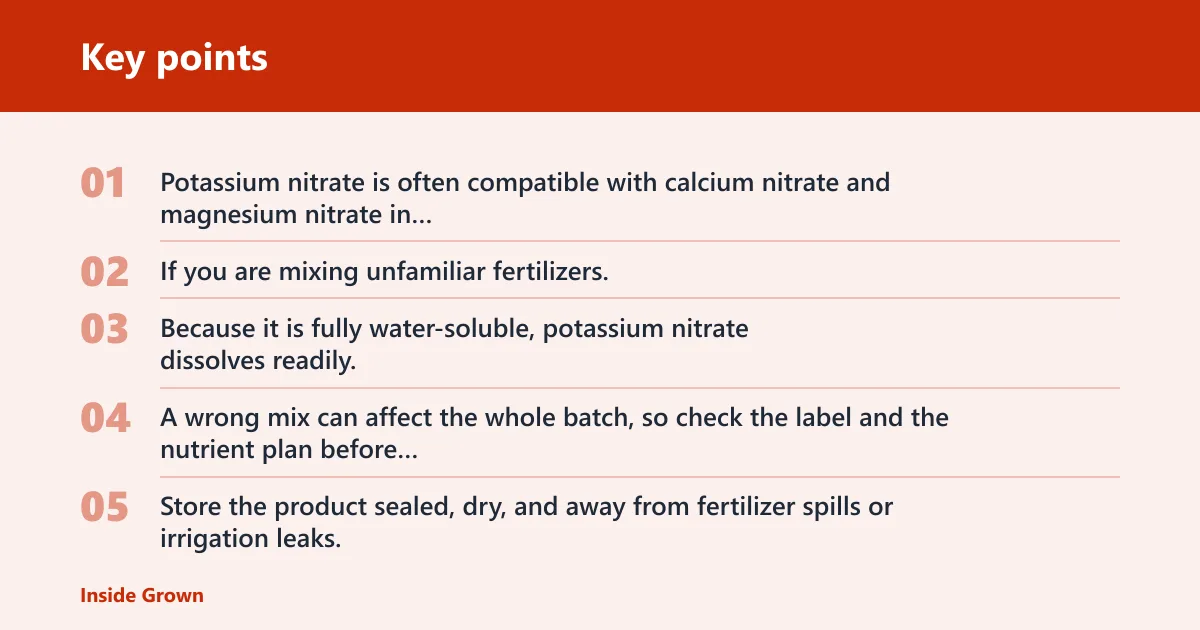
Potassium nitrate is often compatible with calcium nitrate and magnesium nitrate in complete programs, but compatibility is not automatic. If you are mixing unfamiliar fertilizers, test the combination in a small amount first before committing the whole tank.
Compatibility and storage basics
Because it is fully water-soluble, potassium nitrate dissolves readily, but that same solubility also means mistakes spread quickly. A wrong mix can affect the whole batch, so check the label and the nutrient plan before adding it to a sprayer or injector.
Store the product sealed, dry, and away from fertilizer spills or irrigation leaks. If the bag cakes up, do not assume it is still easy to measure accurately; clumps can lead to uneven dosing.
PPE and handling precautions
Wear gloves and eye protection when measuring or mixing. A dust mask is a good idea when handling dry powder in a confined space, especially if pouring from a bag that tends to puff. Keep the work area dry and clean up spills promptly.
Suppose a 5-gallon sprayer is being mixed for tomatoes in a small garden. Measure the fertilizer away from the crop row, dissolve it in a bucket first, and then pour the liquid into the sprayer rather than dumping powder directly into the tank.
| Use case | PPE | Dilution range | Handling note |
|---|---|---|---|
| Foliar spray | Gloves, eye protection, dust mask for dry mixing | 1–2 g per gallon for maintenance; 3–5 g per gallon for deficiency correction | Mix fully, spray in cool weather, avoid runoff onto edible parts |
| Container feeding | Gloves, eye protection | Use a small measured dose; one listed light drench rate is 10 g per 5 gallons | Water in well and watch for salt crust or leaf edge burn |
| Hydroponics | Gloves, eye protection, dust mask when handling dry stock | Target 50–150 ppm potassium in the finished solution | Monitor EC and pH; verify injector ratio such as 1:100 before dosing |
Frequently asked questions
How much potassium nitrate should I apply per gallon of water?
Use the rate on the product label or the crop program you are following. Do not exceed the product label if it gives a different rate.
Is potassium nitrate safe for hydroponic vegetables?
Yes, if you keep the solution within the nutrient program. Follow the crop’s hydroponic feeding plan, keep pH and EC monitored, and match stock solution dilution to the injector setup. Hydroponics leaves little room for error, so measure carefully and adjust in small steps.
Can potassium nitrate be used as a foliar spray on vegetables?
Yes. It is commonly used as a foliar spray because it dissolves fully and delivers nutrients quickly. Stay within the product label or crop program, spray in cool conditions, and avoid heavy runoff that can leave residue on edible parts.
Does potassium nitrate contain chloride or sulfate?
Potassium nitrate is chloride-free, and it does not supply sulfate. That makes it useful in salt-sensitive situations where chloride is a concern. Even so, it is still a salt, so the absence of chloride does not make it risk-free at high rates.
What is the difference between potassium nitrate and other potassium fertilizers?
Potassium nitrate supplies both nitrate nitrogen and soluble potash, while many other potassium fertilizers supply only potassium or pair potassium with a different anion. That means it can feed faster and suit fertigation or foliar use, but it also adds nitrogen that you may not want in every bed.
What PPE should I use when handling potassium nitrate fertilizer?
Wear gloves and eye protection, and use a dust mask when handling the dry material in a confined space or when dust becomes airborne. Keep the product sealed, dry, and away from children and pets. Wash hands after mixing and avoid touching your face until you are done.