How Deep Should You Plant Seeds in Pots and Beds Now?
I plant seeds about 2 to 3 times as deep as the seed is thick; tiny seeds usually stay on the surface or get a dusting of mix, while larger seeds go deeper. Too shallow and they dry out or wash away; too deep and they rot, emerge weakly, or never sprout. I use this guide to choose depth for pots, trays, raised beds, and in-ground beds by seed size, soil texture, and moisture risk.
How deep should you plant seeds?
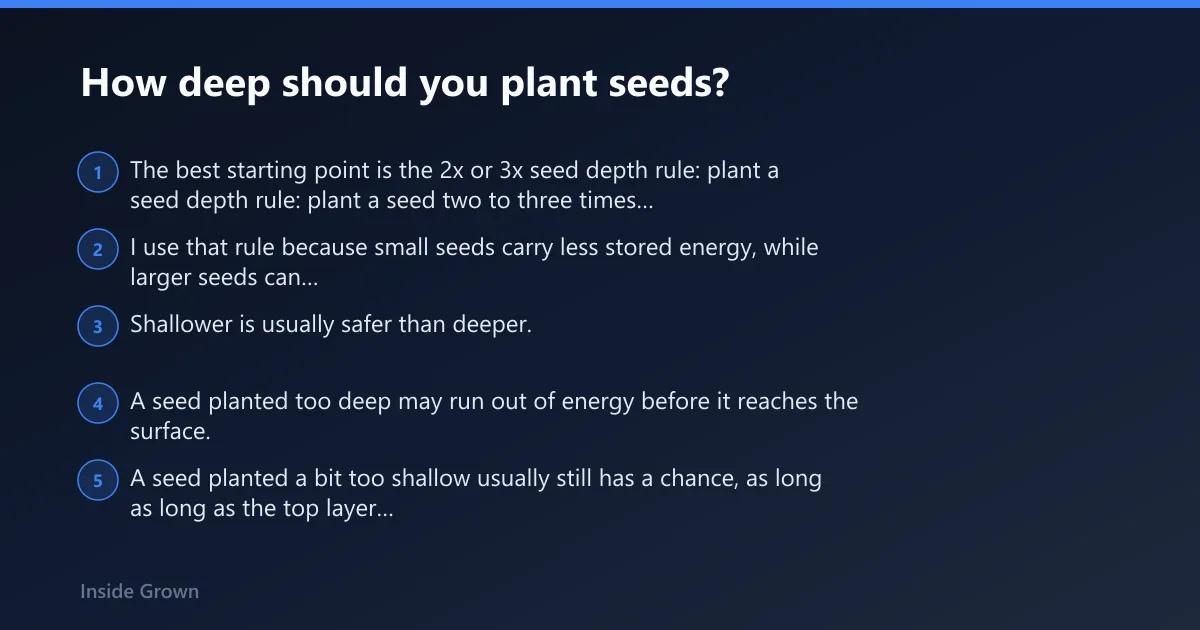


The best starting point is the 2x or 3x seed depth rule: plant a seed two to three times its diameter deep. I use that rule because small seeds carry less stored energy, while larger seeds can push through more soil before they reach light.
Shallower is usually safer than deeper. A seed planted too deep may run out of energy before it reaches the surface. A seed planted a bit too shallow usually still has a chance, as long as the top layer stays moist long enough for germination.
Start with packet depth, then adjust
Seed packet instructions should usually come first, since they often give species-specific depth and spacing guidance that is more useful than a general rule. If the packet says a crop wants surface sowing, follow that guidance even if the seed looks larger than some other shallow-sown crops.
If the packet gives a range, use the middle of that range as the default. Then move slightly shallower for dense, wet, or cool conditions, and slightly deeper for fast-drying, loose conditions.
When shallower is safer than deeper
Shallow planting is the safer move when the seedbed crusts over, when the top layer dries fast, or when the seed is light-sensitive. It is also the better choice for very fine seed, where a thick cover can stop emergence entirely.
That said, shallow sowing is not a free pass. If the surface dries in hours, seeds can fail before they sprout. The right answer is usually a thin cover with steady moisture, not an open surface that bakes dry.
According to The Ultimate Guide to Seed Planting Depth: How Deep Should You Plant … — Medium seeds like beans or peas are planted at 1 to 2 inches.
How deep should you plant seeds in pots?
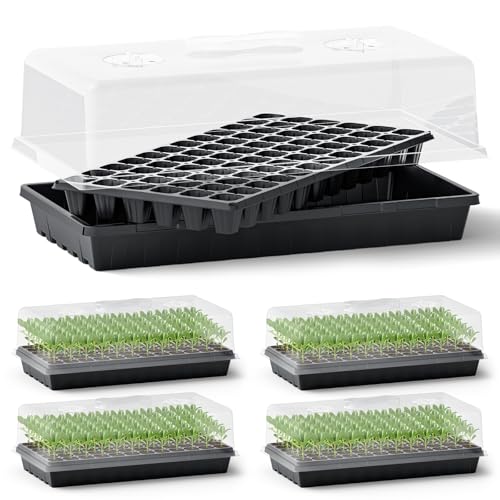
In pots, the depth target is usually a little shallower than in open ground because containers dry faster near the surface. Use potting mix, not garden soil, because it balances drainage and water retention better for containers. Keep the seed zone consistently moist, not soggy.
For many pots, medium seeds like beans and peas are often planted about 1/2 to 1 inch deep, and large seeds like corn, sunflowers, and squash are often planted 1 to 2 inches deep. Small seeds stay near the surface with only a thin cover.
Why container mix and watering method affect depth
Potting mix holds moisture more evenly than field soil, which matters in trays and small pots. But containers also warm and dry faster at the top. That means a seed planted too shallow in a pot can dry out quickly, especially under bright light or airflow.
Bottom watering and fine misting also change the call. If the top stays dry between waterings, seeds need enough cover to stay damp. If the mix is very fine and stays wet, planting slightly deeper can increase rot risk.
When to stay a little shallower in pots and trays
Stay shallower when the seed is tiny, when the pot is covered with a humidity dome, or when the mix is already holding plenty of moisture. That is common with lettuce, celery, and other fine seed that only needs a light cover or surface contact.
For large seeds in pots, do not bury them much deeper just because the pot is deep. Depth still needs to match seed size. A large seed has enough stored energy to justify more cover, but extra depth beyond the packet rarely helps.
How deep should you plant seeds in garden beds?
In garden beds, follow the packet first, then adjust for texture and drying speed. Raised beds often dry out faster than in-ground beds, so they may need a bit more depth or a better mulch strategy. In-ground beds usually hold moisture longer and can support slightly shallower sowing.
Sandy soil may require slightly deeper planting because it drains quickly. Clay soil may allow shallower planting because it holds moisture well. The bed type matters because it changes how long the seed zone stays damp enough to germinate.
Raised beds dry out faster than in-ground beds
Raised beds warm up sooner in spring, which can help germination. They also lose surface moisture faster, especially in wind or full sun. For the same seed, that often means using the deeper end of the packet range in a raised bed.
That does not mean every seed goes deeper. It means the bed’s drying speed becomes part of the decision. Fine seed still needs a light cover, even in a raised bed.
When sandy soil calls for slightly deeper planting
Sandy soil drains quickly and dries fast, so it can justify planting a little deeper than the shallow end of the packet range. That gives the seed more access to steady moisture while roots get started. The tradeoff is simple: enough cover to stay damp, not so much that emergence slows too much.
If a sandy bed is also hot and windy, shallow sowing is riskier. In that case, it is often better to plant at packet depth or just a touch deeper, then water carefully so the seed zone stays damp.
When clay soil calls for slightly shallower planting
Clay soil holds moisture well, so it often supports planting a little shallower. The seed is less likely to dry out before sprouting, and extra depth can trap too much water around the seed coat. That increases the chance of rot, especially in cool weather.
Dense clay can also crust on top. If the surface is sealed hard after watering, very fine seedlings may struggle to break through. In that case, keep the cover light and break the crust gently if needed.
What depth do small, medium, and large seeds need?
Seed size sets the starting depth. Small seeds like lettuce or basil are planted at 1/8 to 1/4 inch, medium seeds like beans or peas are planted at 1 to 2 inches, and large seeds like squash or pumpkins are planted around 2 to 3 inches deep. The 2x or 3x rule means planting a seed two to three times its diameter deep.
| Seed size | Typical depth | Practical note |
|---|---|---|
| Tiny seeds | 1/8 to 1/4 inch | Surface sow or cover very lightly |
| Medium seeds | 1 to 2 inches | Use the lower end in wet, dense soil |
| Large seeds | 2 to 3 inches | Use the deeper end in dry, loose soil |
Tiny seeds and very fine seed sowing
Tiny seeds are usually not buried. Many are pressed into the surface with only a thin soil cover, or left on top and misted in. Lettuce needs very shallow sowing because it is listed at 1/8 inch, and celery is another crop that performs best with very light cover.
This is where people confuse small with light-sensitive. Some tiny seeds still want a thin cover. Others need light to trigger germination and should not be buried at all.
Medium seeds and the middle of the depth range
Medium seeds usually perform well in the middle of the packet range. Beans and peas are often planted about 1/2 to 1 inch deep in pots, and often around 1 to 2 inches in beds depending on soil texture and drying speed. The goal is steady moisture with enough cover to anchor the seed.
If the soil is cool and slow to dry, stay toward the shallower end. If the mix is loose and dries quickly, move toward the deeper end. Do not keep adding depth just because the seed is larger than a pea.
Large seeds and how to avoid planting them too shallow
Large seeds such as squash, pumpkins, corn, and sunflowers have more stored energy, so they can handle more cover. In pots, they are often planted 1 to 2 inches deep. In beds, squash and pumpkins are often planted around 2 to 3 inches deep.
Large seeds can still fail if they are planted too shallow in dry soil. They may swell, crack, and stall before roots anchor. If the top layer dries fast, do not leave a large seed too close to the surface just because the packet range starts lower.
When should you plant seeds shallower or deeper?
Plant shallower when the seed is light-sensitive, the soil is heavy, or the bed stays wet for a long time. Plant a little deeper when the surface dries fast, the soil is sandy, or the seed coat is thick and the crop needs more cover to stay evenly moist.
Temperature matters too. Cool soil slows germination, and depth can change how much warmth the seed gets. A slightly shallower planting can warm faster in spring, while a slightly deeper planting can protect a seed from rapid surface cooling and drying.
Drying speed, crusting, and rot risk
Shallow sowing dries faster. That is useful in wet soil, but dangerous in hot sun or wind. Deep sowing increases rot risk when drainage is poor or the soil stays saturated around the seed coat.
Crusting is another failure case. A thin surface crust can trap tiny seedlings, even if moisture is adequate below. In that situation, a light cover of fine mix is better than a hard-packed top layer.
Cool soil versus warm soil
Cool soil slows water uptake and germination. If soil is cold and wet, extra depth can make the seed sit too long before it moves. That is one reason many spring sowings do better at the lower end of the packet range.
Warm soil changes the calculation. Warm beds dry faster, so slightly deeper sowing may help maintain moisture. The adjustment is small, though. A little extra depth helps; a lot of extra depth hurts.
How seed coat size changes the call
Seeds with thick coats or larger stored energy can often manage a little more cover. Seeds with thin coats or tiny embryos usually cannot. That is why a general size rule works only as a starting point, not as the final answer.
If a packet gives a specific depth, trust that first. Species-specific directions already account for seed coat behavior and early growth needs better than a generic size guess.
How do you measure seed depth without guessing?
You can measure depth with a ruler, a finger joint, or the edge of a small trowel. The goal is not perfect precision down to the millimeter. The goal is to keep the seed close to packet depth and avoid burying it much deeper than intended.
- Check the packet depth and spacing first.
- Use a ruler for exact shallow sowing.
- Use the first knuckle for rough depth in beds.
- Use a finger joint for medium seeds in pots.
- Use a trowel edge or dibber to make a consistent hole.
- Cover, press gently, and water lightly.
Use a ruler, finger joint, or first knuckle
A ruler is the cleanest option for tiny seed and shallow depths. A finger joint or first knuckle works for rough garden estimates when a ruler is not handy. Those body-based measures are not exact, but they are better than guessing by eye.
For tiny seed, “lightly covered” is often the real instruction. If the packet says 1/8 inch, that is a dusting, not a buried seed.
Set depth with a trowel edge or dibber
A small trowel can mark the depth of a hole or furrow consistently. A dibber works the same way in flats and beds. This helps keep every seed at the same level, which matters when one tray should germinate evenly.
Press the soil gently after covering. Do not pack it hard. Good seed-to-soil contact is the point, not compaction.
Quick checks for flats, pots, and open beds
In flats, use a fine layer of mix over tiny seed and a measured hole for larger seed. In pots, check that the surface is not drying between waterings. In open beds, look for crusting after irrigation or rain.
If the top dries quickly, add a little more cover within the packet range. If the soil stays wet for days, reduce depth slightly and improve drainage before planting more seed.
Seed packet instructions and the depth decision checklist
Packet depth and spacing guidance should be the first read, because species-specific instructions override the general rule. After that, adjust with a simple three-branch checklist: pots, raised beds, and in-ground beds. Use the packet depth, then move slightly shallower or deeper only when moisture risk points that way.
Three-way depth decision checklist
| Planting site | Stay at packet depth when | Go slightly shallower when | Go slightly deeper when |
|---|---|---|---|
| Pots and trays | Using potting mix with steady moisture | Seed is tiny, light-sensitive, or mix stays wet | Top of mix dries quickly between waterings |
| Raised beds | Bed is evenly moist and mulched | Clay-rich soil or slow drainage | Bed dries fast in sun or wind |
| In-ground beds | Soil is loose and moisture is even | Heavy clay or crusting top layer | Sandy soil or rapid surface drying |
When to adjust packet depth up or down by a little
Adjust down if the soil is dense, cool, or already holding plenty of moisture. Adjust up if the soil is loose, sandy, or drying too fast at the surface. That is the practical way to turn the packet into an actual planting action.
Do not make large changes. A small move within the packet range is usually enough. If the seed still fails, the problem may be watering, temperature, or poor seed quality rather than depth alone.
What happens if you plant seeds too deep?
Seeds planted too deep may rot, sprout weakly, or never reach the surface. The deeper they sit, the more energy they use before they can photosynthesize. For small seeds, that can mean complete failure. For large seeds, it often means slow, uneven emergence and weak seedlings.
Too much depth can also keep the seed in wet soil too long. That raises rot risk, especially in clay or in containers watered heavily from above. When in doubt, stay near packet depth rather than adding extra cover.
Frequently asked questions
How deep should you plant seeds in pots?
In pots, follow the packet first, then lean slightly shallower if the mix stays wet or deeper if the surface dries fast. Medium seeds like beans and peas are often planted about 1/2 to 1 inch deep in pots. Large seeds like corn, sunflowers, and squash are often planted 1 to 2 inches deep in pots.
How deep should you plant seeds in garden beds?
In garden beds, the packet depth is the baseline, with small adjustments for soil and drying speed. Raised beds dry out faster than in-ground beds, so they may need a little more cover. Sandy soil may need slightly deeper planting, while clay soil may allow shallower planting.
How deep should small seeds be planted?
Small seeds are usually planted very shallow, often at 1/8 to 1/4 inch. Some are only lightly pressed into the surface with a thin soil cover. Lettuce is a good example of a crop that needs very shallow sowing, and celery is another crop that should not be buried deeply.
Should you plant seeds deeper in sandy soil?
Sandy soil often drains quickly, so slightly deeper planting can help keep the seed zone moist long enough to germinate. That does not mean burying the seed well below the packet range. It means using the deeper end of the range when the soil is loose and drying fast.
Should seeds be planted shallower in clay soil?
Clay soil holds moisture well, so shallower planting is often better than extra depth. Too much cover in clay can keep the seed wet for too long and increase rot risk. A lighter cover also helps seedlings push through if the surface crusts after watering or rain.
What is the 2x or 3x seed depth rule?
The 2x or 3x rule means planting a seed two to three times its diameter deep. It is a useful starting point, not a law. Seed packet instructions, soil texture, and drying speed can justify moving a little shallower or deeper within that range.
What happens if you plant seeds too deep?
Seeds planted too deep may use up their stored energy before they reach the surface. They can emerge weakly, rot in wet soil, or fail to sprout at all. The risk is highest with tiny seeds and in heavy, waterlogged soil, where extra depth makes movement even harder.
Which seeds should only be lightly covered?
Very small seeds and light-sensitive seeds should be lightly covered or left on the surface, depending on the packet. Lettuce is a clear example, and celery often needs only a very light cover as well. Do not assume every tiny seed is light-sensitive; size and light need are not the same thing.