How Far Apart Should You Sow Seeds for Healthy Spacing
Sow seeds closer than the final plant spacing, then thin to the mature spacing on the packet. If the packet gives no spacing, start somewhat closer than the mature spacing and remove extras after germination. Crowded plants push up thin stems, make smaller roots, and tangle leaves as they compete for light and space.
This guide is part of our Seed planting guide for beginners series.
What you’ll need
- Seed packet or spacing chart
- Ruler or tape measure
- Labels and a pencil
- Dibber, pencil, or fingertip for making holes
- Seed tray or small pots for indoor sowing
- Snips or small scissors for thinning
How to use this spacing guide
Use three numbers, not one. The first is the sowing distance, which is how close seeds go in the soil. The second is the thinning distance, which is how far apart the strongest seedlings should end up. The third is mature spacing, which is the room the plant needs at full size.
That split matters because many seeds fail to sprout. If you space for mature plants from the start, you leave bare gaps. If you space for germination only, roots crowd together and plants lean, stretch, and stay damp.
How to read the packet without getting stuck on one number
Read the packet for four items: initial sowing distance, plant spacing after thinning, row spacing, and any container or transplant notes. Species-specific spacing beats a one-size rule, but the packet only works if you separate those four jobs.
When the packet gives one number, treat it as mature spacing unless it clearly says sowing distance. Then sow a little closer if germination is uneven, and thin later.
Step 1: Read the packet for sowing, thinning, and row spacing
- Mark the packet’s sowing distance, thinning distance, and row spacing before you open the seed.
- Check for container guidance if you are sowing in pots; some crops need one plant per pot, while others can take several seeds at start.
- Look for soil temperature, seed depth, and whether the crop prefers direct sowing or transplanting.
For zucchini, seeds are planted about half an inch deep when the soil is warm enough for planting. Zucchini seeds can be sown a short distance apart in rows, with wider spacing between rows, and hill planting uses extra room between hills.
Indoor starts for zucchini can use a small pot and a few seeds per container. Seedlings are thinned when they are 2 to 3 inches tall, and only one zucchini plant should remain per 14-inch container.
How far apart should I sow seeds in a row?
Use mature spacing as the target, then plant closer only when you expect some germination loss. One seed per spot works for large, reliable seed; two or three seeds per spot works when germination is uneven; tiny seed often needs surface sowing or broadcast sowing, then later thinning.
For direct sowing in rows, the sowing distance can be much tighter than final spacing. Zucchini is a clear example: seeds may start fairly close in rows, but the plants later need much more room between transplants or between hills, depending on the method used.
If the crop is a bush type, closer spacing is often possible than for long-vining types. Bush plants stay compact, while vine plants need room for long runners and leaves that spread in every direction.
Decision rule for direct sowing
- Tiny seeds: broadcast, pinch sow, or surface sow; thin later.
- Medium seeds: sow 2 to 3 seeds per hole if germination is uncertain.
- Large seeds: sow 1 seed per hole when seed quality is good.
How many seeds should I put in one hole or cell?
Put enough seed in the hole or cell to guarantee a stand, not a thicket. Tiny seeds often need a pinch, not a single seed, because they are hard to place one by one. Medium seeds usually do well with two or three per hole. Large seeds usually get one per hole.
For indoor starts, use the smallest pot or cell that still leaves root room. Zucchini can begin in a 2 to 3 inch pot, and up to four seeds may be started per container. After germination, keep the strongest seedling and remove the rest.
That approach helps when germination is patchy. It also saves time, because empty cells and extra transplants create more work than a slightly crowded start followed by clean thinning.
How far apart should seedlings be after thinning?
Thin once seedlings have true leaves or reach the crop’s thinning height. For zucchini, that thinning point is 2 to 3 inches tall. Keep the strongest plant and remove weaker seedlings before the roots knit together too tightly.
Use snips or small scissors when seedlings are crowded. Snip at soil level instead of pulling, because pulling can disturb the roots of the plant you want to keep. In a tight row, the saved seedling usually recovers faster when the root zone stays intact.
Final spacing should match the mature canopy, not the seedling size. Plants that look tiny at first can fill the space fast, and the leaves need air and light once the canopy closes.
If that didn’t work, try this next
- Recheck the packet for transplant spacing versus direct-sow spacing.
- Measure from stem center to stem center, not leaf edge to leaf edge.
- Remove one more seedling from each crowded spot if stems are already touching.
Do I space seeds differently for direct sowing and transplants?
Yes. Direct sowing usually starts tighter because some seeds fail and some seedlings are removed later. Transplants go into their final spacing sooner, so the hole layout should match the mature plant size more closely from the start.
For zucchini, direct sowing can begin 2 inches apart in rows, with row spacing of 2 to 3 feet. Transplants need 1 to 2 feet between sprouts. Hill planting changes the layout again, with 3 to 4 feet between hills, and bush zucchini usually needs 2 to 3 feet between hills while vine zucchini prefers 5 to 6 feet of space.
Before moving seedlings outside, harden them off so they adapt to sun, wind, and temperature swings. Then plant at the same depth they grew in the pot unless the crop calls for something different.
How do I space large seeds versus tiny seeds?
Tiny seeds need a different tactic from beans or squash. Tiny seed is often broadcast, pinch sown, or surface sown because one-by-one placement is impractical. Large seeds are easier to place exactly, so one seed per hole is usually enough when germination is dependable.
Medium seeds sit in the middle. Two or three seeds per hole gives a backup without wasting too much seed. If all germinate, thin the extras early so the strongest plant gets the room.
Seed size changes handling, not the final plant biology. A tiny seed can still become a large plant, and a large seed still needs room to branch, root, and catch light.
Seed spacing cheat sheet
| Seed type / habit | Initial sowing distance | Final thinning distance | Mature spacing |
|---|---|---|---|
| Tiny seeds | Broadcast, pinch sow, or surface sow | Thin to the strongest seedling per spot | Use packet spacing for the crop |
| Medium seeds | 2 to 3 seeds per hole | Keep 1 plant per spot | Use packet spacing for the crop |
| Large seeds | 1 seed per hole | Usually none if germination is reliable | Use packet spacing for the crop |
| Zucchini, direct sow | 2 inches apart in rows | Thin when 2 to 3 inches tall | 1 to 2 feet between sprouts; 2 to 3 feet between rows |
| Zucchini, hills | Start several seeds per hill | Keep the strongest plant | 3 to 4 feet between hills |
| Bush zucchini | Compact start | Thin to 1 plant | 2 to 3 feet between hills |
| Vine zucchini | Compact start | Thin to 1 plant | 5 to 6 feet of space |
How much spacing do container plants need compared with beds?
Containers need more attention to root room because the pot wall stops root spread. Bed plants can share more soil volume around them, while container plants depend on pot diameter and variety size. Compact forms fit containers better than long-vining plants.
For zucchini, a 14-inch container is recommended, and only one zucchini plant should remain in that container. That is a strong example of mature spacing being controlled by pot size, not by how many seeds fit at sowing.
If the container is too small, seedlings may germinate well and still fail later. Roots circle, water dries too quickly, and the canopy crowds itself before the plant reaches full size.
What happens if I sow seeds too close together?
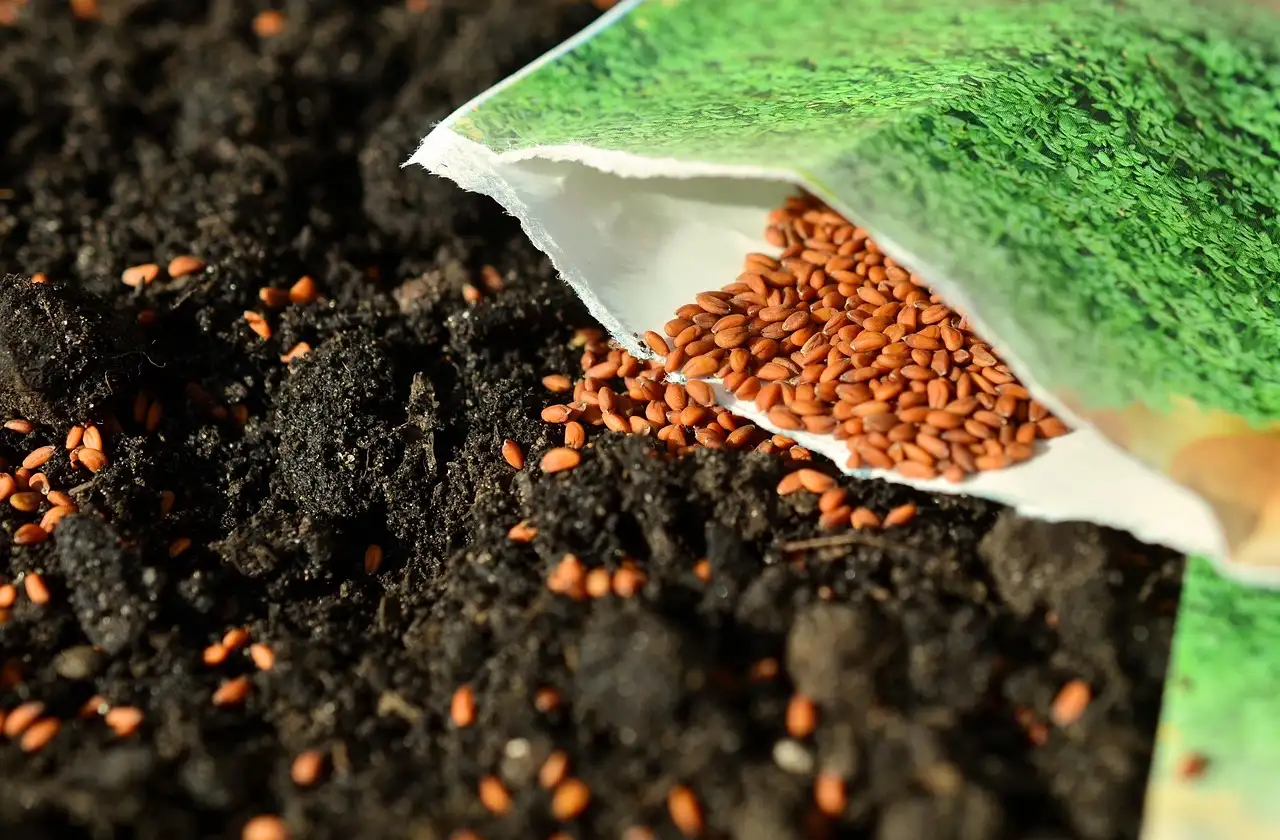
Seeds sown too close compete for water, nutrients, and root room. The stand may look full early on, but the result is often weak stems, smaller leaves, and uneven maturity. Dense plants also stay damp longer, which can invite disease and slow airflow through the canopy.
Overcrowding is most damaging when strong seedlings shade weaker ones. The weaker plants stretch toward light, then lose the race below ground because their roots cannot spread. You get more plants, but less harvest.
Common mistakes
- Sowing at mature spacing: leave room for losses, then thin later.
- Skipping thinning: remove extras early, before roots lock together.
- Ignoring row spacing: leaves need space between rows as well as within rows.
- Using the same spacing for bush and vine types: vine plants need much more room.
- Filling a container by seed count alone: match the final plant size to the pot diameter.
Prevention: write the sowing distance, thinning distance, and mature spacing on each label before planting. That keeps the numbers in front of you when the tray fills up and the seedlings all look the same.
Should I follow the seed packet or a general spacing rule?
Follow the packet first when it gives species-specific spacing, row spacing, plant spacing after thinning, or container guidance. Use a general rule only when the packet is missing details, then start 2 to 4 times closer than final spacing and thin later.
The packet is still the better guide for crops with different habits. A bush form, a vine form, and a transplants-only crop may all need different spacing even if they share the same common name.
Frequently asked questions
How far apart should I sow seeds in a row?
Sow close enough to account for germination loss, then thin to the packet’s final spacing. For direct-sown zucchini, 2 inches apart in rows is a clear example, but the final stand still needs 1 to 2 feet between sprouts and 2 to 3 feet between rows.
How many seeds should I put in one hole or cell?
Use about 1 seed for large seed, a few seeds for medium seed, and a pinch, broadcast, or surface sowing method for tiny seed. For zucchini starts indoors, up to four seeds may be started per container, then thinned to one strong plant.
Do I space seeds differently for direct sowing and transplants?
Yes. Direct sowing starts tighter because some seed will not emerge, while transplants go closer to their final spacing right away. Zucchini transplants need 1 to 2 feet between sprouts, while direct sowing can begin at 2 inches apart in rows.
How far apart should seedlings be after thinning?
Thin to the mature spacing for the crop, not the size of the seedling. Zucchini seedlings are thinned when they are 2 to 3 inches tall, and the strongest plant is kept while weaker ones are removed with snips at soil level.
What happens if I sow seeds too close together?
The stand may germinate well and still fail later because crowded plants compete for light, water, and root room. Leaves stay damp longer, stems stretch, and the weaker plants often stall or die before they can produce a usable harvest.
How much spacing do container plants need compared with beds?
Containers usually need stricter spacing because root room is fixed by pot size. A 14-inch container is recommended for zucchini, and only one zucchini plant should remain in that container, while bed-grown plants can be spaced by row or hill according to habit and mature spread.