How to Tell if Old Seeds Are Still Good Enough to Plant
Use a home germination test: if most old seeds sprout, plant them normally; a moderate sprouting rate means oversow; if fewer than about half sprout, replace the packet. Bad guesses waste bed space, delay harvests, and leave gaps that are hard to fill. This guide shows how to test seeds, calculate viability, and decide whether to plant, oversow, or toss.
This guide is part of our Seed planting guide for beginners series.
What you’ll need before you test them


- Ten or more seeds from one packet
- Paper towel
- Plastic zipper bag
- Marker
- Plate or shallow tray
- Warm indoor spot out of direct sunlight
Use at least ten seeds so the result means something. A test with three or four seeds can look better or worse than the packet really is.
How to tell if old seeds are still worth planting
Old seed can still be plantable if storage stayed cool, dry, and dark, but age usually lowers germination percentage and seedling vigor. A few sprouts only tell you that some seeds are alive. They do not tell you whether the rest will fill a row evenly or produce strong seedlings.
What a home germination test tells you
The test gives you a countable germination percentage: sprouted seeds divided by total tested. It also gives a rough look at seedling vigor, because weak, abnormal, or stalled sprouts often mean the packet is aging out even if it technically still germinates.
Why a few sprouts are not the same as usable seed
One or two sprouts in a bag can happen with seed that is too weak for dependable planting. For a bed or row crop, you need enough healthy seedlings to match spacing. Otherwise you end up thinning, reseeding, or patching holes later.
How do you test seed germination at home?
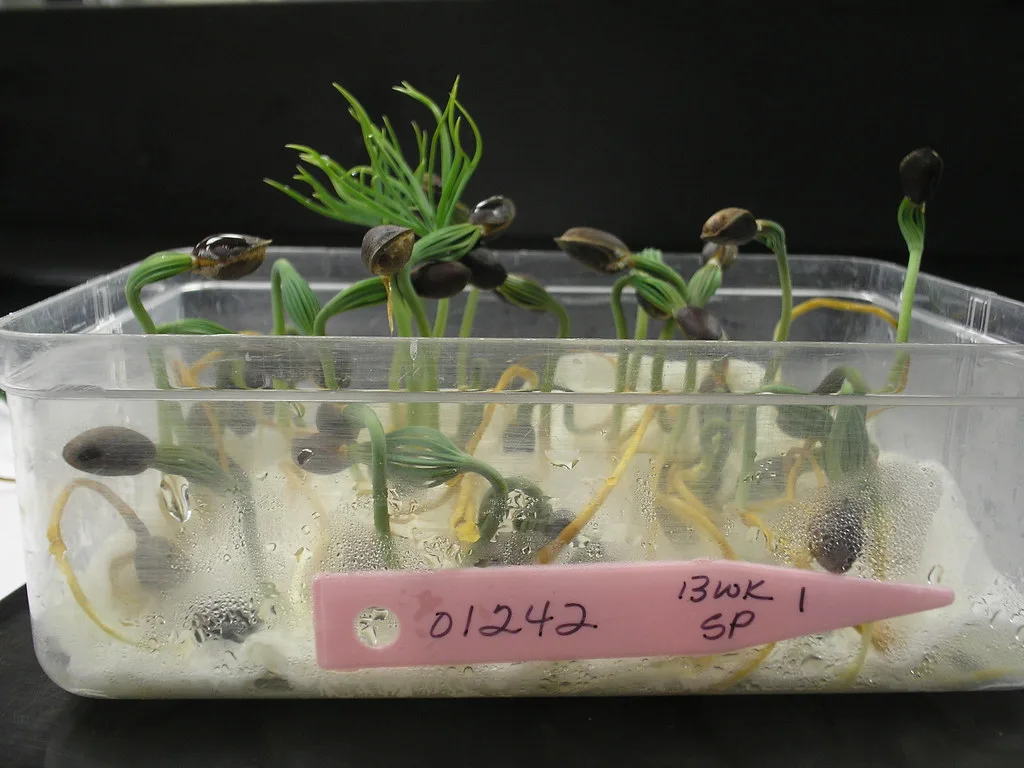
Use the paper towel method: place seeds in a damp towel, seal it in a plastic zipper bag, keep it warm, and count true sprouts after the packet’s expected sprout window. Check every three days so you can catch germination as it happens and avoid overcounting mold-damaged seed.
Step 1: Moisten the towel, then fold in the seeds
- Wet a paper towel and squeeze it until it is damp, not dripping wet.
- Spread the seeds in one layer, then fold the towel over them.
- Write the crop name and date on the bag or a label.
Step 2: Seal the bag and keep it warm
- Place the folded towel in a plastic zipper bag.
- Seal the bag to hold moisture, but do not trap standing water.
- Put it in a warm indoor spot away from direct sun and drafts.
Step 3: Check every three days and count only true sprouts
- Open the bag every three days to inspect the seeds.
- Count a seed only when the root is clearly emerging.
- Do not count swollen seed coats, mold, or a split husk without a root.
Step 4: Stop at the packet’s expected sprout window
- Use the packet’s listed days to sprout as your benchmark.
- Stop counting once the normal germination window has passed for that crop.
- Record the final number of sprouted seeds and the date.
Most seeds germinate best in 70 to 75 degrees F. A warmer or cooler room can slow the test, so keep the bag in a steady spot rather than a windowsill with night swings.
How do you read the results?
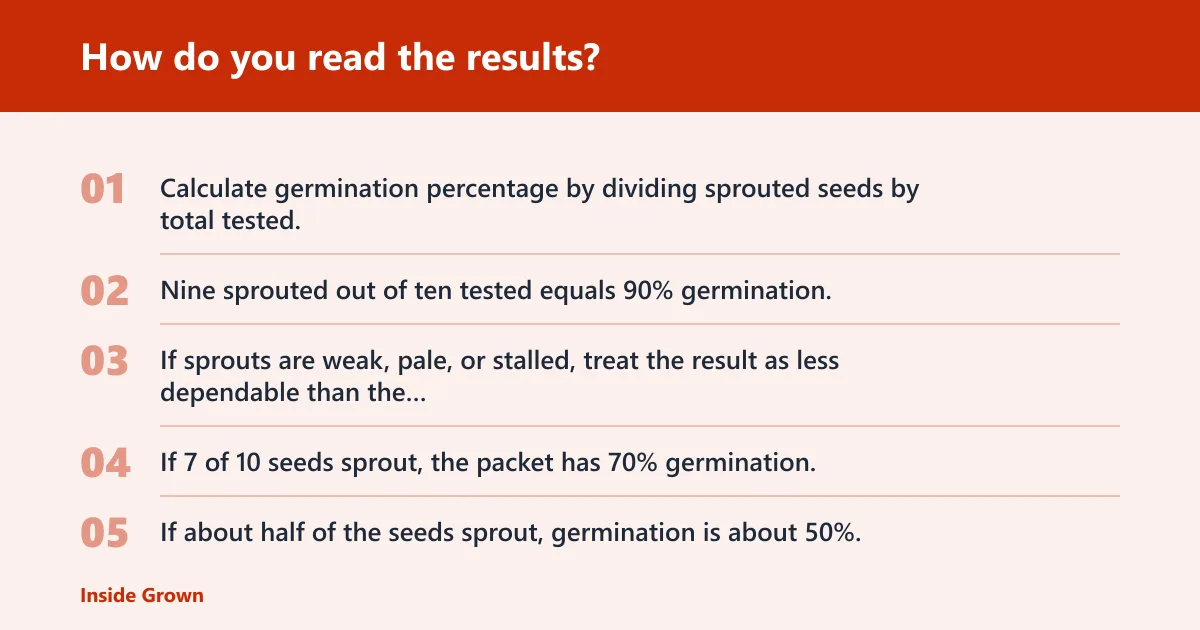
Calculate germination percentage by dividing sprouted seeds by total tested, then judge the quality of the seedlings too. Nine sprouted out of ten tested equals 90% germination. If sprouts are weak, pale, or stalled, treat the result as less dependable than the number alone suggests.
How to calculate germination percentage
If 7 of 10 seeds sprout, the packet has 70% germination. If about half of the seeds sprout, germination is about 50%. That number is useful only when the seeds were counted after the expected germination period and the sample size was large enough.
Judge seedling vigor, not sprouting alone
Healthy seedlings should keep growing after sprouting. Weak or abnormal seedlings may twist, stall, or fail to form a strong root. Those seeds may technically be viable, but they are less reliable in the garden, especially for crops that need even stands.
| Germination result | Action | What it means in the garden |
|---|---|---|
| 80% or higher | Plant as normal | Use the packet’s usual spacing and sowing rate. |
| 60% to 79% | Oversow by about 25% to 50% | Add extra seed so gaps do not reduce stand density. |
| 40% to 59% | Use only for dense crops or sow much thicker | Best for crops you can thin heavily or harvest young. |
| Below 40% | Discard and replace | Too unreliable for most beds and rows. |
Say your lettuce packet tests at 65%. For a 10-foot row, sow about one-third more seed than usual, then thin carefully. Suppose an old bean packet tests at 42%. That is a poor choice for a neatly spaced pole bean row, but it may still work for a thickly sown cover strip or a dense relay planting.
Which old seeds should you replace first?

Replace short-lived seeds first, especially onions and parsnips. Medium-lived seeds like beans, peas, lettuce, and peppers deserve a test before planting. Longer-lived crops such as tomatoes, cucumbers, and melons often stay usable longer if stored well, so they are less urgent to replace.
Short-lived crops: onions and parsnips
Onion, leek, parsnip, and scallion seeds are listed as one-year seeds. If those packets are more than a season old, test them before you count on them. Poor results usually justify replacement because thin stands are hard to fix later.
Medium-lived crops: beans, peas, lettuce, peppers
Beans, carrots, corn, lettuce, peas, peppers, and spinach are listed at two to three years. These can still be fine if stored well, but older packets often show a drop in vigor first, then a drop in total sprouting.
Longer-lived crops: tomatoes, cucumbers, melons
Tomatoes, cucumbers, melons, and watermelons are listed at five to six years. These are the packets most likely to stay useful after sitting in a drawer, though the test still matters if the storage area was warm or humid.
Use this checklist before trusting a packet
- The packet is older than the crop’s usual storage range.
- The seeds were kept in a hot room, garage, or humid shed.
- Only a few seeds sprout in the towel test.
- Sprouts are weak, deformed, or stop growing.
- The crop needs even spacing and hard-to-fill rows.
How should you store seeds so they last longer?
Keep packets cool, dry, and dark, and aim for 40 to 50 degrees F when possible. Temperature swings and humidity shorten seed life. Good storage helps preserve both germination percentage and vigor, which matters as much as the raw sprout count.
Prevent moisture and heat damage
Use a sealed container in a dry place, and keep it away from appliances, attics, and sunny shelves. Warm, damp storage speeds aging even when the packet still looks fine on the outside.
Why storage conditions matter more than the calendar
Two packets from the same year can age very differently. Seed stored in a cool, dry, dark spot may outlast seed kept in a hot kitchen drawer. That is why a quick test is better than guessing by date alone.
What temperature do seeds germinate best at?
Most seeds germinate best in 70 to 75 degrees F. If the room is much cooler, sprouting slows. If it is much warmer, some seed types dry out faster inside the towel or may germinate unevenly.
Keep the test in a stable indoor location, such as the top of a refrigerator only if it stays warm without getting hot. Avoid direct sun, which can overheat the bag and create false failures.
How often should you check seeds during a germination test?
Check the bag every three days. That timing catches sprouts before roots grow too long in the towel and helps you spot drying, excess moisture, or mold early. It also keeps you from stopping the test too soon on slow crops.
If that didn’t work, try this next
- Move the bag to a steadier warm spot if the room temperature keeps changing.
- Replace the paper towel if it has become moldy, torn, or too wet.
- Restart the test with ten fresh seeds if the first batch sat in a cold or sunlit spot.
Can weak old seeds still be planted if I sow more of them?
Yes, if germination is middling and the crop tolerates crowding or thinning. Oversow by about 25% to 50% when the test falls between 60% and 79%, then thin to final spacing. Weak seed is a poor fit for precise rows, but it may still work for dense sowings.
When oversowing makes sense
Use extra seed for salad greens, baby leaf crops, or rows you can thin later. That approach makes sense only when the seedlings do not need perfect spacing on day one.
When oversowing is not enough
If the packet tests below 40%, even a thicker sowing is usually a waste. The bed may still end up patchy, and the weakest seedlings often fail after sprouting.
Common mistakes
Most bad reads come from bad test conditions, not from the seeds themselves. A dry towel, a soaked towel, a cold shelf, or a sunny windowsill can all distort the result and make viable seed look worse than it is.
- Using too few seeds: Test at least ten.
- Letting the towel dry out: Re-moisten it so it stays damp, not dripping.
- Soaking the seeds: Too much water cuts oxygen and encourages rot.
- Testing in the wrong temperature: Keep it near 70 to 75 degrees F when possible.
- Confusing weak seedlings with good viability: A sprout that stalls may not perform in soil.
Frequently asked questions
How can I tell if old seeds are still good enough to plant?
Run a paper towel germination test on at least ten seeds, then calculate the sprouted-to-tested ratio after the packet’s normal sprout window. If the result is 70% or higher and the seedlings look healthy, the packet is usually worth planting. Lower results need thicker sowing or replacement.
How do you test seed germination at home?
Moisten a paper towel, fold the seeds inside, seal it in a plastic zipper bag, and keep it warm. Check every three days. Count only true sprouts, then stop when the crop’s listed sprouting window has passed.
How many seeds should I test for viability?
Test a minimum of ten seeds from the same packet. Ten gives a usable percentage without wasting much seed, and it helps avoid false confidence from a tiny sample.
What is a good germination percentage for old seeds?
For most home gardeners, 80% or higher is good enough to plant as usual. Between 60% and 79%, oversow by about 25% to 50%. Between 40% and 59%, reserve the seed for dense plantings. Below 40%, replace it.
How long do vegetable seeds usually last?
It depends on crop type and storage. Onion, leek, parsnip, and scallion seeds are short-lived at about one year. Beans, carrots, corn, lettuce, peas, peppers, and spinach are listed at two to three years. Tomatoes, cucumbers, melons, and watermelons are listed at five to six years.
How should I store seeds so they last longer?
Keep them cool, dry, and dark, ideally at 40 to 50 degrees F. Avoid moisture, heat, and repeated temperature swings, since all three shorten life and reduce vigor.