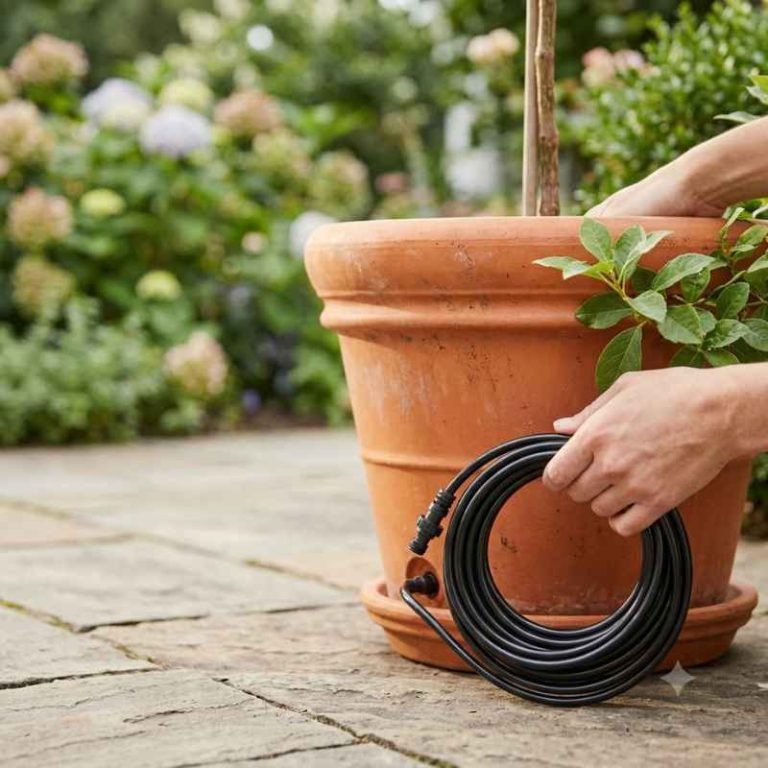
Sprinkler Heads vs Drip Lines for New Landscape Plantings
For new plantings, sprinkler heads cover more ground and fit turf or wide, open beds. Drip lines aim at the root zone and usually suit new beds with mulch and tighter plant groupings. New plantings need steady moisture during establishment while roots spread, so the right system depends on plant type, bed geometry, soil, and zone layout.
This guide is part of our Irrigation systems for home gardens series.
Sprinkler heads vs drip lines for new plantings


| Factor | Sprinkler heads | drip lines for new landscape plantings | Winner |
|---|---|---|---|
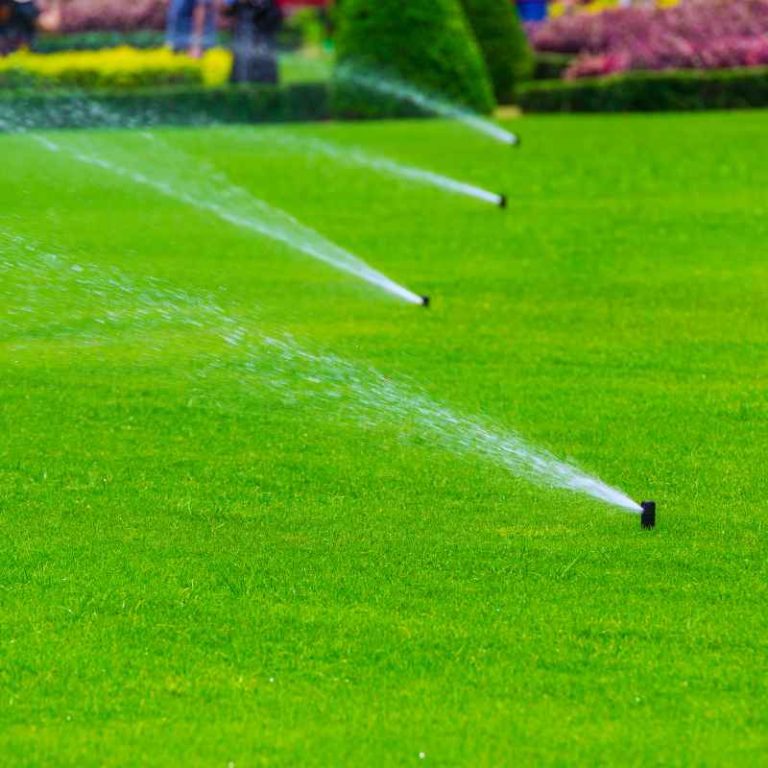
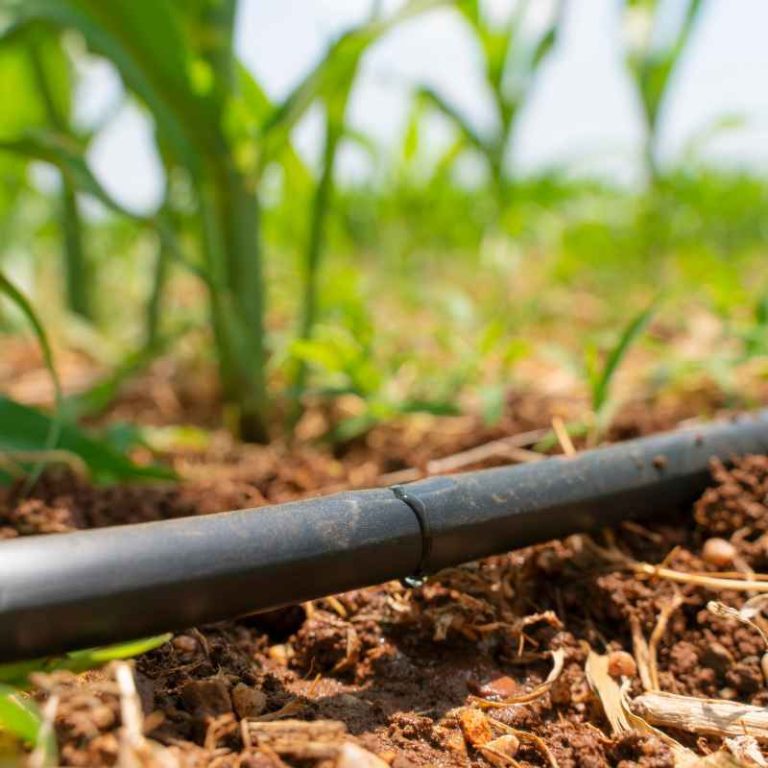
| Coverage pattern | Sprays a broader pattern across open areas and mixed edges | Applies water along a narrow line near the planting row | Sprinkler heads |
| Best fit for establishment | Useful for turf-adjacent zones and very wide beds that need uniform surface wetting | Best for shrubs, perennials, trees, and groundcovers planted in beds | drip lines for new landscape plantings |
| Pressure and filtration needs | Tolerates standard sprinkler pressure and less filtration demand; less sensitive to debris | Usually needs lower operating pressure, cleaner water, a regulator, and a filter to keep emitters from clogging | Sprinkler heads |
| Overspray and wasted water risk | Higher risk near hardscape, trunks, and windy sites; sprinkler spray can drift and wet mulch or hardscape | Lower risk when line placement is correct and emitters stay clear; keeps water close to the root zone | drip lines for new landscape plantings |
| Mulch and bed compatibility | Can be disrupted by tall mulch or irregular bed edges; deep mulch can interfere with sprinkler distribution | Works well under mulch when lines are placed correctly | drip lines for new landscape plantings |
| Best fit by plant type | Can make sense for dense planting only when spray coverage overlaps evenly | Best for shrubs, perennials, trees, and groundcovers; closely spaced plants often benefit from drip | drip lines for new landscape plantings |
| Large mixed beds and lawn edges | Still makes sense at lawn edges and in broad planting zones designed around spray coverage | Better for bed zones without treating them like turf | Sprinkler heads |
| Soil and slope suitability | Loam is easy for either system when layout and pressure are correct | Clay and slope are conditions where drip often works well; sandy soil can also work with matched emitter spacing and run time | drip lines for new landscape plantings |
| Zoning with lawns and beds | A lawn zone can run on sprinkler heads | A bed zone can run on drip lines without forcing one watering style to compromise the other | Tie |
| Establishment watering target | Works best when the planting area is broad and open enough that spray lands where it should | Keeps moisture where roots are forming and helps prevent the root ball from drying out | drip lines for new landscape plantings |
Coverage pattern
Sprinkler heads win when the planting area is broad and open enough that spray lands where it should. Drip lines win when the bed is narrow, curved, or built around separate plants that need water at the root zone instead of across the whole surface.
Best fit for establishment
New plantings are not all watered the same way. Shrubs, perennials, trees, and groundcovers root at different depths, so a bed-by-bed plan works better than treating every zone like turf.
Pressure and filtration needs
Drip asks more from the design. It needs clean water, a regulator, and a filter that keeps emitters from clogging. Sprinkler heads are less sensitive to debris, which is why they are easier to use on rougher water sources, though they still need correct pressure and spacing.
Overspray and wasted water risk
Sprinkler spray can drift in wind, wet trunks, and throw water onto mulch or hardscape. Drip keeps water close to the root zone, so it usually wastes less on exposed surfaces when the bed is laid out well.
Mulch and bed compatibility
Mulch can help slow evaporation, but deep mulch can bury drip lines too far and interfere with sprinkler distribution. The system choice changes with that detail, because the best irrigation plan is the one that still works after the bed is finished.
Which system fits your plantings?
For many new planting beds, drip lines are often the better default for shrubs, perennials, trees, and mixed plantings because they keep moisture where roots are forming. Sprinkler heads can make more sense when the bed is very wide, the planting is dense enough to need more even surface wetting, or the zone is really a turf edge with temporary establishment watering.
New shrubs and small trees
Drip lines usually do a better job of keeping the root ball and surrounding soil moist without soaking the whole bed. That matters because a newly planted shrub or small tree can dry out at the root ball even when the top of the bed looks wet.
Perennials and groundcovers
Closely spaced plants often benefit from drip because the wetting pattern can be matched to the row or cluster. Sprinkler heads work only when the planting is dense enough that spray coverage overlaps evenly and does not blast soil away from crowns.
Large mixed beds and lawn edges
Sprinkler heads still make sense at lawn edges and in broad planting zones that are designed around spray coverage. They are also easier to stage as a temporary system when the bed is changing shape and the final plant spacing is not settled yet.

How much water do new plantings need at first?
New plantings need consistent moisture during establishment, but the goal is not constant saturation. The first priority is to keep the root ball from drying out, then to widen the wetted area as roots extend into the surrounding soil.
First-week and first-month watering goals
During the first week, the root ball should stay evenly moist, especially for recently transplanted shrubs and trees. In the first month, watering should still be frequent enough to prevent stress, but the soak should begin to reach beyond the original root ball so roots can move outward rather than staying concentrated in place.
How root depth changes the schedule
Shallow-rooted perennials and groundcovers usually need more frequent, lighter watering early on. Trees and larger shrubs need slower, deeper watering that reaches below the surface and supports downward root growth.
What dry root balls look like in the field
A dry root ball often feels lighter than surrounding soil, pulls away from the planting hole, or looks dry even when the mulch surface is damp. That is one of the classic establishment failures, and it happens more often when the system wets the bed surface instead of the transplant zone.
How do soil texture and slope change the choice?
Soil texture changes how fast water enters the ground and how far it spreads sideways. Sandy soil drains faster, loam is easier to manage, and clay holds water longer but is more likely to shed water or run off on a slope, which changes whether sprinkler heads or drip lines fit better.
Sandy soil
Sandy soil often needs tighter watering intervals because it drains quickly. Drip lines can work well if emitter spacing and run time are matched to the spread pattern, but the design has to keep water near the root zone long enough to matter.
Loamy soil
Loam is the easiest soil for either system when the layout and pressure are correct. It allows enough spread for drip lines and enough uniformity for sprinkler heads without forcing the designer to fight extreme runoff or excessive drainage.
Clay soil and sloped beds
Clay and slope are conditions where drip often works well. Shorter cycles help avoid runoff, and keeping water at the root zone gives the plant a better chance to absorb moisture before it moves downhill or pools on the surface.
How should you zone a new yard with lawns and beds?
Separate turf from planting beds whenever their flow needs or run times differ. Group zones by water demand and pressure, not by yard size alone, so lawns, shrubs, trees, and groundcovers can each get the schedule and hardware they actually need.
Separate turf from beds
Turf and planting beds usually want different application patterns. A lawn zone can run on sprinkler heads, while a bed zone can run on drip lines without forcing one watering style to compromise the other.
Group zones by flow and pressure
Zone valve layout should keep same-pressure equipment together. The system described in that pilot study used a controller, a pump or water connection, valves, and sprinklers or drip emitters, with electromagnetic valves controlling distribution and a rain sensor available for automation.
Leave room for future expansion
A new yard often changes after the first season. If the valve layout is cramped, adding another bed or separating a high-flow zone later becomes harder and more expensive than planning for it up front.
Pressure regulation, filtration, and mulch placement
Drip lines usually operate at lower pressure than sprinkler heads, and they are less forgiving of dirty water. Mixed systems often need regulators and filters because one zone may be built for spray while another depends on clean, low-flow emitters that clog if debris gets through.
Typical operating pressure differences
Sprinkler heads are generally used for higher-pressure spray zones, while drip lines typically need lower pressure and steadier flow. If drip and spray share the wrong plumbing path, the drip side can fail from overpressure or the sprinkler side can underperform from too much restriction.
When regulators and filters are required
Use a pressure regulator on drip zones and add filtration when the water source carries sediment. Well-water setups deserve extra attention here, because emitter clogging can quickly reduce uniform watering during establishment.
Mulch depth, emitter burial, and interference
Mulch improves efficiency by reducing evaporation, but too much mulch can bury drip components and interfere with sprinkler patterns. Keep drip lines positioned where they can still be inspected, and avoid building the mulch so high that spray hits a soft barrier instead of the planted area.
Decision matrix: plant type, soil, bed width, slope, and pressure
This matrix is the practical shortcut. Match the plant type, soil, bed geometry, slope, and source pressure to the system that can wet the right root zone without creating a second problem, such as runoff, overspray, or emitter clogging.
| Plant type | Soil texture | Bed width / slope / source pressure | Recommended setup |
|---|---|---|---|
| Shrubs | Sandy | Narrow to medium bed, flat, steady pressure | Drip lines with tighter emitter spacing and shorter watering intervals |
| Shrubs | Loamy | Medium bed, flat or mild slope, normal pressure | Drip lines under mulch, grouped by zone with filtration and a regulator |
| Perennials and groundcovers | Loamy | Medium to wide bed, flat, moderate pressure | Drip lines if plants are in rows or clusters; sprinkler heads only if coverage must be broad and even |
| Small trees | Clay | Wide bed, slope present, pressure varies | Drip lines with short cycles to reduce runoff and keep water near the root ball |
| Groundcovers | Loamy | Very dense planting, broad flat bed, stable pressure | Either system can work; choose sprinkler heads only if the coverage pattern is uniform and hardscape risk is low |
| Turf edges | Any manageable soil | Wide edge zone, open exposure, higher flow need | Sprinkler heads, usually on their own zone |
How to read the matrix
If the bed is narrow and the plants are spaced, drip lines usually win. If the planting is broad, open, and surface coverage matters more than root-zone precision, sprinkler heads can be the better tool.
Choose sprinkler heads if… / Choose drip lines if…
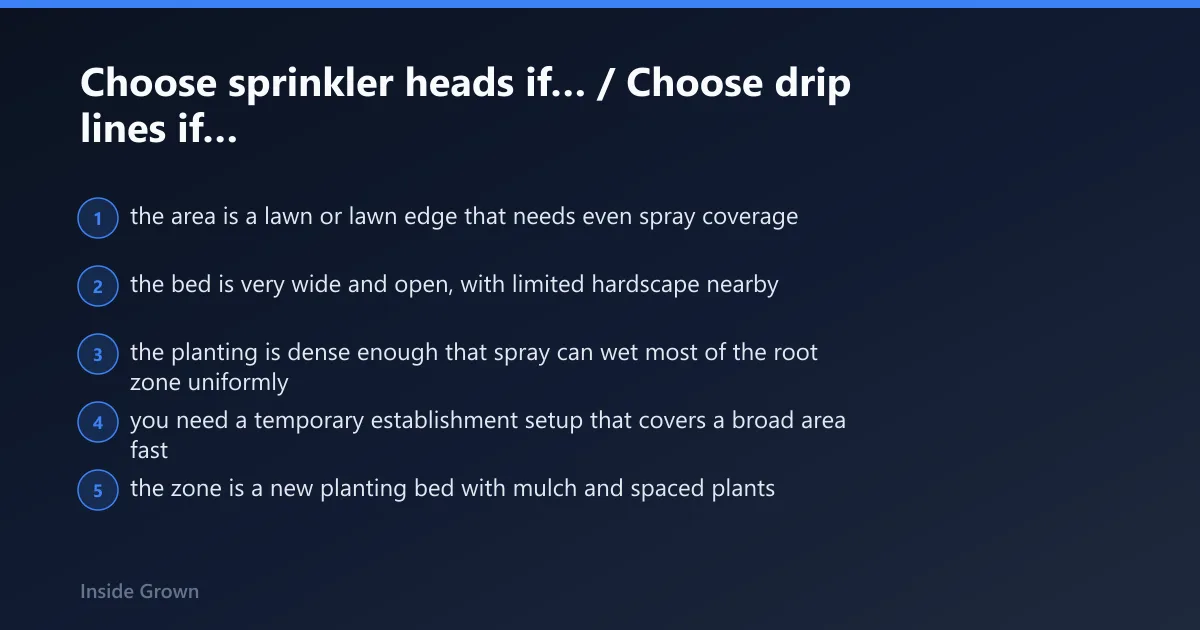
Choose sprinkler heads if the zone is turf-adjacent, the bed is wide and open, or the establishment plan needs quick coverage over a large area. Choose drip lines if the planting bed contains shrubs, perennials, trees, or groundcovers that need water held at the root zone and kept off hardscape.
Choose sprinkler heads if…
- the area is a lawn or lawn edge that needs even spray coverage
- the bed is very wide and open, with limited hardscape nearby
- the planting is dense enough that spray can wet most of the root zone uniformly
- you need a temporary establishment setup that covers a broad area fast
Choose drip lines if…
- the zone is a new planting bed with mulch and spaced plants
- you need to keep water at the root ball and reduce overspray
- the soil drains quickly, the bed is sloped, or runoff is a concern
- the water source benefits from filtration and pressure control
When a mixed system is the right answer
A mixed system can be the right answer when a yard contains both turf and beds, or when the layout calls for different run times and pressure needs. The cleanest design is often a sprinkler zone for lawn and a drip zone for beds, each with its own valve and its own watering schedule.
Frequently asked questions
Should I use sprinkler heads or drip lines for new plantings?
Use drip lines for many new plantings, especially shrubs, perennials, trees, and mixed beds with mulch. Use sprinkler heads when the planting behaves more like a wide, dense groundcover area or a turf edge that needs broad, even coverage across most of the root zone.
Which is better for newly planted shrubs and perennials, drip or sprinklers?
Drip is usually better for newly planted shrubs and perennials because it places water near the root ball without soaking the whole bed. That makes it easier to keep transplant moisture steady while limiting overspray onto mulch, trunks, sidewalks, and other hardscape.
Can I mix sprinkler heads and drip lines in the same new yard?
Yes, and in many yards that is the best long-term answer. Put turf on sprinkler zones and planting beds on drip zones, then group equipment by flow and pressure so each area gets the schedule and hardware it needs without forcing compromises.
How much water do new plantings need at first?
New plantings need frequent, consistent moisture at first, especially during the first week after planting. The root ball should stay moist while roots begin to move outward, then watering can shift toward deeper, less frequent cycles as establishment progresses.
Do sprinkler heads waste more water than drip lines?
Sprinkler heads usually waste more water in beds because spray can drift, overshoot, or wet hardscape and trunks. Drip lines keep water closer to the root zone, but they only beat sprinklers when the lines are filtered, regulated, and placed correctly under the mulch.
When should I switch new plantings from drip to sprinklers or vice versa?
Switch from temporary establishment watering to the permanent setup once the roots have filled out and the bed no longer needs special root-ball targeting. If the final yard includes both turf and planting beds, keep a mixed system instead of forcing one method to do both jobs.