How to Water Newly Planted Shrubs with a Drip System
Water newly planted shrubs with drip by placing about two emitters at the root-ball edge and following the establishment schedule below, adjusting for soil moisture and rainfall. Too little water leaves new roots dry and stalled; too much keeps the root ball soggy, which slows rooting and can kill the shrub. This guide turns shrub size and soil type into emitter count, placement, runtime, and a timer-ready schedule.
Why new shrubs need drip water


Newly planted shrubs spend their first months pushing roots into the surrounding soil. Until that happens, the root ball can dry faster than the rest of the bed, especially when the shrub came from a container and was set into looser backfill. Drip irrigation keeps the root zone evenly moist without blasting water across leaves, bark, or the whole yard.
Drip also keeps water where it matters most: the root zone. Overhead sprinklers wet more surface area than a young shrub can use, and that extra water often evaporates or lands where roots are not yet active. A soaker hose or drip line can deliver water slowly enough for the soil to absorb it instead of sending runoff downhill.
After the first year, watering usually shifts from frequent establishment cycles to deeper, less frequent irrigation. The goal is still the same: keep the root zone from swinging between bone dry and waterlogged while the shrub extends roots outward.
How often should you water?
Use a tighter schedule right after planting, then stretch the interval as roots move outward. The default cadence is daily for the first two weeks, every 2–3 days for weeks 3–12, and weekly after week 12 until the shrub is established. Rainfall and soil moisture always override the timer.
First 1–2 weeks
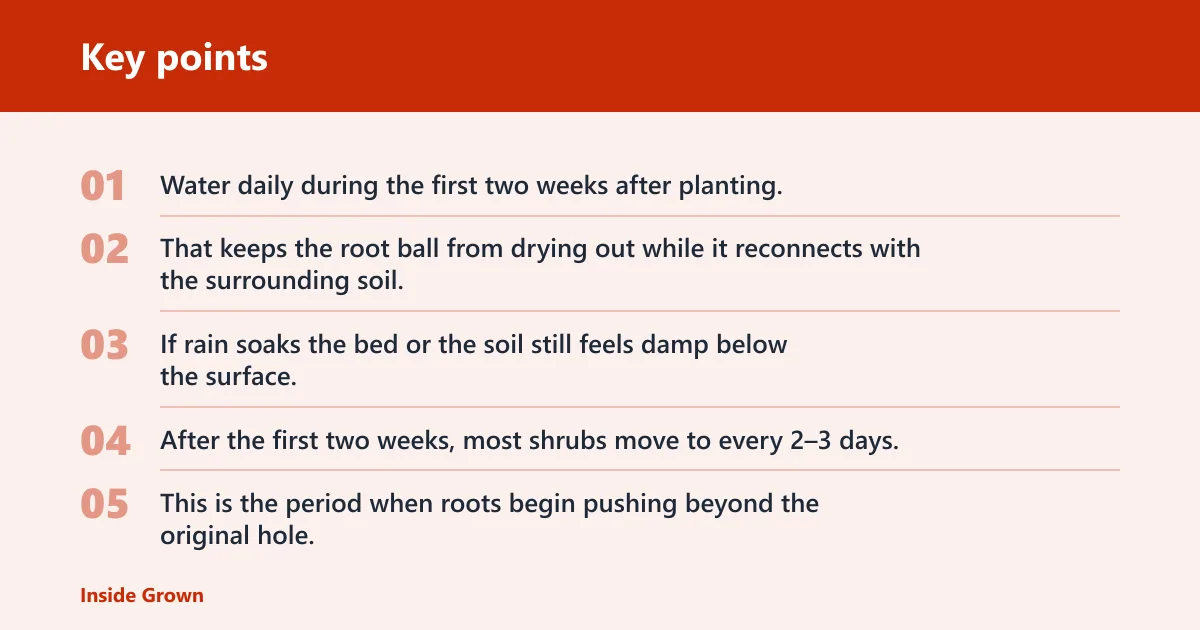
Water daily during the first two weeks after planting. That keeps the root ball from drying out while it reconnects with the surrounding soil. If rain soaks the bed or the soil still feels damp below the surface, skip that cycle rather than stacking extra runtime on top of wet ground.
Weeks 3–12
After the first two weeks, most shrubs move to every 2–3 days. This is the period when roots begin pushing beyond the original hole, so moisture still needs to reach both the root ball and the soil just outside it. In clay, the interval often stretches sooner; in sandy soil, it may need to stay on the shorter side.
After establishment
After week 12, weekly watering is the default until the shrub is established. At that point, the root system should be larger and better able to use deeper moisture. The schedule still changes with heat, rainfall, and drainage, but you no longer need the same tight establishment cycle.
Rain and moisture exceptions
Check the soil before every cycle. A common shrub-watering check is to inspect the top six to eight inches of soil. In clay, check about 6 inches deep before watering; if it still feels damp, wait. In sandy soil, expect water to move through faster and check more often after a hot, windy stretch.
How much water does each shrub need?
For nursery shrubs, a practical starting point is 25–30% of the purchase pot volume per watering. A shrub bought in a 3-gallon container needs about 0.75–1 gallon per session. That gives you a concrete target before you translate gallons into emitter count and runtime.
Root-ball size matters too. The larger the root ball or container at purchase, the more emitters you usually need to spread water across the active root zone. Smaller shrubs can often start with two low-flow emitters; larger shrubs need more points around the perimeter so water does not pool against one side.
Match emitter count to shrub size
Think in terms of coverage, not one emitter per shrub by default. Two emitters work for many small transplants, but medium shrubs often need three or four to wet the root ball evenly. The goal is a ring of moisture that reaches the absorbing roots, not a single wet spot near the trunk.
Translate gallons into minutes
Drip runtime is just gallons needed divided by total flow. If a shrub needs 1 gallon and you use two 1-gph emitters, you need about 30 minutes. If you use two 0.5-gph emitters, the same gallon takes about 60 minutes. If you use two 2-gph emitters, it takes about 15 minutes.
Shrub drip watering calculator
Use this table to convert shrub size into a timer setting. It assumes emitters are placed around the root ball, not next to the trunk, and that the total water per session stays near the container-volume target. These are starting points; clay soil often needs longer wait times between sessions, while sandy soil often needs the shorter interval but careful follow-up.
| Shrub size or root-ball diameter | Assumed emitter flow | Recommended emitter count | Estimated minutes per session | Adjustment notes for clay or sandy soil |
|---|---|---|---|---|
| Small shrub, 8–12 inch root ball | 0.5 gph | 2 emitters | 45–60 minutes | Clay: shorten the run if the soil stays damp below 6 inches. Sandy: keep the same run time but check more often. |
| Small shrub, 8–12 inch root ball | 1 gph | 2 emitters | 20–30 minutes | Clay: split into shorter cycles if water ponds. Sandy: may need the higher end of the range. |
| Small shrub, 8–12 inch root ball | 2 gph | 2 emitters | 10–15 minutes | Clay: watch for runoff and reduce runtime. Sandy: this may be too short unless you water more often. |
| Medium shrub, 14–18 inch root ball | 0.5 gph | 3 emitters | 50–70 minutes | Clay: keep emitters farther apart and avoid long single runs. Sandy: water more frequently, not longer in one shot. |
| Medium shrub, 14–18 inch root ball | 1 gph | 3 emitters | 20–35 minutes | Clay: test soil depth before repeating. Sandy: check the next morning for early drying. |
| Medium shrub, 14–18 inch root ball | 2 gph | 3 emitters | 10–18 minutes | Clay: use caution on slopes and compacted beds. Sandy: may require two sessions per watering day. |
| Large shrub, 20–24 inch root ball | 1 gph | 4 emitters | 25–40 minutes | Clay: avoid one long soak if drainage is slow. Sandy: keep the root zone ring wide enough that water does not miss the outer roots. |
| Large shrub, 20–24 inch root ball | 2 gph | 4 emitters | 12–20 minutes | Clay: shorten runtime and wait longer between waterings. Sandy: split into two shorter cycles if water disappears too quickly. |
Say your shrub came in a 3-gallon pot and is set into loamy soil. Two 1-gph emitters give you about 1 gallon in 30 minutes, which fits the starting target well. If the bed dries fast in afternoon heat, keep the same runtime and shorten the gap between sessions instead of raising the minutes blindly.
Where should emitters go?
Place emitters around the root zone, not against the trunk. The best target is near the root-ball edge at planting, then farther out as the shrub grows. That keeps water where active roots can find it and reduces the chance of trunk-adjacent wetting, bark rot, and shallow rooting.
Set emitters around the root zone
Start with two emitters on opposite sides of the root ball for smaller shrubs. For larger shrubs, use three or four emitters spaced around the perimeter so the wetting pattern forms a ring. As roots spread, adjust the emitters gradually outward while keeping water near the active root zone.
Avoid trunk-adjacent wetting
A common first-timer mistake is putting the emitters right at the stem because it looks tidy. That wets bark instead of feeding roots. Keep the wetting points a few inches out from the trunk at planting, then push the ring outward over time. If the stem stays wet, the planting is too tight.
Set up the drip line
Most home drip systems use 1/2-inch or 5/8-inch tubing for the supply line, with 1/4-inch spaghetti tubing branching to each shrub. Use compression fittings or barbed connectors to attach the smaller line, then close the ends with end caps. This lets you adjust or add emitters without rebuilding the whole line, and a backflow preventer is also a standard component in many systems.
- Run the main supply tubing to the shrub bed.
- Install a filter before the pressure reducer when the water source carries debris, especially with well water.
- Add the 30 psi pressure reducer after the filter in a typical setup.
- Branch off with 1/4-inch spaghetti tubing to each shrub.
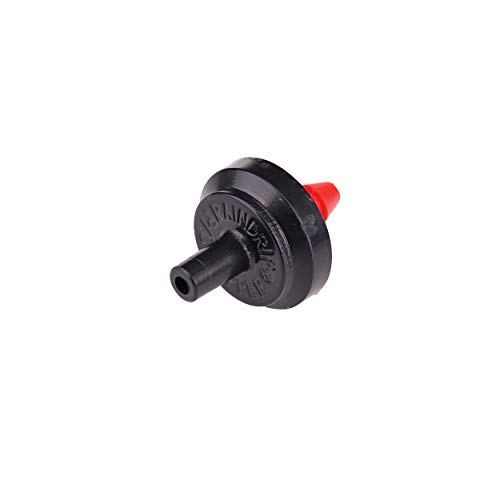
- Attach emitters near the root-ball edge with barbed connectors.
- Finish the run with end caps and test for leaks.
A pressure reducer protects emitters from excessive pressure, which matters because drip parts are designed for low-pressure flow. A filter helps prevent clogging from debris. In municipal systems the water may be cleaner, but a filter still helps protect small passages; on well water, it becomes even more important.
How do soil type and mulch change the schedule?
Clay soil holds water longer, so it usually needs slower drainage checks and shorter or less frequent sessions. Sandy soil drains faster, so it often needs more frequent checks and tighter timing on the schedule. Mulch reduces evaporation and keeps roots cooler, but it should stay back from the trunk bark.
Clay soil: slower drainage, shorter sessions
Clay can stay wet long after the timer stops. That is why the interval may stretch sooner in clay beds, with the soil checked 6 inches deep before watering. If the root zone is still damp, skip the cycle. Do not force a fixed timer into wet clay.
Sandy soil: faster drainage, more frequent checks
Sandy soil often needs water more often because it drains quickly and dries quickly. Keep the same gallon target, but expect to check moisture more often and use a shorter interval between sessions during hot weather. The runtime may be similar to loam, but the frequency usually rises.
Mulch depth and trunk clearance
A roughly three-inch-high berm around the planting area can help hold water where it belongs, and the berm’s outer edge should align with the shrub’s canopy. Add mulch over the wetted root zone to reduce evaporation, but keep mulch a few inches away from the trunk so bark stays dry and air can move around the stem.
How do you know if it is too much?
Check the soil 6–8 inches deep before repeating a cycle. If it is damp there and the shrub still looks fine, wait. Overwatering usually shows up as persistently wet soil, sour-smelling ground, yellowing leaves, and growth that stalls because roots cannot get enough oxygen. Underwatering shows as wilting, leaf curl, and dry soil that pulls away from the planting hole.
Picture a newly planted medium shrub in clay soil with three 1-gph emitters. If runoff starts after 15 minutes, the problem is not that the shrub needs more water; it is that the soil is taking water too fast at the surface and too slowly below. Shorter cycles, better spacing, and slower repeat intervals fix that better than a longer single soak.
If rainfall interrupts the schedule, check the bed before the next run. A dry-looking mulch layer can hide wet soil underneath. The timer is only a starting point; the 6–8 inch moisture check decides whether the next watering happens.
Frequently asked questions
How often should I water newly planted shrubs with drip irrigation?
Use daily watering for the first two weeks after planting, every 2–3 days from weeks 3–12, and weekly after week 12 until the shrub is established. In clay soil, the interval may be longer once the soil stays damp at 6 inches deep. Always check moisture first.
How many gallons should a newly planted shrub get per watering?
A good starting point is 25–30% of the purchase pot volume per watering. A shrub bought in a 3-gallon container needs about 0.75–1 gallon per session. Larger shrubs usually need more emitters rather than a single higher-flow emitter near the stem.
Should drip emitters go near the trunk or at the drip line?
Put emitters around the root zone and build outward from the root-ball edge. Do not park them against the trunk, because that wets bark instead of feeding roots. As the shrub establishes, move the wet ring outward toward the canopy edge and keep the trunk area dry.
How long should I run a drip system for new shrubs?
Runtime depends on emitter flow and count. Two 1-gph emitters deliver about 1 gallon in 30 minutes. Two 0.5-gph emitters need about 60 minutes for the same gallon, while two 2-gph emitters need about 15 minutes. Use the table above to match runtime to shrub size and soil type.
Do newly planted shrubs need different watering in clay soil?
Yes. Clay soil holds water longer, so it may need less frequent watering once the soil stays evenly moist, with the soil checked about 6 inches deep before any repeat cycle. If the soil is still damp, wait. Clay calls for slower drainage checks and less aggressive timer settings than sandy soil.
Can I use a drip system instead of overhead sprinklers for shrubs?
Yes. Drip irrigation is a better fit for shrubs than overhead sprinklers because it targets the root zone and avoids wetting leaves and trunks unnecessarily. It also makes it easier to match runtime to gallons per session, which is hard to do with spray heads.