Irrigation Run Time Calculator
Use an irrigation run time calculator: minutes per zone = (target gallons ÷ zone flow in GPH) × 60; start with about 30 minutes for turf and 20–40 minutes for drip, then adjust for soil and plant type. Wrong runtimes waste water, stress roots, and leave dry or soggy spots. This guide shows how to measure flow, set zone-specific minutes for sprinklers and drip, and fine-tune by soil behavior.
How is this calculated?
Press Calculate to see the math with your numbers.
What irrigation runtime means
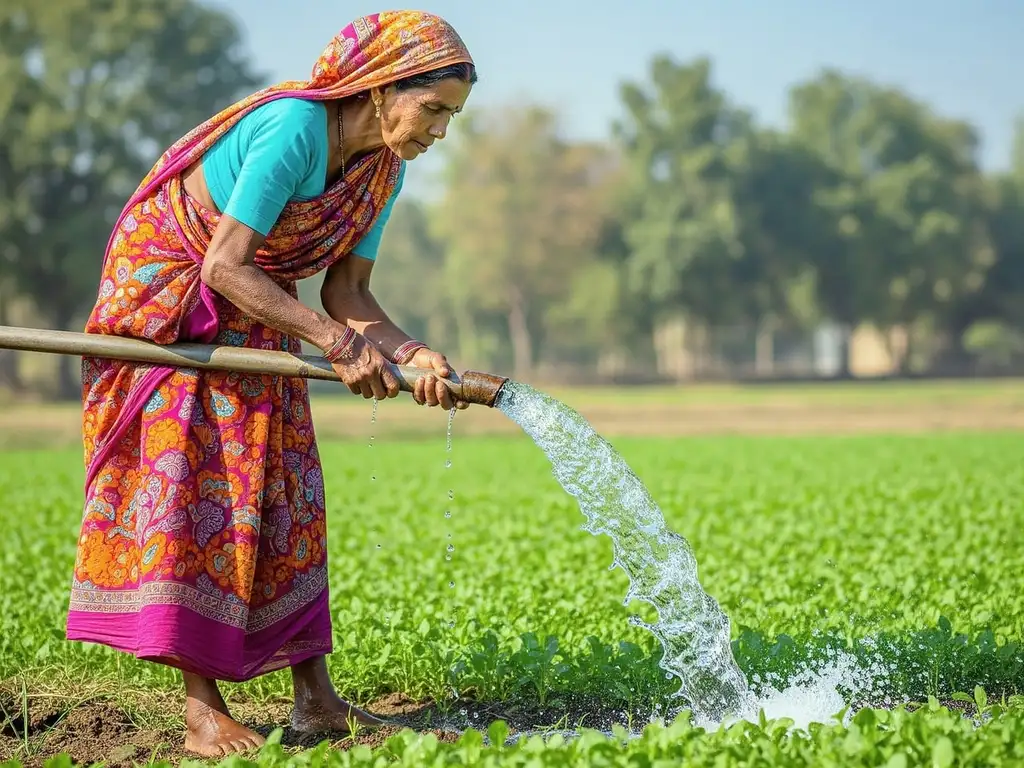


Irrigation runtime is the number of minutes a zone should run for one watering event. It depends on measured flow, the amount of water the plants need, and how evenly that water reaches the root zone. A sprinkler zone and a drip zone usually need different math because they deliver water in different ways.
Why flow rate changes the answer
If a zone flows fast, it reaches the target depth sooner. If it flows slowly, it needs more minutes. That sounds simple, but guessing often causes trouble because one timer setting can leave one zone dry and another soaked.
Use measured flow, not a guess. For sprinklers, that may mean nozzle flow or measured precipitation rate across a zone. For drip, it means emitter flow, either in L/hr or gal/hr, multiplied by the number of emitters.
Sprinkler and drip use different math
Sprinkler zones are usually planned around area and precipitation rate. Drip zones are usually planned around emitter count, emitter flow, and the wetting pattern around each plant. The controller timer may look the same, but the calculation inputs are not the same.
One common mistake is applying a lawn schedule to a shrub bed. Another is assuming a drip line with many emitters needs the same runtime as a few spray heads. It usually does not.
What you need before you calculate
Before you set minutes, gather four things: measured flow rate, target depth per event, plant type and root zone, and recent rainfall. Soil intake matters too, because a zone that cannot absorb water quickly enough may need split cycles even if the total runtime is correct.
Measured flow rate
Flow rate is the water delivered by the zone, in gpm, L/min, nozzle flow, emitter flow rate, or measured precipitation rate. Do not rely on the timer label alone. Check the actual zone output, because the right runtime comes from the hardware, not from the dial.
Target depth per event
Target depth per event is the amount of water you want to apply at one watering, usually based on plant water demand and root depth. The calculator can work from that target depth directly, or from ETo plus crop coefficient when you want a weather-based demand estimate.
Plant type and root zone
Use separate timing logic for cool-season turf, warm-season turf, shrub beds, vegetable beds, and young trees. Those zones hold water differently and use it differently. A shallow-rooted bed can need shorter, more frequent events than a deeper-rooted tree zone.
Rainfall and soil intake
Effective rain reduces the next watering need. Weekly rainfall checks matter because a storm can erase part of the planned runtime. Soil intake matters too: tight clay or sloped ground often cannot take a long run in one shot, so the same total minutes may need to be split.
How do you calculate irrigation runtime?
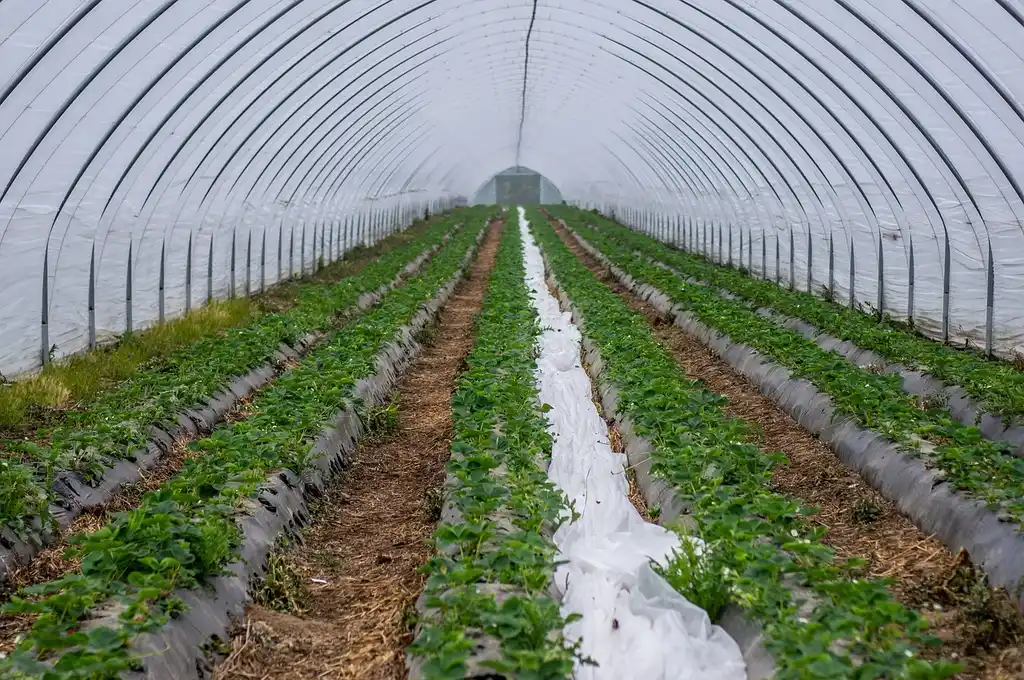
Start with the target water amount for the zone, then divide by the zone’s measured flow, and convert to minutes. If you are using ETo plus crop coefficient, that demand estimate tells you the target depth. If you are using direct depth, the result is the same: minutes per watering event.
Target depth formula
A simple planning formula is: runtime = target water volume ÷ flow rate, with unit conversion to minutes. In other words, gallons ÷ gpm = minutes. For example, if a zone needs about 30 gallons and the zone flow is about 3 gallons per minute, the runtime is about 10 minutes. If the same zone flows at 1.5 gpm, the runtime doubles.
For area-based planning, convert the depth into volume first. That is the cleanest way to move from inches or millimeters of water to minutes on a specific zone.
ETo plus crop coefficient path
ETo means reference evapotranspiration, a weather-based estimate of how much water is leaving the landscape. Crop coefficient adjusts that reference value for the plant type and hydrozone. Use this path when you want a schedule based on weather and plant demand instead of a fixed depth guess. The final runtime still depends on measured flow and efficiency.
Lower efficiency or poor uniformity means more runtime is needed to deliver the same effective water to the driest part of the zone. That is why field-audit values matter. A zone with weak distribution needs a longer setting than a uniform zone delivering the same nominal gallons.
Short worked example
Suppose a shrub bed needs about 18 gallons per event and the drip zone flows at about 0.75 gpm. That zone needs 24 minutes total. If the bed sits on a slope and starts to puddle after 12 minutes, split the run into two 12-minute cycles with a pause between them.
Picture a vegetable bed with wider spacing and a hotter week. If rainfall has already covered part of the weekly demand, the next runtime should be shorter than last week’s. The right answer changes with weather, plant growth, and the measured zone flow.
Do drip and sprinkler zones use the same runtime?
No. Drip and sprinkler zones should be calculated separately because the water delivery method is different. Drip uses emitter count and emitter flow. Sprinklers use nozzle flow, head spacing, and arc coverage. Mixing them on one schedule often leaves one area under-watered and another over-watered.
Drip: emitter count and emitter flow
For drip, total zone flow is the sum of all emitters or the inline dripline flow rate. Many products list emitter flow in L/hr or gal/hr. Count the emitters, multiply by flow per emitter, then convert that total to a runtime for the target depth.
How long should drip irrigation run? Long enough to wet the root zone, but short enough to keep water in the root area and out of runoff or deep drainage. For many drip zones, that means shorter runtimes than sprinklers, but more frequent events can be needed in hot weather.
Sprinkler: nozzle flow and head spacing
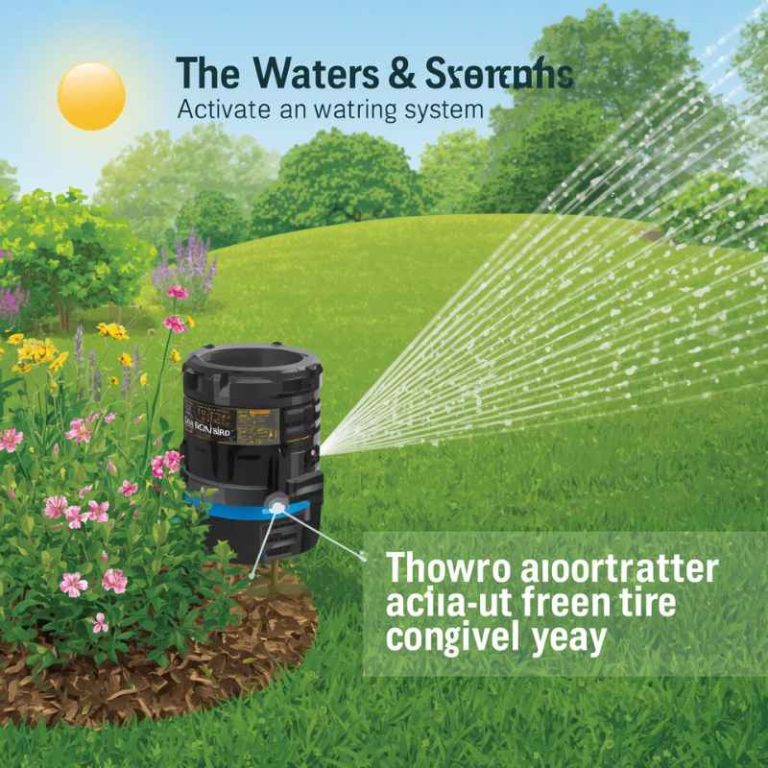
Sprinkler zones depend on nozzle flow, head spacing, and how evenly each arc overlaps the next one. If you change nozzle type or pressure, the precipitation rate changes too. That means the same minute setting may no longer match the zone’s actual output.
Mixed zones need separate timing
Do not run spray heads and drip emitters on the same minute setting unless the math is checked for both. A mixed zone should usually be split into separate zones. If that is impossible, use the most conservative runtime and verify coverage closely.
Runtime decision table
This table gives a zone-by-zone starting point. Use it as a field guide, not a permanent schedule. Fair uniformity means the zone is watering reasonably evenly across the target area, not perfectly but without obvious dry and wet extremes. The warning signs tell you when the calculated runtime needs a retest.
| Zone type | Sample inputs | Estimated runtime range | Split into cycles when | Retest warning signs |
|---|---|---|---|---|
| Lawn | Sprinkler zone, measured precipitation rate 1.0 to 1.5 in/hr, moderate ETo demand, fair uniformity | 25 to 35 minutes | Runoff begins before the full target depth is applied, or the slope sheds water after 10 to 15 minutes | Dry rings, gray blade color, puddles near heads, striping after watering |
| Shrub bed | Drip zone, counted emitters, emitter flow in L/hr or gal/hr, lower plant density, mulch cover | 20 to 40 minutes | Water pools under emitters or moves laterally too slowly in tight soil | Wilted tips, dry soil under mulch, soggy spots around some plants, uneven growth |
| Vegetable bed | Drip or micro-spray, higher water demand, active growth, weekly rainfall check included | 15 to 30 minutes | Topsoil seals over, beds crust, or runoff starts before the target depth is reached | Leaf curl during heat, dry rows between emitters, algae or oversaturation near the line |
| Young tree | Drip ring or basin layout, few emitters, deeper root target, lower frequency with longer soak | 30 to 60 minutes | Soil can absorb only short bursts, or the basin edge overflows before the root zone is wet | Wilting after watering, water escaping the basin, dry soil at the root ball edge |
How often to run drip irrigation
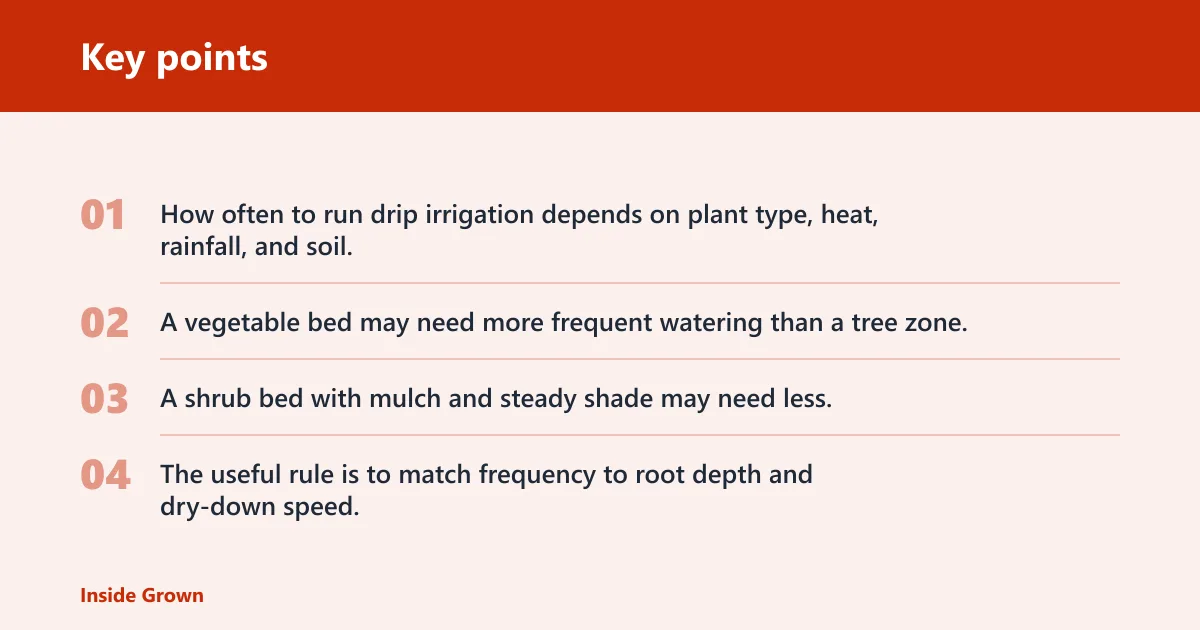
How often to run drip irrigation depends on plant type, heat, rainfall, and soil. A vegetable bed may need more frequent watering than a tree zone. A shrub bed with mulch and steady shade may need less. The useful rule is to match frequency to root depth and dry-down speed.
When should you split a run?
Split a run when the soil cannot absorb water as fast as the system applies it. That happens most often on slopes, in tight clay, with heavy spray application, or when the zone is pushing past its cycle-soak limit. Shorter cycles reduce runoff and improve infiltration.
Cycle-soak limit
The cycle-soak limit is the pause interval and maximum continuous run that keeps water on the root zone instead of washing off the surface. If water starts to move downhill, collect in low spots, or escape the bed edge, the zone likely needs shorter cycles and more total pause time. The pause should be long enough for the soil surface to absorb the first cycle before the next begins.
When longer runs waste water
Longer runs waste water when the extra minutes push moisture below the root zone or off the target area. If the surface is already saturated and the plant still needs more water, split the total runtime into two or more cycles instead of one long block.
What if the calculated time is wrong?
When a schedule looks wrong, check hardware before changing the formula. Clogged emitters, mixed nozzle types, pressure drift, and poor coverage can all change the actual runtime need. If the field result does not match the math, retest the zone rather than adding minutes.
Clogged emitters and pressure drift
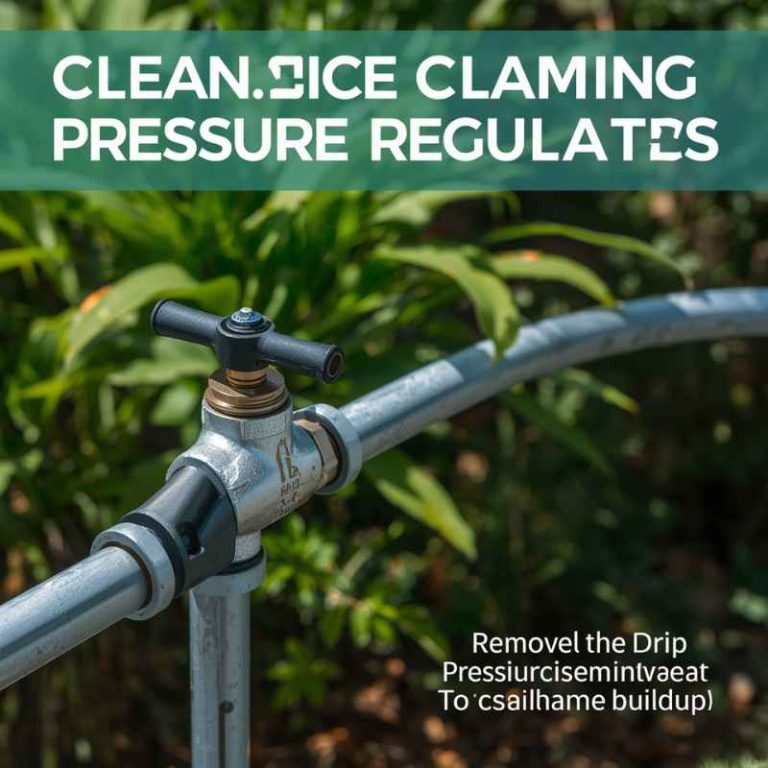
Clogged emitters reduce flow and create dry spots. Pressure drift can do the same, especially in long drip lines or zones that share a weak supply. If some plants are wet and others are dry after the same run, the system needs inspection before the timer is changed again.
Mixed nozzle types
Mixed nozzles can break precipitation balance. If nozzle types differ in flow rate, the zone should be separated or recalculated. A zone with different nozzle types may deliver water unevenly even if the total gallons look correct. That often shows up as one side of the zone turning brown while another side stays wet.
Coverage gaps and runoff clues
Look for obvious clues: dry arcs, overspray onto hardscape, puddling at the downhill edge, and water moving out of the bed before soaking in. These are not timing problems alone. They often point to layout or pressure problems that a longer runtime will not fix.
Irrigation run calculator checklist
- Check whether all emitters or heads are flowing at the expected rate.
- Look for clogged emitters, blocked nozzles, or kinked tubing.
- Confirm that nozzle types match across the zone.
- Watch for pressure drift at the start and end of the run.
- Verify that water reaches all of the root zone, not just the surface.
- If water escapes the basin, adjust emitter spacing or add a berm so the water stays in the root zone.
- Check for runoff, ponding, or overspray after the set runtime.
- Retest after rainfall, nozzle changes, or repairs.
Frequently asked questions
How long to run irrigation?
There is no single correct minute count. The right runtime depends on measured flow, target water amount, plant type, soil intake, and rainfall. For turf, many schedules start around 30 minutes as a starting point; drip zones often land lower or may need more frequent cycles. Use the zone’s actual output, not a guess.
How long to run irrigation system?
Run each zone long enough to reach the target depth for that zone. A sprinkler zone with higher precipitation rate may need fewer minutes than a drip zone with low emitter flow. If the soil starts to shed water before the target is met, split the run instead of extending it.
How many gallons per minute for irrigation?
There is no universal gpm number for irrigation. The needed flow depends on zone size, plant demand, nozzle layout, and desired depth. A lawn sprinkler zone often needs a different flow profile than a shrub bed drip zone. Measure the zone and size the runtime from that measured value.
How long to run drip irrigation?
How long to run drip irrigation depends on emitter count, emitter flow, plant size, and soil. Start by converting the total emitter output into gallons per hour or gallons per minute, then divide the target water amount by that flow. If runoff or pooling appears, shorten each cycle and add a pause.
How do I calculate irrigation run time from gallons per hour?
Convert gallons per hour into gallons per minute by dividing by 60, then divide the target gallons by that per-minute flow. For example, a 120 gal/hr drip zone works out to about 2 gal/min. If the zone needs about 10 gallons, the runtime is about 5 minutes before any efficiency or rainfall adjustment.
How do I stop drip irrigation from overwatering or underwatering?
Match the runtime to the zone’s measured flow, then check the result in the field. Use separate timing for different crops, adjust for rainfall, and split long runs if water pools. Retest after any clog, nozzle swap, pressure change, or layout change, because those can shift the true runtime fast.