How to Measure Garden Water Needs in Gallons Per Week
Measure your hose or emitter in gallons per minute, then multiply by minutes of run time and days per week: gallons per week = GPM × minutes × days. Get this wrong, and you overwater, underwater, or size zones that cannot keep up. This guide shows the bucket test, the weekly formula, and zone-by-zone examples for beds and containers.
Quick calculator: measure hose flow rate
Use this worksheet to turn a bucket test into gallons per minute and gallons per week for each zone. Enter the measured bucket volume, fill time, minutes per event, and watering days, then apply the formulas shown in the last columns.
| Zone | Measured bucket volume | Fill time | Minutes per event | Watering days per week | GPM formula | Gallons per week formula | Output: GPM | Output: gallons per week |
|---|---|---|---|---|---|---|---|---|
| Raised bed | 5 gal | 25 sec | 20 | 3 | 5 ÷ 25 × 60 | GPM × 20 × 3 | 12 | 720 |
| Container group | 5 gal | 40 sec | 15 | 5 | 5 ÷ 40 × 60 | GPM × 15 × 5 | 7.5 | 562.5 |
| Small vegetable plot | 5 gal | 30 sec | 30 | 2 | 5 ÷ 30 × 60 | GPM × 30 × 2 | 10 | 600 |
Use the worksheet as a starting point, not a universal answer. A bucket test at the faucet, a test at the end of the actual hose, and a drip zone with multiple emitters can all give different usable flow numbers because pressure loss, hose length, fittings, and emitter count change the real output.
What gallons per minute means
Gallons per minute, or GPM, is a flow rate. It tells you how many gallons move through a hose, pipe, pump, or emitter each minute, so you can turn a measured flow into a watering volume. Garden watering decisions come down to time and gallons, so the number has to be real.
Volume over time
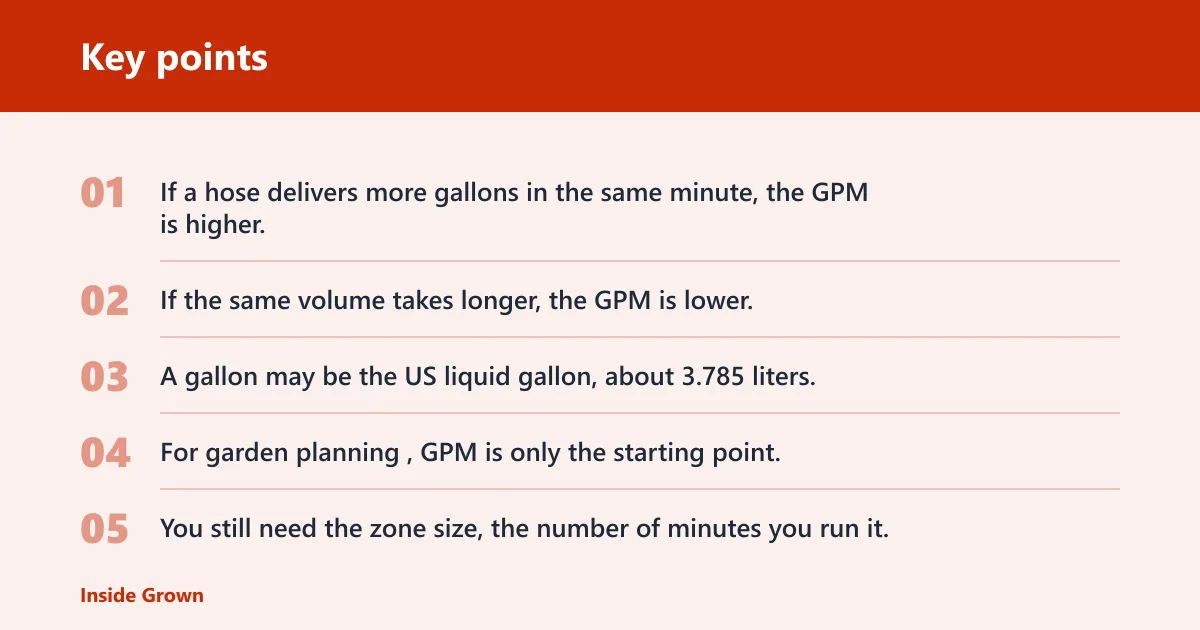
Flow rate is volume divided by time. If a hose delivers more gallons in the same minute, the GPM is higher. If the same volume takes longer, the GPM is lower. A gallon may be the US liquid gallon, about 3.785 liters.
For garden planning, GPM is only the starting point. You still need the zone size, the number of minutes you run it, and how often you water each week. Those three pieces turn a flow reading into a weekly water total you can compare with plant demand.
How do you measure hose flow?
Use a bucket test to measure hose flow, then convert the result into GPM. Fill a known-volume bucket, record the fill time in seconds, convert the bucket volume to gallons, divide gallons by seconds, and multiply by 60. That gives you gallons per minute.
Bucket test setup
- Choose a bucket with a known volume, preferably marked in gallons.
- Run the hose or emitter at the setting you plan to use.
- Time how long it takes to fill the bucket.
- Convert the bucket volume to gallons if needed.
- Divide bucket gallons by fill time in seconds.
- Multiply the result by 60 to get GPM.
Example: a 5-gallon bucket filled in about 25 seconds gives about 12 GPM. That same hose can then be used to estimate weekly water use for any bed or zone that runs at that setting.
Say your bucket fills in 40 seconds instead of 25, with the same 5-gallon bucket. The flow drops to 7.5 GPM, so any watering schedule built around 12 GPM would overshoot the actual runtime and weekly gallon total.
How do you turn GPM into weekly gallons?
To calculate gallons per week, multiply measured GPM by the minutes each zone runs and by the number of watering days per week. A common rule of thumb is weekly gallons = GPM × minutes per watering × watering days per week. If your schedule changes by zone, calculate each zone separately.
Weekly gallons formula
Start with the flow rate, then move to runtime, then frequency. That order keeps the units clean. GPM gives gallons per minute, minutes convert that flow into gallons per event, and watering days per week convert one event into a weekly total.
If a zone runs about 15 minutes at 1.5 GPM and is watered 3 days per week, the weekly total is about 67.5 gallons per week. This is the number you compare with plant demand, soil type, and rainfall gaps.
How to estimate water for drip irrigation zones
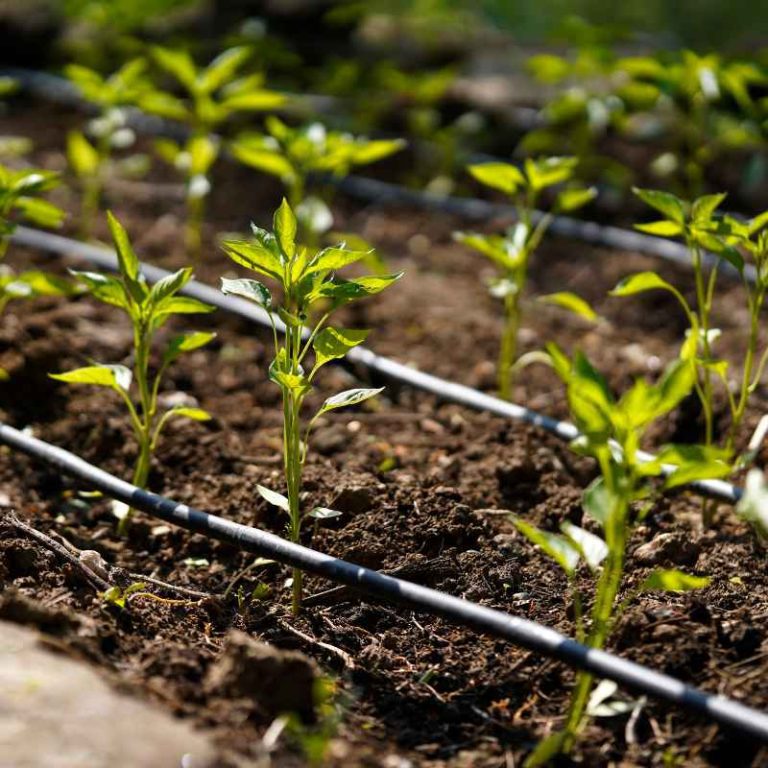
For drip irrigation, add the flow from all emitters in the zone, then multiply by runtime and watering frequency. If the zone has multiple emitters, total GPM is the sum of those emitters. Application rate matters because a slow-drip zone may need longer runtime to wet the root area evenly.
Use emitter sums instead of guessing from hose flow alone. For example, if a zone has six 0.5 GPH emitters and four 1 GPH emitters, the zone flow is 7 GPH total. That is not the same as a hose reading, but it is the correct starting point for a drip zone because the emitters, not the hose bib, determine how much water actually reaches the plants.
A common first-timer mistake is to match a drip zone to hose-flow numbers without checking emitter output. A zone with many emitters can drain faster than expected, while a sparse layout can look wet at the surface and still leave part of the root zone dry.
How do you plan irrigation zones?
Plan each zone by delivery type first: hose, spray, or drip. Then check measured GPM, the total emitter count if it is drip, the bed area, and how often the soil must be rewetted. The best zone is not the one with the highest flow; it is the one that matches the plants, the root depth, and the time available for watering.
Quick sense-check using inches of water per week
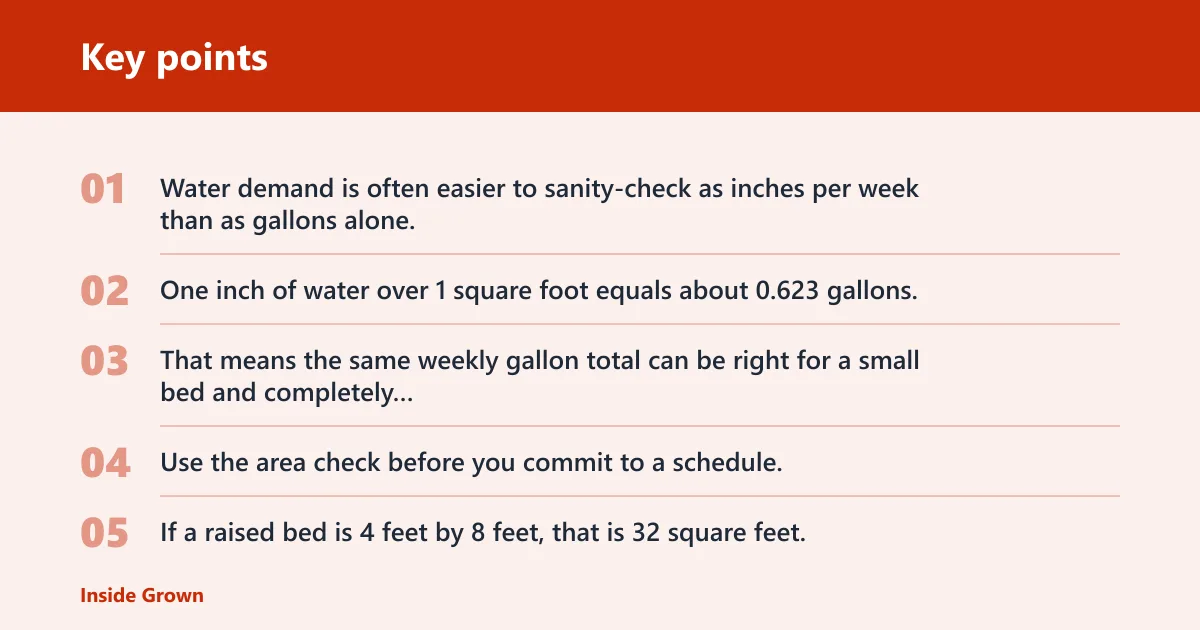
Water demand is often easier to sanity-check as inches per week than as gallons alone. One inch of water over 1 square foot equals about 0.623 gallons, and 1 acre-inch equals about 27,154 gallons. That means the same weekly gallon total can be right for a small bed and completely wrong for a larger plot.
Use the area check before you commit to a schedule. If a raised bed is 4 feet by 8 feet, that is 32 square feet, so 1 inch of water across the bed is about 20 gallons. If the weekly formula says a zone is delivering 120 gallons to that bed, the number may be reasonable only if the bed is large, the plants are heavy drinkers, or the schedule is intentionally split across several waterings.
How hose diameter, length, and pressure shift measured flow
| Factor | Typical direction of change | Why it matters | Practical note |
|---|---|---|---|
| Larger hose diameter | Higher measured flow | Less friction loss for the same pressure | Can raise GPM at the same faucet setting |
| Longer hose length | Lower measured flow | More friction loss over distance | End-of-hose readings are usually lower than faucet readings |
| Higher supply pressure | Higher measured flow, within system limits | More force pushes water through the line | Pressure losses across fittings and emitters still reduce usable flow |
These shifts are setup-dependent, so use them as guidance rather than fixed guarantees. A short hose with modest pressure can outperform a long hose at the same faucet, and a drip system with pressure-compensating emitters can behave differently from an open hose even when the starting pressure is similar.
How much water do garden zones need?
Weekly water demand depends on zone size, runtime, and watering frequency. Raised beds, container groups, and small vegetable plots can all need different schedules even when they sit in the same yard. The measured GPM tells you what the system can deliver; the zone layout tells you what it should receive.
Raised beds
Raised beds often need short, repeated runs because the soil volume is limited and the root zone dries faster than ground soil. Use the bucket-test flow to set a runtime that wets the full bed, then calculate weekly gallons from that runtime and your watering days.
Container groups
Containers usually need more frequent watering than in-ground beds because the root volume is small and exposed to heat and wind. Group the pots by shared watering needs, estimate the total emitter flow for the group, and convert that to weekly gallons so the schedule stays consistent.
Small vegetable plots
Small mixed vegetable plots often sit between beds and containers in water demand. They need enough water to reach the active root zone, but not so much that the soil stays saturated. Use zone-specific gallons per week rather than a single whole-garden number.
Three worked watering scenarios
These worked scenarios show how the same gallons-per-minute logic changes across garden types. Each one starts with a measured input, runs the math step by step, and ends with a simple under- or over-watering diagnosis.
Scenario 1: Raised bed
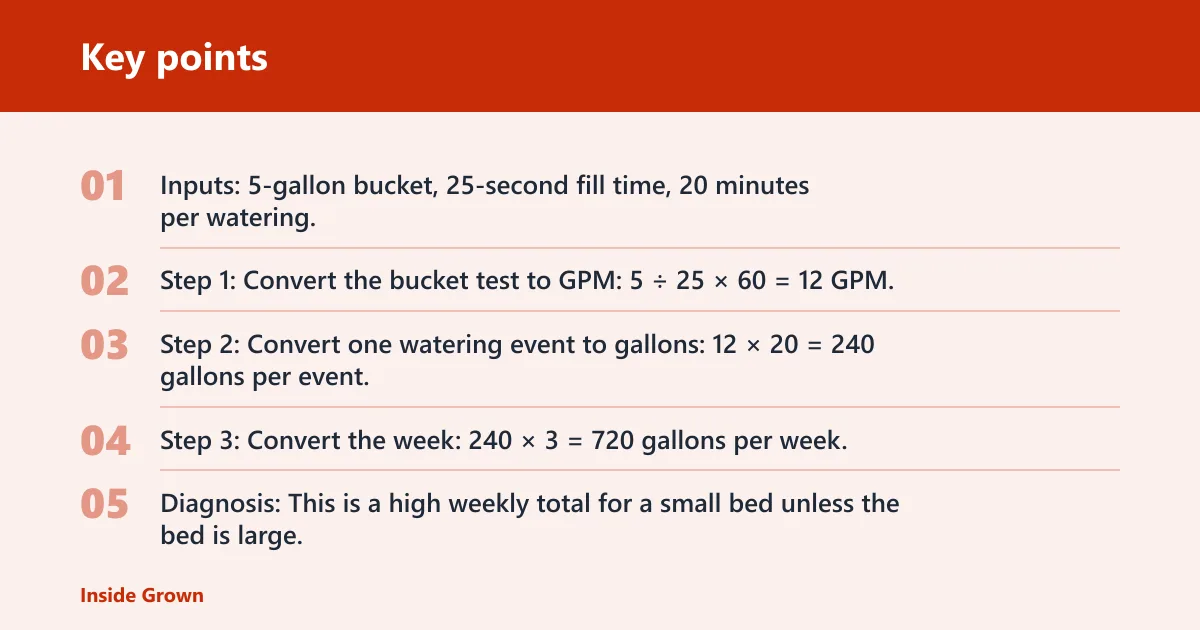
Inputs: 5-gallon bucket, 25-second fill time, 20 minutes per watering, 3 watering days per week.
Step 1: Convert the bucket test to GPM: 5 ÷ 25 × 60 = 12 GPM.
Step 2: Convert one watering event to gallons: 12 × 20 = 240 gallons per event.
Step 3: Convert the week: 240 × 3 = 720 gallons per week.
Output: 12 GPM and 720 gallons per week.
Diagnosis: This is a high weekly total for a small bed unless the bed is large, densely planted, or the water is spread across a much wider area. If the soil stays wet, the zone is probably oversized; if the bed dries out quickly, the bed may simply be under-sized for the crop load and sun exposure.
Scenario 2: Container group
Inputs: 5-gallon bucket, 40-second fill time, 15 minutes per watering, 5 watering days per week.
Step 1: Convert the bucket test to GPM: 5 ÷ 40 × 60 = 7.5 GPM.
Step 2: Convert one watering event to gallons: 7.5 × 15 = 112.5 gallons per event.
Step 3: Convert the week: 112.5 × 5 = 562.5 gallons per week.
Output: 7.5 GPM and 562.5 gallons per week.
Diagnosis: Containers usually dry fast, but this total may still be too much if the pots are small or the media drains slowly. If water runs out the bottom after a short time, the zone may be overwatering; if leaves wilt before the next cycle, the issue is more likely runtime than total weekly gallons.
Scenario 3: Small vegetable plot
Inputs: 5-gallon bucket, 30-second fill time, 30 minutes per watering, 2 watering days per week.
Step 1: Convert the bucket test to GPM: 5 ÷ 30 × 60 = 10 GPM.
Step 2: Convert one watering event to gallons: 10 × 30 = 300 gallons per event.
Step 3: Convert the week: 300 × 2 = 600 gallons per week.
Output: 10 GPM and 600 gallons per week.
Diagnosis: A small vegetable plot can absorb this only if the area is large enough or the soil is very thirsty. If the plot is compact, this points toward overwatering or a need to split the zone. If the soil surface dries but deeper soil stays moist, the weekly number may be fine and the runtime may simply need to be broken into shorter cycles.
Garden water worksheet
This worksheet shows how a measured flow becomes weekly gallons for three common garden zones. Each example uses a simple runtime and watering frequency so you can see how the math changes with zone type.
| Garden zone | Measured flow | Minutes per watering | Days per week | Weekly gallons | Risk note |
|---|---|---|---|---|---|
| Raised bed | 1.5 GPM | 20 | 3 | 90 | Too low if the bed holds thirsty crops or drains fast |
| Container group | 0.8 GPM | 15 | 5 | 60 | Under-watering risk rises if pots are in sun and wind |
| Small mixed vegetable plot | 2.4 GPM | 30 | 2 | 144 | Can be too much if soil holds water or rain is frequent |
The raised bed example shows how a modest flow still adds up over three runs each week. The container group uses less flow per minute, but the higher frequency keeps the weekly total meaningful. The mixed vegetable plot uses a higher measured flow, so runtime discipline matters more.
How do you know if your flow is enough?
Compare measured gallons against the zone’s weekly demand. If the weekly total is too low, plants can wilt between waterings or stay unevenly moist. If the total is too high, the soil can stay wet longer than intended, which wastes water and can stress roots.
Signs the zone may be short on water
A zone may be short if the surface dries long before the next scheduled watering, the bed feels dry at root depth, or different parts of the zone dry at different speeds. In that case, increase runtime, add a watering day, or split the zone so each area gets a better match.
Signs the zone may be getting too much
A zone may be getting too much if water pools, drains past the root zone, or the schedule still leaves the soil wet when the next watering starts. Reduce runtime first, then check whether the measured GPM is higher than the zone can use at the current layout.
Suppose a drip line measures 1.2 GPM at the hose bib, but only part of that water reaches the bed because the zone is split across long runs and fittings. The weekly formula still starts with the measured flow, but the real check is whether the plants and soil show the expected moisture at the root depth.
Frequently asked questions
How do I calculate gallons per week for my garden?
Use gallons per week = GPM × minutes × days. Measure the flow in gallons per minute, decide how long each zone runs, and count watering days per week. Then calculate each zone separately, because beds, containers, and vegetable rows often need different runtimes and frequencies.
How many gallons per week does a vegetable garden need?
There is no single number that fits every vegetable garden. The answer depends on bed size, soil type, planting density, runtime, and how often you water. Start with your measured GPM, then convert each zone into weekly gallons so you can compare demand against what your system actually delivers.
How do I measure a hose’s flow rate with a bucket?
Fill a bucket of known volume, time the fill in seconds, and convert that volume to gallons if needed. Divide gallons by seconds, then multiply by 60. That gives you GPM. Repeat the test at the same nozzle, pressure, and hose length you will use for watering.
How do I convert gallons per minute to gallons per week?
Multiply GPM by the minutes per watering and by the number of watering days per week. For example, 2 GPM for 30 minutes, 3 times per week, equals 180 gallons per week. If the zone changes, run the math again for that zone instead of using the same number everywhere.
What is a normal garden hose flow rate?
The page gives typical garden hose flow at 9 to 17 GPM. That range shifts with hose diameter, hose length, and supply pressure. Shorter hoses tend to flow more, larger diameters increase flow, and pressure in psi affects how much water reaches the end of the hose.
How do I estimate water for drip irrigation zones?
Add up the flow from all emitters in the zone, then multiply by runtime and watering frequency. That gives weekly gallons for the zone. The key check is application rate: a zone with low emitter output may need longer runtimes, while a dense emitter layout may need less time than expected.
Sources
- USGS water conversion references for gallons-to-liters and inches of water over area.
- EPA WaterSense guidance on irrigation efficiency and avoiding overwatering.
- University extension publications on drip irrigation emitter flow, pressure loss, and irrigation scheduling.
- Irrigation manufacturer specifications that describe common emitter output conventions in gallons per hour.
- General plumbing and irrigation references for hose diameter, length, pressure, and friction loss effects on flow.