How Far Apart to Space Emitters in a Vegetable Garden
Space drip emitters 6 to 12 inches apart for most vegetable rows, then tighten to 4 to 6 inches in sandy soil or for shallow-rooted crops and widen to 12 to 18 inches in clay or wider beds. If emitters sit too far apart, roots dry between wetting zones; if they sit too close, you waste water and can keep the soil soggy. This guide shows how to match spacing to root-zone width, soil texture, and emitter flow rate.
How emitter spacing works


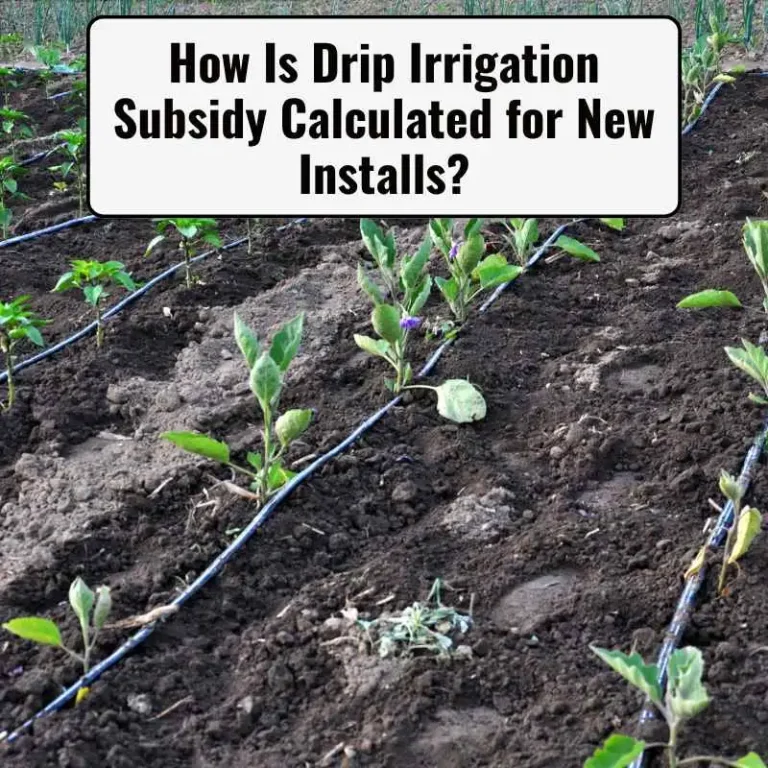
Emitter spacing is the distance between emitters along a drip line. You want overlap, so the wetting pattern from one emitter reaches the next before roots dry out. Many vegetable roots feed near the surface and spread wider as plants mature, so spacing should change with crop size, not only with bed layout.
Three variables drive the decision: the crop’s root-zone width, the soil texture, and the emitter flow rate in gallons per hour, or GPH. A 0.5 GPH emitter wets more slowly and usually in a narrower pattern than a 2.0 GPH emitter. Higher flow can mean a larger wet area, but it does not automatically mean you should space emitters farther apart.
What you’ll need
- Drip line with button, inline, or adjustable emitters
- Tape measure and a simple planting sketch
- Soil probe or hand trowel for checking moisture depth
- Bed width and plant spacing measurements
- Emitter flow-rate label or packaging information
How do you choose spacing by crop?
Start with the mature root-zone width, not the seedling size. Many vegetables begin with a small root ball, then spread feeder roots wider as they grow, so spacing should follow the plant at midseason, when water demand is higher. For seed rows, use tighter spacing because the roots are concentrated in a narrow band.
For transplants, place emitters near the active roots, then adjust as the canopy expands. Tomatoes and peppers usually need emitters centered near each plant or paired across a row because their root zones broaden over time. Lettuce has a shallower, tighter root zone, so closer spacing often works better than a wide gap.
Crop patterns to think about
- Tomatoes: wider root spread; often one emitter per plant is enough early on, then two as the plant matures.
- Peppers: smaller than tomatoes, but still benefit from spacing that covers the root ring around each transplant.
- Lettuce: shallow feeder roots; closer spacing helps keep the top few inches evenly wet.
Should spacing change for soil texture?
Yes. Sandy soil needs closer emitter spacing because water spreads sideways poorly and drops faster through the root zone. Loam is the easiest baseline because it gives moderate spread and moderate infiltration. Clay can support wider spacing, but it infiltrates more slowly, so run time must stay low enough to avoid runoff and puddling.
A practical rule is to tighten spacing in sand, keep a middle range in loam, and widen only with care in clay. The soil’s behavior matters as much as the emitter’s output. If a line wets the surface but leaves dry pockets below, the spacing is too wide for that texture.
How close should emitters be to plants?
Place emitters in the root zone, not against the stem. A transplant needs water near the active feeder roots, not pooled at the crown, where it can encourage rot or keep the stem base too wet. Small transplants may need just one emitter, but only if the wetting pattern reaches the full root ball.
Use two emitters when a larger plant or a wider bed leaves dry gaps on one side. That is common with tomatoes in wider spacing or with mixed beds where one plant sits near an edge. If the wetting footprint stops short of the outer roots, add an emitter rather than stretching the run farther apart.
How do flow rate and bed layout change spacing?
Check the emitter label before choosing distance. A 0.5 GPH emitter usually suits tighter spacing and longer run times. A 1.0 GPH emitter is a common middle ground. A 2.0 GPH emitter can wet faster, but higher output does not mean wider spacing is always better, especially in sandy soil where water can move down before it moves sideways.
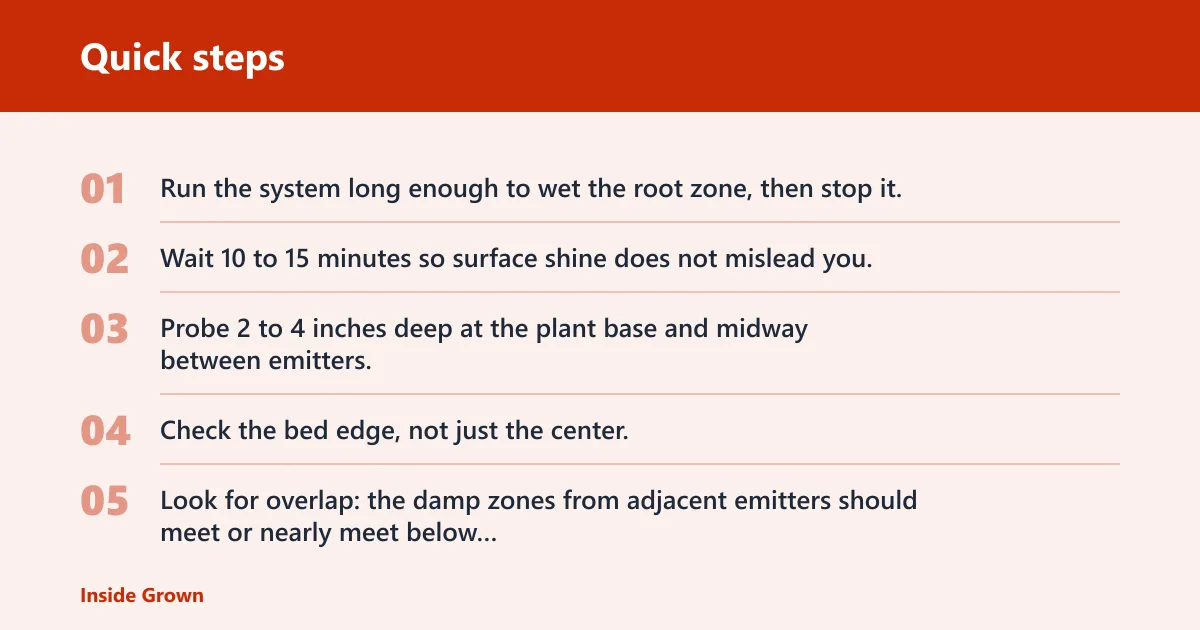
Pressure-compensating emitters help keep output steady across longer runs or elevation changes, which matters when the line is long or the bed slopes. Raised beds often need closer spacing than in-ground rows because they dry out faster at the edges, and many wide beds need two lines per bed to keep the full root zone covered.
Emitter spacing decision table
| Vegetable group | Soil texture | Bed width | Emitter flow rate | Recommended on-line spacing |
|---|---|---|---|---|
| Tomatoes, peppers | Sandy | 18-24 in raised bed | 1.0-2.0 GPH | 4-6 in, often 2 emitters per plant |
| Tomatoes, peppers | Loam | 18-24 in raised bed | 1.0 GPH | 6-12 in, 1-2 emitters per plant |
| Lettuce, spinach | Sandy | 12-18 in in-ground row | 0.5-1.0 GPH | 4-6 in |
| Lettuce, spinach | Loam | 12-18 in in-ground row | 0.5-1.0 GPH | 6-8 in |
| Beans, carrots, beets | Loam | 18-30 in row or bed | 0.5-1.0 GPH | 6-12 in |
| Broccoli, cabbage | Clay | 24-36 in bed | 0.5-1.0 GPH | 8-12 in, with careful run time |
| Mixed vegetable bed | Loam | 24 in raised bed | 1.0-2.0 GPH | 6-10 in, or two lines if edges dry |
Quick field-check checklist
- Run the system long enough to wet the root zone, then stop it.
- Wait 10 to 15 minutes so surface shine does not mislead you.
- Probe 2 to 4 inches deep at the plant base and midway between emitters.
- Check the bed edge, not just the center.
- Look for overlap: the damp zones from adjacent emitters should meet or nearly meet below the mulch.
- If one probe point is dry, shorten spacing or add an emitter and recheck.
- Measure the mature plant spacing and bed width before you lay the line.
- Choose the soil texture baseline: closer in sand, middle spacing in loam, wider only with caution in clay.
- Match emitter flow rate to the layout, using 0.5, 1.0, or 2.0 GPH as your starting point.
- Place button or inline emitters in the root zone, and keep them off the stem base.
- For transplants, center one emitter near the root ball or use two when the plant is wide or the bed is broad.
- For seed rows, tighten spacing so the entire germination band stays evenly moist.
- For raised beds wider than about 24 inches, a second line may be needed if the edge stays dry after a test run.
- Run the system, then use the probe checklist to confirm overlap at the center and edge of the bed.
- If dry spots remain, add 1 emitter every 6 inches along the problem section, then recheck after another run.
Common mistakes
Spacing emitters too far apart in sandy soil is a frequent miss. Water moves down before it spreads, so the roots between emitters can dry even when the surface looks damp. The fix is closer spacing, not just longer run time.
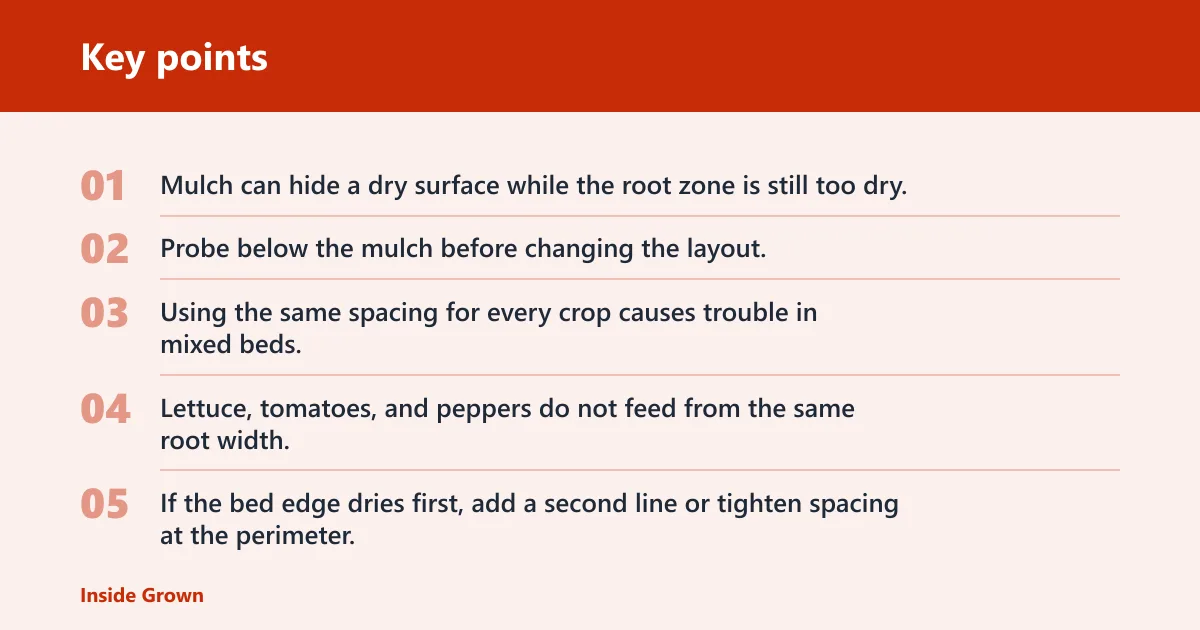
Another common mistake is trusting mulch. Mulch can hide a dry surface while the root zone is still too dry, or it can make a thin wet crust look wetter than it is. Probe below the mulch before changing the layout.
Using the same spacing for every crop causes trouble in mixed beds. Lettuce, tomatoes, and peppers do not feed from the same root width, and raised beds often need more careful layout than in-ground rows. If the bed edge dries first, add a second line or tighten spacing at the perimeter.
Say your 24-inch raised bed has tomatoes on 12-inch centers and 1.0 GPH button emitters 12 inches apart. If the center probes damp but the edge stays dry, the layout is too wide for that bed shape. Add a second line 6 to 8 inches from each edge, then recheck.
Frequently asked questions
How far apart should drip emitters be in a vegetable garden?
For most vegetable rows, start at about 6 to 12 inches apart. In sandy soil or for shallow-rooted crops, a common rule of thumb is 4 to 6 inches; in heavier soil or wider beds, spacing may be widened toward 12 to 18 inches when soil texture and bed width support broader wetting. Always confirm overlap with a probe after installation.
Do I need one emitter per plant or two?
Small transplants may do fine with one emitter if the wetting pattern covers the full root ball. Larger plants, wider spacing, or bed edges often need two emitters so the root zone does not dry on one side. Tomatoes and peppers commonly shift from one to two emitters as they mature.
What emitter spacing works for tomatoes, peppers, and lettuce?
Tomatoes and peppers usually do well with 6 to 12 inches between emitters in loam, tighter in sand. Lettuce often needs 4 to 8 inches because its roots stay shallow and concentrated. If the bed is wide or on an edge, use a second line instead of stretching spacing farther apart.
How many drip emitters should go in a raised bed?
Many raised beds need one line with closer spacing, but wider beds often need two lines. A 24-inch bed may work with one center line if the crop is compact and the soil is loam, while a 30-inch or wider bed often needs two lines to keep the edges wet.
Should emitter spacing change in sandy soil or clay soil?
Yes. Sandy soil usually needs closer emitter spacing because lateral spread is limited. Clay can tolerate wider spacing, but it absorbs slowly, so longer run times can cause runoff or pooling. Use a probe to confirm that the damp zone reaches between emitters and down into the root zone.
Can I space emitters farther apart if I use higher flow rates?
Sometimes, but not automatically. A higher GPH emitter wets faster and may widen the wetted area, yet sandy soil can still drain downward before it spreads sideways. If you move from 0.5 to 2.0 GPH, recheck wetting after a short run rather than assuming the same spacing still works.