How to calculate water flow for a home irrigation system
To estimate home irrigation flow, time a hose-bib fill test, convert gallons and seconds to gallons per minute, then keep each zone at roughly 80% of that flow. Skip this and you’ll get weak spray, pressure loss, and zones that never water evenly. This guide shows the test, unit conversions, and how to divide drip and sprinkler heads into zone-by-zone capacity.
What water flow means in an irrigation system


Water flow is the amount of water moving through a system over time, usually measured in gallons per minute for home irrigation planning. Pressure is the force pushing water through pipe and fittings. You need both numbers before choosing sprinklers or drip emitters.
For most home layouts, GPM is the planning unit because it tells you how much water a hose bib or outdoor tap can supply right now. That source flow becomes the ceiling for each zone. The irrigation calculators page includes a Garden Hose Flow Calculator, and it also lists tap-flow measurement in gallons per minute and litres per minute.
That same page explicitly includes a water application rate calculator, pipe friction loss as a dedicated topic, and fittings handled through equivalent length calculations from 1/2 inch to 24 inch diameter. Those are the pieces you need to move from a tap reading to a workable zone plan.
Why GPM is the planning unit for most home systems
Gallons per minute gives you a direct cap for zone demand. If a hose bib supplies 10 GPM, a zone that needs 9 GPM may work, but a zone that needs 12 GPM will be underfed before you even account for friction loss or elevation change.
Where hose bib flow fits into the design
The hose bib or outdoor tap is your source point. Measure it first, then design around it. The reading does not replace pipe sizing or pressure checks; it tells you how much water you can reasonably allocate to one zone after losses are considered.
How do you test water flow from an outdoor tap?
Test water flow from an outdoor tap with a bucket or container of known volume, a stopwatch, and the tap fully open. Time how long it takes to fill the container, then convert that time into gallons per minute. This gives you the baseline used for every zone decision.
Bucket test method
- Choose a container with a marked volume, such as 5 gallons or 10 litres.
- Open the hose bib or outdoor tap fully.
- Start timing as the water begins to fill.
- Stop timing when the container reaches the mark.
- Record the volume and the fill time.
How to convert a timed fill into GPM
Use this formula: GPM = gallons filled ÷ minutes to fill. If a 5-gallon bucket fills in about 25 seconds, that works out to 5 ÷ 0.4167, or roughly 12 GPM. If the fill time is in seconds, divide seconds by 60 first.
| Container volume | Fill time | Flow |
|---|---|---|
| 5 gallons | 30 seconds | 10.0 GPM |
| 5 gallons | 45 seconds | 6.7 GPM |
| 10 gallons | 1 minute 20 seconds | 7.5 GPM |
| 20 litres | 1 minute | about 5.3 GPM |
How to convert LPM to GPM
Litres per minute is common on metric taps and pump labels. To compare with irrigation zones planned in gallons per minute, divide LPM by about 3.785. A 30 LPM source is roughly 7.9 GPM. The reverse conversion is roughly GPM × 3.785 = LPM.
How do you turn source flow into zone capacity?

Turn source flow into zone capacity by holding back part of the measured tap flow for real-world loss, then assigning only the remaining amount to one zone. A common planning target is about 80% of the hose-bib flow. That buffer helps cover friction loss, fittings, valves, and pressure drop.
Add up sprinkler or emitter demand
Each sprinkler head or drip emitter has a flow rate. Add them together for the zone total. If four sprinklers each use 2.0 GPM, the zone demand is 8.0 GPM. If your source test is 10 GPM, that zone is tight once pipe and fittings are included.
Estimate how many heads or emitters fit on one zone
For drip, total the emitter flow. For sprinklers, total the nozzle flow. Then compare that sum with your usable zone capacity, not just the raw tap flow. A zone is only practical if the total demand stays below the source limit after loss is considered.
Leave room for pressure loss and future adjustment
Do not build right to the edge. A small pressure drop can change spray pattern, and a little extra demand can push the zone past what the tap can deliver. Leave room for filter loss, valve loss, and future changes in plant spacing.
Say your outdoor tap tests at 12 GPM. A lawn zone that needs 9.5 GPM may still be too close if it includes a long lateral, two elbows, a valve, and a filter. The same source may handle a 7 GPM bed zone with room to spare.
Pipe size, fittings, and friction loss
Pipe diameter changes how much water reaches a zone at usable pressure. Larger pipe usually lowers pressure loss, especially on long runs. Friction loss grows with distance and with every fitting. That is where many home systems become underfed, even when the tap test looked fine.
How pipe diameter changes delivered flow
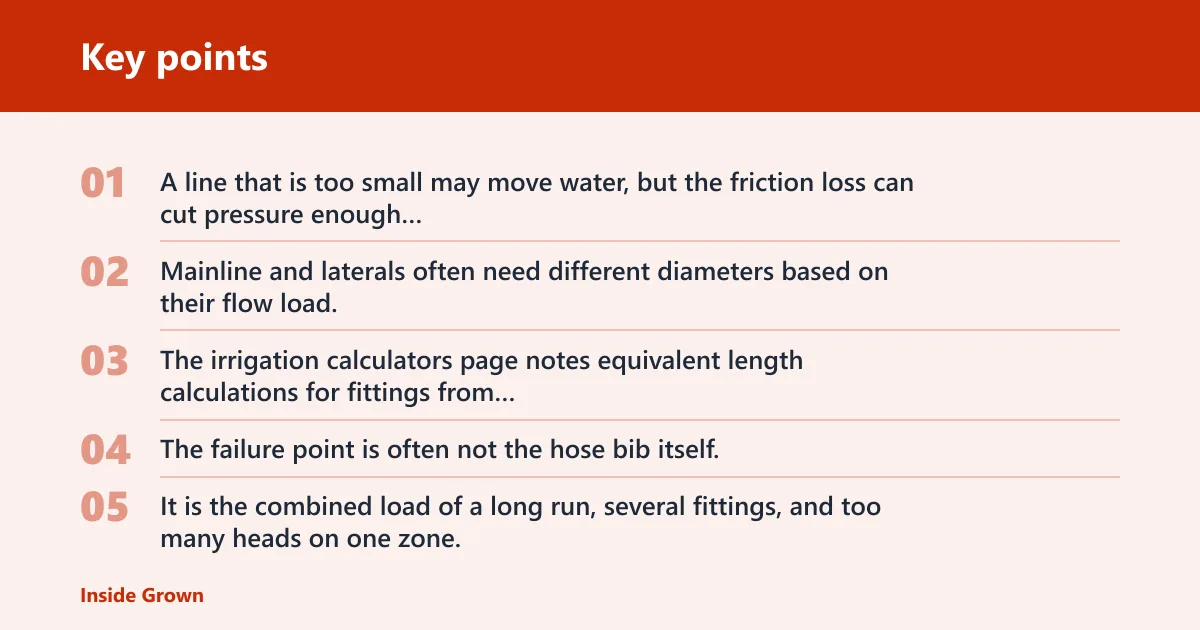
Pipe size should match expected flow. A line that is too small may move water, but the friction loss can cut pressure enough that sprinklers mist or drip regulators do not behave correctly. Mainline and laterals often need different diameters based on their flow load.
Why elbows, tees, and valves reduce usable flow
Each fitting adds resistance. The irrigation calculators page notes equivalent length calculations for fittings from 1/2 inch to 24 inch diameter, which is a practical way to count that resistance as extra pipe length. Valves, tees, and elbows all add up.
Where the system usually runs short
The failure point is often not the hose bib itself. It is the combined load of a long run, several fittings, and too many heads on one zone. A short backyard line may work at first, then fall short once a second tee or a pressure-regulating device is added.
| Check | What to compare | Pass condition |
|---|---|---|
| Source flow | Measured GPM at hose bib | Known before design starts |
| Zone demand | Sum of heads or emitters | Below usable source flow |
| Pipe size | Diameter against zone flow | Enough to limit loss |
| Fittings | Equivalent length added in | Counted in the total run |
| Pressure | Needed pressure at devices | Still available after losses |
How do you calculate sprinkler and drip demand?
Calculate sprinkler or drip demand by summing the flow of every device on the zone, then checking that total against the usable source flow. For lawns, application rate matters too, because the sprinkler output must match soil intake and spacing. For drip, emitter count drives the total zone flow.
Sprinkler application rate for lawn zones
Sprinkler application rate is the amount of water delivered over an area in a set time. It matters because a lawn zone can only absorb so much before runoff starts. If the nozzles apply water faster than the soil can take it, the design needs smaller nozzles, different spacing, or shorter run times.
Total flow for drip emitters
Drip irrigation emitters are selected by flow per emitter, then multiplied by count. Ten emitters at 0.5 GPM total 5 GPM. If pressure regulation is required, account for that device in the zone plan so the emitter flow remains stable.
Mixed zones for beds, lawn, and containers
Mixed zones need more care. A bed zone with shrubs, containers, and a short hedge may use drip and a few micro-sprays, but those devices do not belong in the same zone as full-coverage lawn heads unless the flows and pressure needs are closely matched.
Suppose a front-bed zone has twenty 0.2 GPM emitters and four micro-sprays at 0.5 GPM each. Total demand is 6 GPM. If the tap test gives 8 GPM, that zone still needs pipe and fitting loss checked before it is approved.
Use the worksheet to check each zone
The downloadable home irrigation flow worksheet turns the tap test into a zone-by-zone plan. It includes a source flow test, unit conversion table, zone demand table, pipe-sizing check, and pass/fail summary. Use it after the hose-bib test, not before.
How to use the worksheet step by step
- Record the hose-bib or outdoor tap flow in gallons per minute.
- Enter any litres per minute reading and convert it to GPM if needed.
- List every sprinkler head or drip emitter on the zone.
- Add the flow for each device to get total zone demand.
- Check pipe diameter and add fittings as equivalent length.
- Mark the zone pass or fail against usable source flow.
Worked example
The worksheet example uses a hose-bib source flow test around 10 GPM. It converts 30 LPM to roughly 7.9 GPM for metric comparison, then compares three zones: a lawn zone around 7.5 GPM, a drip bed zone around 5.5 GPM, and a mixed bed zone around 9.2 GPM.
| Zone | Demand | Pipe and fittings check | Result |
|---|---|---|---|
| Lawn | 7.5 GPM | Long run with several elbows | Fail, too close to source flow |
| Drip bed | 5.5 GPM | Short run, few fittings | Pass |
| Mixed bed | 9.2 GPM | Medium run with valve and tee | Fail, likely underfed |
How do you calculate gallons per minute for my irrigation system?
Time a known-volume container at the hose bib, then divide gallons by minutes. That gives the source flow in GPM, which is the first number you need for zone planning. After that, reserve part of the flow for loss and size each zone to stay under the usable amount.
What is the difference between water flow and water pressure in irrigation?
Flow is how much water moves, while pressure is how hard that water is being pushed. A system can have good pressure and poor flow, or the reverse. For irrigation, both matter because devices need enough volume and enough force to operate as intended.
How do I size irrigation pipe based on flow rate?
Match pipe diameter to expected zone flow and run length. Larger pipe reduces friction loss, which helps preserve pressure at the heads or emitters. A short, low-flow drip zone can use smaller pipe than a long mainline feeding several sprinkler heads.
How do fittings and friction loss affect irrigation flow?
Every elbow, tee, valve, and filter adds resistance. That resistance reduces delivered flow and pressure, especially on longer runs. The practical fix is to count fittings as equivalent length, then compare the full adjusted run against the pipe size and the zone’s required demand.
How much water flow does a drip irrigation system need?
A drip system needs enough flow for the total number of emitters on the zone, plus a little room for pressure regulation and loss. Add each emitter’s flow rate, then compare the total with the hose-bib test. The correct number is the one your source can deliver consistently.
How do I convert litres per minute to gallons per minute for irrigation?
Divide litres per minute by 3.785 to get gallons per minute. This is useful when a tap, pump, or flow meter is labeled in metric. Converting to GPM lets you compare the source reading with sprinkler and drip zone demand on the same scale.
Frequently asked questions
How do I calculate sprinkler flow for a lawn zone?
List every sprinkler head in the zone and add the nozzle flow for each one. The total is the zone’s sprinkler flow. Then check that the total stays below your usable hose-bib flow after friction loss and fitting loss are included.
What flow rate do I need for a small garden irrigation system?
A small garden system needs the flow required by all emitters or heads on one zone, not a generic number. Start with the hose-bib test, then size the zone to about 80% of that flow or less. Smaller zones are safer when tap flow is limited.
How do I test the water flow from an outdoor tap?
Use a known-volume bucket or container, open the tap fully, and time the fill. Convert the result to GPM by dividing gallons by minutes. That reading becomes the source limit for pipe sizing, sprinkler count, drip emitter count, and zone splitting.
How do I size irrigation pipe based on flow rate?
Choose a pipe diameter that can carry the planned zone flow with acceptable pressure loss over the full run. Longer lines and more fittings need more margin. If a zone is near the tap limit, a larger pipe often helps more than adding another head.
What is the difference between water flow and water pressure in irrigation?
Water flow is the amount delivered over time. Water pressure is the force behind that delivery. A home irrigation layout needs both measured because a zone may have enough flow on paper but still fail if pressure falls too far after pipe and fittings.
How do I convert litres per minute to gallons per minute for irrigation?
Use the conversion 1 gallon per minute equals about 3.785 litres per minute, so divide LPM by 3.785. That gives a comparable irrigation flow number in GPM. It is the simplest way to compare metric source data with zone demand.