Lawn Fertilizer Calculator
To find lawn fertilizer pounds, divide your lawn’s square footage by the bag’s coverage rate, then apply the label’s rate per 1,000 square feet. If a bag is 20-0-0, 10 pounds of nitrogen takes 50 pounds of product. Too much fertilizer can scorch grass, waste money, and send extra nitrogen into runoff. This guide shows how to use a lawn fertilizer calculator, convert NPK labels into product weight, and pick a safe rate for your grass and season.
How is this calculated?
Press Calculate to see the math with your numbers.
Lawn rate table


The right rate depends on turf type, season, and whether the lawn is stressed, newly seeded, or already established. A basic yearly guide is 3-4 pounds of nitrogen per 1,000 sq ft, but that total is usually split across the season. Most lawns need 1 pound of actual nitrogen per 1,000 square feet per application, and a quick summary puts the maximum at 1.5 pounds.
| Lawn condition | Grass type and season | N rate band per 1,000 sq ft | Skip phosphorus or potassium? | Product pounds at midpoint rate, 1,000 / 5,000 / 10,000 sq ft |
|---|---|---|---|---|
| Established, actively growing lawn | Cool-season grass in fall or spring | 1.0-1.5 lb N | Skip P unless soil test says it is low; skip K if soil test already shows enough | 28-0-3: 4.5 / 22.3 / 44.6 lb; 24-4-12: 5.2 / 26.0 / 52.1 lb; 32-0-4: 3.9 / 19.5 / 39.1 lb |
| Warm-season lawn at peak growth | Late spring through summer | 0.5-1.0 lb N | Usually skip P on established turf; use K only if soil test calls for it | 28-0-3: 3.6 / 17.9 / 35.7 lb; 24-4-12: 4.2 / 20.8 / 41.7 lb; 32-0-4: 3.1 / 15.6 / 31.3 lb |
| Low-input lawn | Centipedegrass or other low-input turf in active growth | 0.25-0.5 lb N | Skip P unless soil test is low; skip K unless the test shows a need | 28-0-3: 1.8 / 8.9 / 17.9 lb; 24-4-12: 2.1 / 10.4 / 20.8 lb; 32-0-4: 1.6 / 7.8 / 15.6 lb |
| Recovered after stress | Drought-stressed, recently renovated, or thin turf | 0.25-1.0 lb N, only if growth has resumed | Base P and K on soil test, not on guesswork | 28-0-3: 1.8 / 8.9 / 17.9 lb; 24-4-12: 2.1 / 10.4 / 20.8 lb; 32-0-4: 1.6 / 7.8 / 15.6 lb |
That table uses the midpoint of each rate band. For example, a 1.0-1.5 lb N band is shown at 1.25 lb N per 1,000 sq ft. The calculator math stays the same at any rate: multiply lawn size by the target nitrogen rate, then divide by the product’s nitrogen percentage.
Say your lawn is 5,000 sq ft and the soil test says to apply 1 pound of nitrogen per 1,000 sq ft. A 28-0-3 fertilizer needs about 17.9 pounds of product for the whole lawn. A 20-pound bag is close, but not exact, so the label still controls the spreader setting and the final amount.
📊 The University of Missouri calculator says good maintenance fertilizers should be in a 3-1-2 ratio. Source: Lawn Fertilizer Calculator.
How much fertilizer do you need?
Use three inputs: lawn size, target nitrogen rate, and the N percentage on the bag. The formula is (Area ÷ 1,000) × N rate ÷ (N% ÷ 100). Once you get product pounds, compare that number with the bag weight to estimate bag count and coverage.
Use the formula
For a 5,000 sq ft lawn at 1 pound of nitrogen per 1,000 sq ft with a 28-0-3 product, the math is 5 × 1 ÷ 0.28, which equals about 17.9 pounds of fertilizer. If the bag is 20 pounds, one bag covers the lawn with a little left over.
Check bag count and coverage
Most lawn fertilizer products are designed to cover 5,000 or 7,500 square feet. Bag coverage is only a guide, though, because the actual amount depends on the nitrogen percentage and the rate you choose. A bag with less nitrogen needs more product to feed the same lawn. (Missouri)
Suppose a 10,000 sq ft lawn is treated with a 32-0-4 fertilizer at 1 pound of nitrogen per 1,000 sq ft. The area factor is 10, and 32% nitrogen means the total product is 31.3 pounds. A single 30-pound bag is short by a little, so the exact label math matters.
Bag price versus nitrogen price
When two products look similar on the shelf, compare cost per pound of actual nitrogen, not bag price. A cheaper bag with a lower nitrogen percentage may cost more per pound of nitrogen delivered. That comparison matters most when you are choosing between a dense product and a light one with more filler.
How do you measure lawn size?
Measure in square feet first, then convert to acres or square meters if needed. One acre equals 43,560 square feet. One square meter is about 10.764 square feet. For irregular lawns, break the space into rectangles, triangles, and circles, then add the parts together after subtracting the house, driveway, patio, sidewalks, and other hardscape.
Measure irregular shapes
- Draw the lawn as simple shapes on paper.
- Measure each section separately in feet.
- Multiply length by width for rectangles.
- Use the usual triangle or circle formula for those sections.
- Add the turf sections together.
- Subtract paved or covered space from the total.
For a rough acre check, divide square feet by 43,560. A 21,780 sq ft lawn is about 0.5 acre. For square meters, multiply square feet by 0.0929. That matters when a soil report or a product label uses metric units.
How to read the bag
The N-P-K numbers are the percentages by weight of nitrogen, phosphate, and potash. The order stays the same: nitrogen first, then phosphorus, then potassium. A 15-5-10 fertilizer contains 15% nitrogen, 5% phosphate, and 10% potash. A 24-4-12 product follows the same pattern.
What the numbers mean
The nitrogen number drives the feeding rate for most lawns. The phosphorus and potassium numbers matter only when the soil test says you need them. Established lawns do not require added phosphorus, according to Missouri Extension, and many local rules limit phosphorus on turf unless a soil test justifies it.
Bag weight versus nutrient weight
Bag weight is the total product on the shelf. Actual nitrogen is only a fraction of that weight. A 20-pound bag of 20-0-0 contains 4 pounds of nitrogen, while a 50-pound bag of the same product contains 10 pounds of nitrogen. Those are very different feeding capacities.
That distinction is where many mistakes start. A bag size does not equal coverage by itself. Coverage depends on the nitrogen percentage and the rate per 1,000 sq ft, not the number printed on the front of the bag.
How much nitrogen should you apply?
A common yearly guide is 3-4 pounds of nitrogen per 1,000 sq ft, split into smaller applications. Many maintenance programs use about 1 pound of nitrogen per 1,000 sq ft at a time, and spoon-feeding can drop to 0.25 to 0.5 pounds per 1,000 square feet per application. The right choice depends on grass type and season.
Cool-season grass
Cool-season grasses usually do best with their heaviest feeding in fall, with lighter spring use if needed. A one-pound application fits many maintenance programs during active growth. Avoid a large nitrogen push during hot stress or when the lawn is dormant.
Warm-season grass
Warm-season grasses take most of their nitrogen during late spring and summer, when growth is active. A lighter rate often fits better than a heavy one, especially when the lawn is already under heat or drought stress. Dormant turf should not be pushed with nitrogen just to make it green early.
Low-input grasses and stressed turf
Centipedegrass and other low-input lawns need less fertilizer than a standard home lawn. Overapplication can do real harm, especially on turf that already grows slowly. If a lawn is stressed, newly seeded, or recovering, keep the rate low and wait until growth is steady enough to use the nutrient.
When phosphorus and potassium matter
Use a soil test before adding phosphorus or potassium. That is the cleanest way to avoid unnecessary application. Established lawns often already have enough phosphorus, and extra phosphorus can contribute to water-quality problems when it leaves the site. Potassium should also follow the soil report, not habit.
Reading the soil test
Soil tests often give a separate pH reading, which affects nutrient availability and grass performance. If pH is off, the lawn may struggle even when the fertilizer rate is correct. A soil test recommendation should guide whether to choose a nitrogen-only product or an N-P-K blend.
When to skip P or K
If phosphorus is already adequate, choose a product with little or none of it. If potassium is adequate, skip that too. A nitrogen-only fertilizer is often the simplest choice for an established lawn that only needs maintenance feeding.
Application timing and spreader setup
Timing should match grass type and the peak growing season. Cool-season turf is usually fed in fall and, if needed, lightly in spring. Warm-season turf is fed in late spring and summer. Winter or dormant feeding only makes sense in limited cases, and usually not on stressed turf.
Slow-release nitrogen
Slow-release nitrogen feeds more steadily, which can lower burn risk and reduce leaching compared with a fast shot of soluble nitrogen. Controlled-release products are useful when you want less surge growth and more even feeding. They do not remove the need to match rate and timing to the turf.
Spreader calibration
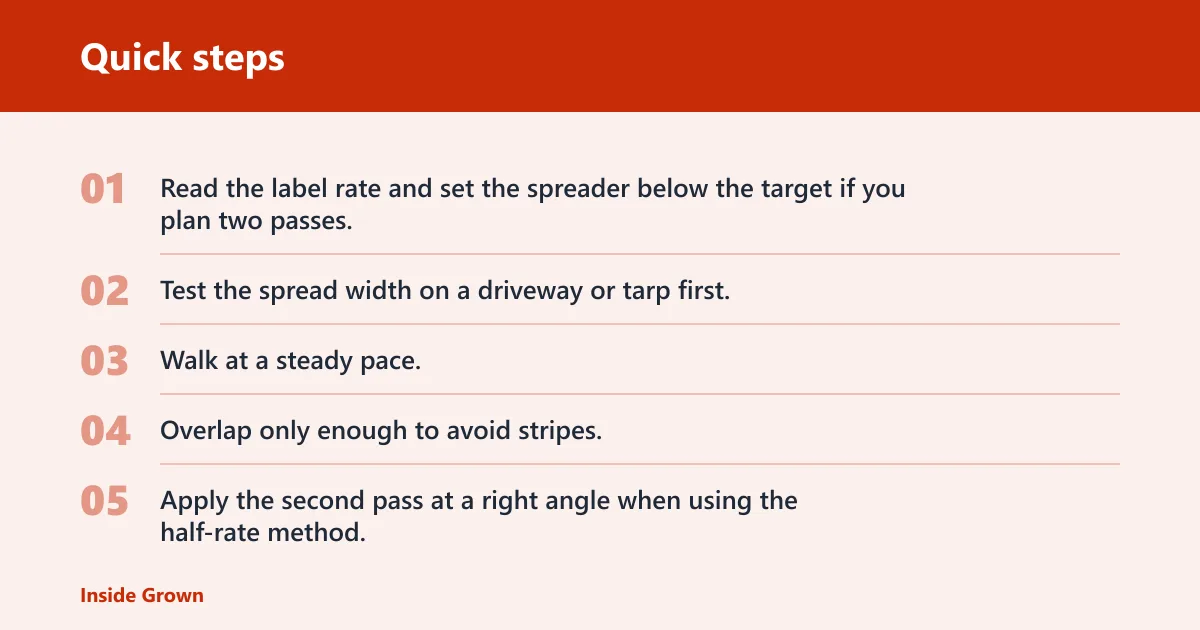
Calibration keeps the spreader from overloading one strip and missing another. The Missouri page advises applying one-half the rate in two directions, which can help even out coverage on larger lawns. Clean off sidewalks and driveways right after spreading so granules do not wash into drains.
- Read the label rate and set the spreader below the target if you plan two passes.
- Test the spread width on a driveway or tarp first.
- Walk at a steady pace.
- Overlap only enough to avoid stripes.
- Apply the second pass at a right angle when using the half-rate method.
- Sweep granules from hardscape back onto turf.
A common first-timer mistake is using a 24-4-12 bag on a lawn that only needed nitrogen. That adds phosphorus and potassium the soil may not need. Another mistake is guessing by bag weight alone and spreading too much because the bag looked small.
Frequently asked questions
How much fertilizer do I need for my lawn calculator?
Start with lawn size, then choose a nitrogen target that fits the grass and season. Use the bag’s nitrogen percentage to convert pounds of actual nitrogen into product weight. A lawn fertilizer calculator does that arithmetic fast, but the rate choice still has to fit the turf.
How much fertilizer do I need for 5,000 square feet?
A 24-4-12 product needs about 20.8 pounds. A 32-0-4 product needs about 15.6 pounds. The exact number changes with the nitrogen rate.
How do I calculate fertilizer from the NPK numbers on the bag?
Use the nitrogen number first. Divide the target nitrogen pounds by the nitrogen percentage as a decimal, then multiply by lawn area in thousands of square feet. The N-P-K order matters because the first number controls how much product you need to deliver the nitrogen dose.
How much nitrogen per 1,000 square feet should I apply?
A general yearly guide is 3-4 pounds of nitrogen per 1,000 sq ft, divided into applications. Most lawns need 1 pound per 1,000 sq ft per application, and spoon-feeding can use 0.25 to 0.5 pounds. Stay below the label’s upper limit and adjust for grass type.
What grass types need less fertilizer?
Centipedegrass and other low-input lawns usually need less nitrogen than a typical cool-season lawn. They are easier to overfeed, and excess nitrogen can cause too much top growth or injury. Newly seeded, stressed, or recovering turf also needs a lighter hand until growth is steady.
How do I know whether I need phosphorus or potassium?
Check the soil test. If phosphorus is already adequate, skip it, especially on established lawns. Use potassium only when the test shows a need. Soil pH also matters because nutrient uptake changes when the pH is off, even if the fertilizer rate is correct.