How Long to Wait After Fertilizing Before Seeding Lawn
Waiting after fertilizing before seeding your lawn can be the difference between a thick, green paradise and a patchy, burned-out mess. Applying granular or liquid fertilizers too close to seeding damages fragile new roots and prevents germination. This guide breaks down exactly how long you must wait based on your fertilizer type, plus a step-by-step schedule to get perfect results every time.
Simply put, wait 4 to 6 weeks after applying a standard synthetic fertilizer before seeding. If you used a “weed and feed” product containing pre-emergent herbicides, extend that to 8 to 12 weeks. Organic fertilizers and starter formulas allow seeding immediately or within 1 to 2 weeks. Watering deeply after fertilizing accelerates the safe window.
Key Takeaways
- Waiting after fertilizing before seeding prevents nitrogen burn and herbicide damage that kills tender grass seedlings.
- Standard synthetic fertilizers require a 4 to 6-week waiting period before you can seed safely.
- Weed and feed products with pre-emergent need a much longer 8 to 12-week gap to avoid killing germinating seeds.
- Starter fertilizers and most organic options allow you to seed immediately or within 2 weeks of application.
- Always water heavily after fertilizing to dissolve nutrients and push them below the seed zone before you plant.
What Determines the Waiting Time Between Fertilizing and Seeding?
No single waiting period works for every lawn. The exact number of days depends on the chemical composition of your fertilizer, the form it takes, and the current soil temperature. Understanding these factors helps you make smart timing decisions.
The primary risk of seeding too soon after fertilizing is nitrogen burn. High-nitrogen fertilizers release salts that draw moisture out of delicate root tips. Young grass seeds cannot tolerate this osmotic stress and will wither instead of sprouting.
Herbicides present in weed and feed products pose an even greater danger by stopping cell division in newly germinated plants.
Soil texture also matters. Sandy soils drain quickly and may flush excess nutrients away faster, shortening the safe waiting window. Heavy clay soils hold onto fertilizer salts longer, requiring a longer pause before seeding.
| Factor | Impact on Waiting Time |
|---|---|
| Nitrogen content (N number) | Higher N = longer wait. Products over 20% N need 6+ weeks. |
| Herbicide presence | Pre-emergents stop all seed germination. Wait 8-12 weeks minimum. |
| Fertilizer form (fast vs slow release) | Slow-release is safer. Fast-release requires longer waiting periods. |
| Soil temperature | Cooler soils (below 55°F) slow chemical breakdown, requiring longer waits. |
| Watering frequency | Deep watering helps leach salts away, reducing the safe gap by 1-2 weeks. |
Knowing these variables allows you to customize your lawn care schedule. For most homeowners, the quickest way to determine safety is to look at the nitrogen source on the fertilizer label and check for any herbicide ingredients like dithiopyr or prodiamine.
What Type of Fertilizer Are You Using? A Complete Breakdown
Your specific fertilizer product dictates the exact waiting period. Using the wrong fertilizer before seeding is one of the most common lawn care mistakes. Let’s break down the major categories and their specific timing requirements.
Synthetic quick-release fertilizers are the most dangerous for new seeds. They contain water-soluble nitrogen that immediately feeds existing grass but creates a high-salt environment. If you have applied a standard lawn fertilizer like a 30-0-0 or 29-3-4, you must wait a full 4 to 6 weeks before seeding.
During this time, water at least once a week with half an inch of water to help flush the salts deeper into the soil profile.
Weed and feed products present a double threat. The nitrogen portion can burn roots, while the herbicide component actively prevents seed germination. These products usually contain pre-emergent chemicals that form a barrier in the top inch of soil.
This barrier stops crabgrass and other weeds but also stops grass seeds from sprouting. You must wait 8 to 12 weeks after applying weed and feed before you can successfully seed any area.
Warning: Never apply weed and feed and then seed within the same season unless the product label explicitly states it is safe for seeding. The herbicide damage can last for months and will completely prevent any grass seed from germinating.
Starter fertilizers are specifically designed for seeding. They have a higher phosphorus content (the middle number on the label) to encourage strong root development in new seedlings. These products are safe to apply at the exact same time you plant your seed.
In fact, many lawn care experts recommend applying starter fertilizer immediately before or during the seeding process for best results.
Organic fertilizers like compost, manure, or blood meal break down slowly through microbial activity. They release nitrogen at a rate that matches plant uptake, making them very safe for new seed. You can generally seed immediately after applying organic fertilizers or wait just 1 to 2 weeks for heavy applications.
| Fertilizer Type | Recommended Wait Period | Safe to Apply with Seed? |
|---|---|---|
| Standard Synthetic (High N) | 4 to 6 weeks | No |
| Weed and Feed (with herbicide) | 8 to 12 weeks | No |
| Starter Fertilizer (High P) | 0 to 1 week | Yes |
| Organic (Compost, Manure) | 0 to 2 weeks | Yes |
| Slow-Release Synthetic | 2 to 4 weeks | Conditional |
Always read the label on your specific product before making a decision. Lawn fertilizer labels include explicit instructions about waiting periods for reseeding. Following the manufacturer’s directions protects your investment and guarantees the best results.
Step-by-Step Guide to Fertilizing and Seeding a Lawn
Following a structured process helps you avoid costly mistakes and ensures your new grass establishes quickly. Here is the exact sequence you should follow when planning your lawn renovation project.
- Test your soil first. Collect a sample from the area you plan to seed and send it to a local extension office or use a home test kit. Knowing your current pH and nutrient levels prevents you from over-fertilizing and burning the soil.
- Apply any non-starter fertilizer at least 4 weeks before seeding. If you are using a standard lawn fertilizer to feed existing grass, make the application early in the season. Water deeply and regularly during the waiting period to help the nutrients dissolve and move into the soil.
- Prepare the seedbed. About one week before planting, remove debris, thatch, and weeds. Rake the soil to create a loose, crumbly texture about 2 to 3 inches deep. Level low spots and fill in holes.
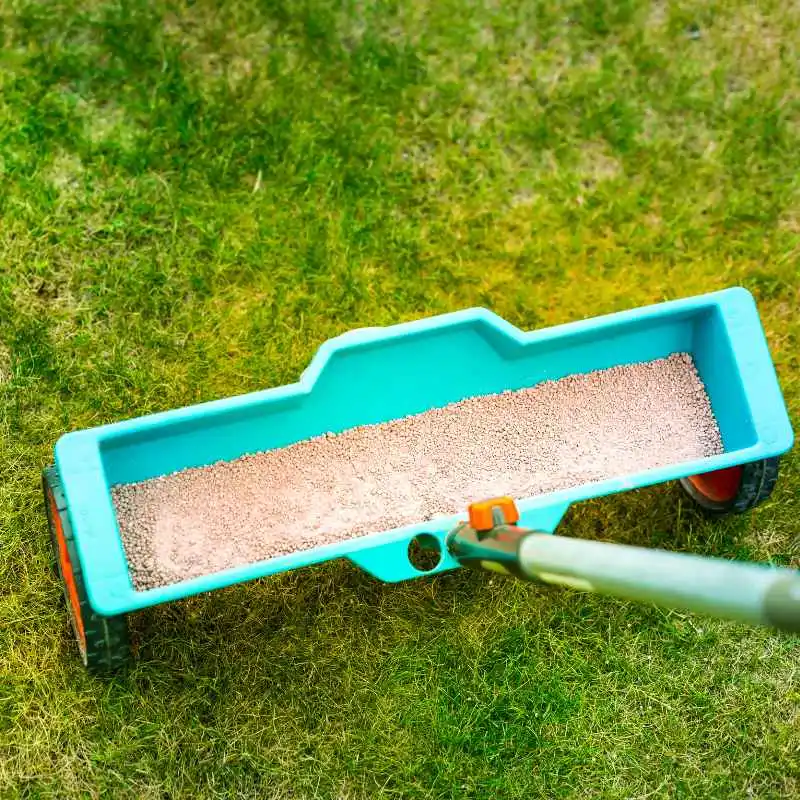
- Apply starter fertilizer immediately before seeding. Spread a high-phosphorus starter product evenly over the prepared soil. Use a broadcast spreader for large areas or a hand spreader for small patches.
- Plant the grass seed. Sow the seed at the recommended rate on the bag. Rake lightly to cover the seed with about 1/8 to 1/4 inch of soil. This protects the seed from birds and promotes good soil contact.
- Water consistently. Keep the top inch of soil consistently moist for the first 2 to 3 weeks. Light watering twice a day works well until germination. After the grass reaches 3 inches tall, reduce watering frequency but increase depth.
Tip: If you missed the window and already applied a high-nitrogen fertilizer, don’t panic. Water the area with one full inch of water per week for 2 to 3 weeks. This leaching process significantly reduces salt levels and allows you to seed sooner than the standard waiting period.
Patience is the key to success. Rushing the process by seeding too soon after applying standard fertilizers leads to wasted seed, dead patches, and the frustration of starting over. Taking the proper steps in the right order saves you time and money in the long run.
How to Test Your Soil Before Seeding for Best Results
Soil testing removes the guesswork from lawn care. You cannot know if your soil needs nutrients or if it already has too many without testing. Many lawn problems start with imbalanced soil chemistry that fertilizer alone cannot fix.
DIY soil test kits are available at garden centers and cost between $10 and $30. These kits measure pH, nitrogen, phosphorus, and potassium levels. They give you a general idea of your soil’s health and are useful for quick checks before small seeding projects.
Professional lab analysis provides much deeper insights. Your local cooperative extension office offers soil testing for $15 to $40 per sample. Lab reports tell you exactly what your soil needs and recommend specific fertilizer formulations for your grass type.
Professional testing is especially important if you have struggled with waiting after fertilizing before seeding because it reveals whether residual nutrients are causing the problem.
- Collect soil from 5 to 10 different spots across your lawn for a representative sample.
- Remove grass, roots, and stones from the sample before sending it to the lab.
- Test at least 6 weeks before your planned seeding date to allow time for results and any needed amendments.
- Target a pH between 6.0 and 7.0 for most cool-season grasses.
- Correct pH imbalances with lime (to raise pH) or sulfur (to lower pH) before applying any fertilizer.
Proper soil testing prevents the common problem of over-fertilizing existing soil. When nitrogen levels are already high, adding more fertilizer forces you to wait longer before seeding. Testing helps you avoid this cycle entirely.
How Long to Wait After Seeding Before Fertilizing Again
Your lawn care schedule does not end once the seed is planted. Knowing when to apply the next round of fertilizer is just as critical as waiting after fertilizing before seeding in the first place. Applying fertilizer too soon after germination burns the tender young roots of your new grass.
Wait until the new grass has been mowed at least 2 to 3 times before applying any additional nitrogen fertilizer. This usually takes about 4 to 6 weeks after the seed germinates. At this point, the root system is established enough to handle a balanced fertilizer without being damaged.
When you do apply the first post-seeding fertilizer, use a product with a lower nitrogen number. A balanced 10-10-10 or 16-4-8 formula works well for established young grass. Avoid high-nitrogen products above 20% N for the first feeding to protect the still-developing root system.
| Grass Stage | Fertilizer Action | Wait Time |
|---|---|---|
| Before seeding | Apply starter fertilizer only | 0 days |
| Germination (0-3 weeks) | No fertilizer | N/A |
| After 2nd mowing | Apply balanced low-N fertilizer | 4-6 weeks after seeding |
| Established lawn | Standard high-N fertilizer | 8+ weeks after seeding |
Understanding this full cycle helps you plan your entire lawn care season. Mark your calendar for key dates: the initial feeding, the waiting period, the seeding day, and the first post-seeding feeding. Planning ahead ensures you never miss a critical window.
Common Mistakes to Avoid When Fertilizing and Seeding
Even experienced gardeners make errors when combining fertilizers and grass seed. Recognizing these common pitfalls helps you avoid wasting time, money, and effort on a failed lawn renovation.
Mistake 1: Ignoring the fertilizer label. Many homeowners assume all lawn fertilizers are the same. They grab a bag of high-nitrogen fertilizer designed for established lawns and spread it over a freshly seeded area. This mistake burns the seed and stops germination completely.
Always read the label and check the nitrogen content before applying anything to new seed.
Mistake 2: Seeding right after weed and feed. Weed and feed products contain powerful herbicides that persist in the soil for months. Seeding too soon after applying these products guarantees failure. Many people make this mistake because they want to fill in bare spots, but the herbicide prevents any new growth from taking hold.
Warning: Do not attempt to “spot seed” after applying weed and feed. The herbicide barrier covers the entire treated area, not just the weed patches. Wait the full recommended period before planting any new seed in treated areas.
Mistake 3: Over-fertilizing before seeding. More fertilizer is not better. Applying an excessive amount of nitrogen creates a toxic environment for seeds. Stick to the recommended application rates on the bag.
If you accidentally over-fertilize, water heavily for several weeks and delay your seeding until the excess nitrogen has leached away.
Mistake 4: Seeding into cold soil. Soil temperature matters more than air temperature. Grass seed needs soil temperatures consistently above 55°F to germinate. If you fertilize and seed when the soil is too cold, the seed sits dormant and may rot or get eaten by birds.
Wait until spring or early fall for best results.
Mistake 5: Skipping the starter fertilizer. Some people think that existing soil nutrients are enough for new grass. In most cases, soil alone does not provide enough phosphorus for strong root development. Using a starter fertilizer gives your new grass the foundation it needs to grow deep roots and survive summer stress.
- Always identify whether you are applying maintenance nitrogen or starter phosphorus.
- Measure your lawn area accurately before buying fertilizer to avoid over-application.
- Use a calibrated spreader for even distribution and to prevent hot spots.
- Water immediately after applying any synthetic fertilizer to dissolve the granules.
- Test your soil every 2 to 3 years to track nutrient levels and adjust your program.
Important: A successful lawn renovation depends on timing. Mark the date you applied your last fertilizer on a calendar and count forward to determine the safe seeding window. Waiting a few extra weeks is always better than rushing and having to start over from scratch.
Frequently Asked Questions
Can I fertilize and seed on the same day?
Yes, but only if you are using a starter fertilizer specifically formulated for new grass. Starter fertilizers have low nitrogen content and high phosphorus content. Standard lawn fertilizers and weed and feed products should never be applied on the same day as seeding.
What happens if I seed too soon after fertilizing?
Seeding too soon after applying standard fertilizer causes nitrogen burn. The high salt concentration draws moisture out of the seed and young roots, causing them to dry out and die. You may also see yellowing or browning if any seeds do manage to germinate.
How long after applying weed and feed can I plant grass seed?
You must wait 8 to 12 weeks after applying weed and feed before planting grass seed. The pre-emergent herbicides in these products persist in the top layer of soil and prevent all seed germination. Check the product label for the exact reseeding window.
How long should I water after fertilizing before seeding?
Water deeply at least twice a week for 3 to 4 weeks after fertilizing before you plan to seed. Each watering session should deliver about 1/2 inch of water. This helps dissolve the fertilizer granules and leaches excess salts below the seed zone.
Do I need to fertilize again right after seeding?
No, do not fertilize immediately after seeding if you have already applied a starter fertilizer. The starter provides enough nutrients for the first 3 to 4 weeks of growth. Wait until the new grass has been mowed at least twice before applying any additional fertilizer.
Final Thoughts
Waiting after fertilizing before seeding is a simple but critical rule for lawn success. Standard synthetic fertilizers need 4 to 6 weeks to break down, while weed and feed products require 8 to 12 weeks. Using a starter fertilizer and organic options allows you to seed immediately without risk.
Test your soil, plan your schedule, and water consistently for the best results. Patience during the waiting period pays off with a dense, healthy lawn that thrives for years.