Grass Seed Calculator: How Much Seed to Buy and Why
A grass seed calculator should use your lawn area, grass type, project type, bag coverage, and a 5% to 10% waste buffer; for irregular yards, it is a common rule of thumb to buy a little extra seed beyond the calculated amount. Too little seed leaves thin spots, so the lawn fills in unevenly. Too much seed raises cost and can crowd seedlings. This guide shows how to pick the right seeding rate for new lawns, overseeding, patch repair, and odd-shaped yards.
How is this calculated?
Press Calculate to see the math with your numbers.
What the calculator estimates


The main job is simple: match seed to area, then round up to whole bags. Seed need changes with grass type, and it also changes with the project type. New lawns usually need more seed than overseeding, while patch repair often uses a separate, smaller calculation.
Most tools estimate pounds and kilograms per 1,000 square feet or square meters. Inch Calculator does that for both new lawns and overseeding, which makes it useful when you need a quick estimate in either imperial or metric units.
Why bag count is rounded up
Seed bags do not split neatly across a yard. If the math says 2.3 bags, you still buy 3 bags. That extra headroom covers overlap at edges, missed spots, and the small amount left in the spreader.
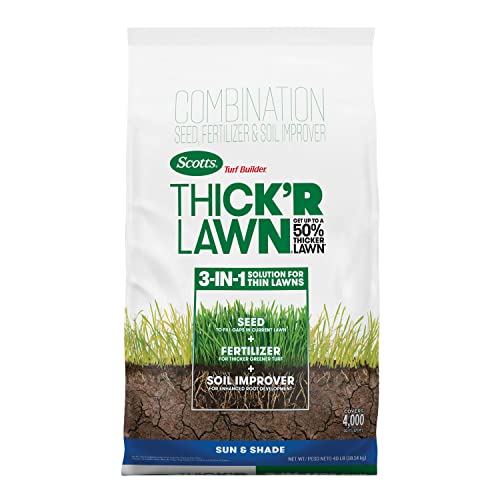
Bag coverage also changes because label rates differ. A bag may list a coverage rate based on one grass type and one use case, so the same bag can cover very different areas depending on whether you are seeding a new lawn or thickening an existing one.
Where the waste buffer fits
A waste or extra factor belongs after you set the base seeding rate. Infinity Calculator uses a 10% waste factor by default, and it says 5% to 15% extra is recommended for uneven spreading and edges. GrassSeedCalculator.com allows a custom extra seed buffer up to 30%.
That buffer matters most on curved borders, narrow runs, and spots where the spread pattern changes near beds, walks, and driveways. It also helps when the seed mix has a lower germination percentage than expected, because the real-world count of viable seeds is not the same as the bag weight.
How much seed do you need?
Start with the project type, then use the seeding rate on the seed label or supplier guidance, then add a waste buffer. A new lawn, overseeding job, renovation, and patch repair do not use the same rate, so a one-size formula will miss the mark.
For a plain area calculation, convert the lawn to square feet, square meters, acres, or hectares first. Then apply the correct rate per unit area, add the buffer, and round up to whole bags.
Choose the project type first
- New lawn: use the rate for full establishment.
- Overseeding: use the lower rate for an existing lawn.
- Renovation: treat the area as partial reset if the turf is thin or damaged.
- Patch repair: calculate only the bare spots.
USCalculators says its tool adjusts for germination percentage from the seed tag, and it uses 85% as the default germination percentage if the tag does not list one. That matters because a lower germination percentage usually means you need more seed to hit the same final coverage.
Use the seed label rate next
Some labels list pounds per 1,000 square feet. Others list kilograms per 1,000 square meters. Do not mix the two without converting the area first, or the result will be off by a wide margin.
Inch Calculator lists examples for new lawns that include Bahia at 10 lbs per 1,000 sq ft, Bermuda at 2 lbs per 1,000 sq ft, Kentucky Blue Grass at 4 lbs per 1,000 sq ft, Perennial Ryegrass at 10 lbs per 1,000 sq ft, and Tall Fescue at 10 lbs per 1,000 sq ft.
Add 5% to 15% for real-world spread
A small buffer is not waste. It covers overlap, skipped strips, and edge work. A 5% to 15% range is common, and a 10% default is a practical middle point when the lawn has curves or multiple sections.
Say your lawn measures 2,000 square feet and the label rate is 4 lbs per 1,000 sq ft. The base need is 8 lbs. Add a 10% buffer, and the purchase target becomes 8.8 lbs, which rounds up to a 10 lb bag if that is the next size available.
Lawn area inputs
Area can be entered as length by width or as a known total. The unit may be square feet, acres, square meters, or hectares. Once the area is set, the calculator can convert it into the same unit system as the seed label.
For simple plots, length multiplied by width is enough. For larger sites, acreage or square meters can be easier to work with, especially when comparing supplier labels in metric units or planning a UK-style purchase.
Length and width for simple plots
Rectangles are the easiest. Multiply length by width to get area. A circle, triangle, or ellipse needs a shape formula, but the calculator can still work if you give it the right dimensions.
- Rectangle: length × width
- Triangle: base × height ÷ 2
- Circle: use the radius-based area formula
- Ellipse: use the two axis measurements
Converting acres, hectares, and square meters
How much grass seed per acre? For acre-based buying, convert the label rate to acres before rounding bags. Because many seed labels are written per 1,000 square feet, it helps to convert once and keep the same unit through the whole calculation.
How much grass seed per acre uk? In UK-style metric use, many buyers work in square meters or hectares instead of acres. The same logic still applies: choose the project type, use the label rate, then scale the total to the full area and round up.
Breaking irregular yards into smaller sections
How do you calculate grass seed for an irregular lawn? Split the yard into rectangles, triangles, circles, and cutouts, then add the sections together. Curved borders and odd corners should be treated as separate pieces, not guessed as one big shape.
Picture a yard with a 30 by 40 foot main rectangle, a small triangle near the driveway, and a curved bed that cuts out part of one corner. Calculate each section on its own, subtract the bed, then total the remaining area before adding the waste buffer.
New lawn or overseeding?
Do I need more seed for a new lawn or overseeding? A new lawn usually needs more seed because the soil surface is bare and every square foot must be filled from scratch. Overseeding adds seed to an existing stand, so the rate is lower and the soil is already doing some of the spacing work.
Renovation sits between those two. Patch repair is narrower still. The calculation changes because the plant density, competition from existing grass, and expected seed-to-soil contact are not the same.
Why the rates are different
Full establishment needs enough seed to create even coverage before the seedlings compete with each other. Overseeding aims to thicken what is already there, so the goal is usually lighter coverage with less overlap.
That difference is why the same yard can need very different totals depending on the task. A thin overseeding rate on a bare yard will leave gaps. A full new-lawn rate on an established lawn can crowd the seedlings and create waste.
Renovation and patch repair rules
GrassSeedCalculator.com lists patch repair as a separate project type, which is useful because spot repairs should be calculated by damaged area, not by the whole lawn. That is especially helpful after utility work, pet damage, or winter injury.
For a patch job, measure the bare spots, group small areas together, and add a small buffer if the edges are ragged. The purchase rule is still the same: round up to the nearest whole bag.
How seed depth changes the job
Seeding depth matters for germination. Depending on the grass type and seed size, planting depth can range from surface placement to about 1/4 inch. Too deep slows emergence; too shallow can dry out before germination.
That depth choice affects how much seed stays in place after spreading and light raking. It also affects whether straw or mulch is needed to protect the seed without blocking light or water.
Seed rate by grass type
What grass seed rate should I use for Kentucky bluegrass or tall fescue? Use the seed label first, then confirm that the project type matches the rate. Kentucky bluegrass and tall fescue often appear with different new-lawn rates, and those rates should not be copied from a different species or from overseeding guidance.
Species matters because seed size, growth habit, and coverage needs differ. Bahia, Bermuda, Buffalo, Centipede, Fine Fescue, Kentucky Bluegrass, Perennial Ryegrass, and Tall Fescue are all common choices, but they do not all use the same amount per area.
| Grass type | Example new-lawn rate | What to check |
|---|---|---|
| Bahia | 10 lbs per 1,000 sq ft | Confirm if the label is for new lawn or overseeding |
| Bermuda | 2 lbs per 1,000 sq ft | Check whether the mix is coated or uncoated |
| Buffalo | Use the supplier label | Rates vary by product and region |
| Centipede | Use the supplier label | Do not assume it matches another warm-season grass |
| Fine Fescue | Use the supplier label | Project type can change the rate |
| Kentucky Bluegrass | 4 lbs per 1,000 sq ft | Rate may differ for overseeding |
| Perennial Ryegrass | 10 lbs per 1,000 sq ft | Check germination and blend ratio |
| Tall Fescue | 10 lbs per 1,000 sq ft | Use the bag label for the exact product |
Coverage rate is the seed needed per unit area, and it can change from bag to bag. That is why the bag label matters as much as the calculator output. Two bags of the same weight can cover different areas if the species or blend is different.
Seed calculation table
This table gives the purchase path, not a one-size rate. Use it to decide which inputs matter first, how much buffer to add, and when to round up to whole bags.
| Scenario | Input needed | Default waste buffer | Common mistake | Purchase rule |
|---|---|---|---|---|
| New lawn | Total area and grass type | 10% | Using overseeding rates on bare soil | Round up after adding buffer, then buy whole bags |
| Overseeding | Existing lawn area and label rate | 5% to 10% | Applying a full new-lawn rate | Buy enough for the thin spots plus edges |
| Patch repair | Bare-spot area only | 10% to 15% | Calculating the whole lawn instead of the damaged sections | Add a small buffer and round up to the next bag |
| Irregular shape | Section-by-section area total | 10% to 15% | Guessing the area from the outside boundary | Split the yard, total the pieces, then round up |
| Bag-size rounding | Final seed total after buffer | Built into the final number | Buying the exact decimal amount | Round up to the next whole 3, 5, 10, 25, or 50 lb bag |
A common first-timer mistake is buying based on the bare area alone. Suppose the yard is split by a walkway and the total calculation comes to 27 lbs after waste. A 25 lb bag plus a 5 lb bag is a better fit than trying to force the math into one undersized bag.
How many bags should you buy?
How much will a 50 lb bag of grass seed cover? It depends on the species, the label rate, the project type, and the waste buffer. A 50 lb bag is often the most economical choice when the final need is close to that size or when a larger area would otherwise require several smaller bags.
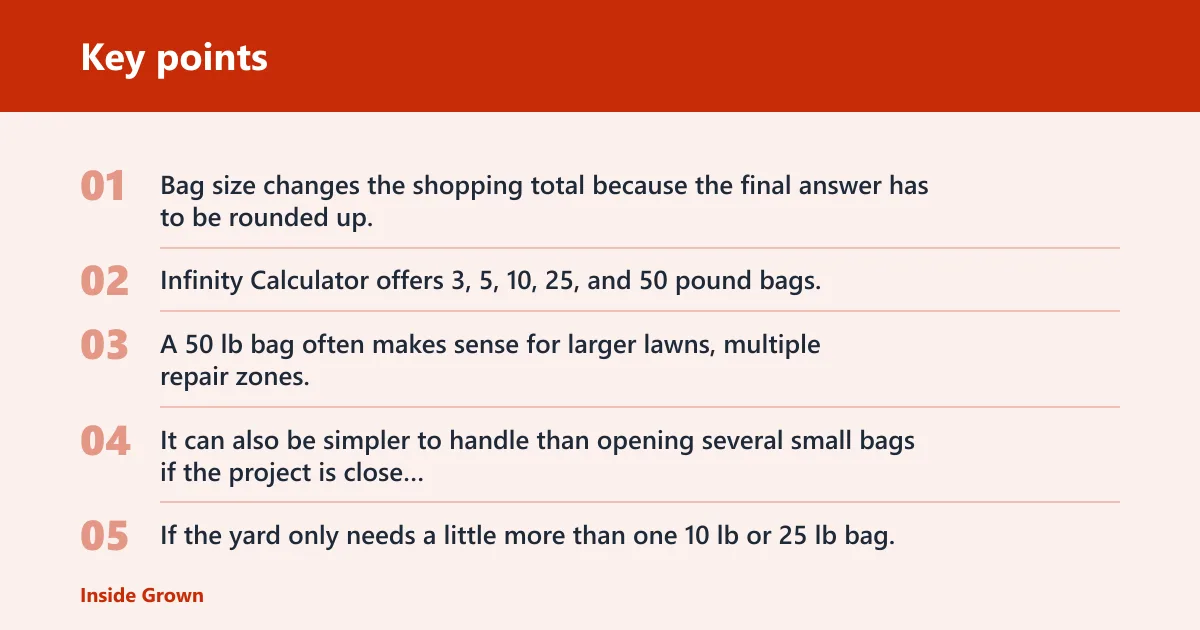
Bag size changes the shopping total because the final answer has to be rounded up. Infinity Calculator offers 3, 5, 10, 25, and 50 pound bags, which makes it easier to choose between one large bag and several smaller ones.
When a 50 lb bag makes sense
A 50 lb bag often makes sense for larger lawns, multiple repair zones, or projects where the buffer pushes the total just past a smaller bag size. It can also be simpler to handle than opening several small bags if the project is close to the upper end of the rate range.
But bigger is not always cheaper. If the yard only needs a little more than one 10 lb or 25 lb bag, a 50 lb bag may leave a large leftover amount for no practical gain.
How smaller bags change the total
Smaller bags can be useful for patch repair and for yards with many cutouts, because they reduce leftover seed from a large overshoot. They also let you separate grass types or blends if the supplier label uses different rates for different areas.
How much grass seed per acre? The bag-size choice does not change the acre math itself, but it changes how close the purchase lands to the calculated amount after the waste buffer is added.
Rounding after waste and touch-ups
Round up only after the buffer is added. That final number should include a small amount for touch-ups, especially near borders, corners, and the last pass of the spreader. Rounding too early can leave the job short.
If the lawn is highly irregular, one extra small bag is often safer than buying a larger bag that leaves too much unused seed. Seed storage matters, so the goal is enough for the project without creating a large remainder that may not be used later.
How much straw do you need?
How much straw do I need to cover grass seed? Use the same area you used for seed, then choose a thin application that protects the seed without burying it. Straw or mulch is a separate coverage decision tied to area and thickness, not a fixed add-on.
A light layer helps hold moisture and reduce seed movement. A heavy layer can block light, slow germination, and make the surface too dense for seedlings to push through.
Match straw coverage to area
Start with the seeded area, not the full property. If only the repair zones were seeded, straw should cover only those spots. For a full new lawn, coverage should be spread evenly and lightly across the entire seeded section.
The right amount depends on how open the soil surface is and how much wind or runoff the area gets. Flat, calm spaces usually need less than sloped or exposed areas.
Keep the layer thin enough for germination
Grass seed needs contact with moist soil. Straw should help retain moisture while still letting light and water reach the seed. If the layer mats down, it can create a barrier instead of a helper.
That is why the thickness matters more than a fixed bag count. One area may need only a light scatter, while another may need a fuller cover after heavy rain risk or on a slope.
When mulch is a better fit
Mulch can be a better fit than straw on small repairs, steep edges, or places where erosion control matters more than broad coverage. It should still be chosen by area and application depth, not guessed as a standard amount for every lawn.
For any cover material, the same rule applies: seed first, then a light protective layer that does not bury the seed. If the layer looks thick enough to hide the ground, it is probably too much.
Frequently asked questions
How much grass seed do I need for my lawn?
Use the lawn area, the grass type, and the project type first. Then add a 5% to 10% waste buffer, or more if the yard has many edges and curves. The final purchase should be rounded up to whole bags so you do not run short during spreading.
How much grass seed per acre?
Per-acre seed needs come from the same label rate used for smaller lawns, just scaled to the acre. Because many products are labeled per 1,000 square feet or per 1,000 square meters, convert the area first, apply the correct species rate, then round up the bag count.
How much grass seed per acre uk?
UK-style buying often uses square meters or hectares instead of square feet and acres. The method is still the same: measure the area, match it to the label rate, then add a modest waste buffer for overlap and edges before rounding up to full bags.
How much grass seed per m2 calculator?
A per m2 calculator should translate the seed label into metric area, then apply the right rate for your grass type and project type. Inch Calculator estimates seed in pounds and kilograms per 1,000 square feet or square meters, which makes metric planning easier for non-US use cases.
Should I buy extra grass seed beyond the calculator result?
Yes, usually a small amount. A 5% to 15% buffer helps with uneven spreading, edges, and touch-ups, and many calculators default to 10%. For a very regular lawn, the lower end is often enough; for an irregular yard, one extra small bag is safer.
How do I calculate grass seed for an irregular lawn?
Break the lawn into simple shapes, measure each section, subtract cutouts, and add the remaining areas together. Then apply the correct grass rate and buffer. This works better than estimating the whole yard as one shape, especially when borders curve around beds, walks, or patios.