Square Foot Gardening Calculator: Plants Per Square
A square foot gardening calculator turns bed area into crop counts by treating each 12-inch square as a spacing unit, then matching that square to 1, 4, 9, or 16 plants per square, based on mature size. If you miss the spacing, plants crowd each other, waste seed, tangle roots, and lower yield. This guide shows how to convert square-foot totals into crop sections, seed or transplant counts, and spacing fixes.
How is this calculated?
Press Calculate to see the math with your numbers.
What square foot gardening calculates
Square foot gardening divides a raised bed into 1-foot by 1-foot squares and uses tight spacing instead of row spacing. Mel Bartholomew developed the method, and it is usually paired with raised beds because the grid is easy to plan, plant, and replant. The calculator’s job is to turn a bed’s footprint into usable planting squares.
The soil system usually paired with this method is Mel’s Mix, the classic blend of equal parts compost, peat moss or coir, and coarse vermiculite. It is commonly used in beds about 6 inches or deeper. That soil choice matters because tight spacing only works if roots have loose, uniform growing media.
How the calculator fits the method
The calculator starts with bed dimensions, then maps each square to a crop density. That is different from row spacing, where plants are measured from row center to row center. In square foot gardening, the question is simpler: how many plants can fit in each square, and how many squares should each crop get?
It is most useful when you are planning a new raised bed, filling a salad bed, or dividing a mixed planting into clear sections. It is less useful if you want a single total without thinking about crop size, trellising, or repeat harvests.
How to calculate bed size
Use length × width to get bed area, then treat each square foot as one planting square. A practical starter bed is 4×4 feet, and a common larger size is 4×8 feet. A 4-foot width is often recommended because it is usually reachable from both sides, while length is measured in feet to help set the total number of squares.
A 4×8 bed has 32 square-foot sections. A 4×4 bed has 16. Those counts are the base for everything else: plant totals, seed order estimates, and the number of transplants you need to buy.
What to do with border and path space
Not every square in a real bed is equally easy to use. Border squares can be crowded by trellises, overhanging foliage, or access from the path side. If the bed sits beside a fence or wall, leave the edge closest to that structure for climbing crops, or reduce the count there if you cannot reach it cleanly.
Path space does not change the bed’s square-foot count, but it changes how you plant. A 4-foot width works because you can usually reach the middle without stepping into the bed. Wider beds often create unusable squares near the center unless you add access from both sides.
How many plants fit per square foot?
The count depends on the crop’s mature size. The calculator typically groups plants at about 1, 2, 4, 8, 9, or 16 per square foot. Large crops may take one square each, while tiny roots or greens can fit 16 per square. The right number comes from spacing needs, not from a fixed bed size rule.
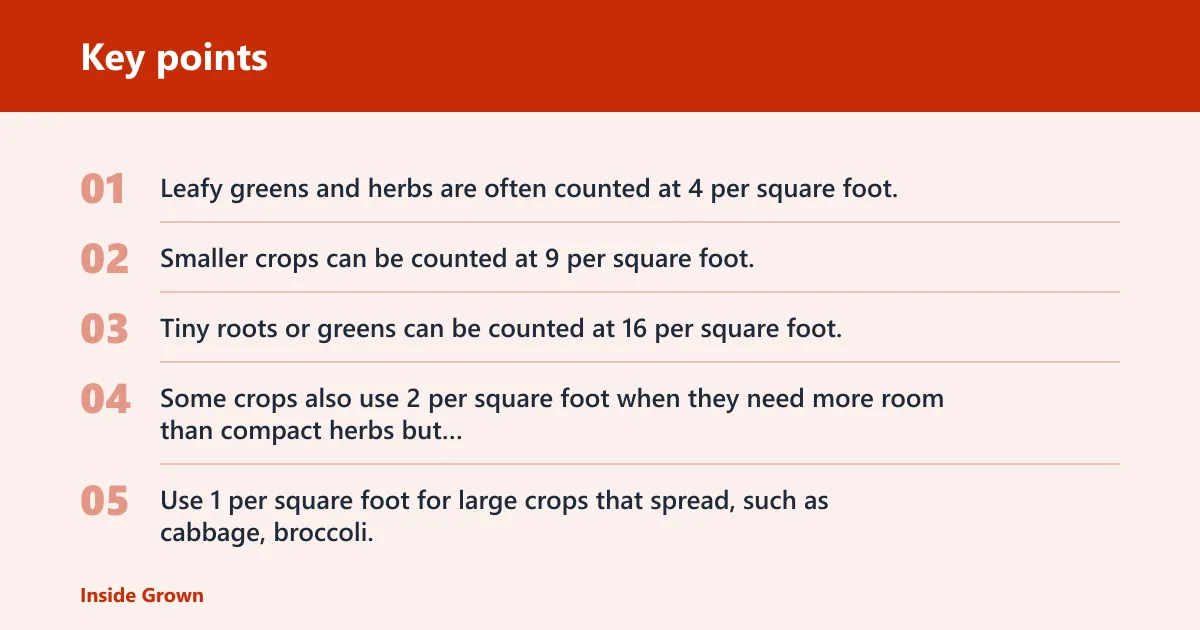
Leafy greens and herbs are often counted at 4 per square foot. Smaller crops can be counted at 9 per square foot. Tiny roots or greens can be counted at 16 per square foot. Some crops also use 2 per square foot when they need more room than compact herbs but less than a single large plant.
Which crops use 1, 4, 9, or 16 plants per square foot?
Use 1 per square foot for large crops that spread, such as cabbage, broccoli, or a single tomato plant with support. Use 4 per square foot for many leafy greens and herbs. Use 9 for smaller roots or compact greens. Use 16 for tiny roots or very small greens, such as radishes or baby-leaf plantings.
Crop variety matters. A variety labeled “compact” can fit more tightly than a sprawling one, while an oversized type may need fewer plants than the calculator suggests. If a seed packet lists wider spacing than the square-foot rule, follow the packet. That is the safer choice for the mature size on your site.
When to trellis instead of spreading
Climbing crops change the math. Pole beans, peas, cucumbers, and some tomatoes can use the bed’s vertical space instead of consuming many squares on the ground. That often makes a mixed bed more productive, because you can dedicate floor squares to low crops while training tall crops upward.
Picture a 4×8 bed with a trellis on the north edge. You can reserve the back row for climbing peas and use the front squares for lettuce, beets, or herbs. The calculator still counts the squares, but the trellis changes how you divide them.
How do you use the calculator?
Enter the bed length, bed width, and crop choice, then assign each crop the number of squares it needs. The output should tell you the total plant count, the seed count or transplant count, and whether the crop is better direct sown or transplanted. A good calculator also lets you split the bed into sections for mixed crops.
Inputs and outputs that matter
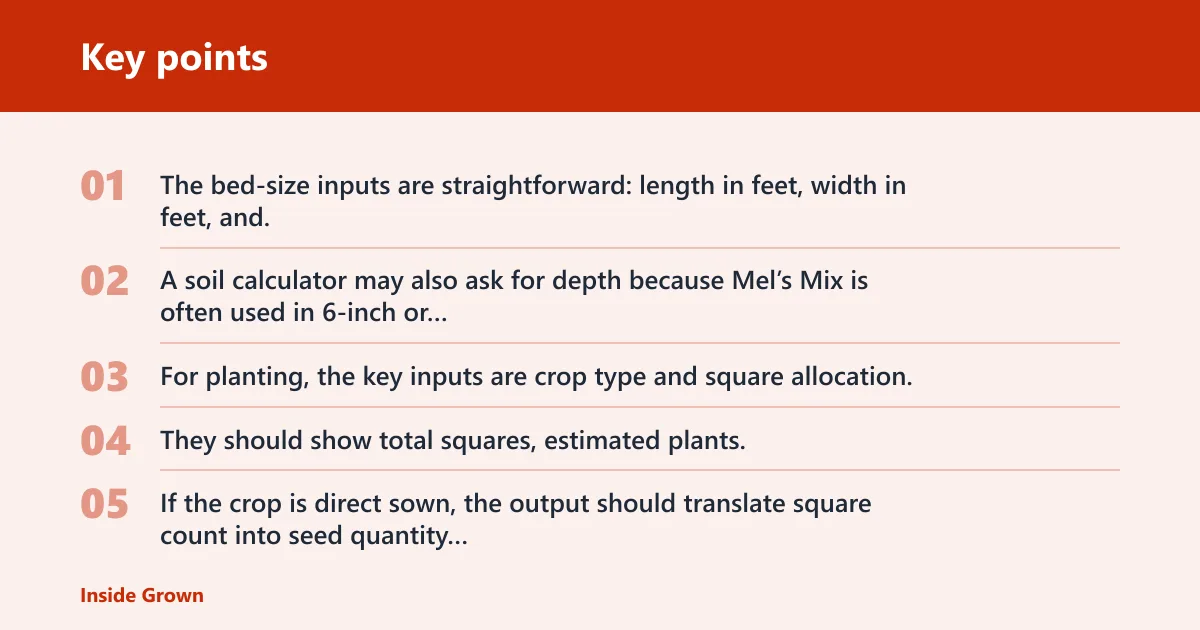
The bed-size inputs are straightforward: length in feet, width in feet, and, for soil planning, depth in inches. A soil calculator may also ask for depth because Mel’s Mix is often used in 6-inch or deeper beds. For planting, the key inputs are crop type and square allocation.
Useful outputs go beyond a bare count. They should show total squares, estimated plants, and a purchase target for seeds or seedlings. If the crop is direct sown, the output should translate square count into seed quantity with a small buffer for germination loss. If it is transplanted, it should tell you how many starts to buy.
Direct sow versus transplant
Direct sow crops usually include fast-growing roots and many greens. Transplants are better for crops that are slow to start, larger at maturity, or more sensitive at germination. The calculator should not treat those the same way, because a seed packet count and a transplant count are different buying decisions.
A common first-timer mistake is to buy exactly enough seed for the number of final plants. That leaves no room for weak germination. For direct sowing, add extra seed allowance based on packet viability and your own sowing margin, then thin to the final count after emergence.
Square foot gardening table
This decision table turns common calculator outputs into action. It shows bed size, crop density, estimated plant count, a buying note, and whether to direct sow or transplant. Use it as a planning check before you buy seeds or starts.
| Bed size or layout | Crop density | Estimated plant count | Seed or seedling purchase note | Direct sow or transplant |
|---|---|---|---|---|
| 4×4 bed, lettuce section | 4 plants per square foot | 64 lettuce plants | Buy extra seed for germination loss; thin after sprouting | Direct sow |
| 4×4 bed, carrot or radish section | 16 plants per square foot | 256 carrots or radishes | Seed packet count should exceed the final plant target | Direct sow |
| 4×8 bed, mixed greens and herbs | 4 per square foot in one section, 9 per square foot in another | 128 greens in 16 squares, 72 smaller crops in 8 squares | Separate the seed list by crop section; do not total them as one block | Mostly direct sow |
| 4×8 bed, trellised beans and salad mix | 1 per square foot for beans, 4 per square foot for salad greens | 8 bean plants, 48 salad greens | Buy bean transplants only if your climate favors starts; otherwise direct sow | Direct sow or transplant, depending on crop |
| Mixed bed with 6 squares lettuce, 4 squares beets, 2 squares basil | 4, 9, and 4 per square foot | 24 lettuce, 36 beets, 8 basil plants | Purchase each crop separately and match quantity to the section total | Direct sow lettuce and beets; transplant basil if needed |
How to plan mixed crops
Mixed beds should be calculated section by section, not as one total. A salad bed may need lettuce, scallions, and radishes in different square counts. A themed bed may combine herbs, roots, and a single trellised crop. The calculator should add those parts together after you assign each crop its own squares.
Separate planning prevents two common errors: overbuying one crop and underbuying another. It also makes succession planting easier. If you harvest a square of radishes early, you can replant that square with a faster or later crop without changing the whole bed plan.
Mixed-bed planning that works
Suppose your 4×8 bed is split into three zones: 8 squares for lettuce at 4 per square, 8 squares for carrots at 16 per square, and 4 squares for bush beans at 4 per square. That gives you a purchase list tied to real bed space, not just a single plant total.
For repeated harvests, keep one section open for a second planting wave. That helps a 4×8 bed function like two or three smaller beds over the season. The calculator can still do the math, but you choose the timing.
What to buy for seeds or seedlings
Seed buying should account for germination rate and extra seed allowance. If you need 24 final lettuce plants, do not buy exactly 24 seeds unless the packet is known for strong germination and you are sowing carefully. A modest buffer protects the plan from gaps in the square grid.
Seedling buying is simpler but still needs a margin. If you need 8 tomato transplants, buy only what you can fit after spacing for stakes, cages, or trellis support. The final count should respect the crop’s mature width, not just the bed’s empty squares.
How to adjust for germination loss
For direct sowing, use the final plant count as a target, then add a small surplus before thinning. The exact surplus depends on seed age, packet quality, and sowing skill, so the calculator should present the final count as an estimate, not a guarantee. That is especially important for carrots, beets, lettuce, and other fine seeds.
If germination is uneven, the spare seed lets you fill gaps without rebuilding the plan. If too many sprout, thin aggressively to the intended square-foot density. Crowding defeats the point of the method.
How to avoid spacing mistakes
Most spacing problems come from treating every crop like a small crop. Oversized varieties can outgrow the grid, trellising can change how many squares a plant needs, and local weather can slow or speed growth enough to change spacing pressure. The calculator should be adjusted when the crop size on the packet does not match the standard square-foot rule.
Edge loss also matters. A bed may have a full square-foot count on paper, but some border areas may be hard to reach or too close to a trellis. That is why a 4-foot width is practical: it keeps the middle reachable and reduces wasted squares.
When local conditions justify adjusting the count
Cool, short seasons may favor tighter succession planting so a square is replanted sooner. Hot, wet, or windy sites may favor wider spacing for airflow and disease control. If a crop has a larger-than-usual variety or a dense disease history, reduce the calculator’s count rather than forcing the grid to fit.
Say your seed packet lists a tomato that reaches a much wider spread than a compact patio type. In that case, one square may still be the right plan, but the support and pruning needs rise. If the packet calls for a very large indeterminate plant, the calculator’s output should be treated as a starting point, not a fixed rule.
Frequently asked questions
What is square foot gardening?
Square foot gardening is a raised-bed method that divides the bed into 1-foot by 1-foot squares and uses intensive spacing instead of row spacing. It was developed by Mel Bartholomew. The method works best when each square is assigned to a crop based on mature size, not on rows.
How do I calculate plants per square foot?
Start with the crop’s mature spacing, then map it to the closest square-foot pattern: 1, 2, 4, 8, 9, or 16 plants per square foot. Large crops get one square each. Smaller crops get more. If the packet spacing differs from the square-foot rule, follow the crop’s actual mature size.
How do I square foot garden in a raised bed?
Measure the bed’s length and width, divide it into 1-foot squares, then assign each square a crop and density. A 4-foot width is practical because you can reach the center from either side. Fill the bed with Mel’s Mix in 6-inch or deeper beds, then plant by square rather than by row.
How many square-foot sections are in a 4×8 raised bed?
A 4×8 raised bed has 32 square-foot sections. That total comes from length × width, so 4 feet times 8 feet equals 32 square feet. Those 32 squares are the base unit for crop counts, seed estimates, and mixed-bed planning.
How do I estimate spacing from plants per square foot?
Use the plant-per-square count as a spacing guide, then compare it with the crop’s mature width. One plant per square is for large crops, while 4, 9, and 16 per square fit progressively smaller plants. If the crop spreads more than expected, reduce the count or move it to a trellis.
Can I use a square foot gardening calculator for mixed crops?
Yes, but calculate each crop section separately. A mixed bed may include lettuce, beans, herbs, and roots in different square counts, and each crop can use a different density. The calculator should total the sections after you assign them, not before. That gives you a usable planting and buying plan.