How Many Plants Fit in a 4×8 Raised Bed? 32 Plants
A 4×8 raised bed holds about 32 standard-spacing plants, but I’d treat roughly 20 to 24 as a safer working number for larger crops and about 48 to 64 for tighter crops like carrots or lettuce. Put too many in, and roots press together, air slows down, and the harvest shrinks. This guide gives crop-by-crop counts, spacing rules, and a simple layout method for planning your bed.
How many plants fit in a 4×8 raised bed?


A 4×8 raised bed is 32 square feet, so the answer depends on plant size, root spread, and how much of that space you can use without crowding. Compact crops can go in high numbers. Tomatoes, cucumbers, and other larger plants need far more room.
Use safe count versus comfortable count
The comfortable count leaves room for air, weeding, and harvest. The safe maximum still works if every plant stays compact and you stay on top of pruning, watering, and pest checks. In practice, a 4×8 bed often fits roughly 4 to 8 large plants, 8 to 16 medium plants, or dozens of small salad and root crops.
Why plant habit changes the answer
Plant habit matters more than the name on the label. Bush beans, determinate tomatoes, compact peppers, and loose-leaf lettuce behave very differently from indeterminate tomatoes or vining cucumbers. A sprawling plant can take over the bed fast if it grows hard, while a compact one fits a tighter plan.
According to 4×8 Raised Bed Vegetable Garden Layout Ideas — The bed size discussed is 4×8, framed as a vegetable garden layout.
How do I figure out spacing in a raised bed?
Use the spacing on the seed packet or plant tag first, then check the mature width and height. Raised beds can take closer planting than in-ground rows, but only if air moves through the leaves and the plants still have room to finish at full size.
Read seed packets and plant tags for mature spacing
Packet spacing is the starting point. If a tomato tag says 24 inches between plants, that means the plant needs room for branches, fruit load, and airflow. For root crops and lettuce, packet spacing often assumes thinning after germination, not leaving every seedling in place.
Use mature width, air flow, and thinning
Mature width tells you how wide the plant will get when it is grown well. Air flow matters because tight planting traps moisture and raises disease pressure. Thinning matters because carrots, beets, lettuce, and herbs usually start crowded on purpose, then are cut back to the strongest plants.
Why raised beds can use tighter spacing than in-ground rows
Raised beds support intensive planting, also called intensive gardening. Mel Bartholomew’s square foot gardening method uses a 1-by-1-foot grid to plan spacing by crop size instead of by long rows. That approach works well in a 4×8 bed because every square foot can be assigned a job.
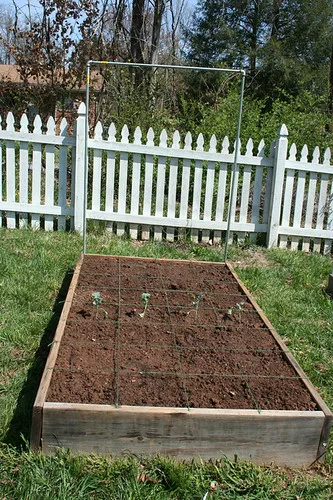
Square foot gardening basics for a 4×8 bed
A square-foot layout divides the bed into 32 one-foot squares. That makes the bed easier to plan, especially when mixing crops. Small plants can share one square, while larger plants may need one square each or more.
How the 1-foot grid works
Use the grid to map each crop before planting. A square can hold one tomato if the variety is compact, four pepper plants if they are small and well spaced, sixteen carrots, or nine small onions. The grid is a planning tool, not a rule; mature size still decides the final count.
Plant-per-square estimates for common crops
Loose-leaf lettuce often fits about 4 per square. Carrots can fit about 16 per square after thinning. Beets often fit about 9 per square. Basil usually fits 4 per square if plants are kept trimmed. Bush beans commonly fit 9 per square, while a compact tomato may need a full square on its own.
When to switch from grid math to larger spacing
Use larger spacing when a plant climbs, sprawls, or shades nearby crops. Cucumbers on a trellis, indeterminate tomatoes, and large peppers often need more than a simple square-foot count suggests. In those cases, reserve whole squares or bed edges and leave open paths for access.
Crop-by-crop capacity table for a 4×8 raised bed
The table below gives practical safe counts for a true 4×8 bed. “Single crop” means the bed is planted mostly with one crop. “Mixed layout” means the bed combines crops and usually leaves a few squares for access, edging, or succession planting.
| Crop | Spacing or habit | Trellis or support | Safe count in single-crop bed | Safe count in mixed layout |
|---|---|---|---|---|
| Tomatoes, determinate or bush | 1 per 2×2 area; compact types only | Cage or stake recommended | 4 to 6 | 2 to 4 |
| Tomatoes, indeterminate | 1 per 3×3 area | Strong trellis or cage | 2 to 4 | 1 to 2 |
| Peppers | 12 to 18 inches apart | Usually none | 12 to 16 | 6 to 10 |
| Cucumbers | Vining habit, space-saving when vertical | Trellis strongly recommended | 4 to 6 | 2 to 4 |
| Lettuce and salad greens | Tight spacing, cut-and-come-again | None | 32 to 64 | 16 to 32 |
| Carrots | Dense sowing, then thin | None | 256 to 512 seedlings before thinning | 128 to 256 seedlings before thinning |
| Beets | Dense sowing, then thin | None | 144 to 288 seedlings before thinning | 72 to 144 seedlings before thinning |
| Basil | Compact varieties, frequent harvest | None | 12 to 16 | 6 to 10 |
| Onions | Small, upright bulbs | None | 32 to 64 | 16 to 32 |
| Strawberries | Perennial edging crop | None | 8 to 16 | 6 to 12 |
How many tomato and pepper plants fit?
Tomatoes and peppers both do well in raised beds, but they take very different amounts of space. Compact peppers can sit closer together than tomatoes, while tomatoes need support and more air around their leaves. The gap between determinate and indeterminate tomatoes changes the count a lot.
Tomatoes: determinate vs indeterminate
Determinate tomatoes are bushier and finish in a shorter window, so they can sit closer together. A 4×8 bed can hold roughly 4 to 6 determinate plants if they are caged and pruned lightly. Indeterminate tomatoes keep growing, so I’d use roughly 2 to 4 plants as a safer range.
One plant per square foot only for compact types
One plant per square foot works only for very compact tomato types, and even then it is tight. I usually get better results by giving each tomato more room and keeping the bed from turning into a wall of leaves. Tomatoes that shade each other often set fewer fruits.
Pepper spacing and edge access
Peppers are usually smaller and more forgiving. A 4×8 bed can hold about 12 to 16 peppers in a single-crop layout, or 6 to 10 in a mixed bed with paths, lettuce, or basil. Keep them near the front or edge if the bed is deep and access matters.
How many lettuce, cucumber, and root crops fit?
Lettuce, cucumbers, carrots, and beets fill a 4×8 bed in very different ways. Lettuce and roots can be planted tightly because they stay small or are harvested young. Cucumbers need a trellis if the goal is to keep the bed from being swallowed by vines.
Cut-and-come-again lettuce and greens
Loose-leaf lettuce and many greens can be planted tightly and harvested often. A full 4×8 bed can hold 32 to 64 small greens if the planting is dense, or 16 to 32 in a mixed layout. Successive sowings help here because empty spots can be replanted quickly.
Trellised cucumbers versus sprawlers
Cucumbers are a classic place where support changes capacity. On the ground, they need far more room and can crowd neighbors. On a trellis, a 4×8 bed can hold about 4 to 6 cucumbers in a single-crop plan, or 2 to 4 when mixed with herbs or greens below.
Carrots and beets, including thinning needs
Carrots and beets are planted densely, then thinned. That means the number of seedlings is much higher than the number of final plants. A 4×8 bed can start hundreds of carrot seeds and end with roughly 256 to 512 usable roots at full density, depending on thinning and spacing. Beets run lower, but still fill space well.
How do I avoid overcrowding a raised bed?
A bed is too full when plants lean hard for light, leaves stay wet, harvest becomes difficult, or disease starts moving through the canopy. Crowding often looks efficient at planting time and disappointing by midsummer. Leaving some breathing room usually improves yield and makes the bed easier to manage.
Signs the bed is too full
If you cannot reach the center without stepping on soil, the bed is probably packed too tightly. If leaves touch from one end to the other, airflow is poor. If tomatoes or cucumbers must be bent away from neighbors to harvest, the layout is already working against you.
Disease, shade, and harvest access problems
Overcrowding raises humidity inside the canopy. That can lead to fungal issues, slower drying after rain, and smaller fruits. Tall crops should be placed so they do not shade shorter ones, and trellises should sit where they will not block access to the rest of the bed.
Use succession planting after quick crops finish
Succession planting keeps the bed productive by reusing empty space after quick crops finish. The space left by spent plants should be filled again, especially after peas or garlic. Garlic spaces may not be available again until about July, which makes them useful for a second crop of greens or beans after harvest.
Add seasonal companions without crowding
Small pollinator-friendly flowers such as marigolds can fit along edges or corners without taking over the bed. They should not replace crop space, but they can help keep the bed busy while leaving the main planting plan intact. Compact companions work best in mixed layouts.
How many plants can i put in a 4×8 raised bed?
A practical answer is 20 to 24 larger plants, or 48 to 64 small plants, with everything in between based on mature size. The count changes fast once trellises, compact varieties, and mixed planting enter the plan. The bed can be very productive, but only if air, light, and access stay part of the design.
- Check the mature spacing on each seed packet or plant tag.
- Decide whether the crop is compact, bushy, vining, or tall.
- Map the 4×8 bed as 32 one-foot squares.
- Assign large crops first, then fill gaps with greens, herbs, or roots.
- Leave room for trellises, cages, and harvest access.
- Replant open squares after quick crops finish.
Frequently asked questions
how many plants can fit in a 4×8 raised bed
Most gardeners can fit 20 to 24 larger plants or 48 to 64 small plants in a 4×8 raised bed, depending on crop type and spacing. Compact roots and greens fit far more densely than tomatoes or cucumbers. The best count comes from mature width, airflow, and access, not seedling size.
how many tomato plants fit in a 4×8 raised bed
Expect about 4 to 6 determinate tomato plants or 2 to 4 indeterminate plants in a 4×8 raised bed. Compact tomatoes can be placed closer than sprawling types, but they still need staking or cages. If the bed also holds peppers or herbs, reduce the tomato count further.
how many pepper plants can i fit in a 4×8 raised bed
A 4×8 raised bed can usually hold 12 to 16 pepper plants in a single-crop layout, or 6 to 10 in a mixed layout. Peppers are a strong raised-bed crop because they stay relatively compact and tolerate close spacing better than larger fruiting plants, as long as airflow remains open.
how many strawberries can you fit in 4×8 raised bed
A 4×8 raised bed can fit about 8 to 16 strawberry plants if the bed is used mostly for strawberries, or 6 to 12 if they are mixed with other crops. Strawberries work well along edges, but they should not be packed so tightly that runners and leaves block airflow.
How do I figure out spacing in a raised bed?
Use the spacing on the seed packet or plant tag, then adjust for mature width, plant height, and airflow. Raised beds can be planted more closely than in-ground rows, but the bed still needs room to dry, to harvest, and to let each crop reach normal size without stress.
Can I plant more closely in a raised bed than in rows?
Yes, a raised bed can usually be planted more closely than traditional rows because the soil is contained and planting is often more intensive. Even so, close spacing should still respect mature size. Crowding may seem efficient early on, but it often reduces airflow and lowers harvest quality later.