How Many Cucumber Plants Per Trellis? Ideal Count
For most home gardens, I plant about 1 cucumber per trellis panel, and sometimes 2 only on a sturdy trellis with compact varieties and regular pruning. Pack them in too tight, and mildew moves in, air slows to a crawl, and picking turns into a knotted mess of stems and leaves. This guide gives a simple count by trellis type, cucumber vigor, and how much upkeep you want to handle.
This guide is part of our Planting quantity guide series.
How many cucumber plants should one trellis hold?
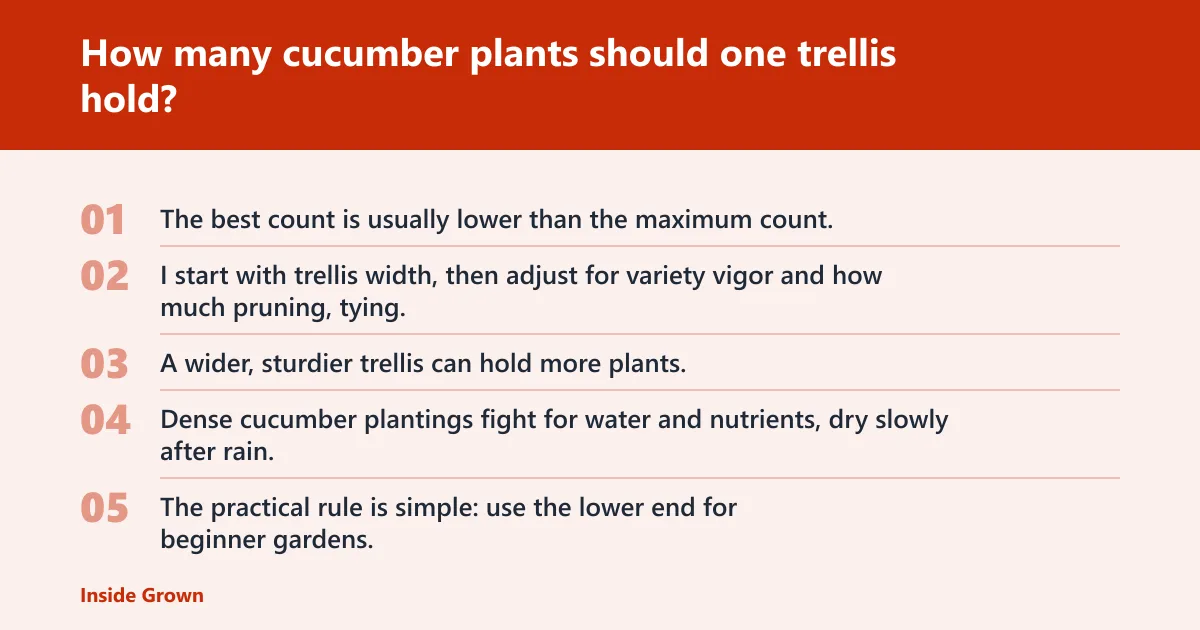

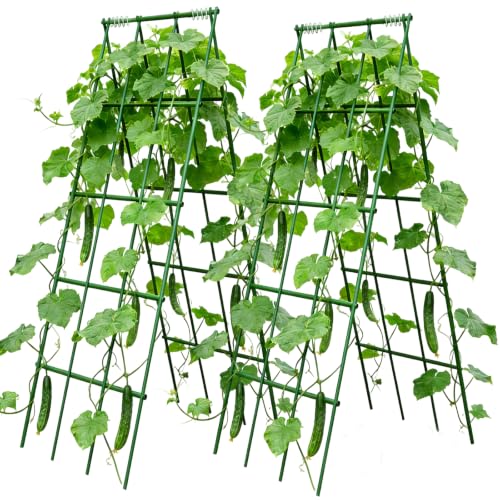

The best count is usually lower than the maximum count. I start with trellis width, then adjust for variety vigor and how much pruning, tying, and watering I can keep up with. A wider, sturdier trellis can hold more plants, but “can hold” is not the same as “should hold.”
When the ideal count is lower than the max count
If the trellis is narrow, the variety is a strong vine, or disease pressure runs high, the ideal count drops fast. Dense cucumber plantings fight for water and nutrients, dry slowly after rain, and trap humidity in the canopy. That is where powdery mildew shows up first.
The practical rule is simple: use the lower end for beginner gardens, use the middle for steady production, and use the upper limit only when the trellis is large and the gardener is comfortable training vines often.
📊 A single stake or teepee is recommended for 1 plant. Source: How Many Cucumbers per Trellis: Spacing Guide 2026.
Cucumber plant counts by trellis type
Trellis style sets the ceiling. A cattle panel can carry more than a single stake. An A-frame sits between the two. For most gardens, fewer plants on a smaller trellis gives cleaner growth, fewer disease problems, and easier picking.
Cattle panel trellis: ideal, beginner-safe, and upper-limit counts
A cattle panel arch is one of the strongest common setups. A practical count is 2–3 vining plants on one side, or 4–6 plants on both sides. The source lists 8 plants as the maximum safe count for experienced growers, but that is a max, not the best target for most people.
For a home gardener, 4–6 plants on both sides is usually the sweet spot when the panel is full-size and the vines are kept moving upward. If the panel is only serving one side, 2–3 plants is the cleaner choice.
A-frame or lean-to trellis: when two plants is enough and when four is pushing it
An A-frame or lean-to trellis is recommended for 2 plants, and the source says it can handle up to 4 plants. For most gardens, 2 plants is the practical ideal. Four is the edge of comfort unless the varieties are compact and the grower stays on top of training.
If the frame is around the 6–8 ft wide range, two plants leave enough room for airflow and harvest access. At four plants, vines tend to cross, which makes pruning and pest checks harder.
String or net wall trellis: how many plants fit across the span
A string or net wall trellis is recommended for 3–4 plants, and the maximum is 6 plants. This style works well when the wall is broad and the vines can be spread side by side instead of piled into the same section.
For a 6 ft high × 10 ft long wall, 3–4 plants is the balanced count. Six can work, but only if the gardener is willing to tie and redirect vines often. Otherwise, the middle section becomes a tangle.
Single stake or teepee trellis: why one plant is usually the smart call
A single stake or teepee is recommended for 1 plant, and the source says 2 plants can fit for bush types. That small footprint is the clue. This style works best for one plant because cucumber vines want width, not just height.
One plant keeps the stem base open and makes watering simpler. Two plants on the same teepee is only sensible when the plants are bush types and the gardener accepts a smaller total harvest.
Which cucumber varieties need more space?
Variety matters as much as trellis style. Vining cucumbers need more trellis width than bush types. Some types also set fruit more efficiently, which can reduce how many plants are needed for the same harvest goal.
Vining cucumbers: why Marketmore and Suyo Long need wider spacing
Vining types such as Marketmore and Suyo Long send out longer runners and keep climbing. The source suggests a low number of plants per trellis for these types. That is a good sign that wide spacing matters more than cramming in extra starts.
These plants are better on broader support with room for side shoots. If they are crowded, the canopy thickens fast and the lowest leaves stay damp longer.
Bush cucumbers: why Salad Bush and Spacemaster can sit closer together
Bush cucumbers have shorter vines than vining types. Salad Bush and Spacemaster are the common examples. The source suggests several plants per trellis, which is a sign that the plant habit is more compact and the spacing can be tighter.
Even so, bush does not mean crowding-proof. They still need light and airflow, especially once fruiting starts.
Parthenocarpic and gynoecious types: when fewer plants can still give strong yield
Parthenocarpic and gynoecious cucumbers can set more fruit per plant because they produce fewer male flowers or all-female flowers. The source claims noticeably more fruit, which may mean a gardener needs fewer plants to reach the same yield target.
That matters in small beds. If the goal is steady picking from fewer plants, these types are often a better fit than simply adding more seedlings to the trellis.
Can you grow two cucumber plants on one trellis?
Yes, two cucumber plants can share one trellis when the structure is sturdy and the variety is not overly vigorous. Two plants are a good fit for many cattle panels and A-frames. The problem starts when two plants are treated as a minimum instead of a workable limit.
When two plants work well on a cattle panel or A-frame
Two plants on a cattle panel usually leave enough room for airflow and easy harvesting, especially if they are trained to separate sides. Two plants on an A-frame can also work well, because the vines can be pulled apart instead of stacked on the same face.
This is the safer route for gardeners who want fewer chores. It lowers the chance of vines overlapping too early.
When two plants become too much for airflow, pruning, and watering
Two plants can be too much when the trellis is small, the cucumber type is vigorous, or the garden gets regular humidity and leaf wetness. At that point, pruning becomes constant and watering needs rise because two root systems pull from the same limited zone.
If leaves stay wet after sunrise, the setup is already too tight.
How many cucumber plants can I grow in a container with a trellis?
For vertical cucumbers, container size is a hard limit. The source recommends 15–20 gallon pots for one plant and 25–30 gallon pots for two plants. Three or more plants in one pot are not recommended. In containers, root competition shows up faster than it does in open ground.
Minimum pot size for one vertical cucumber plant
A single plant needs at least 15–20 gallons when it is grown vertically. That volume gives the roots room to hold moisture without drying out too fast between waterings. Smaller containers often force the gardener into daily watering once the vines are established.
Fabric pots are often a better fit than plastic or terra cotta for vertical cucumbers. The source claims they gave 28% higher yield in a trial, and the aeration advantage makes sense for a thirsty crop.
When two plants can share a 25- to 30-gallon container
Two cucumber plants can share a 25–30 gallon container if the trellis is sturdy and the gardener waters and feeds consistently. Even then, this is the upper practical range for most home setups. It works best with compact vines and active training.
Once two plants share one pot, the mix dries faster and nutrient demand rises. That is fine for an attentive gardener, but it is not a low-maintenance arrangement.
Why three or more plants in one pot usually backfires
Three or more cucumber plants in one container is usually too crowded. The roots compete hard, the pot dries quickly, and fruit size often suffers because water and nutrients cannot keep up with demand. The canopy also closes in, which raises mildew risk.
In a pot, crowding is felt sooner than in a bed. Leaves wilt first, then fruit quality slips.
Trellis capacity matrix: ideal, beginner-safe, and max counts
This is the quickest way to choose a count. Use the ideal number if you want the cleanest mix of yield and maintenance. Use the beginner-safe number if you want the setup to stay manageable. Use the max only if you can prune, tie, and water often.
| Trellis style | Ideal count | Beginner-safe count | Upper-limit count |
|---|---|---|---|
| Cattle panel trellis | 2–3 plants on one side, or 4–6 plants on both sides | 2–4 plants depending on access and variety vigor | 8 plants for experienced growers |
| A-frame or lean-to trellis | 2 plants | 2 plants | 4 plants |
| String or net wall trellis | 3–4 plants | 3 plants | 6 plants |
| Single stake or teepee | 1 plant | 1 plant | 2 plants for bush types |
Quick yes/no checklist: If you answer “yes” to any of these, choose fewer plants.
- Is the variety a vigorous vine?
- Is the container smaller than 15–20 gallons per plant?
- Does the site stay humid or disease-prone?
- Will you skip regular tying or pruning?
- Are multiple plants sharing one watering zone?
What happens when you overcrowd cucumber plants?
Too many plants on one trellis usually means weaker roots, more watering, more feeding, and more disease. The source links overcrowded trellises to 62% more mildew, while optimal spacing produced 2.1× yield. In other words, the crowded setup often loses on both health and harvest.
Root competition, watering frequency, and nutrient load
Shared trellises are also shared root zones. More plants in the same bed or pot pull moisture faster and use up nutrients sooner. The gardener then has to water more often and feed more carefully, or fruit size and leaf health slide.
That is why the ideal count is often lower than the maximum count. A plant that is not fighting its neighbors usually performs better.
Why tight spacing can raise powdery mildew risk
Powdery mildew loves dense foliage and poor airflow. When cucumber leaves overlap, the canopy stays humid longer after rain or irrigation, and the disease spreads faster. This is the main failure case for tight trellis layouts.
If the lower leaves are staying shaded and damp, the spacing is already too aggressive.
Signs you planted too many for the trellis
- Leaves touch and stay packed together.
- Harvesting requires moving multiple vines at once.
- The soil dries faster than expected.
- New growth looks pale or slowed.
- Powdery mildew starts on the inner leaves.
Frequently asked questions
How many cucumber plants should I put on one trellis?
For most home gardens, 1 to 2 plants is the safest target on a single trellis panel, and more only makes sense on wide, sturdy support. Cattle panels and large wall trellises can carry more, but the ideal count still depends on variety vigor and how much training you will do.
Can I grow 2 cucumber plants on a cattle panel?
Yes. Two plants are a comfortable count on a cattle panel for many gardens, especially if the panel is sturdy and the vines are trained to separate sides. On a full arch, 2–3 vining plants on one side or 4–6 plants on both sides are workable ranges.
How far apart should cucumber plants be on a trellis?
Spacing depends on the trellis type and cucumber habit more than on a single inch rule. On narrow supports, one plant per section is safer. On wider cattle panels or wall trellises, leave enough room that leaves do not mat together early in the season.
How many cucumber plants fit on an A-frame trellis?
An A-frame or lean-to trellis is recommended for 2 plants, and the source says up to 4 plants can fit. For most gardeners, 2 plants is the cleanest count because it keeps airflow better and makes pruning and harvest access much easier.
How many cucumber plants can I grow in a container with a trellis?
One plant fits best in 15–20 gallons, and two plants need 25–30 gallons. Three or more plants in one container are not recommended. If the pot is smaller than that, the root zone usually dries too fast and the plants begin competing hard for nutrients.
Do bush cucumbers need the same spacing as vining cucumbers?
No. Bush cucumbers are shorter and usually tolerate tighter spacing than vining types. The source suggests 3–4 plants per 6 ft trellis for bush types, while vining types are closer to 1–2 plants per 6 ft trellis. Even so, airflow still matters.