How Many Marigolds Should You Plant Around Vegetables?
For a 4-by-8-foot bed, plant about 8 to 10 marigolds as a border at around 12-inch spacing, or roughly 12 to 16 if you interplant one every 18 to 24 inches between vegetables. Too few flowers do little for pest pressure, and crowding them can shade crops and waste space. Use bed size, bed layout, and spacing to set the count for borders, row planting, and quick estimates in common raised beds.
How many marigolds should you plant around vegetables?
The quick answer by bed size
The right count depends on whether you ring the bed edge or tuck flowers into crop rows. Border planting follows the perimeter, while interplanting follows the gaps inside the bed. A small raised bed may need only 6 to 10 plants around the edge. A larger bed often needs more if you want flowers across the planting area.
A simple rule works well: count border plants by perimeter, then count interior plants by open gaps. For borders, use one marigold every 10 to 12 inches around the edges. For in-bed planting, use one marigold every 18 to 24 inches in the open spaces you leave between vegetables. That gives a practical count without stuffing the bed full.
When a border is enough
If your goal is mostly pollinator access and a neat frame around the bed, a border can be enough. Border planting is especially useful on the outer edge of raised beds where flowers stay visible and do not compete directly with vegetables. French marigolds and signet marigolds fit this use best because they stay smaller.
When you need in-bed plants too
If the bed has wide aisles between crops, tomatoes on stakes, or roomy brassica spacing, border plants alone may leave too much open ground. In that case, add marigolds in the bed itself, either in rows, blocks, or single plants between crops. This spreads the flowers through the bed rather than keeping them only on the edge.
Border planting vs. interplanting: which setup do you need?
Use border planting when you want a clean frame around the vegetable bed and easy access for pollinators along the edges. Use interplanting when you want flowers inside the crop layout. The count changes because a border follows the perimeter, while interplanting follows spacing between vegetables and the amount of open ground left in the bed.
Perimeter planting around bed edges
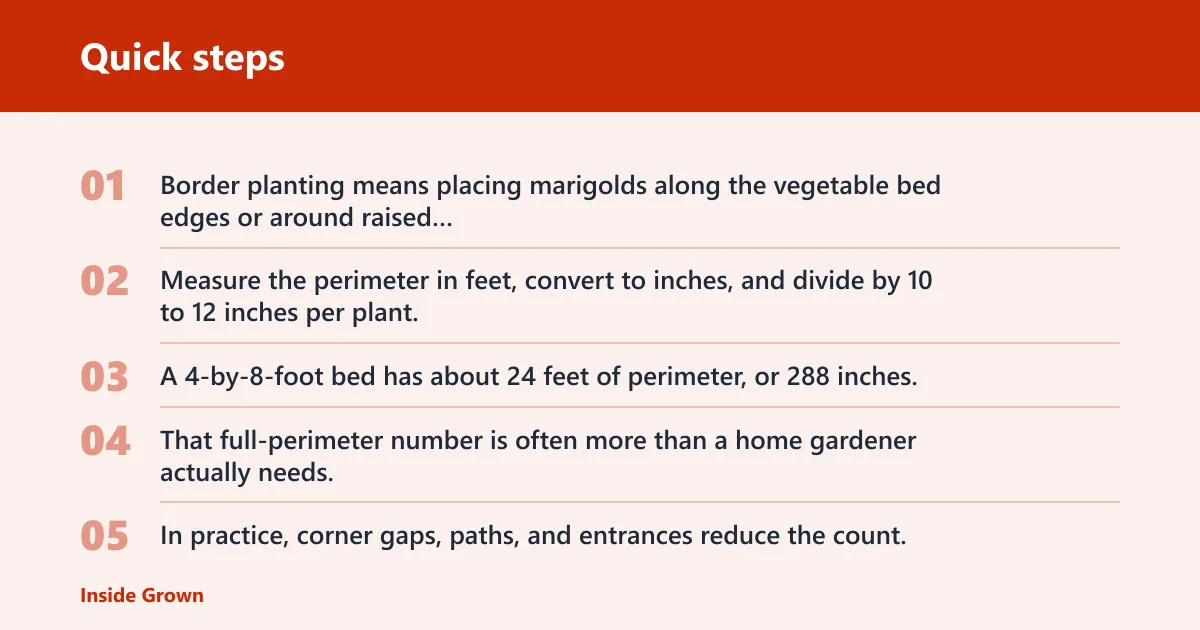
Border planting means placing marigolds along the vegetable bed edges or around raised beds. It is the simplest way to calculate a count. Measure the perimeter in feet, convert to inches, and divide by 10 to 12 inches per plant. A 4-by-8-foot bed has about 24 feet of perimeter, or 288 inches; that can support roughly two dozen to just under 30 plants if you fill every side.
That full-perimeter number is often more than a home gardener actually needs. In practice, corner gaps, paths, and entrances reduce the count. For a 4-by-8-foot bed, many gardeners use 8 to 10 marigolds spaced around the visible sides instead of packing every inch of the rectangle. That still frames the bed without crowding the crop area.
Planting between vegetables in rows or blocks
Interplanting means placing marigolds among vegetables in rows, blocks, or individually. A common rule is one plant every 18 to 24 inches in the open spaces, with smaller types used when the bed is tight. This is a companion planting approach, not a hedge. The flowers should sit where they do not steal light from the crops.
Use interplanting when rows already have gaps. For example, a bed with peppers in staggered rows may fit one marigold between plants at the row ends or at wider intervals along the row. A common first-timer mistake is putting marigolds in every open spot. That can quickly turn a food bed into a flower bed and reduce airflow.
How spacing changes the final count
Spacing sets the count more than bed size alone. Tight spacing, such as 10 to 12 inches, gives more plants and a fuller border. Wider spacing, such as 18 to 24 inches, gives fewer plants and leaves more room for vegetables. The tighter the bed and the larger the marigold type, the smaller the final count should be.
Which marigold type should you choose for a vegetable garden?
French marigolds and signet marigolds are the best choices for most vegetable beds because they stay smaller and fit tighter spacing. African marigolds are larger-growing and more statuesque, which makes them less suitable where compact planting is needed. If the bed is narrow or densely planted, smaller types are the safer choice.
French marigolds for most beds
French marigolds are the default pick for vegetable gardens. They stay smaller, and they work well for borders and interplanting. If you want the safest choice for a mixed bed, start here. They fit around bed edges without leaning heavily into crop space, and they handle the sunny spots that marigolds prefer.
Signet marigolds for smaller, tighter spaces
Signet marigolds are also called gem types. They are a small-growing option for kitchen gardens and mixed beds where you want flowers but have limited room. Use them when you need a lighter border or a few in-bed flowers without much bulk. Their smaller size makes the spacing math easier in compact beds.
Why African marigolds are often too bulky
African marigolds are larger-growing than the other recommended types. That extra size can be useful in open ornamental plantings, but it can be too bulky for tight vegetable spacing. If you plant them in a small bed, you may end up shading crops or blocking access. They are a poor match for beds that already feel crowded.
Suppose a 3-by-6-foot bed holds lettuce, bush beans, and a few peppers. French or signet marigolds can fit at the corners and along one side. African marigolds would likely take too much room and compete with the crop canopy. In a bed that small, smaller types keep the math simple and the layout workable.
Use this marigold-count table for common bed sizes

This table separates border planting from in-bed planting. Border counts assume plants spaced about 12 inches apart around the visible bed edge. In-bed counts assume one marigold every 18 to 24 inches in open spaces among vegetables. Use the notes column to choose compact types for tight beds and larger types only where space allows.
| Vegetable bed size | Perimeter border count at 12-inch spacing | In-bed count at 18-inch spacing | In-bed count at 24-inch spacing | Notes on type and fit |
|---|---|---|---|---|
| 2 x 4 ft | 4 to 6 | 2 to 4 | 1 to 2 | Use French or signet types only; African types are usually too bulky. |
| 3 x 6 ft | 6 to 8 | 3 to 5 | 2 to 3 | Good size for a light border plus a few interplanted flowers. |
| 4 x 4 ft | 4 to 6 | 2 to 4 | 1 to 2 | Compact beds work best with signet types or small French marigolds. |
| 4 x 8 ft | 8 to 10 | 5 to 7 | 4 to 6 | Useful for border-only planting or a mixed border plus interior plants. |
| 4 x 10 ft | 10 to 12 | 6 to 8 | 5 to 7 | Best when the bed has wider crop spacing and sunny edges. |
| 3 x 8 ft | 7 to 9 | 4 to 6 | 3 to 5 | Choose smaller types if tomatoes, peppers, or brassicas already fill the row width. |
How to read the table
Start with the bed size, then choose border planting or interplanting. A border count gives the number of plants around the edges only. In-bed counts show how many flowers fit inside the vegetable layout when you plant at wider intervals. If you want both, add the border number and the interior number, then trim the total if the bed already feels full.
Border spacing examples
A 4-by-8-foot bed usually lands near 8 to 10 border plants when you space them around the edge and leave room for access points. A 3-by-6-foot bed usually needs 6 to 8. These counts assume compact marigolds and a practical home-garden layout, not a solid ring of flowers with no breaks.
In-bed spacing examples
If a bed has tomatoes on cages, a few peppers, and open ends, one marigold every 18 to 24 inches is usually enough. That spacing lets the flowers sit between crops without blocking airflow. In denser beds, use the wider spacing and fewer plants. In looser beds, the tighter end of that range usually works better.
Where should marigolds go in the vegetable bed?
Marigolds should go in sunny spots, especially at bed edges, corners, and open gaps between crops. They flower best with good light, and the blooms are the part that draws pollinators and beneficial insects. Use the edges for the cleanest border, and use interior gaps only where the vegetables leave enough room.
Sunny spots and flowering
Marigolds prefer sun in vegetable gardens. If they are shaded by tall crops or by their neighbors, flowering drops and the plant value falls with it. That matters because the blooms are what attract bees and other beneficial insects. For count planning, a sunny edge usually performs better than a cramped, shaded interior pocket.
Edges, corners, and open gaps
The best placement is often the bed edge, where plants frame the vegetables without crowding them. Corners can take a slightly larger plant if you choose a compact type. Open gaps between crops work best when the vegetables are already spaced with airflow in mind. Fill gaps, not every inch of soil.
Raised beds and pots
Raised beds can use the same count formulas as in-ground beds. Measure the edges, then decide whether you want border-only planting or a mixed layout. Pots with vegetables are different: one small marigold in a large container is usually enough, because the container itself limits root space. Smaller French or signet types fit pots better than larger types.
Do marigolds help with pollinators and pests?
Marigolds can help a vegetable garden by bringing color that attracts bees and other beneficial insects, and they may contribute to lower pest pressure in a mixed planting. They should be treated as support plants, not as a pest shield. Good spacing, sun, and the right marigold type matter more than sheer plant count.
Why flowers matter for bees and other beneficial insects
The yellow, orange, and red blooms are easy for pollinators to notice. More flowers can mean more activity from bees and other beneficial insects around the bed. That can support pollination in crops that need it and may help natural pest control by drawing insects that feed on aphids and other small pests.
What marigolds can reasonably do for pest pressure
Marigolds may help reduce pest pressure when they are part of a diverse bed, but that effect is not guaranteed. They work best as one piece of a wider plan that also includes crop spacing, healthy soil, and regular scouting. If the bed is overcrowded or shaded, the marigolds may do little beyond taking up space.
What they cannot be expected to do
Marigolds should not be expected to block all pests or replace monitoring. They do not guarantee that aphids, beetles, or other pests will stay away. They are useful plants, but only within reason. If you want enough marigolds, plant enough to flower well and cover the bed edges or gaps, not enough to smother the vegetables.
How far apart should marigolds be planted in a vegetable garden?
For most vegetable beds, space marigolds about 10 to 12 inches apart on the border and about 18 to 24 inches apart when interplanted among crops. Use the tighter spacing for smaller French or signet types and the wider spacing when the bed already holds a lot of vegetables. Bigger types need more room than many gardeners expect.
How to calculate spacing by bed length
Measure the border section you plan to plant, then divide by your spacing. A 96-inch side planted at 12-inch intervals gives 8 plants on that side. For in-bed planting, count only the open stretch where a flower can fit without crowding a crop. This keeps the number grounded in usable space instead of a guess.
- Measure the bed edge or open interior section in inches.
- Choose 10 to 12 inches for a border or 18 to 24 inches for interplanting.
- Divide the length by the spacing to estimate plant count.
- Round down if the bed already feels full.
- Use smaller marigolds if the remaining spaces are narrow.
Should marigolds go around the edges or between vegetables?
Both placements can work, but the better choice depends on bed density. Edges are best when you want a border and easy access. Between vegetables is better when the bed has room and you want flowers spread through the crop layout. If space is tight, start with the edges and add only a few interior plants.
When borders are the better choice
Use a border when the crop bed is already dense, when you want a cleaner look, or when you need pollinator access along the outside. Borders also make the count easier to control. If the bed is narrow, a border often gives enough flowers without cutting into planting space for vegetables.
When interplanting is the better choice
Use interplanting when the vegetables are spaced widely enough that open gaps remain. This can help spread flowers through the bed instead of concentrating them at the edge. It also works well in rows of tomatoes, peppers, or brassicas where a few individual plants can fit between crop groupings.
Should you deadhead marigolds for more blooms?
Yes. Deadheading marigolds helps keep them blooming longer, which matters if you are planting them for color, pollinators, and season-long usefulness in a vegetable bed. Remove spent blooms before they set seed heavily. That keeps the plant focused on new flowers instead of slowing down after the first flush.
Why deadheading matters in vegetable beds
Marigolds are doing a job in the bed, not just sitting there. More blooms mean more visual signal for pollinators and a longer period of usefulness in the layout. If the flowers fade early, the border or interior planting can become bare before the vegetables are done producing.
How to keep the plants useful longer
Check the plants every few days and pinch off spent flowers. Water them well enough to keep growth steady, and keep them in sun. That combination helps the flowers keep coming. Deadheading does not make a crowded bed less crowded, though, so spacing still matters more than pruning.
Frequently asked questions
How many marigolds should I plant around my vegetable beds?
For most home beds, a practical starting point is 6 to 10 marigolds around a small raised bed and 8 to 12 around a 4-by-8-foot bed. Use the higher end of the range only if you are planting compact French or signet types and leaving access points open.
How far apart should marigolds be planted in a vegetable garden?
Space marigolds about 10 to 12 inches apart for borders and about 18 to 24 inches apart when planting among vegetables. Smaller marigolds handle tighter spacing better. Larger plants need more room, or they will crowd the bed and compete with crops for light and airflow.
Should marigolds go around the edges or between vegetables?
Edges are usually the better first choice because they are easy to count and do not take growing space away from vegetables. Interplanting works when the bed has open gaps and the vegetables are already spaced widely. Many gardeners use both, with a light border and a few interior plants.
Which marigold type is best for a vegetable garden?
French marigolds are the best all-around choice for most vegetable beds because they stay smaller and fit tighter spaces. Signet marigolds are also a strong option for kitchen gardens and mixed beds. African marigolds are usually too bulky for compact vegetable spacing.
Do marigolds really help repel garden pests?
Marigolds may help reduce pest pressure, but they do not guarantee pest control or exclusion. Their blooms can attract pollinators and beneficial insects, which may support the garden’s natural balance. For best results, combine them with good spacing, sun, and regular pest checks.
Can I plant marigolds in pots with vegetables?
Yes, but keep the count low. One small marigold in a large pot with vegetables is usually enough, because container space fills quickly. French and signet marigolds are better choices than larger types. Make sure the pot stays in a sunny spot so the flowers keep coming.