How Many Strawberry Plants Should a Beginner Start With?
For many beginners, start with a small group of strawberry plants; choose fewer for a small container or trial run, and more if you want enough berries for regular snacking. Too few plants can leave you with a tiny harvest, while too many can crowd a bed, dry out containers, and waste space and money. This guide shows how to size your start by eating goal, space, first-year yield, and strawberry type.
How many strawberry plants should you start with?


A beginner-safe starting range is 6 to 12 plants, with 6 as the low-risk start and 12 as the more confident start. That range gives you room to learn spacing, watering, and harvest timing without overcommitting before you know how your site performs.
How to choose a low-risk count versus a higher starter count
Start at 6 if you have a small container setup, a new bed, or only a narrow patio space. Start at 12 if you have full sun, open bed space, and a clear goal of regular fresh eating. Strawberry plants are perennial, so the planting decision affects more than one season.
First-year yield is usually lower than mature-year yield, so a “small” planting can feel smaller than expected at first. That is why beginners should buy plants rather than start from seed if the goal is a practical first harvest. Seed adds time before you get fruit.
What should you base the count on?
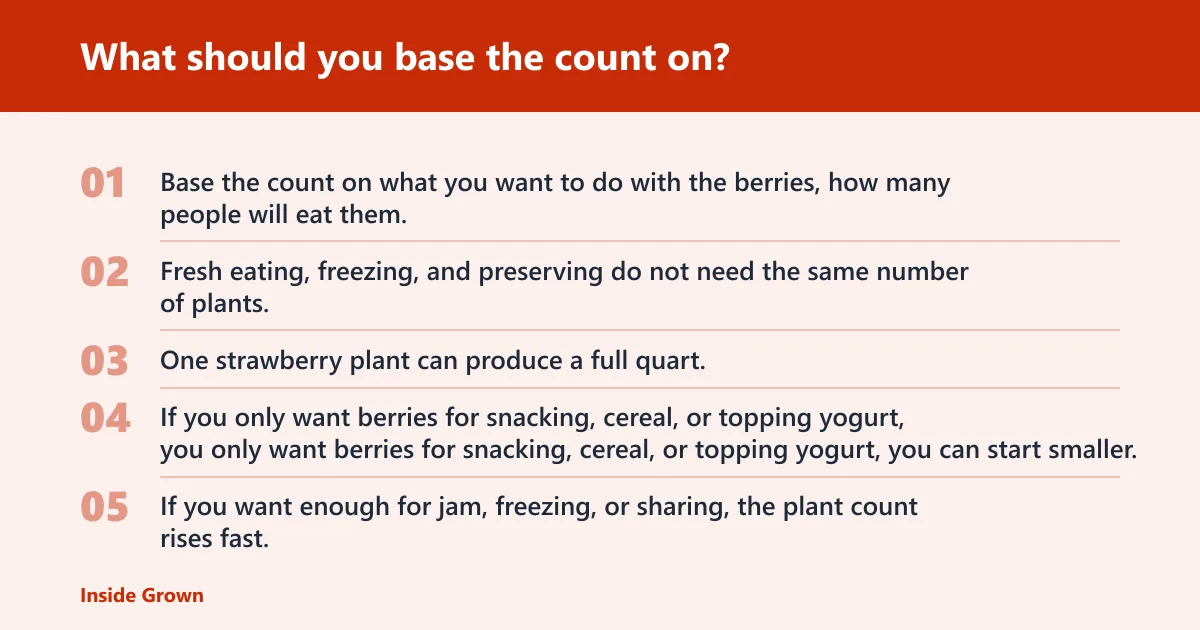
Base the count on what you want to do with the berries, how many people will eat them, and how much space you can spare. Fresh eating, freezing, and preserving do not need the same number of plants. One strawberry plant can produce a full quart, but one plant rarely covers a whole household’s needs.
Fresh eating versus freezing or preserving
If you only want berries for snacking, cereal, or topping yogurt, you can start smaller. If you want enough for jam, freezing, or sharing, the plant count rises fast. Preserving needs a larger flush of fruit, not a few berries here and there.
Say your goal is one bowl of berries each week for the family table. A dozen plants may cover some weeks well and other weeks lightly, especially in the first year. If your goal is several quarts for freezing, you will need more plants than a fresh-eating patch of the same size.
Household size and weekly harvest goals
Use household size as a starting point, then adjust for appetite and harvest style. A single eater who wants a few berries at a time needs fewer plants than a family that expects berries at breakfast several times a week. Weekly harvest goals matter more than household size alone.
For planning, think in quarts rather than in vague “some berries.” If each plant is productive, a few plants may supply a quart every few harvests, while a larger planting can begin to support a steadier fresh harvest. Mature plants give more than first-year plants.
Why one plant usually is not enough
One plant can be useful as a trial, but it is rarely enough for a household plan. A single plant may fruit, yet the crop can disappear in one snack bowl. Small harvests also make it harder to see the difference between a good variety and a poor one.
Strawberries are perennial, so you are not only buying one season of fruit. You are planting a patch that should expand over time. Starting with too few plants can delay the point where the planting feels worthwhile.

Which strawberry type should you choose first?
Choose the type before you buy plants, because fruiting habit changes how many plants make sense. June-bearing strawberries give one large crop, while everbearing and day-neutral types spread harvest across the season. For beginners, the “best” type is the one that matches your eating goal and space.
June-bearing strawberries
June-bearing strawberries give one concentrated crop. That can be a strong fit if you want enough berries for preserving or for a short, heavy harvest window. Because the crop arrives in a shorter burst, June-bearing plants often fit gardeners who want to process fruit in batches.
If your goal is fresh eating over many weeks, June-bearing types may feel too brief unless you plant enough of them. In that case, a larger count or a second type may make more sense.
Everbearing and day-neutral strawberries
Everbearing and day-neutral strawberries spread production out more evenly, which can suit beginners who want a steady trickle of fruit. That can make a smaller planting feel more useful in a small garden or container setup. The harvest is often easier to use fresh, because it arrives in smaller amounts.
These types can be easier to match to a snack-focused goal, but they still need enough plants to create a real harvest. A few plants may keep you picking, but they may not fill the freezer.
How type changes your plant count
Use June-bearing when you want a big crop in a short period. Use everbearing or day-neutral when you want a longer picking season and a steadier kitchen supply. The count should rise if you want to preserve fruit, because spreading fruit across the season does not increase the total by itself.
How much space do strawberry plants need?
Space is a hard limit. Strawberries can fit small space constraints or fill large garden plots, and they can be grown in containers or pots on a deck, porch, patio, or balcony. In a bed or container, the planting count should match available sun, airflow, and room for the plants to spread.
Garden bed and raised bed spacing
In a bed or raised bed, fewer plants can fit well if you leave room for growth and picking access. Crowding makes watering and harvest harder. That matters most in the first year, when plants are still settling in and do not yet give mature yields.
Container or pot spacing
Containers are a real option for beginners with limited ground space. They suit a deck, porch, patio, or balcony, but they limit plant count because each plant needs enough root room and consistent moisture. Small containers dry faster, so the count should stay modest at first.
Picture a balcony grower with two 12-inch pots. That setup is better for 2 to 4 plants than for a full dozen. The plant count should fit the watering routine as much as the floor space.
How many strawberry plants can fit in a small garden?
A small garden can often fit a modest number of plants without crowding, depending on layout and variety. That range is usually enough for a beginner patch that is meant to learn the crop rather than supply a large household. If the bed is very narrow, start on the low end.
Use this starter calculator to set your first count
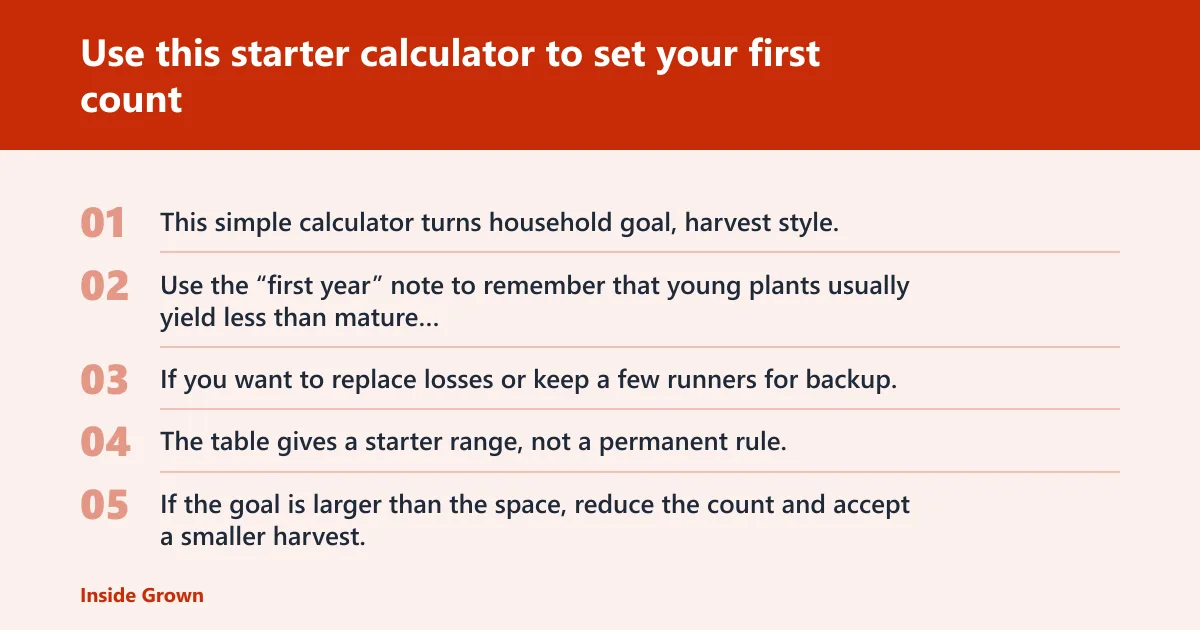
This simple calculator turns household goal, harvest style, and space into a starting range. Use the “first year” note to remember that young plants usually yield less than mature plants. If you want to replace losses or keep a few runners for backup, add a small buffer rather than doubling the planting.
| Household size / goal | Harvest style | Space available | Recommended start | First-year adjustment | Keep extras for replacement? |
|---|---|---|---|---|---|
| 1 person | Fresh eating | Small container or balcony | 4 to 6 plants | Plan for the low end in year 1 | Yes, 1 to 2 extra plants if space allows |
| 1 to 2 people | Fresh eating, regular snacking | Small bed or raised bed | 6 to 8 plants | Choose 8 if first-year yield matters | Yes, if you want runner replacement |
| Family of 4 | Fresh eating | Medium bed or several pots | 10 to 16 plants | Expect the first season to feel light | Keep a few extras only if space is not tight |
| Family of 4 | Freezing or preserving | Open bed | 16 to 25 plants | Use the higher end for year 1 | Yes, a small reserve helps replace weak starts |
| Any household | Trial planting | Very small space | 3 to 6 plants | Keep expectations modest in year 1 | No, unless you have spare room |
The table gives a starter range, not a permanent rule. If the goal is larger than the space, reduce the count and accept a smaller harvest. If the space is large but the goal is only fresh snacking, stay moderate and avoid planting a patch that is hard to water well.
First-year versus mature-year adjustment
Plan on a lighter first-year crop than later seasons. That matters because strawberries are perennial, and the plants usually settle in before they hit fuller production. A beginner who wants a useful first harvest should choose more plants than a mature patch would need for the same amount of fruit.
A common first-timer mistake is counting on next-year output for this year’s dinner table. That creates disappointment. Start with the crop you want in year 2, then trim back one step if your space is tight or your watering routine is uncertain.
When to keep extra plants for replacement
Keep a few extras only if the site can support them. Extra plants help when a transplant fails, a pot dries out, or one plant stays weak. They are not a substitute for good spacing, but they can protect a small starter patch from gaps.
Should you start with a bed or containers?
Start with containers if your space is limited, you want to move pots to the sun, or you only want a few plants to learn with. Start with a bed if you want more room to scale, steadier moisture, and a plant count that can move beyond a trial patch. Either can work well.
When containers are the better first step
Containers are a strong choice for a patio, deck, porch, or balcony. They let you control the soil mix and keep the planting compact. They also force a realistic plant count, which helps beginners avoid overbuying.
If you are unsure about sun, a pot setup is easier to reposition than a bed. That flexibility matters because strawberries need enough light to fruit well.
When a bed gives you more room to scale
A bed or raised bed makes sense when you want to move from “try a few” to “harvest often.” It gives more room for 6 to 12 plants, and later for a larger patch if the first season goes well. Beds also make it easier to spread plants without crowding.
How many plants is enough for common beginner goals?
The right count depends on whether you want one person’s fresh berries, a family’s snack supply, or a small patch to test the crop. About 25 strawberry plants should supply a normal family with strawberries, but many beginners do not need to start that large. Start smaller if you are learning.
One person eating fresh berries
For one person, 4 to 6 plants is a practical starting point, especially in containers or a very small bed. That count can give a steady fresh supply without creating more fruit than you can use before it softens.
A family of four
For a family of 4, a rough beginner range of about 10 to 16 plants can work for fresh eating. If you want some freezing or preserving, lean toward a larger planting—roughly the mid-teens to mid-20s. That larger count is more appropriate when the family wants fruit in batches, not only occasional snacks.
A small patch for trial planting
For a trial patch, 3 to 6 plants is enough to learn the crop without using much room. That small start is useful when you are unsure about the site, the variety, or the watering routine. It is also a good fit for a first container planting.
How many strawberry plants should I start with as a beginner?
Most beginners should start with 6 to 12 strawberry plants. Use 6 if you are short on space or want a low-risk test, and choose 12 if you want a more useful harvest from the start. The right number still depends on your eating goal and whether you are planting in containers or a bed.
Is 10 strawberry plants enough for one person?
Yes, 10 plants is usually enough for one person if the goal is fresh eating and not a large preserving project. Since each plant can produce a full quart of strawberries, 10 plants can be more than enough once the patch matures. The first year, though, the harvest is usually lighter.
How many strawberry plants do I need for a family of 4?
A family of 4 can start with about 10 to 16 plants for fresh eating. If the family wants freezing or preserving, a larger start is more appropriate, and about 25 strawberry plants should supply a normal family with strawberries. First-year output will usually be lower than mature output.
Should I start with everbearing or June-bearing strawberries?
Start with June-bearing if you want one larger crop for preserving or a heavy flush of berries. Start with everbearing or day-neutral if you want a longer harvest window and more frequent fresh picking. The better choice depends on whether you want one big harvest or steady use over time.
How much space do strawberry plants need?
Space needs depend on whether you are growing in a bed or in containers. Strawberries can fit small space constraints or larger plots, but crowding reduces comfort and harvest quality. In containers, the plant count should stay lower because moisture and root room are limited, especially on hot, sunny days.
Can I grow strawberries in containers instead of a bed?
Yes, and containers are a practical choice for a deck, porch, patio, or balcony. They work well for beginners who want a smaller plant count and a movable setup. Just keep the planting modest, because containers dry out faster than beds and do not suit a large patch well.
How many strawberry plants can fit in a small garden?
A small garden often fits 6 to 12 plants well, depending on bed shape, variety, and how much room you want for picking. If the garden is very narrow or partly shaded, stay near 6. If the site is open and sunny, 12 can still be reasonable for a beginner.
How many plants will one strawberry plant produce?
One strawberry plant can produce a full quart of strawberries under good conditions. That is helpful for planning, but it does not mean one plant is enough for a household. The first season usually gives less than later seasons, so use per-plant yield as a guide, not as a guarantee.