How to Tell If Your Plant Needs a Bigger Pot
A plant often needs a bigger pot when roots circle the container, push through drainage holes, or the plant dries out much faster than it used to. Just as often, though, the real issue is watering, poor soil, or top-heavy growth. The guide below separates true rootbound signs from lookalikes so you can choose keep current pot, repot same size, or move up one size.
Start here: the 2-minute check


Use a quick visual check before you repot. The goal is to separate rootbound roots from lookalike problems such as dry soil, poor drainage, or a plant that leans because the top is heavy. If two or more rootbound signals show up, the plant is more likely to need a larger container.
- Check the drainage holes. Lift the pot and look underneath. Roots coming out of the holes are one of the clearest signs that the plant may need more root space.
- Check how the pot dries. Water normally and see whether runoff goes straight through and the soil dries much faster than usual. A mix that dries too fast can mean the potting material no longer holds water well enough.
- Check the root shape. If you can ease the plant out of the pot, look for roots circling the bottom or pressing hard against the sides. That pattern points to limited root space, not just a thirsty plant.
- Check the plant posture. Leaning or falling over can mean a top-heavy plant needs stability, especially with snake plants, aloe plants, and spider plants. Stability alone does not always mean the pot is too small.
What you’ll need
- A pot with drainage holes
- A clean saucer or tray
- Fresh potting mix suited to the plant type
- Gloves, if the plant has sharp leaves or spines
- A trowel or spoon for loosening the root ball
- Pruning shears or clean scissors, if roots are tightly packed
- Paper towel or newspaper to catch spillover
Should I up-pot checklist
Use this checklist to decide whether to keep the current pot, repot into the same size, or move up one size. The table groups rootbound signs, moisture behavior, and stability clues so you do not confuse drought stress, poor soil, or a loose top with a real pot-size problem.
| Group | Yes/No check | What it points to | Recommendation |
|---|---|---|---|
| Rootbound signals | Yes: roots emerge from drainage holes | Limited root space | Move up one size |
| Rootbound signals | Yes: roots circle the bottom or press tightly against the sides | Rootbound root system | Move up one size |
| Rootbound signals | No: roots are not crowded and the plant is still settling after purchase | Acclimating, not cramped | Keep current pot |
| Moisture behavior | Yes: water runs through fast and the mix dries much sooner than usual | Potting mix may no longer hold moisture well | Repot same size |
| Moisture behavior | No: soil stays evenly moist for several days | Pot size may be adequate or mix may already be holding water | Keep current pot |
| Moisture behavior | Yes: soil stays wet for many days after watering | Oversized pot or poor aeration | Keep current pot |
| Moisture behavior | Yes: the plant shows watering stress but the roots are not crowded | Soil or watering issue, not a root-size issue | Repot same size |
| Stability signals | Yes: the plant leans, but roots are not crowded | Top-heavy growth | Repot same size |
| Stability signals | Yes: the pot feels unstable and the plant is crowded from above | Support issue rather than pot volume | Repot same size |
| Stability signals | No: the plant is stable, roots are not escaping, and moisture is normal | No clear pot-size problem | Keep current pot |
How do you know if a plant is rootbound?
A plant is often considered rootbound when roots circle the container, show through drainage holes, and leave very little loose soil in the pot. Growth often slows too, because the root system has run out of room. That is different from a plant that only looks tired from watering mistakes or low light.
Roots at the drainage holes
Roots peeking through drainage holes indicate a plant may need more root space. For succulents, roots clogging the drainage hole are a strong repotting signal. If the plant also dries out faster than usual, the root ball may be so full that water cannot stay in the mix long enough.
Roots circling the pot
Slide the plant from the pot and look at the bottom and outer edge. Roots that loop in circles or wrap tightly around the root ball are a classic rootbound sign. At that point, the plant may still be alive and stable, but it has limited room to grow.
Slowed growth and cramped root space
Large pots can cause little leaf or plant growth for a long time, but the same can happen when a small pot is already full of roots. If the plant has stopped putting out new leaves and the roots are packed tight, a larger pot is reasonable. If growth is slow for other reasons, repotting will not fix it.
Say your spider plant has several roots coming out of the drainage holes and the soil dries in a day and a half. That is a stronger repotting case than a spider plant that only looks crowded in the top leaves but still stays evenly moist for several days.
How do you know it is not a pot-size problem?
Not every stressed plant needs more pot volume. Yellowing, wilting, or stunted growth can come from underwatering, poor drainage, nutrient problems, or a mix that holds too much or too little water. The key is to match the symptom to the soil and roots before you repot.
Underwatering versus dry mix
If a plant wilts because the potting mix is bone-dry, the problem may be watering frequency rather than pot size. A mix that dries too fast after watering can mean the old potting material has broken down or no longer holds water well. In that case, repotting into fresh mix may help even if the pot size stays the same.
Soil staying wet too long
Oversized pots can make soil retain moisture too long and increase root rot risk. A pot that is too big can also waste resources because the plant cannot use all the moisture and nutrients in the extra soil. If the mix stays wet for days, stay with the current size or move to a better-draining mix rather than going larger.
Yellowing, wilting, and nutrient-related stress
Yellow leaves and limp growth do not prove a plant is rootbound. They can also show up with poor drainage, root rot, or nutrient stress. Root rot is harder to reverse once advanced, so a plant that has been sitting wet should be checked for mushy roots before any repotting decision.
What should you do after the check?
Choose the action that matches the strongest signal. Keep the current pot if the plant is still settling or the problem is clearly watering-related. Repot into the same size if the plant needs fresh mix or more stability but not more volume. Move up one size only when the roots have outgrown the container.
Keep the current pot
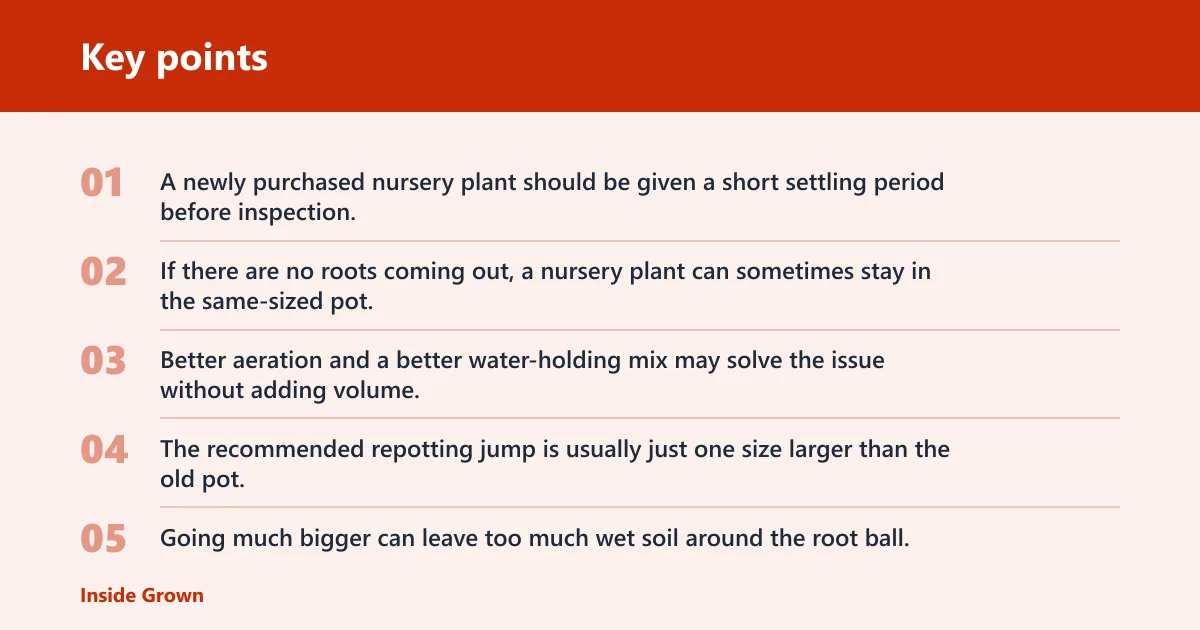
Keep the current pot when the plant was newly purchased and has not had time to settle, or when the soil is staying wet too long. A newly purchased nursery plant should be given a short settling period before inspection. If there are no roots coming out, a nursery plant can sometimes stay in the same-sized pot.
Repot into the same size
Repot into the same size when the plant is top-heavy, the mix has broken down, or the roots need a refresh but not extra space. This is often the better move for a plant that leans but does not show clear rootbound roots. Better aeration and a better water-holding mix may solve the issue without adding volume.
Move up one size
Move up one size when roots circle the container, emerge from drainage holes, or the plant is clearly cramped and slowing down. The recommended repotting jump is usually just one size larger than the old pot. Going much bigger can leave too much wet soil around the root ball.
Suppose a snake plant is leaning after a heavy top growth flush, but the roots are not pushing out of the holes. A same-size repot with fresh mix is usually the safer choice. If the roots are tightly circling the base and poking through the bottom, then a one-size-larger pot makes more sense.
Common mistakes
The biggest mistake is treating any wilted plant as rootbound. Wilting can mean underwatering, overwatering, or root rot. Another common mistake is jumping to a much larger pot. Extra soil stays wet longer, which can invite pests and pathogens and raise the risk of root rot.
- Do not repot only because the plant looks crowded at the top.
- Do not choose a pot far larger than the root ball.
- Do not ignore drainage holes; they are the easiest runoff check.
- Do not assume yellow leaves always mean more room is needed.
- Do not skip the settling period after purchase.
Frequently asked questions
How do you know if your indoor plant needs a bigger pot?
Look for roots at the drainage holes, circling roots at the bottom, and a plant that dries out much faster than it used to. If the pot stays wet for days instead, the issue is more likely drainage than size. A one-size increase is usually enough when size is the real problem.
How do you know when your plant needs a bigger pot?
Choose a bigger pot when the roots have filled the container and the plant has started to slow down. The best signs are roots escaping through drainage holes and a tight root ball. If the plant was just bought and has not settled yet, wait a short time before deciding.
How do you know if your snake plant needs a bigger pot?
A snake plant often needs more room when roots press out of the drainage holes or the clump becomes so crowded that watering becomes uneven. A snake plant that leans does not always need a bigger pot; it may only need better support or a same-size repot with fresh mix.
How do you know if your aloe plant needs a bigger pot?
Aloe usually needs repotting when roots show at the bottom, the plant lifts itself out of the pot, or the mix dries too quickly after watering. If the pot is already large and stays wet, do not size up. Root rot risk rises when aloe sits in too much moist soil.
How do you know when your spider plant needs a bigger pot?
Spider plants often need a larger pot when roots crowd the drainage holes and the plant dries fast after watering. If the plant is simply top-heavy with long arching leaves, a same-size repot may be enough. Crowded roots plus fast drying is the stronger signal.
How do you know your plant needs a bigger pot?
Use the root check first. Roots circling the container, roots exiting the drainage holes, and fast-drying soil are the clearest signs. Yellow leaves or wilting matter only when they line up with the root and moisture clues. If the plant is unstable but not rootbound, repotting the same size may be better.