How to Tell If Your Houseplant Is Getting Too Much Sun
If a houseplant shows bleached, tan, or crispy patches on the sun-facing side after being moved to a brighter window, it may be getting too much sun; move it about 1–3 feet back from the glass or hang a sheer curtain to soften the midday beam. Left alone, that damage can keep spreading and leave the plant weak, stressed, and more prone to leaf drop. This guide shows how to spot true sun scorch, tell it apart from lookalike problems, and match the fix to your window exposure.
For related placement guidance, see our grow light placement, plant species light chart, and seasonal window care guides.
SUN SCORCH:          UNDERWATERING:        FERTILIZER BURN:
[window side]        [whole leaf]          [tips/edges + crust]
bleached/tan patch   crispy tips           browned margins
one-sided exposure   wilt + dry soil       recent feeding/salt
Signs of sun damage

True sun damage usually shows up on the leaves that got the most direct light first. Look for pale, yellowed, bleached, or tan tissue, then crisp brown patches that stay fixed in place. The damaged spots do not green up again.
Direct sunlight is often the strongest indoor light source, and it can scorch tender leaves through glass. Extension guidance and university horticulture references note that acclimation matters because a plant moved abruptly from low light to intense direct sun can be damaged quickly; the risk is highest when the plant sits in a south- or west-facing window, or anywhere the sun beam lands directly on the foliage for part of the day.
Bleached, yellowed, or tan patches
Sunburn on leaves often starts as flat, faded patches. They may look washed out before they turn tan or paper-brown. The pattern is usually uneven and appears on the most exposed side of the plant, not all over the plant at once.
If the plant was recently moved from a low-light spot, the change can be fast. University extension sources commonly recommend gradual acclimation over 1–2 weeks when moving plants into brighter light; a sudden shift into stronger light can create damage in days, especially after winter or after a store purchase, when the plant has not had time to adjust.
Crispy brown spots and dry edges
Leaf scorch can look like browned tips, dry margins, or crispy spots. That pattern can overlap with heat stress and underwatering, so it is easy to misread as a nutrient issue. The leaf edge is often the first place to dry out.
Brown edges do not automatically mean sun scorch, though. Dry soil can make scorching worse, and fertilizer burn can also leave browned tissue at the margins, so the leaf shape alone is not enough to diagnose the problem.
Why the sun-facing side shows it first
Upper leaves often scorch first because they receive the strongest beam. The sun-facing side usually shows damage before the shaded side, and a tilted pot can create one-sided exposure that makes the pattern look lopsided. New growth may come in smaller or paler while the plant recovers.
Say your pothos sits in a west window and one side of the plant faces the glass for part of the afternoon. If only those leaves bleach while the back side stays green, that pattern points toward direct sun damage rather than a whole-plant disease.
Too much sun or something else?
Not every brown or yellow leaf means too much sun. Before you move the plant, check the soil and the recent care pattern. Water stress, heat from the glass, and fertilizer salt buildup can all mimic sun damage and need different fixes.
Underwatering and dry soil
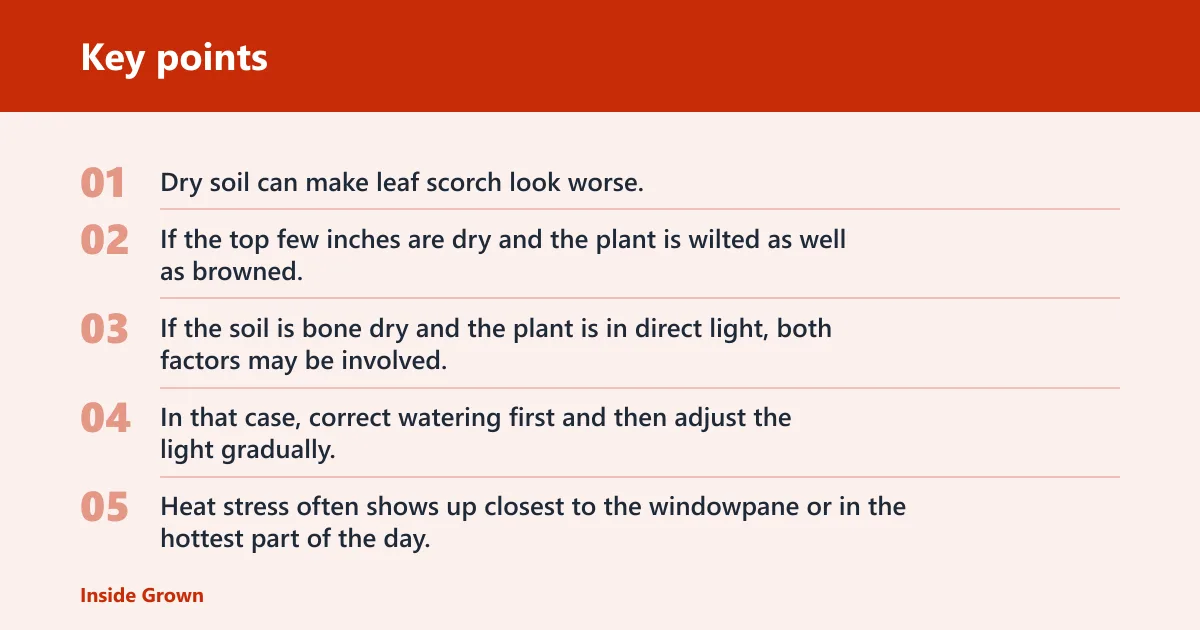
Dry soil can make leaf scorch look worse, and underwatering can produce brittle tips that resemble sunburn. Check the potting mix before changing light. If the top few inches are dry and the plant is wilted as well as browned, water stress may be part of the problem.
If the soil is bone dry and the plant is in direct light, both factors may be involved. In that case, correct watering first and then adjust the light gradually, because a thirsty plant can react badly to a sudden move into brighter conditions.
Heat stress near hot glass
Heat stress often shows up closest to the windowpane or in the hottest part of the day. A leaf can cook on a hot sill even when the room itself feels comfortable. The damage may be more severe on leaves touching the glass or pressed against a warm pane.
South-facing windows usually get the brightest light, while west-facing windows can hit harder in the afternoon. That stronger afternoon sun, plus glass that traps heat, is why plants near the pane can fail even when they were fine in a softer window.
Fertilizer burn and salt buildup
Fertilizer burn usually starts at the tips or edges and can look like dried, browned margins. If the plant was fed heavily, or if white crust has built up on the soil surface or pot rim, salt buildup may be the better fit than sun scorch.
Fertilizer burn tends to track recent feeding more than window position. If the damage shows up on shaded leaves too, or if it began soon after a heavy feeding, check the fertilizer schedule before blaming the sun.
Window direction and light
Window direction matters because direct light is not equal in every spot. South-facing windows are often among the brightest, west-facing windows can get harsher afternoon sun, east-facing windows may give gentler morning sun, and north-facing windows are usually lower light. Glass can still intensify direct exposure. University plant care references also note that actual usable light varies by season, window cleanliness, distance from the pane, and whether trees or buildings block part of the exposure.
South-facing windows
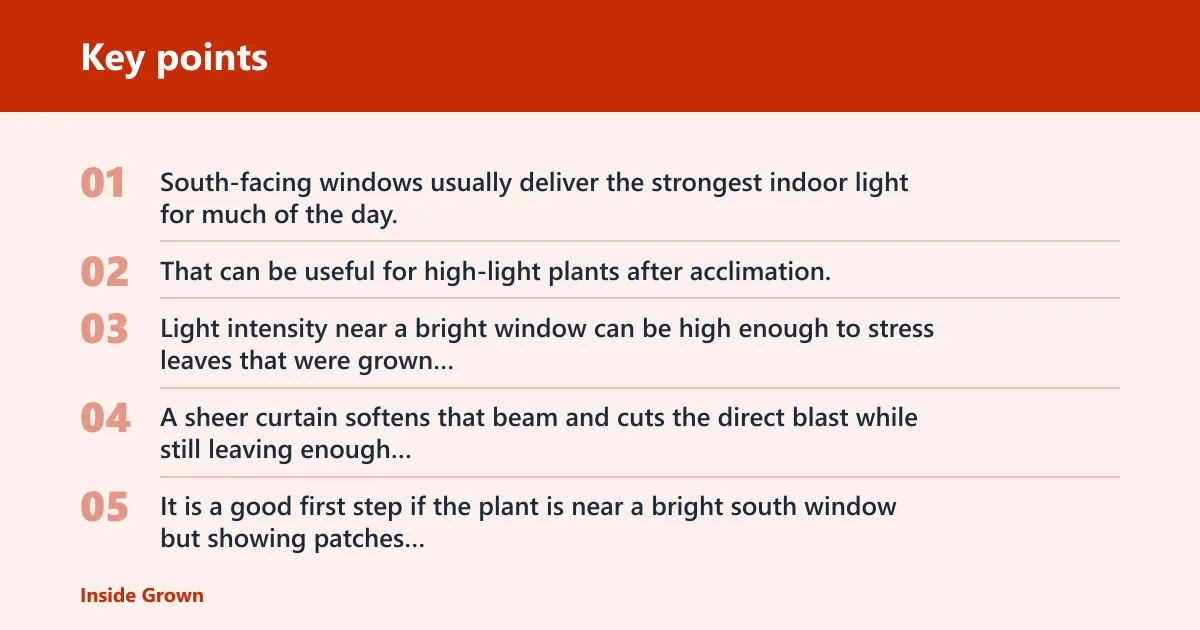
South-facing windows usually deliver the strongest indoor light for much of the day. That can be useful for high-light plants after acclimation, but tender foliage can scorch there if it hits direct rays without any filtering. Light intensity near a bright window can be high enough to stress leaves that were grown in lower light.
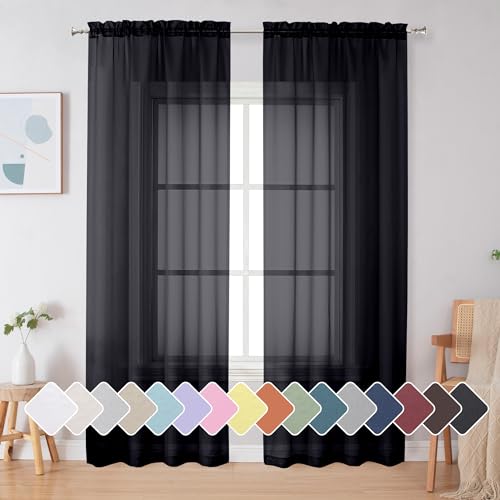
A sheer curtain softens that beam and cuts the direct blast while still leaving enough light for growth. It is a good first step if the plant is near a bright south window but showing patches on the sun side.
West-facing windows
West-facing windows can often cause the harshest burn because afternoon sun can arrive hot and direct. Plants that looked fine in the morning may show trouble later in the day, especially in summer or when the pot sits close to the glass.
If a west window is the only bright spot available, start the plant farther from the pane and move it closer only after it has adjusted. A sheer curtain or blinds can take the edge off without sending the plant into low light.
East-facing and north-facing windows
East-facing windows usually give gentler morning sun, which many houseplants handle better than midday or afternoon exposure. North-facing windows are generally lower light, so they rarely cause scorch unless the plant is already very close to the glass or under a grow light.
Lower light is not the same as no light. A plant moved from a north window to a south window may need a longer acclimation period because the jump in exposure is large.
Picture a fern that was happy on an east windowsill all winter and then gets moved straight into a south window in spring. The same leaves that stayed green for months can bleach in a few days if the change is too abrupt.
Sun damage diagnosis table
This table separates the most common lookalikes and gives the next step for each one. Use it after you check the soil and look at the plant’s window position.
| Symptom pattern | Most likely cause | How to confirm it | Next action |
|---|---|---|---|
| Bleached, tan, or crispy patches on the sun-facing side | Sun scorch | Damage appears after brighter direct light, often on upper or outer leaves first | Move 1–3 feet back, or filter the window with a sheer curtain |
| Brown tips, curled edges, dry soil, wilting | Underwatering | Pot feels light, mix is dry, leaves perk up after watering | Water thoroughly, then reassess light after the plant rehydrates |
| Droop plus browned patches closest to hot glass | Heat stress | Worst on the side against the pane or in the afternoon | Move the plant farther from the glass and add a curtain or blinds |
| Brown tips and edges after feeding, possible white crust on soil | Fertilizer burn | Damage follows recent fertilizer use more than window exposure | Flush the pot with water if the mix drains well, then pause feeding |
| Plant in a south window with crisping only on midday-exposed leaves | Direct light overload | Light beam lands on the foliage for hours | Use a sheer curtain or move the plant to a safer distance |
| Plant in a west window with afternoon leaf bleaching | Harsh afternoon sun | Symptoms appear after the hottest part of the day | Filter the window and acclimate over 1–2 weeks |
| Plant in an east window with mild morning light and no scorch | Usually appropriate exposure | Growth remains steady and leaves stay evenly colored | Keep placement, then monitor for seasonal changes |
| Plant in a north window with leggy growth, not scorch | Low light, not sun damage | No bleaching; stems stretch toward the window | Move closer to brighter light if the species needs more |
Can the plant recover?
A plant can recover from too much direct sun, but the damaged tissue will not heal. The goal is to stop new damage and protect the remaining healthy leaves. New growth can improve once light, water, and temperature are corrected.
What damaged leaves can and cannot do
Sunburned tissue stays damaged. It will not turn green again, even if the plant is moved to a better spot. That said, the rest of the leaf can still support the plant for a while, so there is no need to remove every blemished leaf at once.
When to trim leaves
Trim only the leaves that are mostly brown, brittle, or fully collapsed. If a leaf is still partly green, it can still photosynthesize. Cutting too many healthy sections at once can slow recovery.
Signs new growth is improving
Watch for steady new leaves that are larger, greener, and less bleached than the old ones. Healthy new growth is the best sign that the light change worked. If new leaves still scorch, the plant is still too close to strong direct sun.
Move it to safer light
Do not yank the plant far from the window on day one unless the damage is severe. A gradual move over 1–2 weeks is safer for many houseplants, especially after a dark-room move or a winter shift into brighter sun. University extension guidance commonly recommends slow acclimation because leaves adjusted to lower light can scorch if they are exposed too quickly.
Stepwise move over 1-2 weeks
- Shift the plant a little farther from the glass, or filter the beam with a sheer curtain.
- Keep that position for several days and check whether new damage stops.
- If the plant still looks stressed, move it a bit farther back or add blinds during the brightest hours.
- Recheck soil moisture before each move so water stress does not get mistaken for light stress.
Use a sheer curtain or blinds
A sheer curtain diffuses intense light and protects plants from midday sun while keeping usable brightness in the room. Blinds can do a similar job if they are adjusted to block the direct beam without throwing the plant into deep shade.
This is often the best fix for a plant that wants bright light but not a blast of direct sun. It keeps the window useful without repeating the same scorch pattern.
How far from the window to start
A common starting point is about 1–3 feet back from the glass for a plant that seems to be getting scorched at the sill. The right distance depends on species, season, and window direction, so watch the leaves rather than relying on a fixed rule.
Adjust for plant type
Species and cultivar matter. Succulents and cacti usually tolerate more sun than ferns and prayer plants, and juvenile or recently repotted plants are often more sensitive than established ones. A plant’s history matters as much as the window does.
Sun-tolerant plants
High-light plants can handle stronger exposure after acclimation, especially in south or west windows. Even then, direct sun through glass can still scorch tender leaves if the move is sudden or the plant was grown in lower light before you brought it home.
Low-light plants
Ferns, prayer plants, and many other shade-tolerant houseplants usually prefer less direct sun. They may do best with bright indirect light, a filtered south window, or an east window with gentle morning sun.
Young, stressed, or recently repotted plants
Juvenile plants, freshly repotted plants, and plants already dealing with drought or root stress can burn faster. Keep them out of harsh direct light until they settle in. A small change now is better than a big rescue later.
Frequently asked questions
How do I know if my houseplant is getting too much sun?
Look for bleached, tan, or crispy patches on the side facing the window, especially after the plant was moved into brighter light. Check the soil first, because dry soil and heat stress can mimic scorch. If the damage keeps appearing on the sun-facing side, too much direct sun is likely.
What do sunburned houseplant leaves look like?
Sunburned leaves often show pale or yellowed patches that turn tan, then dry and brown. The damage usually appears on the most exposed side and may start on upper leaves first. The affected tissue will not turn green again, even after the plant is moved.
Can a houseplant recover from too much direct sun?
Yes, the plant can recover if the light is corrected quickly, but the damaged tissue itself will stay damaged. New growth should look better once the plant is moved to safer light and watering is corrected. Trim only the leaves that are mostly dead or brittle.
Should I move my plant away from a south-facing window?
If the leaves are bleaching or crisping, yes, at least for now. South-facing windows are usually the brightest, so they can be too strong for tender plants. Move the plant back a little or filter the light with a sheer curtain, then watch for fresh damage.
How far should houseplants be from a window?
There is no single distance that fits every plant. A common starting point is 1–3 feet back from a hot, direct window, then adjust based on species and season. South and west windows usually need more filtering than east windows, while north windows are often gentler.
Can grow lights cause the same damage as too much sun?
Yes. A grow light that is too close or too intense can bleach leaves, especially on plants that were not acclimated to it. The fix is similar: increase distance, shorten exposure, and watch for scorching on the side facing the light.
Which houseplants tolerate direct sun better than others?
Succulents and cacti usually tolerate more direct sun than ferns, prayer plants, and many other low-light houseplants. Even sun-tolerant types can scorch if moved suddenly from shade into a hot south or west window. Acclimation still matters, especially after winter or a store purchase.
How quickly can sun stress damage indoor plants?
It can happen fast, sometimes within days of a brighter window or a sudden move into direct sun. The speed depends on species, window direction, season, and whether the plant was already stressed. If the sun-facing side starts bleaching, treat it as an early warning and act right away.
Sources
- University extension houseplant guidance on acclimating plants gradually to brighter light, commonly over 1–2 weeks, rather than moving them suddenly from low light into direct sun.
- University horticulture resources on window orientation and indoor light, including the generally brighter conditions at south- and west-facing windows and the gentler exposure common in east-facing windows.
- Extension and botanical garden references on sun scorch, fertilizer burn, and drought stress as lookalike causes of browning, crisping, and leaf-edge damage.
- Recognized plant-care authorities noting that species tolerance differs substantially, with succulents and cacti typically handling stronger light than ferns and many prayer plants.