How to Tell if a Houseplant Needs Repotting: 7 Signs
Repot a houseplant when roots circle the pot, poke from drainage holes, or the root ball dries out very quickly after watering; if only leaves look bad, check water, light, and feeding first. I wait too long only when I miss those signs, and then growth slows, wilting turns chronic, and watering problems get harder to correct. This guide gives a quick repot-or-wait test and the signs that point to lookalikes instead of root bound roots.
This guide is part of our Houseplant care guide for healthy indoor plants series.
What you’ll need


- A pot with drainage holes
- Fresh, high-quality potting mix matched to the plant
- A hand trowel or spoon
- Gloves
- A tarp, tray, or newspaper for cleanup
How do you know a plant needs repotting?
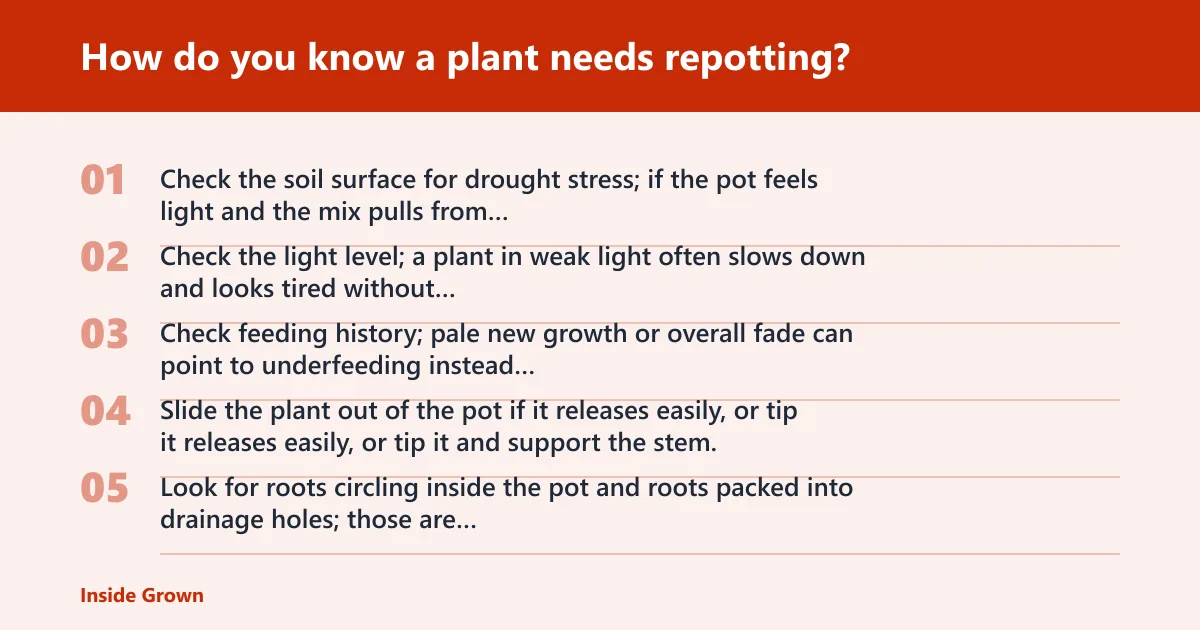
Check for roots coming out of drainage holes, mix that dries far too fast, and a plant that has stopped growing. If those signs show up together, I lift the root ball to confirm. If the problem is only drooping or yellow leaves, I check watering, light, and feeding first.
Step 1: Rule out lookalikes first
- Check the soil surface for drought stress; if the pot feels light and the mix pulls from the edges, water may be the issue.
- Check the light level; a plant in weak light often slows down and looks tired without being root-bound.
- Check feeding history; pale new growth or overall fade can point to underfeeding instead of crowded roots.
Step 2: Confirm by lifting the root ball
- Slide the plant out of the pot if it releases easily, or tip it and support the stem.
- Look for roots circling inside the pot and roots packed into drainage holes; those are stronger signs than leaf symptoms alone.
- Judge how much soil volume is left. If the root ball is compressed and there is very little loose mix, the plant has outgrown its container.
How do I know if a plant needs repotting?
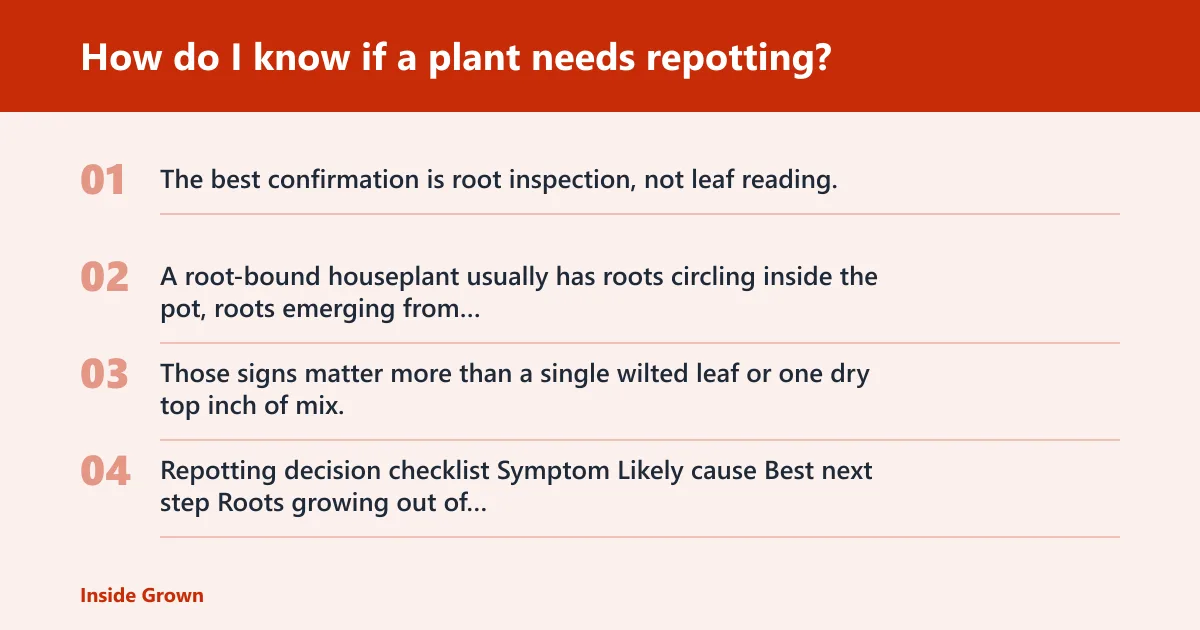
The best confirmation is root inspection, not leaf reading. A root-bound houseplant usually has roots circling inside the pot, roots emerging from drainage holes, a compressed root ball, and less available soil volume. Those signs matter more than a single wilted leaf or one dry top inch of mix.
Repotting decision checklist
| Symptom | Likely cause | Best next step |
|---|---|---|
| Roots growing out of drainage holes | Root-bound houseplant | Confirm by lifting the root ball, then repot into a pot 1 to 2 inches wider |
| Potting mix dries much faster than similar plants | Roots have filled the container | Check for circling roots and reduced soil volume before moving up one pot size |
| Plant has stopped growing | Could be crowding, low light, or underfeeding | Do not repot yet; check light and feeding, then inspect roots if other signs line up |
| Leaves droop, but soil stays wet | Overwatering or poor drainage | Do not repot yet; let the mix dry partway and confirm drainage holes are open |
| Top growth looks pale or weak | Underfeeding or low light | Do not repot yet; correct light or feeding first, then reassess in 2 to 4 weeks |
| Roots circle the pot and the root ball is tight | Root-bound houseplant | Repot now during active growing season if possible |
What are the signs a houseplant is root-bound?
The clearest signs are roots circling inside the pot and roots packed into the drainage holes. A compressed root ball and a shrinking share of usable soil volume come next. A pot that dries faster than nearby plants can help confirm the diagnosis, but it is not enough on its own.
If that didn’t work, try this next
- Lift the plant and inspect the side walls of the root ball for white or tan roots wrapping around in rings.
- Check the drainage holes for roots that have threaded through and formed a tight mat.
- If the root mass fills the pot but the plant still looks stressed, move to repotting rather than waiting for more visible decline.
How much bigger should the new pot be?
Use a pot 1 to 2 inches wider in diameter, or go up one pot size. That gives the roots room without leaving so much extra wet mix that the plant sits in moisture too long. Oversizing is the common failure point; too much soil stays wet and can push roots toward rot.
Choose the next size carefully
- Measure the current pot across the top.
- Pick the next pot that is slightly larger, such as adding about 1 to 2 inches in diameter or going up one standard size.
- Use a container with drainage holes so excess moisture can leave the pot.
What kind of pot should I use for repotting?
Choose a pot with drainage holes, sized just one step above the current container. Drainage holes help excess moisture leave the pot and keep the mix from staying wet around the roots. The best container gives roots room to expand, but does not leave a soggy center.
If that didn’t work, try this next
- If the current pot is decorative without holes, keep it as an outer cachepot only.
- Move the plant into a nursery-style pot with drainage holes, then place that inside the decorative pot.
- If the plant is a fast grower, choose a sturdier pot that will not tip as the top becomes heavier.
When is the best time of year to repot a houseplant?
Spring and summer are the best time to repot because most houseplants recover faster during active growth. Repotting in cooler, darker months is harder on stressed roots. Fast growers usually need checking sooner, while succulents and slower plants can often wait longer between moves.
Repot now, wait, or top-dress?
- Repot now if roots are crowded and the plant is actively growing.
- Wait if the symptoms fit drought stress, low light, or underfeeding more closely than crowding.
- Top-dress if the plant is too large to move comfortably.
Can I top-dress instead of repotting?
Yes, when a large plant cannot be moved, top-dressing is the safer option. Remove roughly the top inch or so of old compost and replace it with fresh compost. That refreshes the surface mix without tearing into a root ball that is too heavy, tight, or awkward to handle.
Top-dress the pot in place
- Scoop off the top layer of tired mix carefully.
- Replace it with fresh compost or potting mix suited to the plant.
- Water lightly only if the new top layer is dusty and needs to settle.
Should I water a plant before repotting it?
Watering before repotting depends on the condition of the mix. If the root ball is very dry, a light watering a day ahead can help reduce breakage and make roots easier to handle. If the mix is already wet, wait; wet roots tear more easily and wet soil is harder to work with.
After repotting, water this way
- Water after repotting to help settle the soil.
- Let excess water drain out fully.
- Wait until the mix starts drying before watering again.
Common mistakes
Most problems come from repotting too early, choosing a pot that is too large, or watering again before the mix starts drying. A pot without drainage holes can hold excess water around the roots. A new container with far more soil than the root ball can use often creates the next problem.
If that didn’t work, try this next
- If you already moved the plant into an oversized pot, reduce watering and let the mix dry more between waterings.
- If the new pot has no drainage holes, move the plant to one that does.
- If the plant was repotted while stressed from low light or drought, correct that issue first and leave the roots alone.
Prevention
Check faster-growing plants more often than slow growers, and step most houseplants up to a larger pot as they fill the current one. Succulents usually need less frequent changes than vigorous foliage plants, so timing should match growth rate, not a fixed calendar.
Frequently asked questions
How do I know if a plant needs repotting?
Lift the plant and inspect the root ball. Circling roots, roots in drainage holes, and a tight mass with little loose mix point to repotting. If the leaves look poor but the roots are open and the soil volume is still usable, check light, water, and feeding first.
Do indoor plants need repotting?
Most houseplants need to be stepped up to a larger pot as they grow, but not on a fixed schedule. Some fast growers may need repotting more often, while slow growers and succulents can often stay in the same pot longer. Repot only when roots fill the pot or growth clearly slows for structural reasons.
What are the signs a houseplant is root-bound?
The clearest signs are roots circling inside the pot, roots emerging from drainage holes, and a root ball that has compressed into a hard shape. A mix that dries faster than similar plants can support the diagnosis, but root inspection gives the clearest answer.
How often should houseplants be repotted?
Use plant growth as the timer, not the calendar. Fast growers may need a larger pot more often, while slower plants can wait much longer. Check each plant during spring or summer, and repot only when the roots have filled the pot or the mix no longer holds enough moisture.
What happens if I repot into a pot that is too big?
Too much soil stays wet too long, which raises the chance of rot. The plant also spends extra energy filling unused space instead of pushing new top growth. Stay close to the root ball and move up only 1 to 2 inches in diameter.
What kind of pot should I use for repotting?
Use a pot with drainage holes and only a small size increase. That combination helps excess moisture leave the container and keeps the mix from staying wet around the roots. A fresh potting mix matched to the plant type matters as much as the pot itself.