How to Treat Mealybugs on Houseplants Naturally
Treat mealybugs on houseplants by moving the plant away from others, wiping visible bugs with a cotton swab dipped in isopropyl alcohol, then checking again about every week; for light infestations, a second pass may be enough, but root or heavy infestations may need pruning, repotting, or insecticidal soap. If you delay, mealybugs move to nearby plants and can stunt growth, yellow leaves, and cause sticky honeydew and sooty mold. This guide gives a plant-by-plant decision tree for the least risky natural fix and when to escalate.
How the treatment plan works
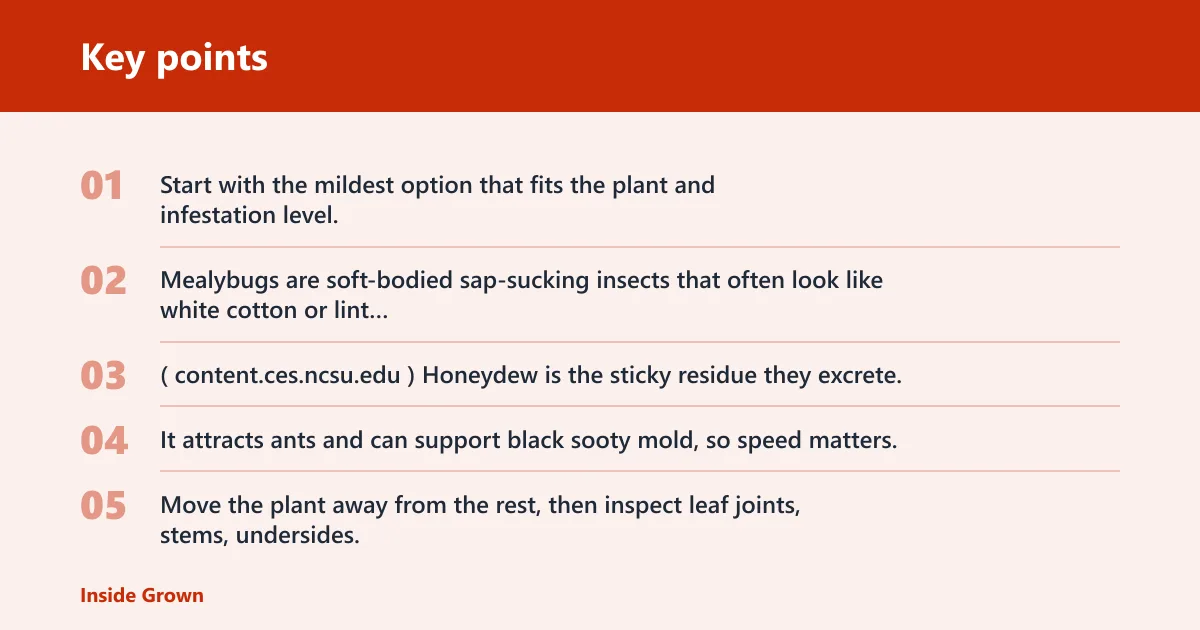


Start with the mildest option that fits the plant and infestation level. Mealybugs are soft-bodied sap-sucking insects that often look like white cotton or lint on stems, leaf joints, and undersides; common indoor species include citrus mealybug and longtailed mealybug, and some live in roots as root mealybugs. (NCSU)
Honeydew is the sticky residue they excrete. It attracts ants and can support black sooty mold, so speed matters. Move the plant away from the rest, then inspect leaf joints, stems, undersides, and hidden crevices before you treat anything nearby.
Why repeat treatments matter
Repeat treatment is necessary because eggs and crawlers survive the first pass. To repeat treatment every 5-7 days for at least three to four weeks, and the same guide says the treatment timeline should last 4-6 weeks. The full life cycle takes about six weeks indoors.
Female mealybugs can lay up to 200 eggs, so a clean-looking plant can still rebound. Do not stop after the first wipe if you still see wax, honeydew, or fresh cottony clusters.
Where to inspect first
Check the tight places first: stem nodes, leaf axils, petioles, the underside of leaves, and the soil line. Mealybugs hide in seams and crevices where spray coverage is weak, and root mealybugs stay below the surface until the plant starts to decline.
Say your pothos has one cottony cluster at a node and sticky leaves below it. That is a light, top-growth infestation, so direct removal and a follow-up pass make sense before you reach for a full spray routine.
What you’ll need
- Cotton swabs or q-tips for direct spot removal in leaf joints, stems, and tight crevices
- 70% isopropyl alcohol for visible bugs and spot treatment
- Insecticidal soap for repeated follow-up treatment
- Neem oil for ongoing control if the plant tolerates it
- Gloves and pruning shears for trimming badly infested growth
- A clean wipe cloth for wiping honeydew and debris
- A spare pot and fresh mix if roots need repotting
Mealybug treatment matrix
| Infestation level | Succulents | Orchids | Vining plants | Delicate foliage |
|---|---|---|---|---|
| Light | 70% alcohol on a swab; retry in 5-7 days; stop if leaves pucker or bleach | Alcohol on a swab; retry in 5-7 days; stop if roots or tender leaves dry out | Alcohol on a swab; retry in 5-7 days; stop if vines show spotting or burn | Alcohol on a swab only after a test spot; retry in 5-7 days; stop at any scorch |
| Moderate | Insecticidal soap on stems only; retry every 5-7 days; stop if leaves wrinkle or burn | Soap mist on stems and undersides; retry every 5-7 days; stop if buds or roots dry fast | Soap on stems and leaf undersides; retry every 5-7 days; stop if new growth pales | Soap only if test spot holds; retry every 5-7 days; stop if leaf edges brown |
| Root-level | Unpot, wash roots, replace mix; retry in 7-10 days only if live bugs remain; stop if roots are badly shriveled | Unpot, inspect roots, refresh mix and clean pot; retry in 7-10 days; stop if root mass is too weak to recover | Unpot, clear soil, clean pot; retry in 7-10 days; stop if stems collapse after repotting | Unpot, discard old mix, use clean pot; retry in 7-10 days; stop if the plant wilts hard after handling |
How do you treat light infestations?
For a light infestation, remove visible bugs by hand or with a swab, then dab stems and leaf joints with 70% isopropyl alcohol. Recheck after 5 to 7 days. This is the fastest first response, but test first on sensitive plants such as succulents, orchids, and delicate foliage.
- Move the plant away from the collection and inspect the whole plant under bright light.
- Dip a cotton swab in 70% isopropyl alcohol and touch each visible bug directly.
- Wipe leaf joints, stems, and the underside of leaves where cottony clusters hide.
- Check the plant again in 5 to 7 days and remove any new crawlers.
Pruning a badly infested tip can help on a small vine or cane. A common first-timer mistake is spraying every leaf at once on a drought-stressed succulent, then wondering why the tissue scars. A spot test avoids that failure.
How do you handle moderate infestations?
Use insecticidal soap when alcohol spot treatment is not enough. Coat stems and leaf undersides fully, then repeat every 5 to 7 days until activity stops. Soap works best as an ongoing treatment because it reaches crawlers and new hatchlings after the first pass.

- Rinse off honeydew first so the spray can reach the insects.
- Apply insecticidal soap to stems, leaf undersides, and joints until surfaces are evenly wet.
- Leave the plant away from the rest and recheck in 5 to 7 days.
- Repeat the same coverage if you still see wax, crawlers, or fresh sticky residue.
Suppose a hoya has clusters along three nodes and sticky leaves below. Soap is the better follow-up than more alcohol alone, because the hidden crawlers need broader contact. Neem oil is another option, but it can burn young or weak plants if overused.
When neem fits
Neem oil can help with ongoing control when the plant tolerates repeated contact and the infestation is not root-based. One competitor guide uses an interval of about 1 to 2 weeks. Keep it off heat-stressed, newly rooted, or already weak plants unless a test spot stays clean.
Do not stack heavy neem applications on a plant that already looks soft or bleached. If new growth folds, spots appear, or the surface turns dull after spraying, stop and switch back to hand removal plus soap.
How do you know it is root mealybugs?
Root mealybugs show up in the root zone or soil line, not only on leaves and stems. Look for white wax in the potting mix, stunted growth, yellowing, wilt that does not match the watering schedule, and root clusters with cottony residue. Root mealybugs can attack plant roots.
- Slide the plant out of the pot and inspect the root ball.
- Look for white wax, cottony threads, or insects tucked between roots.
- Remove the old mix and wash the pot thoroughly.
- Repot in fresh mix and a clean pot if the infestation is confirmed.
Root cases need a separate path because leaf spray will miss the colony. If the roots are badly damaged, the plant may not recover even after cleaning, so do not keep recycling the same contaminated mix.
What kills mealybugs on plants?
Direct contact kills visible mealybugs fastest. 70% isopropyl alcohol is the quickest first response for spot treatment, while insecticidal soap and neem oil help with repeat control. The best result comes from a combination: isolate, remove what you can, then repeat on a schedule that catches the next hatch.
Water rinses can knock off loose insects, but they rarely finish the job on their own. Wax-heavy colonies and hidden crawlers often survive unless you inspect the plant again and repeat treatment through the full 4-6 week window.
Common mistakes
Skipping quarantine is the fastest way to spread the problem. A new plant should stay away for 1-2 weeks before it joins the collection, and an infested plant should stay apart until you see no new cottony clusters on follow-up checks.
Missing the undersides of leaves and tight joints leaves colonies behind. Overusing alcohol or neem on tender plants can scorch tissue, and treating the potting mix like a leaf spray fix wastes time when the insects are actually in the root zone.
- Do not spray once and call it done.
- Do not ignore sticky honeydew or ants.
- Do not reuse tools on nearby plants without cleaning them.
- Do not keep a root-infested plant in the same mix.
How do you prevent mealybugs on plants?
Prevention depends on inspection, spacing, and quarantine. Keep new plants away for 1-2 weeks, check leaf joints and undersides during watering, and clean tools after pruning. Good airflow and enough space between pots make it harder for crawlers to move from one plant to the next.
Watch the watering workflow too. Watering one infested plant and then touching the rest without cleaning hands or tools is how a small problem becomes a collection-wide problem. Regular checks catch waxy clusters before they spread.
Frequently asked questions
How do I get rid of mealybugs naturally on houseplants?
Move the plant away from others, remove visible bugs with a cotton swab dipped in 70% isopropyl alcohol, then repeat every 5 to 7 days for at least three to four weeks. Finish with insecticidal soap if new crawlers keep appearing, and inspect stems, undersides, and joints each time.
How do I remove mealybugs from plants without chemicals?
Use manual removal first: pick off clusters, wipe stems with a damp cloth, and rinse loose bugs with water. For persistent infestations, a cotton swab and 70% isopropyl alcohol are the least disruptive next step, especially for light infestations on sturdy plants.
How often should I treat houseplants for mealybugs?
Repeat treatment every 5 to 7 days for at least three to four weeks, and keep checking through the 4-6 week window. That timing fits the hatch cycle, so you catch crawlers after they emerge instead of stopping after the first visible cleanup.
How do I know if my houseplant has root mealybugs?
Unpot the plant and inspect the root ball if the plant wilts, stalls, or keeps yellowing even when watering looks normal. White wax in the mix, cottony residue on roots, and bugs around the soil line point to root mealybugs, which need a fresh mix and clean pot.
What is the best home remedy for mealybugs on plants?
For most light infestations, 70% isopropyl alcohol on a cotton swab is the best first home remedy because it targets visible bugs directly. If the colony is wider, insecticidal soap is the better follow-up, because it reaches new hatchlings on stems and undersides.