How to Quarantine New Houseplants to Prevent Pests
Quarantine new houseplants for about 14 days in a separate space, then inspect leaves, stems, and soil on a regular schedule before moving them near other plants. Skip this, and pests like thrips, spider mites, and mealybugs can spread fast and force treatment for every plant you own. This guide covers the two-step intake system: isolation first, then a repeatable 14-day inspect-and-decide routine.
Quarantine vs acclimation and hidden pest risks
Quarantine is a pest-control step, not a styling step. You isolate a new plant so hidden pests, eggs, and early damage stay away from your collection while you check for symptoms that may not show on day one.
That matters because quarantine works best when you treat it like restriction after exposure, before the problem becomes obvious. In other settings, quarantine can hold potentially dangerous or unwanted messages; Microsoft lists Bulk as a quarantine reason with view, release, and delete options, and says messages held for high confidence phishing, malware, or mail flow rules are only available to admins by default. ScienceInsights says quarantine separates and restricts movement after exposure but before symptoms.
Acclimating a plant is different. Acclimation helps a plant adjust to light, humidity, and watering after a move; quarantine is about stopping pests from spreading while you inspect. You can acclimate a plant during quarantine, but you should not treat the two tasks as the same job.
Hidden risk is why a single quick look is not enough. Thrips may hide in leaf folds, spider mites may leave faint stippling before webbing shows, mealybugs can sit in petioles, and fungus gnat larvae can be inside damp soil long before adults appear.
Where can you quarantine a plant?
Place the plant in a separate room or a separate corner that does not touch your existing plants. A bathroom, bedroom, laundry area, or office can work if the space is isolated enough, has usable light, and keeps the plant away from drafts, shared plant shelves, and pets.
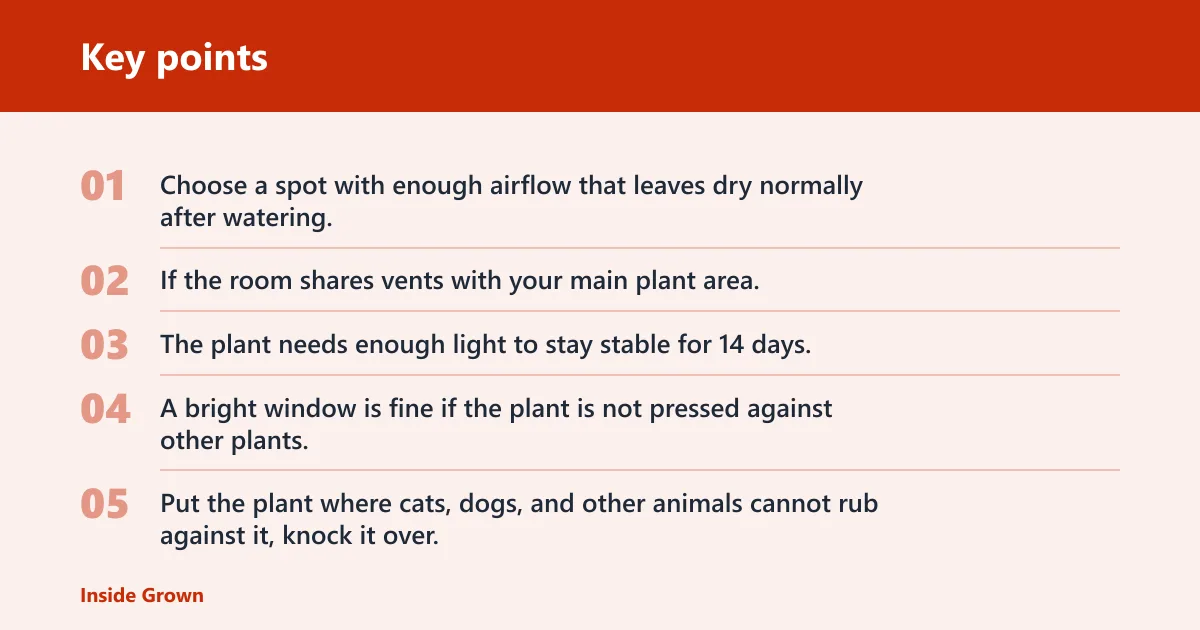
Choose a spot with enough airflow that leaves dry normally after watering, but not so much airflow that pests or soil splash can move from one plant to another. If the room shares vents with your main plant area, keep the quarantined plant farther away from the return path and do not place it beside a fan that pushes air across your collection.
Light still matters. The plant needs enough light to stay stable for 14 days, so a dim closet is a poor choice unless you add a grow light. A bright window is fine if the plant is not pressed against other plants, and if runoff cannot reach nearby pots.
Pets matter too. Put the plant where cats, dogs, and other animals cannot rub against it, knock it over, or carry soil to another room. A high shelf is not enough if leaf tips hang into traffic.
Can you quarantine a plant in a bathroom or bedroom?
Yes, if the room functions as a true buffer between the plant and your collection. A bathroom can work for short quarantine if it gets enough light and you can manage humidity, while a bedroom can work if the plant stays away from bedding, vents, and any other plants already in the room.
How far away should it be?
Use as much distance as the room allows, and do not let leaves touch walls, curtains, or other plants. The exact number is less important than preventing contact, runoff, and tool sharing. If space is tight, a hard separation such as a closed door is better than a few extra inches.
How long should quarantine last?
Use about 14 days as the baseline quarantine window for a new houseplant. Check it at least every few days, and inspect it more often if it came from a crowded greenhouse, had visible specks on arrival, or sat near other plants in transit.
Restart the clock if you find live pests, fresh eggs, new webbing, sticky honeydew, or a spreading symptom after a treatment step. A reset also makes sense if you repot into contaminated soil, move the plant back into contact with other plants, or discover hidden pests in drainage holes or soil folds late in the hold.
Keep the plant isolated longer than 14 days if you see repeated signs that appear only after watering, after the plant dries, or under a flashlight at night. A longer hold also makes sense for plants with dense foliage, plants that arrived rootbound in wet mix, and plants with known pest-prone structures such as leaf axils and petioles.
When should you keep the clock running?
Keep counting if the plant still shows new pest evidence, if treatment has only just started, or if one inspection cannot rule out hidden eggs. If the plant looks clean for several days in a row and no new signs appear at the final check, you can move to the end-of-quarantine checklist.
Plant quarantine inspection log
This log gives you a repeatable 14-day routine. Inspect on about day 1, day 3, day 5, day 7, day 10, day 12, and day 14. On each check, look at leaf tops, leaf undersides, stems, petioles, the soil surface, and drainage holes, then record what you saw and what you did.
| Day | Plant part checked | Pest signs found | Action taken | Pass/fail decision |
|---|---|---|---|---|
| 1 | Leaves, stems, soil surface | No pests visible | Isolated, added sticky trap nearby | Pass |
| 3 | Leaf undersides, petioles | One speck near vein, no movement | Wiped with damp paper towel, rechecked with magnifier | Pass |
| 5 | Soil surface, drainage holes | No gnats, no residue | Left in quarantine | Pass |
| 7 | Leaf tops, undersides | Two pale stippled leaves | Started insecticidal soap plan, isolated from other plants | Fail |
| 10 | Stems, petioles, soil line | No new spots after treatment | Repeated inspection, cleaned tray | Conditional pass |
| 12 | Leaf folds, drainage holes | No eggs, no honeydew | Kept isolated | Pass |
| 14 | Whole plant, pot, runoff area | No live pests found | Moved after final checklist | Pass |
One-page end-of-quarantine checklist
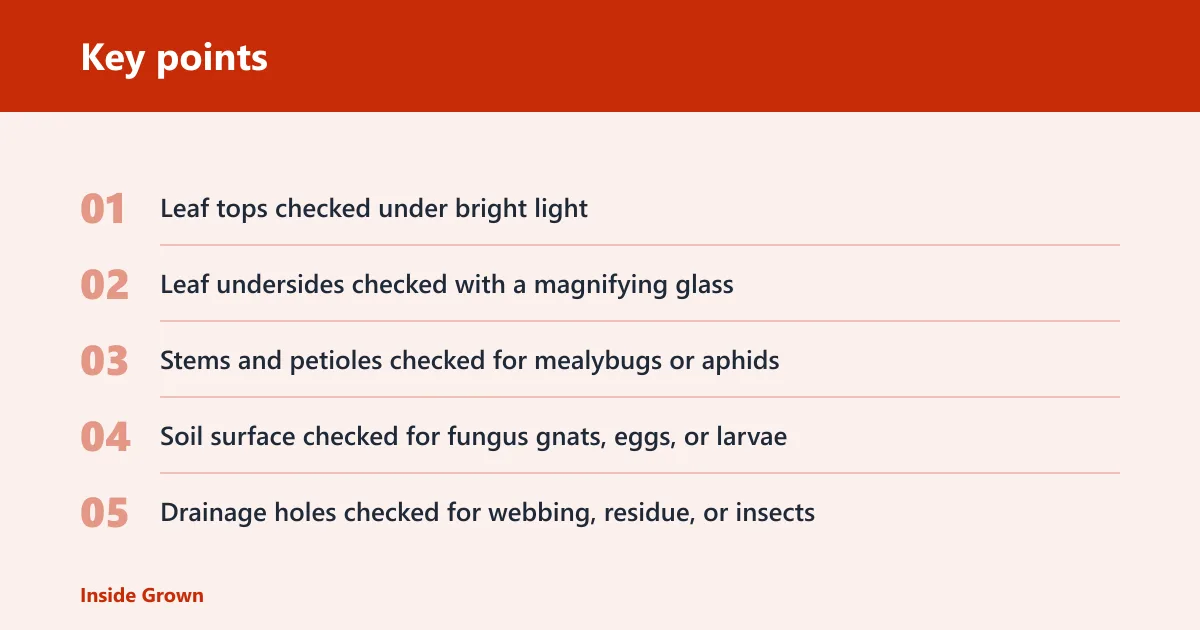
- Leaf tops checked under bright light
- Leaf undersides checked with a magnifying glass
- Stems and petioles checked for mealybugs or aphids
- Soil surface checked for fungus gnats, eggs, or larvae
- Drainage holes checked for webbing, residue, or insects
- No sticky honeydew, fresh webbing, or moving pests
- Yellow sticky trap shows no new captures for the final stretch
- Pot, saucer, and nearby surface cleaned
- Tools not shared with the main plant area
- Plant can move only after a clean final inspection
What should you inspect on each check?
Check the plant the same way each time so you can spot change, not guess at it. Start with leaf tops and undersides, then move to stems, petioles, the soil surface, and drainage holes. Finish by looking for webbing, residue, eggs, and sticky honeydew.
Leaves, stems, and petioles
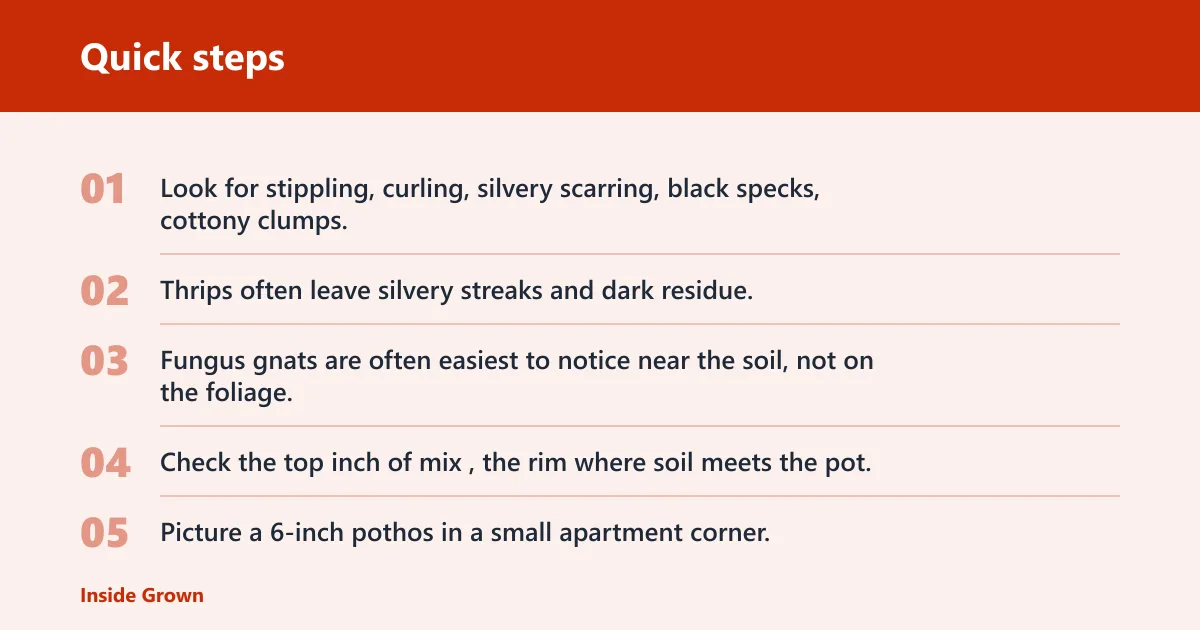
Look for stippling, curling, silvery scarring, black specks, cottony clumps, and tiny moving dots. Thrips often leave silvery streaks and dark residue; spider mites leave fine stippling and delicate webbing; mealybugs look like white cotton; aphids cluster on new growth and can leave sticky honeydew.
Soil surface and drainage holes
Fungus gnats are often easiest to notice near the soil, not on the foliage. Check the top inch of mix, the rim where soil meets the pot, and the drainage holes for adults, larvae, algae-like film, or moisture that stays wet too long. A flashlight helps here.
Picture a 6-inch pothos in a small apartment corner. The leaves look fine from above, but a flashlight at night shows tiny flies at the soil line and damp mix that never dries fully; that points you toward fungus gnats, not leaf pests.
Webbing, residue, eggs, and honeydew
Use a magnifying glass to check for spider mite webbing between stems and leaf joints, thrips eggs tucked into tissue, and mealybug residue in fold lines. Sticky honeydew can signal aphids or mealybugs and often attracts sooty film later, so treat any tacky surface as a warning sign.
Common first-timer mistake is checking only the top of a shiny leaf. A narrow band of eggs under a curled leaf edge or a small cluster in a petiole crease can be the only visible clue until the pest spreads.
What to do if bugs show up
If you find live pests during quarantine, do not move the plant to the main collection. Treat during quarantine, then repeat the inspection after the treatment window. If the infestation is heavy, the plant is often not worth the risk to the rest of your space.
When to treat during quarantine
Start treatment as soon as you confirm live pests, fresh eggs, or new damage. Remove visible insects with a paper towel, isolate the plant farther if possible, and use a targeted control such as insecticidal soap where the label allows. Rubbing alcohol can help on cottony mealybug clusters when used carefully on a swab.
Neem oil can help some soft-bodied pests, but it is not a free pass. Use it only with label directions, and avoid heavy applications on plants that already struggle with light, heat, or leaf spotting. Test any treatment on a small section first if the product label recommends it.
When to repot, repeat, or discard
Repot if the problem is rooted in the soil, such as fungus gnats, sour mix, or a potting medium that stays wet and crowded. Repeat inspection after each treatment cycle, because one clean look does not end quarantine. Discard the plant if it is heavily infested, the pests keep returning after treatment, or the plant is too damaged to justify the biosecurity risk.
If you repot, use a separate tray, fresh mix, disposable gloves, and cleaned tools. Do not bring the old soil into your general potting area.
How to quarantine multiple new plants at once
Multiple plants can share a quarantine zone if they do not touch and you treat the zone like a batch intake area. Give each plant its own saucer or tray, keep enough space between pots that leaves never meet, and inspect each one on the same schedule.
Batch spacing and contact control
Space the plants so one sick plant does not touch another during watering, wind, or when you move them for inspection. If one plant tests positive, keep it isolated from the rest of the batch and inspect the remaining plants more closely for the next 14 days.
Say your three new plants arrive on the same day: a fern, a peperomia, and a philodendron. If the peperomia shows mealybugs on day 5, the fern and philodendron stay in quarantine, but they do not get automatic treatment unless their own checks show signs too.
Tools, runoff, and clothing precautions
Do not share tools between quarantine and the main plant area without cleaning them first. Keep a separate magnifying glass, paper towels, and if possible a separate flashlight for quarantine. Use disposable gloves if you are handling multiple pots or treating sticky residue.
Control runoff with a separate saucer or tray so water does not drip onto floors, baseboards, or nearby pots. Wash hands after handling a quarantined plant, and change clothing if you have brushed against a heavily infested specimen. That reduces the chance of carrying pests on fabric or sleeves.
Frequently asked questions
How long should you quarantine a new houseplant?
Use 14 days as the baseline, with checks every few days and extra attention after watering. Extend the hold if you see live pests, eggs, fresh webbing, honeydew, or anything that appears only after treatment or after the plant dries.
What signs of pests should I check before moving a plant in?
Inspect leaf tops, undersides, stems, petioles, soil surface, and drainage holes. Look for webbing, residue, eggs, sticky honeydew, moving insects, stippling, cottony clumps, and tiny flies near the soil. A magnifier and flashlight make the small signs easier to spot.
What should I do if I find bugs during quarantine?
Keep the plant isolated, identify the type of pest if possible, and treat it before any move to the main collection. If the infestation is heavy or keeps returning, repot, restart the quarantine clock, or discard the plant rather than risking the rest of your plants.
Do I need to repot a new plant before quarantining it?
No. Quarantine first unless the plant is sitting in obvious problem soil, has a broken pot, or shows a soil-based pest issue that needs urgent replacement. Repotting is a treatment step, not a default step for every new plant.