What Seeds Can You Plant in Fall for Next Season?
Choose fall seeds by your goal: sow hardy annual flowers and cold-tolerant vegetables 6 to 10 weeks before your first frost for spring bloom or an early crop, and use winter sowing or overwintering only where your climate can carry seed or seedlings through cold. Plant the wrong seeds too late and germination drops, seed gets wasted, and bare beds can greet spring. This guide covers which seeds to plant in fall by frost date, climate band, and whether you want spring flowers, overwintered seedlings, or an early edible harvest.
Match seeds to your frost date and soil conditions
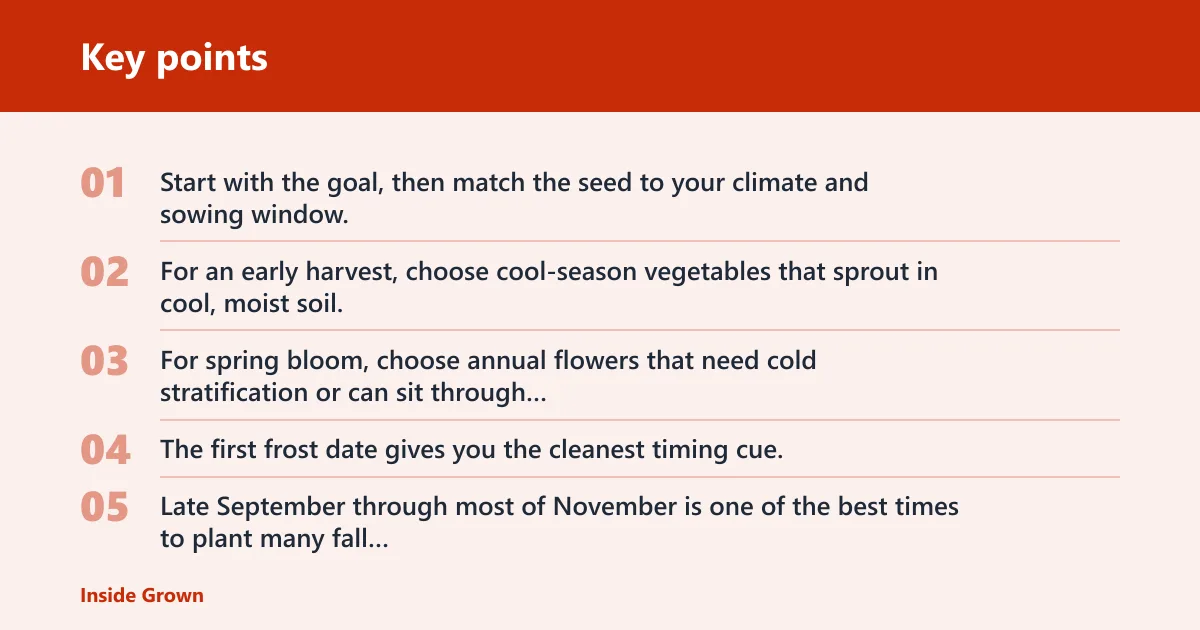


Start with the goal, then match the seed to your climate and sowing window. For an early harvest, choose cool-season vegetables that sprout in cool, moist soil. For spring bloom, choose annual flowers that need cold stratification or can sit through winter and resume growth in spring. The first frost date gives you the cleanest timing cue.
Late September through most of November is one of the best times to plant many fall crops, but that window only works when the soil still drains and you have time before hard freeze. Many fall-planted seeds do best when sown about 6 weeks before ground-freezing weather, while cool soil can slow top growth and reduce heat stress on seedlings.
Soil temperature matters as much as the calendar. Many seeds sprout faster and more evenly after the soil cools, and some spring-blooming bulbs are planted when nighttime temperatures drop to around 50 degrees. Fall seed sowing follows the same pattern: warm enough to start, cool enough to keep growth compact.
Fall seeds decision table
| Seed | Sowing method | Winter behavior | Best-fit climate band | Avoid if |
|---|---|---|---|---|
| Beets | Direct sow | Germinates now in cool, moist soil | Average or mild winter | Soil stays waterlogged or stays too warm after sowing |
| Broccoli | Direct sow or start indoors | Germinates now; seedlings can hold through light frost | Average winter, with protection in cold winter | You expect a long warm spell that pushes soft growth |
| Cabbage | Direct sow or start indoors | Germinates now; tolerates hard frost once established | Average or cold winter | Heavy wet soil that crusts after rain |
| Carrots | Direct sow | Germinates slowly in cool soil or waits for spring | Mild or average winter | Rocky soil, crusting soil, or a short fall window |
| Kale | Direct sow or start indoors | Germinates now; can overwinter under protection | Average or cold winter | Fall stays hot enough to keep plants leggy |
| Spinach | Direct sow | Germinates in cool soil, then slows through winter | Cold, average, or mild winter | Soil dries out right after sowing |
| Turnips | Direct sow | Germinates now; roots size up in cool weather | Average or mild winter | You need long warm growth after sowing |
| Larkspur | Direct sow | Needs cold treatment; often germinates after winter | Cold or average winter | Soil is heavy and stays soggy |
| Love-in-a-mist | Direct sow | Often overwinters, then blooms in spring | Average or cold winter | Fall heat keeps seedlings growing too fast |
| Calendula | Direct sow or start indoors in cold climates | Germinates now in cool soil or flowers early after winter | Mild or average winter | You have a very short fall window before hard freeze |
| Bachelor’s button | Direct sow | Often germinates now and blooms next spring | Mild, average, or cold winter | Bed drains poorly after rain |
| Poppies | Direct sow | Many types need cold to break dormancy | Cold or average winter | You plan to transplant seedlings later |
Quick filter: if the soil is cold, damp, and still workable, direct sow hardy vegetables and many flower seeds. If the season is short or the climate stops germination fast, start the tenderer options indoors or skip them for fall and wait for spring.
Say your garden gets a hard freeze by late October and the beds hold water after rain. Beets and spinach can still work if you sow promptly into a raised, draining bed, but carrots may fail because crusted soil blocks emergence. In that case, direct sowing is better than transplanting, and a light cover can help hold even moisture.
Which vegetables can you plant in fall?
Cool-season vegetables are the safest next-season bet because many of them germinate in cool, moist soil and take frost better than summer crops. Beets, broccoli, cabbage, carrots, kale, spinach, and turnips are the main fall options here. Some keep growing after light frost, and a few survive well below freezing once established.
Beets establish more easily under cool, moist conditions. Spinach grows slowly through winter and bounces back in early spring. Broccoli can survive temperatures as low as 28 F, cabbage can withstand frost down to 20 degrees or even 15 degrees F, carrots can survive temperatures as low as 15 degrees Fahrenheit, and kale often holds on with protection in cold weather. If you garden in a colder zone, collards and leeks are even tougher, with collards down to 5 F and leeks sometimes to 0 °F.
Direct sowing usually beats indoor starts for root crops and many cold-hardy greens because transplant shock can stall them right when cool weather should help. For broccoli and cabbage, indoor starting can make sense if your fall window is short or if the soil is still hot when you want to begin. That keeps young plants from sulking in the heat.
A common first-timer mistake is sowing carrots into a bed that stays wet and sealed after rain. The seed sits, rots, or germinates unevenly. A loose, fine seedbed and even moisture matter more than extra fertilizer at this stage.
Vegetable sowing guide
- Direct sow beets, carrots, spinach, and turnips when the soil is cool enough to slow top growth but still workable.
- Start broccoli, cabbage, and kale indoors if your fall is short or your soil stays warm longer than expected.
- Plan for overwintering only if your climate and protection can carry seedlings through winter without rot or heaving.
- Mulch lightly after germination in colder regions to buffer temperature swings and keep the root zone steadier.
Which flowers should you sow in fall?
The best fall flower seeds for spring are the ones that either need cold stratification or can overwinter as seedlings without trouble. Larkspur, love-in-a-mist, calendula, bachelor’s button, and poppies are the main annuals to look at. Most bloom in spring or early summer next year if you sow at the right time and let winter do its work.
Cold stratification matters for some seeds because it simulates winter chill and breaks dormancy. Poppies and larkspur are common examples of seeds that respond well to that cold period. Love-in-a-mist and bachelor’s button often do fine with direct fall sowing and winter exposure, while calendula can be a better indoor start in colder climates if fall arrives too fast.
Direct sowing is usually simpler for these annuals because the seedlings dislike root disturbance. If you are in a mild winter band, some will overwinter as small plants and restart in spring. If you are in a cold winter band, sow only where snow cover, mulch, or a cold frame can hold the seed through freeze-thaw cycles.
Suppose you want a front border of spring poppies but your ground turns heavy and slick after a week of rain. Direct sowing into that soil can wash seed into clumps and leave gaps. In that case, wait for a dry window or move the sowing to a protected bed with better drainage.
Flower timing and treatment
- Larkspur: direct sow in a cold or average winter area; expect spring bloom after chilling.
- Love-in-a-mist: direct sow for easy overwintering and spring flowers.
- Calendula: direct sow in mild or average winters; start indoors in colder climates if the fall window is short.
- Bachelor’s button: direct sow for spring bloom; it tolerates cool soil well.
- Poppies: direct sow where cold weather can break dormancy naturally.
How late can you plant seeds in fall?
The safest cutoff is tied to your first frost date, not a fixed calendar date. Count back so the seed has about 6 weeks before hard, ground-freezing weather, and make sure the soil is still warm enough to germinate for the species chosen. If the seed needs cold treatment, later sowing can still work in a climate that will hold it through winter.
Warm autumns create one of the biggest failure cases. Seeds may sprout, then make soft growth that gets checked by a sudden freeze. Heavy wet soil is the other problem because it cools slowly, compacts easily, and can drown fine seed before it sprouts. In that setting, a cold frame or delayed sowing may be safer than a rushed direct sow.
Climate band matters here. In mild winter areas, many seeds can germinate in fall and sit as young plants through winter. In average winters, you can split the difference: sow hardy vegetables and cold-loving flowers while the soil is still open, then protect them. In cold winters, prioritize seeds that either need stratification or can be started indoors and set out later.
What seeds should you direct sow in fall versus start indoors?
Direct sow hardy crops and annuals that often resent transplanting, such as beets, carrots, spinach, turnips, larkspur, love-in-a-mist, bachelor’s button, and poppies. Start indoors when the fall window is too short, the soil is already cold, or tighter control over germination is needed, which can matter for crops such as broccoli, cabbage, kale, and calendula in colder climates.
Indoor starting is not the default for fall, but it helps when the season closes fast. For some crops, a common indoor lead time in spring is about 6-8 weeks before last frost, but fall starting is different because the goal may be a small transplant or a protected seedling rather than a full-size plant. Check the manufacturer’s listing or packet directions for your exact variety when timing is narrow.
Direct sowing works best when the ground is workable and moisture is available. Indoor starts are safer when warm autumns would keep seedling growth going too long, or when a hard freeze would arrive before roots have a chance to settle. A cold frame, row cover, or mulch can bridge the gap in harsher winters.
Simple fall sowing checklist
- Check your first frost date.
- Confirm whether your seed wants cool germination or a cold period.
- Decide if your climate is mild, average, or cold enough for overwintering.
- Choose direct sowing for hardy seeds and indoor starting only when the season is short.
- Keep the bed evenly moist until germination.
Frequently asked questions
What seeds can you plant in fall for next season?
The best fall seeds are cool-season vegetables and spring-blooming annuals that handle chill well. Beets, broccoli, cabbage, carrots, kale, spinach, and turnips fit the vegetable side, while larkspur, love-in-a-mist, calendula, bachelor’s button, and poppies are strong flower choices if your climate and timing give them a cold period.
Which flower seeds should I sow in fall for spring blooms?
Choose larkspur, love-in-a-mist, calendula, bachelor’s button, and poppies. Some need cold stratification to break dormancy, while others simply overwinter and bloom in spring or early summer. Direct sowing is usually the best method because these flowers often dislike transplanting.
Which vegetable seeds can I plant in fall and harvest next season?
Beets, broccoli, cabbage, carrots, kale, spinach, and turnips are the core fall vegetables for next-season harvests. Spinach and some brassicas can keep moving through cool weather, and roots like beets and carrots often improve in cool, moist soil if the bed drains well.
Do fall-sown seeds need cold stratification?
Some do, but not all. Poppies and larkspur are common examples of seeds that benefit from winter chill to break dormancy, while spinach, beets, and turnips usually need only cool soil and steady moisture. Read the packet carefully, because cold stratification and simple cool germination are not the same thing.
When is the best time to plant seeds in fall before frost?
Count back from your first frost date and aim for a window of at least about 6 weeks before hard, ground-freezing weather. That leaves enough time for germination and root growth before the soil shuts down. Late September through most of November is often a good fall planting span, depending on region.