How to Succession Sow Seeds for Continuous Picking
Stagger sowings by crop speed and harvest demand: fast crops every 1 to 2 weeks, medium crops every 2 to 4 weeks, and long-season crops every 4 to 6 weeks. Then tighten or widen the next sowing once you see real germination and harvest timing. Ignore spacing, and you get one glut, then bare beds, missed picking windows, and quality that falls fast. This guide shows how to set intervals from frost dates, crop type, and picking pace, then tune each next sowing from real results.
What succession sowing means
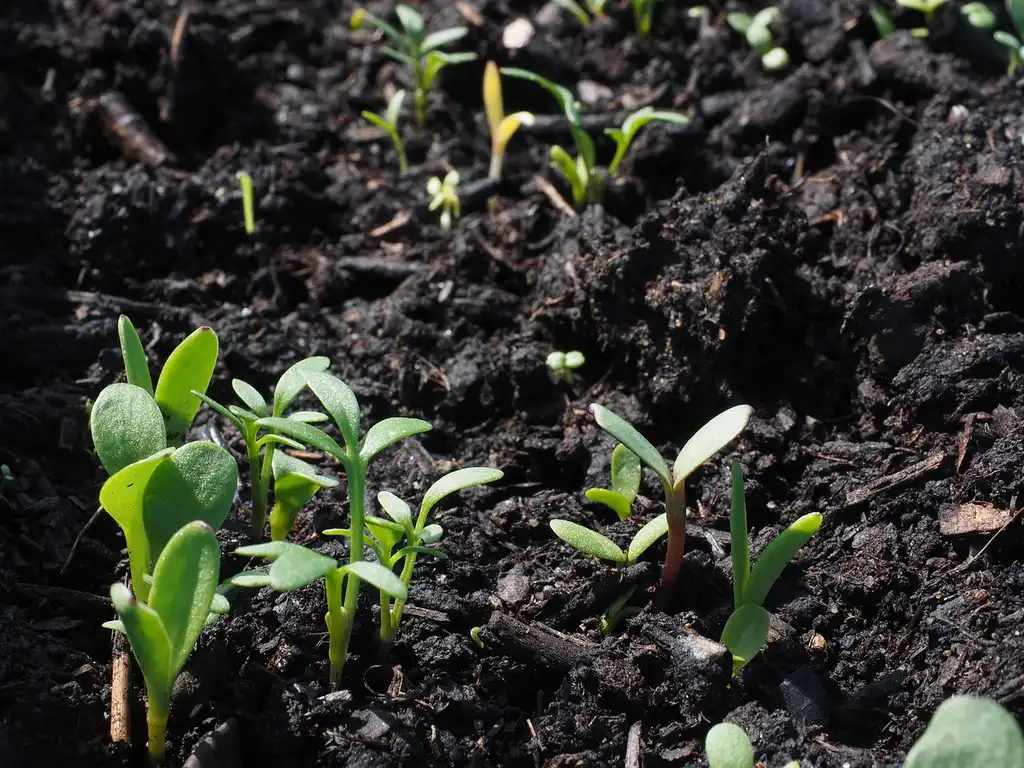

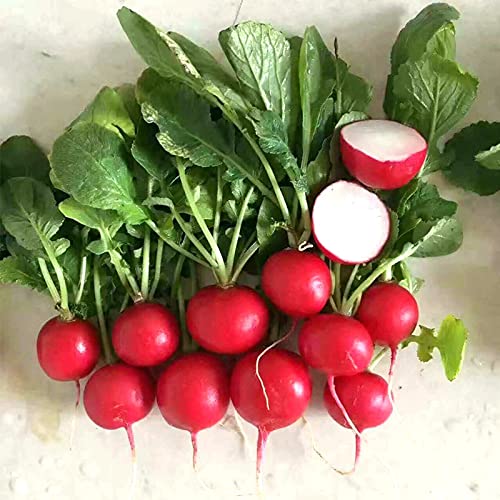
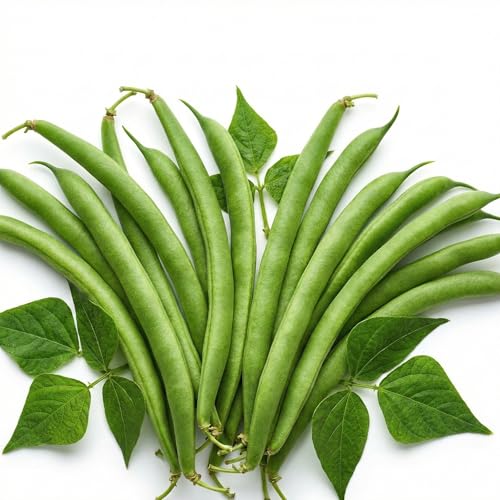
Succession sowing means planting small batches at staggered intervals so harvests come in a steady flow instead of all at once. It works best for crops with short picking windows, where quality drops fast after maturity. The goal is simple: keep beds productive, keep the fridge from filling up at once, and keep the next harvest close behind the last.
Why staggered sowings work
Large one-time sowings create a short harvest spike. Staggering the planting spreads maturity dates across several weeks, which gives you a smaller but longer picking season. That matters most for quick crops, because their eating stage can pass in a few days.
A practical rule is to match the interval to two things: how fast the crop matures and how much your household actually eats. A small household that eats a little lettuce each day can stretch sowings farther apart than a larger household that clears a tray fast.
How to think about bed sections
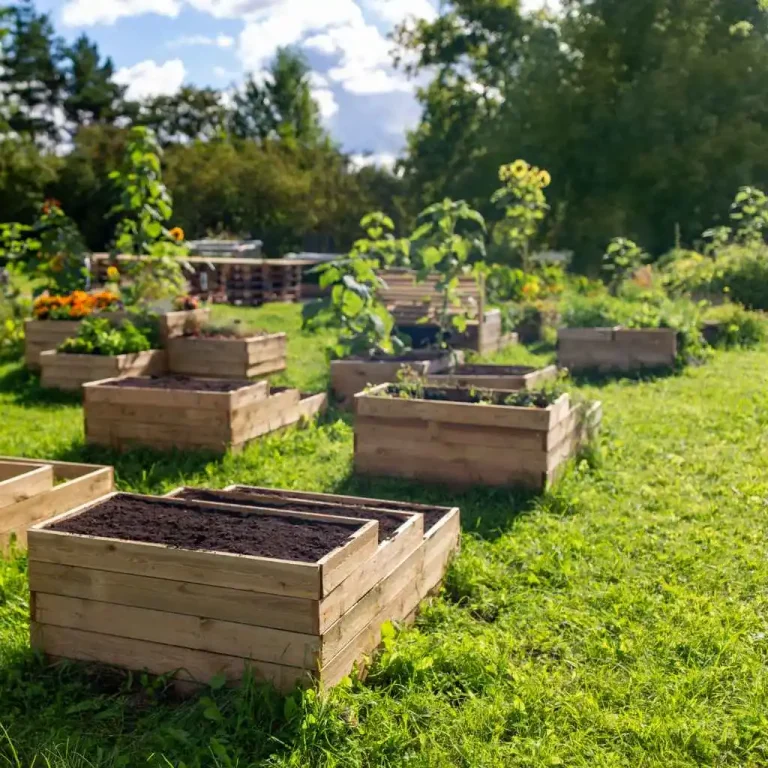
Divide a row or bed into repeat sowing sections so you do not plant everything at once. In a narrow bed, that can mean marking off thirds or quarters. In a container, it can mean sowing one half now and the other half later. That simple split keeps harvests rotating across the space.
Which vegetables are worth repeating?
The best candidates are crops that move from sowing to harvest fast, or crops that can be cut in stages. Lettuce, radishes, spinach, bush beans, carrots, and beetroot are common choices. Quick crops are the easiest to keep on a staggered schedule, while slower crops need wider gaps and fewer rounds.
Crops that usually repay the effort
Lettuce is a strong choice, especially loose-leaf or cut-and-come-again types. Radishes are even faster, but quality drops quickly after maturity, so timing matters. Spinach works well in cool windows. Bush beans can be sown in two to three rounds where the season allows. Carrots and beetroot suit succession sowing too, though they usually need wider spacing between sowings than lettuce or radishes.
Crops that are often poor fits
Some crops do not pay back the effort in a small garden. Long-season crops that take a bed for months, or crops picked once and done, are usually better planned as a single sowing unless you have a long season and extra space. If a crop has a wide harvest period already, repeated sowing may add work without adding much yield.
A common first-timer mistake is sowing the same crop on the same day in every part of a bed. Suppose a 4-foot raised bed gets all its lettuce seed at once in early spring. The harvest lands together, then the bed is empty while the next sowing is still growing. Split the bed instead, and the harvest line moves forward.
How to time each sowing
Start with days to maturity from the seed packet, then work backward from your last frost date in spring or your first fall frost date in autumn. Use that to find the last safe sowing date, then set the next sowing based on how much produce you actually need before the first batch runs out. That gives you a schedule built on harvest demand, not guesswork.
Use days to maturity as the starting point
Days to maturity tells you how long a crop needs from sowing to first harvest. It varies by crop and variety, so check the packet for the number on the seed you bought. A lettuce that matures in 45 days needs a different plan from a bean that needs about 60 days or more.
Then add a harvest window. If a crop can be picked over several weeks, the next sowing can wait longer. If quality falls quickly after maturity, the next sowing should be closer.
Back-calculate from frost dates
Last frost date helps you start spring sowings safely, especially for frost-sensitive crops. First fall frost date helps you set the final sowing deadline for cool-season crops and lets you know whether a late sowing will finish on time. Backward planning matters more than calendar habit, because two gardens in different climates do not share the same safe window.
For a fall crop, count backward from first fall frost by the days to maturity plus a small buffer for slow germination or cool weather. If the crop cannot mature before frost, skip that round or switch to an earlier-maturing variety.
Set the next sowing from eating rate
Household demand changes the interval. If a family finishes a row of lettuce in 8 days, a 3-week interval will produce a gap. If the same household only needs a small salad each week, a 2-week interval may be too frequent. The right interval is the one that keeps harvests overlapping without wasting produce.
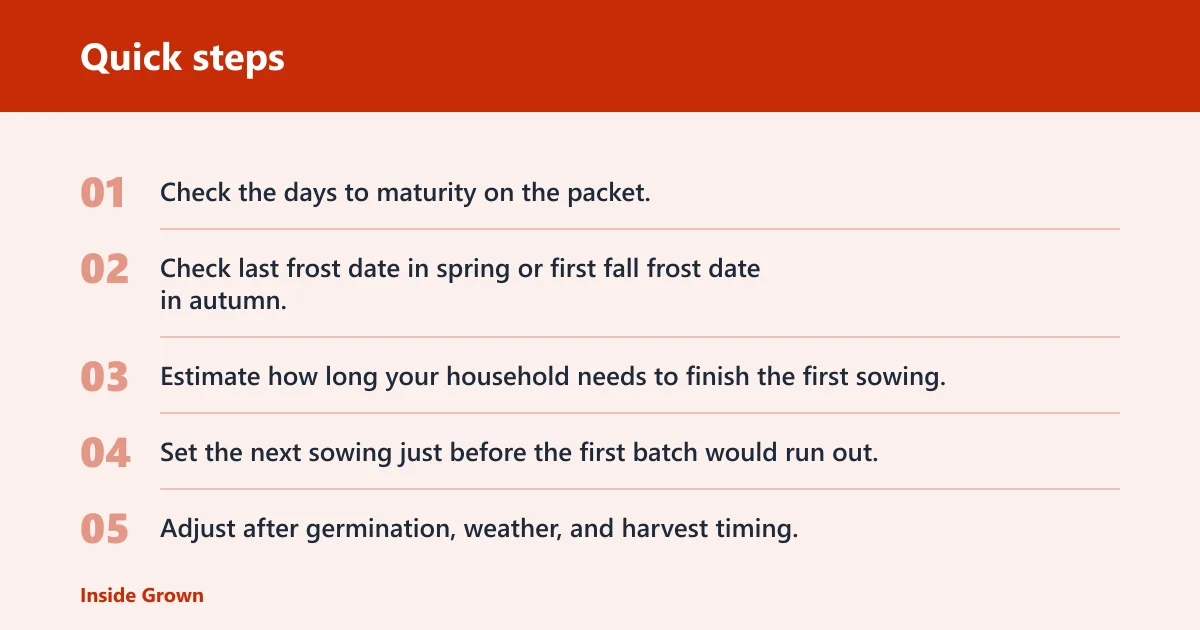
- Check the days to maturity on the packet.
- Check last frost date in spring or first fall frost date in autumn.
- Estimate how long your household needs to finish the first sowing.
- Set the next sowing just before the first batch would run out.
- Adjust after germination, weather, and harvest timing.
How often should I sow again?
Fast crops usually take the shortest intervals, medium crops need moderate gaps, and slower crops need fewer sowings. For many gardens, that means 7 to 14 days for very fast crops, 2 to 3 weeks for mid-speed crops, and 3 to 4 weeks or more for slower crops. The exact interval depends on heat, moisture, and how much you harvest.
Fast crops
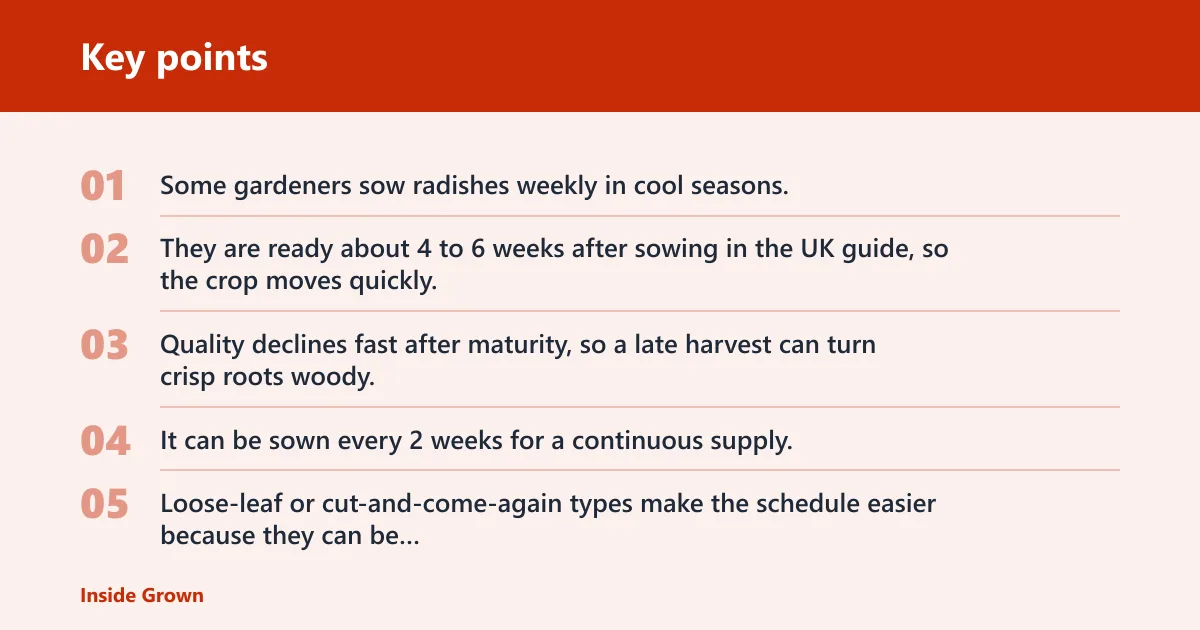
Radishes are the clearest example. Some gardeners sow radishes weekly in cool seasons, and radishes are often succession sown every 10 to 14 days. They are ready about 4 to 6 weeks after sowing in the UK guide, so the crop moves quickly. Quality declines fast after maturity, so a late harvest can turn crisp roots woody.
Lettuce also fits short intervals. It can be sown every 2 weeks for a continuous supply, and the UK guide lists leaf lettuce as a 2-week succession crop with a 6 to 8 week harvest timeline. Loose-leaf or cut-and-come-again types make the schedule easier because they can be harvested more than once.
Medium crops
Spinach is a cool-season succession crop. It is often sown every 10 to 14 days in cool windows, and arugula and spinach are both quick crops suited to weekly sowing. Use shorter intervals in spring and fall, when growth is steady and bolting risk is lower.
Carrots usually need wider gaps than fast crops. They are commonly succession sown every three weeks. They also need consistent moisture during germination, so a dry spell may delay emergence and shift the next sowing. Beetroot follows a similar logic in many small gardens: repeat sowing works, but not on the same tight loop as radishes.
Slower or heat-sensitive crops
Bush beans usually need warm soil and frost-free timing. They are often planted in two or three sowings spaced two weeks apart, and the UK guide recommends French beans every 3 weeks from mid-May to early July. The UK guide also says bush French beans are ready in roughly 8 to 10 weeks. That makes them a good short-round crop, not a season-long weekly sowing.
Picture a 2-by-6-foot raised bed with beans on one half and carrots on the other. If the first bean sowing is delayed by cold rain, push the next bean sowing back only if the bed will still finish before your stop date. Carrots can usually absorb a small delay better than beans, because they are not waiting on warm-soil germination.
When should I stop sowing?
Stop sowing when heat, frost risk, or lost germination time makes the next batch unlikely to pay back. Lettuce and spinach often stop performing well in warm weather, while beans stop making sense once nights cool and the frost-free window closes. The right stop date is the point where the crop will no longer reach a useful harvest window.
Summer heat and bolting limits
Lettuce and spinach are the main heat-sensitive crops in this group. Warm weather can cause bolting, tougher leaves, or poor germination. If daytime heat is rising and seedlings are failing, shorten the sowing season or pause until cooler weather returns. For lettuce, that often means shifting to a later sowing only if your climate stays mild enough for it to mature cleanly.
Spinach is especially sensitive. It works best in cool seasons, so spring and fall are the best windows for short intervals. In hot weather, a sowing may germinate poorly or head straight to flower before harvest size.
Frost-sensitive crops and final safe dates
Bush beans need warm soil and frost-free timing, so their final sowing date is controlled by your first fall frost date. If the crop will not reach harvest before frost, stop sowing. The same logic applies in spring: do not rush frost-sensitive crops before the soil is ready, even if the calendar says the season has started.
For cool-season crops, a late sowing may still work if the forecast stays cool long enough. For warm-season crops, late sowing usually fails for the opposite reason: not enough heat early enough, followed by an abrupt cold finish.
Spacing and bed sections
Spacing the crop across sections of a row or bed keeps one sowing from crowding out the next. It also makes harvest rotation easier. Instead of sowing the whole bed, you can treat each section as a separate planting date and keep one section ready while another is maturing.
How to split a bed without crowding
In a small raised bed, mark sections with short stakes, plant labels, or simple mental divisions. A 4-foot bed can be split into two or four repeat sections. In containers, sow only part of the pot and leave room for the next round. Narrow rows can be treated the same way: sow one end now, the other end later.
This method also helps if rain delays a sowing. You can shift one section by a week without throwing the whole bed off schedule. That is often easier than trying to force every crop into one fixed calendar slot.
Succession sowing planner table
Use this planner as a starting point, then adjust after each sowing based on germination speed, weather, and how fast the crop was actually picked. The “last safe sowing date” column is a planning line, not a guarantee. If the crop is slow to emerge or the weather turns, move the next sowing earlier or skip it.
| Crop | Days to maturity | Suggested interval | Last safe sowing date before frost | Expected harvest window | Weather or germination notes |
|---|---|---|---|---|---|
| Lettuce | 45-60 days | Every 2 to 3 weeks | About 60-75 days before first fall frost | 6 to 8 weeks after sowing | Best in loose-leaf or cut-and-come-again types; slow or stop in warm weather |
| Radish | 25-45 days | Every 7 to 14 days | About 30-45 days before first fall frost | 4 to 6 weeks after sowing | Pick promptly; quality drops fast after maturity |
| Spinach | 35-50 days | Every 10 to 14 days | About 50-65 days before first fall frost | 5 to 7 weeks after sowing | Cool-season crop; bolts quickly in heat |
| Bush beans | 50-60 days | Two to three sowings, 2 weeks apart | About 60-75 days before first fall frost | 8 to 10 weeks after sowing | Needs warm soil and frost-free timing; sow only when soil is warm |
| Carrots | 60-80 days | Every 3 weeks | About 80-100 days before first fall frost | 8 to 12 weeks after sowing | Needs steady moisture during germination; slow emergence can shift the schedule |
| Beetroot | 50-70 days | Every 2 to 3 weeks | About 70-90 days before first fall frost | 7 to 10 weeks after sowing | Repeat sowings work well if seedlings emerge evenly |
Frequently asked questions
How often should I succession sow seeds for continuous picking?
Use the crop’s speed and your eating rate together. Fast crops often work at 7 to 14 days, medium crops at 2 to 3 weeks, and slower crops at 3 to 4 weeks or longer. If you harvest a crop before the next sowing is ready, shorten the interval next time.
Which vegetables are best for succession sowing?
Lettuce, radishes, spinach, bush beans, carrots, and beetroot are all common choices. Arugula is also a good quick crop. The best options are the ones with short maturity times, a clear harvest window, or a cut-and-come-again habit that spreads picking over more than one week.
When should I stop sowing lettuce, spinach, or beans in summer heat?
Stop when heat starts to reduce germination, trigger bolting, or push the crop past its useful harvest window. Lettuce and spinach usually need a pause first. Beans are limited more by frost-free timing and soil warmth, so they stop when the season no longer gives enough warm weeks to finish.
How do I time the next sowing so harvests overlap without gaps?
Count backward from the harvest date of the first sowing, not just from the calendar. Use days to maturity, then add how long the crop stays good once picked. If the first batch will be finished before the second is ready, move the next sowing earlier by a few days or a week.
What days-to-maturity window works best for succession sowing?
Shorter maturity windows are easier to manage because they let you reset the schedule quickly. Crops in the roughly 25- to 70-day range are the easiest to stagger in small gardens. Longer crops can still be repeated, but they need wider spacing between sowings and more room in the season.
How do I know when to sow the next batch of seeds?
Watch three things: how fast the first sowing germinated, how quickly it is being picked, and whether the weather is helping or hurting the crop. If germination is slow, delay the next batch only if the season still has enough time. If harvest is moving fast, bring the next sowing forward.
What crops are not worth succession sowing?
Crops that take a long time to mature, need a large block of space, or produce one main harvest are usually poor candidates. If a crop already holds the bed for months and does not offer repeated picking, one sowing is often enough. Save the repeat schedule for crops that respond well to it.