How to Save Money on Seeds Without Sacrificing Quality
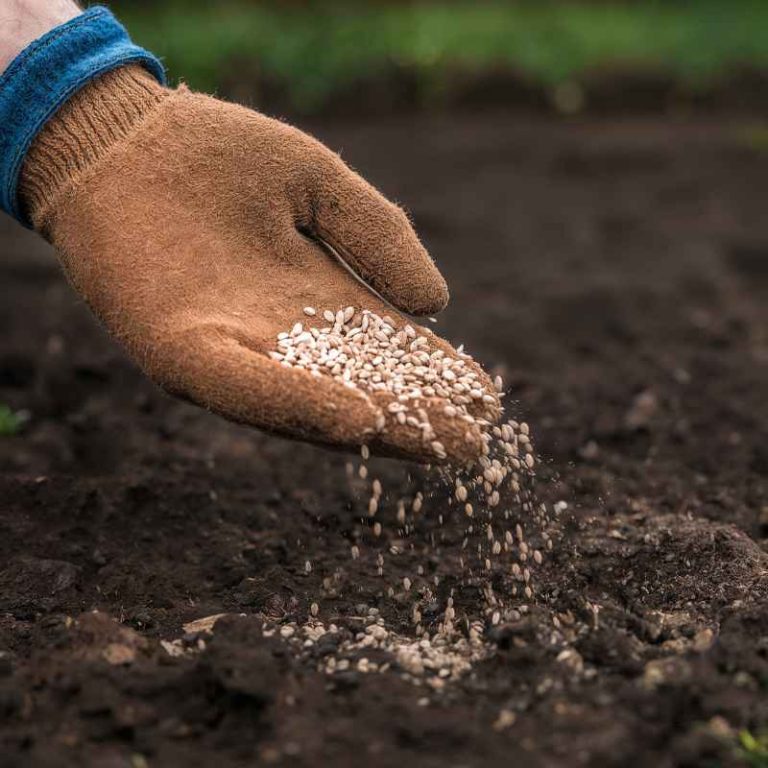
Save money on seeds by comparing cost per viable plant, not packet price. Buy fresh seed with germination rates above about 75% and the lowest cost per usable plant. Skipping that rule can leave you with weak germination, wasted space, and expensive re-seeding. This guide shows how to judge packet value, read seed labels, and cut costs without lowering plant quality.
What you’ll need



- Seed packets or catalog listings with price, seed count, and date
- A calculator or spreadsheet for cost per plant
- A cool, dry storage spot
- Airtight containers for opened seed packets
- Desiccant packets for moisture control, if needed
- Labels for variety names, purchase dates, or test dates
How do you compare seed value?
The quickest method is to divide packet price by expected usable plants. That number tells you more than the sticker price because seed count and germination rate change what you actually get. A $4 packet with 200 seeds can cost less per plant than a $2 packet with 25 seeds and weak germination.
- Check the seeds per packet.
- Check the stated germination rate on the label.
- Estimate usable plants by multiplying seed count by germination rate.
- Divide packet price by usable plants to get cost per viable plant.
Seed tags and catalog listings usually rely on a germination test lot result, not a guess. University seed-testing guidance describes germination as the percentage of seeds that produce normal seedlings under controlled conditions, which is why the percentage matters so much when you compare packets. In practical terms, a 75% threshold is a useful minimum for most home gardeners because it helps limit the cost of empty cells and re-sowing. Extension sources and seed industry testing guidance commonly use this same basic approach.
A packet that lists about 100 seeds and an 80% germination rate should produce roughly 80 usable plants. If it costs $3.20, the effective cost is 4 cents per plant. If another packet costs $2.00 but has only 25 seeds and 60% germination, it yields about 15 plants at 13 cents each. The cheaper packet is not the better value.
Money table
This table uses a simple planning method: estimated usable plants = seeds per packet × expected germination rate, then effective cost per plant = packet price ÷ usable plants. The crop ranges below reflect common packet sizes and typical home-garden expectations from university extension and seed-industry references, with the decision column showing where a low-cost packet is usually enough versus where better genetics, vigor, or higher seed value justify spending more.
| Crop | Packet price | Seeds per packet | Expected germination rate | Expected usable plants | Effective cost per plant | Decision |
|---|---|---|---|---|---|---|
| Lettuce | $3.00 | 500 | 85% | 425 | $0.007 | buy cheap |
| Radish | $2.50 | 150 | 90% | 135 | $0.019 | buy cheap |
| Carrot | $3.50 | 300 | 75% | 225 | $0.016 | buy cheap |
| Tomato | $4.50 | 25 | 85% | 21 | $0.21 | buy mid-range |
| Pepper | $4.75 | 20 | 80% | 16 | $0.30 | buy premium |
| Cucumber | $3.75 | 30 | 85% | 26 | $0.14 | buy mid-range |
| Bean | $4.00 | 50 | 90% | 45 | $0.089 | buy mid-range |
| Spinach | $3.25 | 200 | 80% | 160 | $0.020 | buy cheap |
| Broccoli | $4.25 | 100 | 75% | 75 | $0.057 | buy mid-range |
| Sweet corn | $5.00 | 75 | 85% | 64 | $0.078 | buy premium |
Use the table as a starting point, not a rulebook. A crop moves from cheap to premium when the seed count is low, the variety has special traits, or a failed seed would force you to restart a whole row. For fast, high-count crops such as lettuce and radish, low-cost seed usually makes sense. For peppers and sweet corn, stronger germination and better lot quality are worth more because replacement is harder and the number of seeds per packet is smaller.
Which seeds are worth buying cheap?

Budget seed makes the most sense for crops with high seed counts, fast germination, and low replacement cost. Lettuce, radish, spinach, and many herbs are usually fine as low-cost seed if the packet still shows a solid germination rate and a current packed-for or test date. A low price works here because a few failed seeds do not change the harvest much.
When higher prices pay off
Pay more for crops where every seed matters more. Tomato, pepper, sweet corn, and some specialty hybrids have fewer seeds per packet and higher cost per plant, so weak germination hurts more. Premium seed can also be worth it when disease resistance, uniform maturity, or stronger vigor reduces losses later in the season. Extension and seed-company trial guidance often point to these traits as the reason a premium packet can still be a better value overall.
Open-pollinated versus hybrid
Open-pollinated seed can be a smart value buy if you want to save seed later and keep the same traits in future seasons. Hybrid seed is not lower quality; it is bred for specific traits, and that can justify the higher price. Do not expect reliable seed saving from hybrid plants, though, because saved seed often does not come true.
Suppose you have one 10-by-4-foot bed and want tomatoes from a single packet. A high-germination open-pollinated tomato seed may be the better value if you plan to save seed next year. If you need uniform fruit set for a short season, a pricier hybrid may return more usable harvest per plant.
How can you cut waste before you buy?
Start by buying fewer varieties. Small-space gardeners lose money when they buy six packets they will never sow. Pick crops you eat often, then choose packet sizes that match the bed or container space you actually have. A tiny garden needs fewer packets, not more options.
How do seed catalogs and promotions change the real price?
Catalogs and promotions can lower the price, but only if they do not push you into overbuying. Free-shipping thresholds, bundle deals, and coupon codes help most when you already know your plant count. Otherwise, the sale price may be offset by extra seed that expires before you use it or by impulse purchases that sit unused in storage.
Use bulk and multipacks with caution
Bulk seed can lower cost per plant when you grow the crop every year and can how to store the extra seed so it stays viable correctly. It is less useful for one-off experiments or small beds. If a bulk packet holds far more seed than you need, split the order with a neighbor or buy a smaller packet instead of paying for seed that may age out in storage.
Use swaps and sales without giving up quality
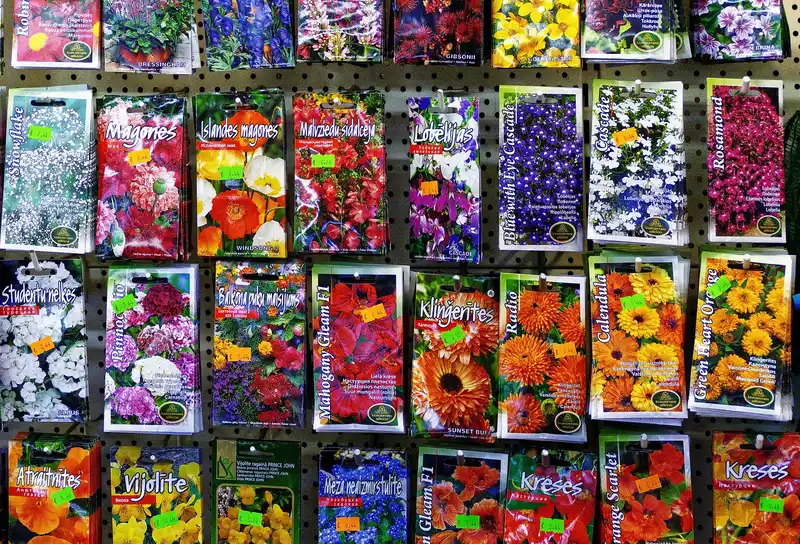
Seed swaps, exchanges, and local community sources can cut costs sharply, especially for common vegetables and flowers. Screen what you get: check packet dates, ask about storage, and favor sealed or recently shared seed from reliable growers. End-of-season sales, bundle deals, and free-shipping thresholds can also save money if you still choose seed with good germination information.
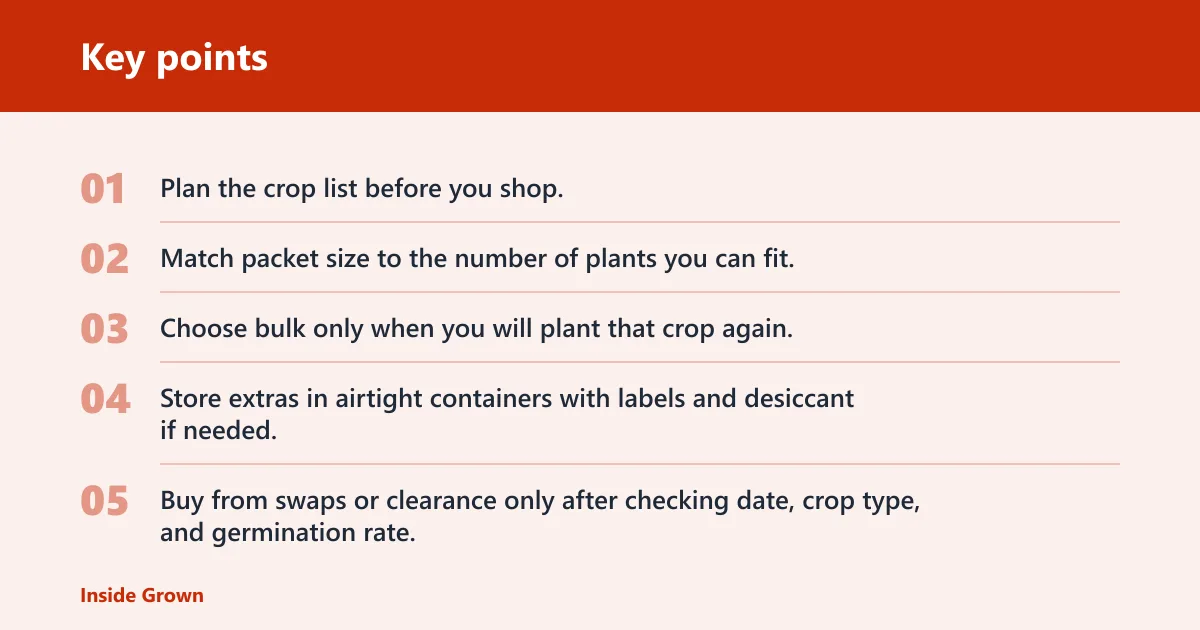
- Plan the crop list before you shop.
- Match packet size to the number of plants you can fit.
- Choose bulk only when you will plant that crop again.
- Store extras in airtight containers with labels and desiccant if needed.
- Buy from swaps or clearance only after checking date, crop type, and germination rate.
How do you tell if discounted seeds are still viable?

Check the date, the crop, and the storage history. A discounted packet can still be a good buy if it was stored cool and dry and the species keeps well. A tomato packet from a recent season is usually a safer bargain than old onion seed, because different crops lose viability at different speeds.
How does seed longevity vary by crop?
Seed life varies a lot by species. University horticulture and extension references commonly note that onions, parsnips, sweet corn, and parsley lose vigor more quickly, while beans, peas, tomatoes, lettuce, brassicas, and many cucurbits tend to hold up longer in dry, cool storage. That is why the same discount can be smart for one crop and wasteful for another.
How do germination tests work?
A germination test measures how many seeds sprout into normal seedlings under controlled conditions. For home use, a damp paper towel in a labeled bag or container is the simplest method. Count only normal sprouts after the crop’s usual germination window, and compare the result with the packet rate before you commit bed space or tray mix.
How do you decide whether 75% germination is good enough?
Around 75% is a practical cutoff for many home-garden purchases because it helps keep the cost per plant reasonable while leaving room for normal losses. If the seed is older, the crop is difficult to start, or you need a full bed to come up evenly, a higher percentage is safer. Below that point, the savings often disappear once you factor in reseeding.
A common first-timer mistake is buying clearance basil seed because the price looks low, then sowing the whole packet in one tray. If only half emerge, the tray space, potting mix, and time are wasted. A quick germination test avoids that loss.
How does seed-starting waste raise the true cost per plant?
Overseeding, extra trays, and wasted potting mix all raise the real cost of each plant because you pay for more inputs than you end up transplanting. If you sow three seeds where one or two would do, you also spend more time thinning and may still discard healthy seedlings. The cheapest packet can become the most expensive once waste is included.
To reduce that hidden cost, sow only the number you need, then label each tray and track what you actually planted. If a crop has a lower germination rate, adjust the sowing rate rather than doubling the tray count automatically. Better planning usually saves more than buying the cheapest seed.
Common mistakes
Buying by packet price alone is the biggest one. A cheap packet with poor germination often costs more per plant than a mid-priced packet with better seed count and fresher stock.
Another mistake is ignoring storage after bulk buying. If the extra seed sits in a warm pantry or humid shed, the savings disappear fast. Use airtight containers, label the variety and date, and keep them cool and dry.
Mixing up open-pollinated and hybrid seed also causes trouble. Open-pollinated seed can often be saved and replanted; hybrid seed usually should not be counted on for that purpose.
Overseeding and heavy thinning waste money too. Sow only the amount you need, then recheck spacing before you sow more. For a 4-inch pot or cell pack, adding 1 or 2 extra seeds is usually enough; more than that often creates thinning losses later.
Keeping old seed without checking crop life span is another false economy. Some crops hold viability longer than others, and storage conditions matter. If the packet is several seasons old, confirm the date and test a sample before using bed space.
Frequently asked questions
How can I save money on seeds without buying low-quality seed?
Compare cost per viable plant, not packet price. Choose fresh packets with germination rates above 75%, seed counts that fit your space, and a clear packed-for or test date. Then buy only the crops you will actually grow, because fewer wasted packets often save more than chasing the lowest sticker price.
Is it cheaper to buy seed packets or bulk seed?
Bulk seed is cheaper only when you will use most of it and can store the remainder well. If you grow the crop every year, a larger pack may cut cost per plant. For small gardens, a packet or split bulk order is often the better deal because it reduces spoilage and overbuying.
What seed-saving tricks actually reduce costs for home gardeners?
The best savings come from saving seed only from open-pollinated plants, storing it in airtight containers with labels, and planting only what you need. Buying fewer varieties, skipping needless thinning, and using swaps or clearance deals also reduce cost. Seed saving helps most when you already grow those crops every season.
Which seeds are worth buying cheap and which should be high quality?
Buy cheap for high-count crops with easy germination, such as lettuce, radish, spinach, and many herbs. Pay more for low-count or high-loss crops like pepper, sweet corn, and specialty tomatoes, where every failed seed costs more. Disease resistance and uniform fruiting can justify the premium on those crops.
Should I buy open-pollinated seeds to save money?
Often, yes, if you want to save seed for later seasons or want a lower-cost path for common crops. Open-pollinated seed is not always cheaper per plant, though, and some hybrids outperform it. The best choice is the one with the lowest cost per usable plant for your space and goals.