How to Protect Seeds From Heavy Rain and Runoff
Cover seeds with fine soil at about 2 to 3 times the seed width, then keep back hard splash with a breathable row cover or a board until the first soaking rain passes. That limits seed movement, surface crusting, and gaps that never fill in. This guide shows how to protect seeds from runoff, sealing, and splashing in beds and containers.
What heavy rain does to fresh seed


Heavy rain is first a seed-placement problem. It can move seed downhill, press fine soil into a crust, and leave pockets where water sits long enough to starve the seed of oxygen. Once the top inch of soil starts to change shape, germination can become uneven quickly.
How runoff moves seed out of place
Sheet flow can slide seed to the low side of a bed, bury it too deep, or leave it on the surface. That matters most on slopes, packed soil, and any row that sits below a downspout or a hard edge that sends water straight at the planting line.
How crusting blocks germination
Fine seed-starting mix resists crusting better than coarse field soil, but any surface can seal after impact from rain. When the top layer crusts, tiny seedlings may fail to break through. Large seeds can still fail if the crust seals the pore space they need for air and moisture exchange.
How pooling causes waterlogging
Standing water that lasts more than a day signals a drainage problem, and low spots that hold water for more than 24 hours are bad places for fresh seed. Seed can rot, swell unevenly, or sit too wet to germinate. Raised beds lower that risk by lifting the root zone above soggy soil.
What you’ll need
- Lightweight row cover or frost cloth that lets air and water through
- Fine mesh or bird netting for bird pressure
- Straw, shredded leaves, or similar light mulch for splash control
- Pins, hoops, weights, labels, and markers
- Seed-starting mix for trays or shallow containers
- Raised beds, mounded rows, or a rake for shaping slope
- Sandbags or soil for a temporary berm where runoff must be redirected safely
- Biodegradable blankets or seed mats for exposed slopes
Seeds from heavy rain checklist
| Timing | Direct-sown beds | Pots | Trays |
|---|---|---|---|
| Before sowing | Yes: raise the bed, loosen the top inch, and keep the planting line off low spots | Yes: use free-draining mix and a container with open drainage holes | Yes: fill with seed-starting mix, not field soil |
| Within 24 hours of forecast rain | Yes: cover with row cover on hoops, or a light mulch after sowing, and anchor the edges | Yes: move under shelter or cover with breathable cloth that does not touch the surface | Yes: move inside or under cover if possible |
| After heavy rain | Yes: check for crusting, buried seed, and washed-out seed | Yes: dump standing water and recheck drainage holes | Yes: look for floated mix and exposed seed |
| Problem found | Re-sow threshold | What to do |
|---|---|---|
| Washed-out seeds | If seed is missing from more than about 25% of the row, resow. | Resow the bare sections at the original depth |
| Crusted surface | If a light scratch with your finger does not break the crust cleanly | Gently loosen the top 1/4 inch and resurface only if seed is still in place |
| Exposed seeds | If seed is visible and dry on the surface after the storm | Cover to the crop’s proper depth and press lightly for contact |
How do you protect seeds before rain?
Direct water away from the planting line, then add a breathable cover or light mulch after sowing. For direct-sown beds, the best protection is a stable surface and a cover that slows splash without sealing in moisture. For pots and trays, shelter matters more than mulch.
- Shape the bed with a slight slope away from the row and avoid low spots where runoff pools for more than 24 hours.
- Use raised beds or mounded rows if the soil stays wet after storms or if clay soil leaves a crust.
- Sow at the crop’s correct depth. Tiny seed needs shallow coverage; larger seed can take more, but do not bury surface-sown types.
- Press the soil gently so seed makes contact with the moist layer below, then keep the top inch moist, not saturated.
- Lay row cover or frost cloth over hoops, then pin or weight the edges so wind cannot lift it. The material must let air pass.
- Add a thin surface layer of straw, shredded leaves, or compost only after sowing if it will not block emergence. Keep it light enough for sprouts to break through.
- For containers and trays, move them under cover before rain. If that is not possible, use a breathable cover that stays off the surface and comes off quickly when sun returns.
Suppose a 3-foot bed of lettuce seed sits under a downspout-fed slope. The first fix is not more seed. Redirect the water path with a temporary berm, cover the bed with row cover on hoops, and recheck after the storm whether the top 1/4 inch stayed in place.
A common first-timer mistake is adding thick mulch before a storm. That can float, slide, or block tiny seedlings. A thin layer after sowing is useful; a deep layer over fresh seed often causes more loss than the rain itself.
Birds target exposed seed, especially small seed sown near the surface. Fine mesh or bird netting helps, but it should sit above the seed on hoops so it does not press into the soil. Use enough burial depth to reduce exposure, then remove the barrier as soon as seedlings emerge.
Use the right cover for the job
Lightweight row cover or frost cloth can cut rain impact while still letting air and water through. Fine mesh deters birds. Straw or shredded leaves help with splash control. Each one has a limit: if it blocks emergence, traps moisture too long, or floats away in runoff, it is doing the wrong job.
Redirect water before it hits the seed
Temporary swales, shallow diversion paths, and short berms can move sheet flow away from the row if water still has a safe exit point. A downspout should discharge away from the seed zone. A French drain is a gravel trench with a perforated pipe, but it belongs where you need longer-term drainage, not as a quick fix that dumps water downhill.
How do you protect seeds after a storm?
After heavy rain, look for exposed seed, buried seed, crusting, and any spot where water sat too long. Then decide whether to wait, repair the surface, or re-sow bare sections. Reset labels and markers so you do not mistake a protected area for one that still needs water.
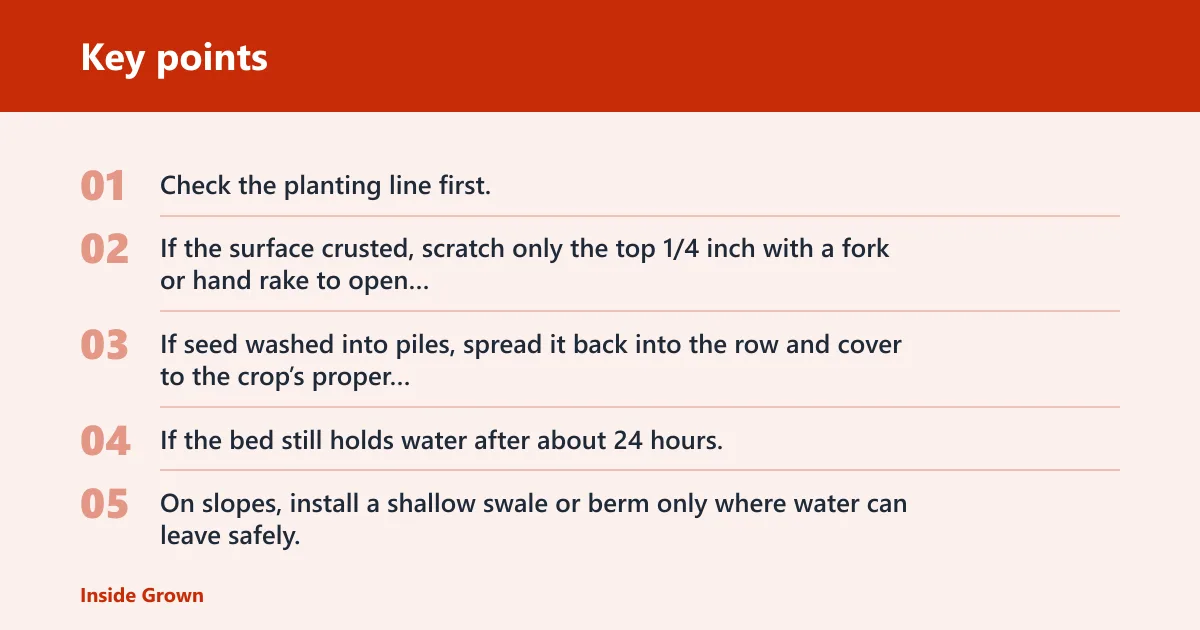
- Check the planting line first. If seed is still covered and the surface is loose, leave it alone.
- If the surface crusted, scratch only the top 1/4 inch with a fork or hand rake to open it without pulling seed upward.
- If seed washed into piles, spread it back into the row and cover to the crop’s proper depth.
- If the bed still holds water after about 24 hours, stop watering and improve drainage before sowing again.
- On slopes, install a shallow swale or berm only where water can leave safely. Do not cut a hard channel that speeds flow into another bed.
- Remove wet covers once the weather clears. Leaving them on too long can trap pests and slow emergence.
If that did not solve the problem, move to a more sheltered setup next time. Use trays for small seed, or sow direct only in the best-drained section of the bed. A rain garden-style basin can work for runoff control, but it should drain within 12 to 48 hours and be set away from the seed row.
Common mistakes
- Using too much mulch: keep it thin enough for seedlings to push through. Thick mulch can block emergence and hold too much moisture.
- Letting plastic touch seedlings: if you use a cover, it must stay off the soil surface and come off quickly in sun.
- Ignoring runoff paths: a bed can fail even with good seed depth if downspouts or sheet flow hit it directly.
- Leaving wet covers in place: remove them once the storm passes so pests do not hide under damp material.
- Working saturated soil: wait until the top layer is workable. Walking on wet soil compresses pores and worsens crusting.
Frequently asked questions
How to protect newly planted seeds from heavy rain
Use a breathable row cover on hoops, keep the bed slightly raised, and sow at the crop’s correct depth. If the forecast is severe, move pots and trays under shelter. After the storm, check for crusting and bare patches before watering again.
What prevents seeds from germinating after rain
Crusting, burial depth loss, and waterlogged soil are the main problems. If the top layer sealed over or water sat for more than 24 hours, loosen the surface lightly and inspect seed placement before deciding whether to re-sow.
What protects the seeds after planting
After planting, the best protection is a stable seedbed, the right cover depth, and a breathable barrier that does not block emergence. In beds, use light mulch or row cover. In pots and trays, move them under shelter before the rain starts.
How to keep seeds moist without washing them away
Water lightly enough to dampen the top inch, then use row cover, straw, or shredded leaves to soften rain impact. The goal is moist soil with open pores, not saturation. If the surface puddles, drainage needs attention before the next sowing.
How to keep seeds from washing away in a storm
Press seed into a fine-textured medium, cover to the right depth, and hold the surface with a breathable cover or light mulch. Send downspouts and sheet flow away from the row, and anchor any cover so wind does not lift it.