Gardening techniques for heavy rain: fix drainage fast
After heavy rain, fix garden drainage by reading the symptom. Puddles that clear within about a day may call for soil improvement, standing water that lasts roughly two days or more may need regrading or drains, and runoff on slopes may need interception. Leave it alone and roots lose air, beds stay cold, and crops rot after the next storm. I use the water pattern, the drain test, and the site shape to pick the fix fast.
This guide is part of our Gardening techniques series.
What you’ll need



- Shovel or post-hole digger
- Measuring tape or ruler
- Bucket or hose for the drainage test
- Timer or phone stopwatch
- Flags, sticks, or chalk to mark puddle edges
- Compost or other organic matter
- Mulch
- Raised bed materials for a 4×4 or 4×8 feet bed
- French drain parts, catch basin, or downspout extension for severe cases
- Wet-tolerant native plants for rain garden basins
How do I tell why my garden stays wet?
Read the water first, not the guess. Mark where puddles sit after rain, test one slow spot, and separate slope runoff from a true low point. That split tells you if you need soil work, a raised bed, a rain garden, or a French drain.
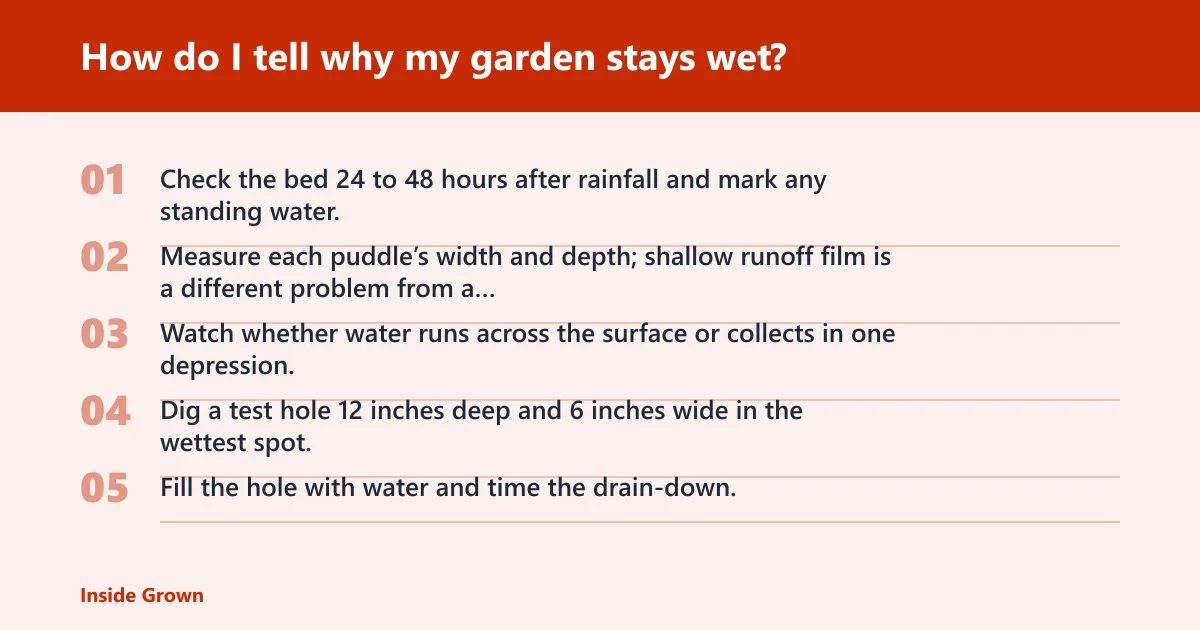
- Check the bed 24 to 48 hours after rainfall and mark any standing water.
- Measure each puddle’s width and depth; shallow runoff film is a different problem from a basin that stays full.
- Watch whether water runs across the surface or collects in one depression.
- Dig a test hole 12 inches deep and 6 inches wide in the wettest spot.
- Fill the hole with water and time the drain-down.
- Rate the site: 4 to 6 hours suggests workable drainage, 12 to 24 hours points to slow clay-heavy soil, and over 24 hours is very poor drainage.
Wet garden triage matrix
| Symptom | Drainage test result | Best fix | First 48-hour action |
|---|---|---|---|
| Puddles gone by the next day | 4 to 6 hours | Soil improvement with compost or organic matter | Loosen crusted soil, top-dress with compost, and mulch lightly |
| Water remains in a low spot for 24 hours | 12 to 24 hours | Raised bed or partial regrading | Protect roots, mark the low area, and keep traffic off saturated soil |
| Standing water still present after 48 hours | Over 24 hours | French drain, catch basin, or downspout extension | Divert roof runoff and keep edible crops above the waterline |
| Water racing downhill after storms | Surface runoff, not a soak problem | Rain garden or interception swale | Slow flow before it reaches the bed |
Should I use raised beds, a rain garden, or a French drain?
Use a raised bed when you want plants above wet native soil, a rain garden when you need to catch and absorb runoff, and a French drain when a larger zone stays waterlogged. For clay that only needs a better root zone, soil amendments may do the job.
- Choose a raised bed if the wet area is small, isolated, or used for vegetables.
- Build common beginner sizes like 4×4 or 4×8 feet, or adapt to a manageable 10×10 in-ground plot nearby.
- Choose a rain garden if water arrives as roof or slope runoff that can be slowed and spread out.
- Place the rain garden at least 10 feet from the house foundation and size it to about one-third the draining surface area.
- Choose a French drain for larger or persistent waterlogged zones, especially where gutters, patios, or driveways send repeat flows.
- Add a catch basin or downspout extension when the source is concentrated roof water.
- Mix in compost or organic matter where the test shows slow but not failed drainage; use sand only where soil texture and drainage pattern justify it.
If that didn’t work, try this next
- Raise the planting zone first if roots are drowning.
- Route incoming water away from the bed before it enters the soil.
- Install the French drain only after the runoff source and low point are clear.
- Retest the same 12-inch hole after the fix before adding more material.
What should I do in the first 48 hours after heavy rain?
In the first two days, protect roots and move obvious water before it settles again. Stop repeat soaking, keep feet and tools off saturated soil, and sort the problem into a puddle, a runoff path, or a failing drainage zone.
- Inspect puddles, beds, and downspouts before the next storm.
- Mark the highest water line and measure how long each wet area lasts.
- Open the triage matrix and match symptom to fix.
- Lift containers, boards, or stones that block flow paths.
- Cover bare soil with mulch to stabilize the surface and limit splash.
- Shield edible crops with boards, hoops, or temporary paths so you do not compact the bed.
Protect vegetable beds after repeated storms
For edibles, keep roots above saturated soil whenever possible. If a crop row sits in water more than once, move the next planting to a raised bed or a better-drained section. Standing water can trigger root rot, so repeated wet feet mean stop replanting the same spot without a fix.
How do I fix a garden that floods after heavy rain?
Fix flood-prone gardens by tracing the water source, testing the soil, and matching the fix to the pattern. A puddle in one low point calls for grading or a raised bed; water arriving from a roofline or slope usually needs interception; a whole zone staying wet points toward drains.
What are the first steps to stop standing water in a garden?
Mark where water pools after rain, measure puddle size and depth, and separate runoff spots from true low areas. Then run a 12-inch drainage test hole. If the hole empties in 4 to 6 hours, soil work may be enough; if it takes over 24 hours, use a more aggressive fix.
How do I tell if my soil drains too slowly?
Dig a 12-inch-deep, 6-inch-wide hole in the wettest spot, fill it with water, and time the drain-down. Well-draining soil should empty within 4 to 6 hours. Clay-heavy soil may take 12 to 24 hours or longer, and over 24 hours is very poor drainage.
How long should water take to drain from a test hole?
Use the test hole as the decision point. Four to 6 hours is usually fine for many garden beds. Twelve to 24 hours means the soil needs help. Over 24 hours means the site is too slow for most direct planting without a raised bed, drain, or rebuilt root zone.
What can I plant in a wet, poorly drained garden?
Choose native wet-tolerant plants with deep roots that handle wet-dry cycles, especially in rain garden basins. They hold soil, take short flooding, and recover after the site dries. Skip plants that hate wet feet if the test hole shows slow drainage or repeated ponding.
Best plant choices for wet areas
- Deep-rooted native perennials that tolerate alternating wet and dry periods
- Plants suited to shallow rain garden basins about six to twelve inches deep
- Species that can sit in runoff capture areas without collapsing after one storm
Can vegetable beds stay wet and still produce?
Only if roots stay above the saturation line. A 4×4 or 4×8 raised bed is the fastest way to keep edible crops productive in a bad spot. If the bed still puddles at the base, fix the water path first or the bottom layer will remain cold and soggy.
How far from the house should a rain garden be?
Place a rain garden at least 10 feet from the house foundation so it captures runoff without sending extra water against the structure. A shallow basin, about six to twelve inches deep, works best where the drainage area can be spread and slowed instead of dumped in one low point.
When rain gardens fail
Rain gardens overflow when they are too small, too close to the source, or fed by fast runoff on a steep slope. If the basin keeps filling past the outlet, reduce inflow with a downspout extension, enlarge the basin, or switch the worst section to a drain-based fix.
What soil changes help drainage in clay soil?
Compost or other organic matter helps clay by improving structure and infiltration over time. Sand is only useful when the soil profile and mix are right; adding it to the wrong clay can make a tighter mass instead of a looser bed. Slow drainage still needs testing before any amendment.
Use amendments with a limit
- Add compost to open compacted soil and improve aggregation.
- Use sand only when the soil mix is appropriate and the site needs more coarse fraction.
- Do not expect amendments alone to solve a zone that stays saturated over 24 hours.
Mulch after the amendment layer is in place. It stabilizes the surface, suppresses weeds, and helps new drainage areas settle in without crusting or splashback.
Common mistakes
Most failures start with the wrong diagnosis. A bed that floods from roof runoff needs interception, not more compost. A low spot that stays wet for days needs regrading or a drain, not another top-dress of soil.
- Fixing the wrong problem because the site was not tested
- Putting a rain garden too close to the house
- Mixing in sand without checking the soil type first
- Skipping mulch and early follow-up after installation
First 30 days after a fix
Watch the repaired area through the next few storms. Check the same puddle points, confirm the drain path stays open, and top up mulch if bare soil appears. Many projects fail when the first big rain arrives and nobody looks for overflow or settling.
Frequently asked questions
How do I fix a garden that floods after heavy rain?
Mark where the water sits, run a 12-inch drainage test hole, then choose the fix from the result. Use raised beds for isolated wet planting areas, a rain garden for runoff you can slow, and a French drain for persistent waterlogged zones that stay wet more than a day.
What can I plant in a wet, poorly drained garden?
Plant deep-rooted native species that tolerate wet-dry cycles, especially in a rain garden basin. If you are growing vegetables, move them to a 4×4 or 4×8 raised bed so roots stay above saturated soil. Avoid plants that need fast-draining ground.
How do I tell if my soil drains too slowly?
Dig a 12-inch-deep, 6-inch-wide hole, fill it with water, and time the drop. A result of 4 to 6 hours is workable, 12 to 24 hours is slow, and over 24 hours is very poor drainage. Use that result before choosing a major fix.
Should I use raised beds, a rain garden, or a French drain?
Use raised beds for small planting zones, a rain garden for runoff capture, and a French drain for larger or persistent waterlogged areas. If the water source is a downspout, add an extension or catch basin first. Match the fix to the way water moves.
How far from the house should a rain garden be?
Keep it at least 10 feet from the foundation. That distance helps protect the house while the basin stores runoff. A shallow basin about six to twelve inches deep works best when the site can absorb overflow without backing water toward the building.
What soil changes help drainage in clay soil?
Add compost or other organic matter to improve structure, and use sand only when the soil mix supports it. If a test hole still takes over 24 hours to drain, amendments alone are not enough. Move up to a raised bed or drainage system instead.