What Seeds Can You Start Indoors in February?
Start long-season vegetables about 8 to 10 weeks before the average last frost date, cool-season crops about 4 to 6 weeks before, and keep heat-loving crops outdoors until the soil warms. University and extension guidance commonly uses this backward-count method because the best start date depends on your frost window, not the calendar alone (University of Minnesota Extension; Penn State Extension). Start too early, and you waste light and space with leggy seedlings that outgrow trays before transplant time. This guide sorts February starts by frost window and indoor capacity, so you can choose what to sow now, what to wait on, and what to leave outside.
February seed-starting basics



February works for some indoor sowing, but only when the crop’s seed packet timing matches your average last frost date. That date is the backward-count anchor, and it changes with region, elevation, and microclimate. A gardener in a mild coastal pocket and one in a cold inland valley should not use the same calendar day. Seed packet guidance and extension charts both rely on “weeks before last frost” for exactly that reason (Johnny’s Selected Seeds; University of Minnesota Extension).
Seed packets usually speak in weeks before last frost, not in months. That matters more than “February” on its own, because February can be too early for fast crops and too late for slow ones. For many gardens, February covers a wide band, from crops that want 12 to 16 weeks of indoor time to crops that only need 4 to 6 weeks. In small indoor setups, the real bottleneck is often not seed count but shelf space, tray count, and light coverage.
Indoor space changes the decision. A tray of onions or celery can sit under lights for weeks, while broccoli transplants move on quickly. If you have one shelf and a small lamp, sort crops by tray time, not by enthusiasm. In practice, the crops that get you in trouble fastest indoors are the ones that stretch in low light or sit too long after germination.
Use grow lights for about 14 to 16 hours per day, keep the fixture roughly 2 to 4 inches above the tops of seedlings, and raise it as they grow. Without that close light, February-started celery, onions, geraniums, and brassicas are the first to get leggy. A bright window alone is usually not enough for sturdy indoor starts in late winter, especially on cloudy days.
- Find your average last frost date for your area.
- Check each seed packet for the sowing window in weeks before last frost.
- Match long indoor crops to February first.
- Reserve limited tray space for crops that need it most.
- Keep direct-sown crops out of the seed trays unless the packet says otherwise.
What seeds should you start indoors in February?
Start the crops that need a long lead time, slow germination, or an early head start before outdoor conditions stabilize. Annual geraniums, globe artichokes, onions, and celery fit that pattern well. These crops either need many weeks indoors or reward early sowing with stronger transplants. Seed packets and university extension calendars commonly place these crops in the earliest indoor window because they need a longer runway than quick brassicas (Burpee; Cornell Cooperative Extension; University of Illinois Extension).
Annual geraniums
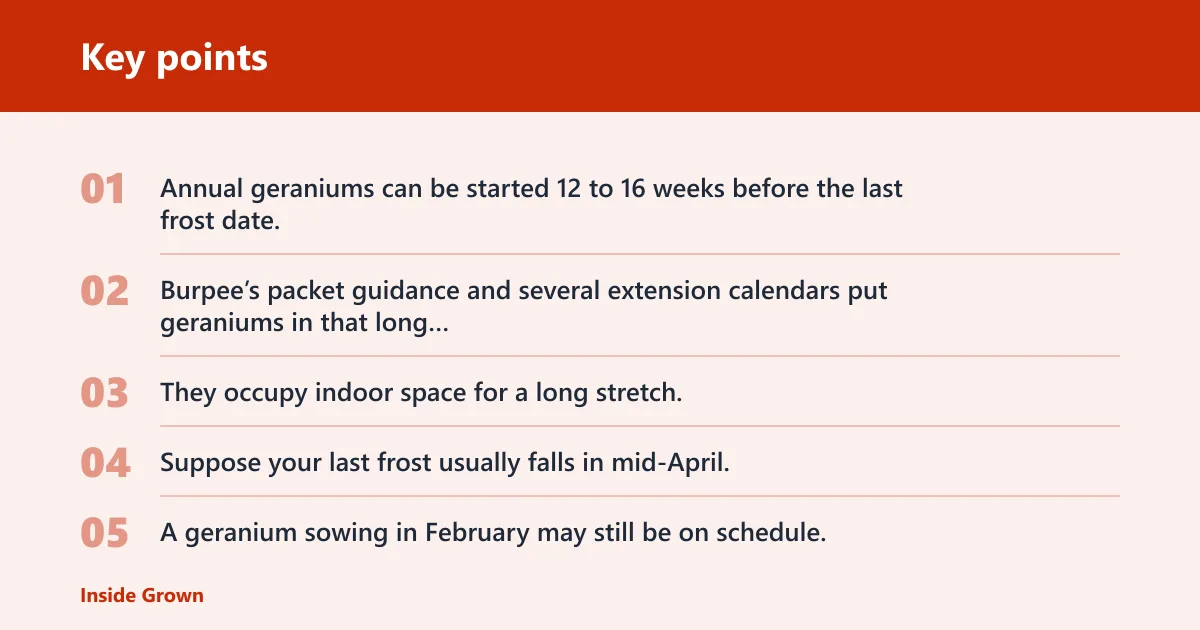
Annual geraniums can be started 12 to 16 weeks before the last frost date, which makes them one of the earliest February candidates in many regions. Burpee’s packet guidance and several extension calendars put geraniums in that long indoor window because they grow slowly from seed and benefit from an early start. They occupy indoor space for a long stretch, so they are a good fit only if you can spare a tray and bright light.
Suppose your last frost usually falls in mid-April. A geranium sowing in February may still be on schedule, but a late-March start would be too late for that same bloom window. The crop’s indoor lead time is the whole point, and geraniums are one of the clearest examples of why February can be “start now” for flowers even when it is too early or too late for other crops.
Globe artichokes
Globe artichokes should be started about 10 to 12 weeks before the last frost date, and packet guidance from major seed companies places them in that early indoor range because they are slow to mature. They also germinate slowly, often taking 10 to 14 days, so do not assume the tray is empty just because sprouts are not visible right away. Give them steady warmth, moisture, and patience. Cornell and other extension programs treat artichokes as a long-season crop that benefits from an early indoor start in cool spring climates.
Artichokes are a strong February choice when your frost window is still far off. They are not a quick filler crop. They need a long enough runway to size up before transplanting outdoors, and they are one of the clearest crops where starting too late usually means losing the best harvest window.
Onions
Onions are a February staple for seed starting because they need about 10 weeks of indoor growth before moving outside. University extension guidance commonly places onions in the 8 to 10 week range, and onion seed packet schedules often point to late winter sowing for spring transplants. Seed-started onions are usually better than sets when you want more variety and a longer growing season. They also make efficient use of a tray because seedlings stay fairly narrow for much of their indoor life.
Once onion seedlings reach 6 inches tall, clip them back to 3 to 4 inches. That keeps them sturdier and easier to handle. The tops will regrow. In a small indoor setup, onions are one of the best “space-efficient” February crops because they use vertical space more than tray footprint.
Celery
Celery is one of the seeds to start in February because it has a long indoor lead time. University extension schedules typically place celery at 10 to 12 weeks before transplanting, and celery seed packets often recommend early sowing for spring gardens. It is slow to size up and does not forgive a rushed schedule. If your climate gives you a short spring, celery usually belongs in the earliest round of indoor sowing rather than in March.
A common first-timer mistake is giving celery a small tray and hoping it can wait. It often cannot. Check moisture often and keep the seedlings under strong light so they do not stretch toward the window. Of the February crops here, celery is one of the fastest to get leggy if the light is too far away or the room is too warm.
February seed-start calendar
This calendar ranks common February crops by last-frost timing and tray time. Use it as a quick sorting tool, not as a replacement for the seed packet. The status column tells you whether to start now, wait, or direct sow. The decision logic below is keyed to last-frost ranges so you can act without doing a separate calculation for every crop.
| Crop | Weeks before last frost | Space cost | Status |
|---|---|---|---|
| Annual geraniums | 12 to 16 | 10 to 14 weeks | Start now |
| Globe artichokes | 10 to 12 | 8 to 10 weeks | Start now |
| Onions | About 10 | 10 weeks | Start now |
| Celery | Varies by packet, often February | 10 to 12 weeks | Start now |
| Cabbage | 4 to 6 | 4 to 6 weeks | Start now if frost is near enough |
| Broccoli | 4 to 6 | 4 to 6 weeks | Start now if frost is near enough |
| Cauliflower | 4 to 6 | 4 to 6 weeks | Start now if frost is near enough |
| Beans | Direct sow | None indoors | Direct sow |
| Carrots | Direct sow | None indoors | Direct sow |
| Beets | Direct sow | None indoors | Direct sow |
| Radishes | Direct sow | None indoors | Direct sow |
| Peas | Direct sow | None indoors | Direct sow |
| Corn | Direct sow | None indoors | Direct sow |
If your last frost is 12 to 16 weeks away, start geraniums now and keep artichokes, onions, and celery in the queue. If your last frost is 8 to 10 weeks away, prioritize onions and celery first, then brassicas if you have room. If your last frost is 4 to 6 weeks away, shift to broccoli, cabbage, and cauliflower now, and stop using tray space on crops that should already be outdoors or direct sown.
Which vegetables can you start indoors in February?
Broccoli, cauliflower, and cabbage are the main vegetables that fit February’s shorter indoor window for many gardeners. These cool-season brassicas need just 4 to 6 weeks inside under grow lights, which lines up with extension recommendations from university programs and packet timing from seed companies. They should move out young, before they become cramped or rootbound.
Broccoli
Broccoli is a fast cool-season brassica and usually belongs in the 4 to 6 week window before last frost. Cornell and other extension schedules place broccoli in that short indoor range, and seed packets commonly describe a similar transplant timeline. That makes it a February start in many places, especially where spring planting happens early. Keep seedlings bright and cool enough that they do not get lanky.
Cauliflower
Cauliflower uses the same basic timing as broccoli: 4 to 6 weeks before last frost. Extension guidance treats cauliflower as a short indoor crop that should move out young, and many seed packets reinforce that schedule. It is sensitive to stress, so do not leave it sitting in a flat too long. Transplant young, and keep the move from tray to garden steady.
Cabbage
Cabbage also fits the 4 to 6 week indoor window and should move out while still young. University extension calendars and seed packet guidance place cabbage in that same short-start range as broccoli and cauliflower, making it a reliable February choice when frost is close enough. If your February is already close to last frost, cabbage may be a better fit than longer-season crops.
Other cool-season crops can fit this window if the packet timing agrees, but do not guess. Lettuce can be started indoors for early transplants in cool spring weather, yet it is only worth the tray if you actually plan to set it out promptly. In a small setup, short brassicas are usually easier to manage than leafy starts that linger too long under lights.
What should stay out of the seed trays?
Some crops are poor indoor candidates because they dislike root disturbance or are better handled as direct-sown seed. Beans should not be started indoors. Carrots should not be started indoors. Peas, beets, radishes, and corn are also usually better direct-sown outdoors. (Cornell)
Beans, peas, and corn
Beans should not be started indoors, and peas and corn are usually better left for outdoor sowing. These crops do not gain much from a head start, and transplanting often creates more trouble than it solves. The better move is to wait until the soil can support them outside, which is why extension guidance repeatedly groups them as direct-sow crops rather than tray crops.
Carrots, beets, and radishes
Carrots should not be started indoors, and beets and radishes generally do better when direct sown. Root crops dislike being moved after sprouting. Their early growth depends on undisturbed roots, so a tray adds risk without much reward. A common February failure is trying to “save time” with root crops, only to lose time later to deformed roots or weak transplants.
Why direct sowing is the better fit
Direct sowing avoids transplant shock and keeps root shape intact. It is usually the cleaner choice for these crops, especially in gardens with limited indoor light. If you try to start them indoors, you can end up with twisted roots, weak starts, or seedlings that stall after transplanting.
Picture a small apartment setup with two trays and one light shelf. Filling both with carrots and beans would crowd out onions and broccoli that actually need the indoor head start. The right move is to save the trays for the crops that pay back the space. In practice, February growers often lose the most time to overfilled shelves, weak window light, and flats left too long after germination.
How much indoor space do February seedlings need?
February seedlings split into two groups: crops that only need a short tray stay and crops that monopolize indoor space for weeks. That difference matters when you have a windowsill, a single shelf, or only one grow light. February planning is as much about capacity as it is about calendar timing. In small-space gardens, “space cost” is often the deciding factor after frost timing is accounted for.
Short tray time versus long tray time
Broccoli, cauliflower, and cabbage need just 4 to 6 weeks indoors, so they free up space quickly. Annual geraniums, globe artichokes, onions, and celery can sit much longer. The long-tray crops are the ones most likely to overload a small setup. If you only have one shallow tray and one light, the short brassica window is easy to manage, but the long crops can crowd each other before transplant time.
Which crops occupy lights for weeks?
Onions need about 10 weeks of indoor growth, and celery is also a long-lead crop. Annual geraniums can stay inside 12 to 16 weeks before the last frost date, which makes them the most space-hungry of the group listed here. Globe artichokes also need enough room to remain healthy through their longer indoor period. These are the crops most likely to become leggy or rootbound if the light is weak or the tray is too shallow.
Simple space triage for small setups
Start with the crops that cannot wait. If your setup is tight, give priority to onions, celery, artichokes, and any geraniums you want for spring. Use the shorter brassica window only if you can move plants out on time.
A practical rule: if a crop will still be in the tray when your outdoor planting date arrives, it may be too much for a small indoor system. That is a timing problem, not a motivation problem. Another common February mistake is starting too many long-season crops at once and then running out of room before transplanting day.
What if you missed February?
If February slipped by, do not try to force every crop into a late start. Move by weeks before last frost instead. Early March can still work for some cool-season starts, mid-March fits short indoor crops and some direct-sown planning, and late March is better for outdoor sowing on many crops that hate root disturbance.
Early March backup crops
Early March is still useful for broccoli, cauliflower, cabbage, and some lettuce transplants if your frost date is close enough. It can also work for growers who are behind on onions or celery, though those crops may end up smaller at transplant time. Check the packet and count backward from your frost date again. The later you start, the more important good light becomes, because seedlings have less time to recover from stretch or stress.
Mid-March backup crops
Mid-March is a better time for crops with shorter indoor windows, especially if your region has an early spring. It is also a good point to shift attention toward direct sowing plans for peas, radishes, and similar crops once conditions allow. Do not crowd the trays with late starts that will not be ready in time.
Late March crops to wait
Late March is too late for many February crops that need 10 to 16 weeks indoors. It is usually also too late to gain much from starting beans, carrots, or corn inside, since those belong outdoors. At that point, the right move is often to wait for outdoor soil conditions rather than forcing a tray schedule.
Frequently asked questions
What plants to start indoors in February?
February is a good month for slow-growing plants that need steady indoor conditions before transplanting. That includes annual geraniums and globe artichokes, plus vegetable starts like onions, celery, broccoli, cauliflower, and cabbage. The best choices are the ones that match your frost window and your available tray space. A bright shelf can carry a few crops well, but an overcrowded shelf usually produces weaker starts than a simpler plan.
What seeds to start indoors in January?
January usually belongs to the longest indoor crops, especially annual geraniums and some very slow-starting plants that need 12 to 16 weeks before frost. In colder regions, onions and celery may also begin then. January is for the crops that would be too late if you waited until February.
What seeds to start indoors in March?
March is better for shorter indoor crops and for regions with an earlier last frost. Broccoli, cauliflower, cabbage, and some lettuce transplants can still fit, depending on your frost date. By late March, many gardeners should shift away from long-season indoor starts and toward direct sowing plans. If your seedlings are already stretching, increase light rather than adding more warm indoor room.
How many weeks before my last frost should I start seeds indoors?
That depends on the crop. Fast cool-season crops usually need about 4 to 6 weeks, long-season crops often need about 6 to 10 weeks, and very slow crops like annual geraniums may need about 12 to 16 weeks. Use the packet timing and count backward from your average last frost date. Extension calendars and packet guidance are the safest sources when the schedule is unclear.
Should I start these seeds indoors or direct sow them?
Start indoors when the crop benefits from a head start and tolerates transplanting well. Direct sow beans, carrots, beets, radishes, peas, and corn because they are poor indoor candidates or dislike root disturbance. If the seed packet gives a narrow window, follow that timing before choosing the method. When in doubt, direct sowing is usually the safer choice for root crops and many field crops.