How to Buy Seeds Online Without Getting Scammed
Check the seller’s domain, contact details, seed listings, payment options, and refund policy; if two or more are missing or inconsistent, it is safer not to buy. Bad seed sellers can take your money, send old or wrong seed, or disappear when the order fails. This guide gives you a practical legitimacy scorecard to verify online seed sellers before checkout.
What you’ll need
- The exact variety name you want, including species and cultivar if known.
- Two or more seller listings for the same seed type.
- A notes app or screenshots folder.
- A payment method with dispute protection, such as a card or marketplace checkout.
- A quick reference for what the seed should look like before buying.
How do you check a seed seller?
Start with the listing, then the seller, then the payment path. A page can look polished and still hide wrong species, vague quantities, weak refund terms, or payment requests that leave you exposed. The quickest filter is simple: compare price, read the listing details, ask one direct question, and save proof before you pay.
1. Compare the price against similar listings
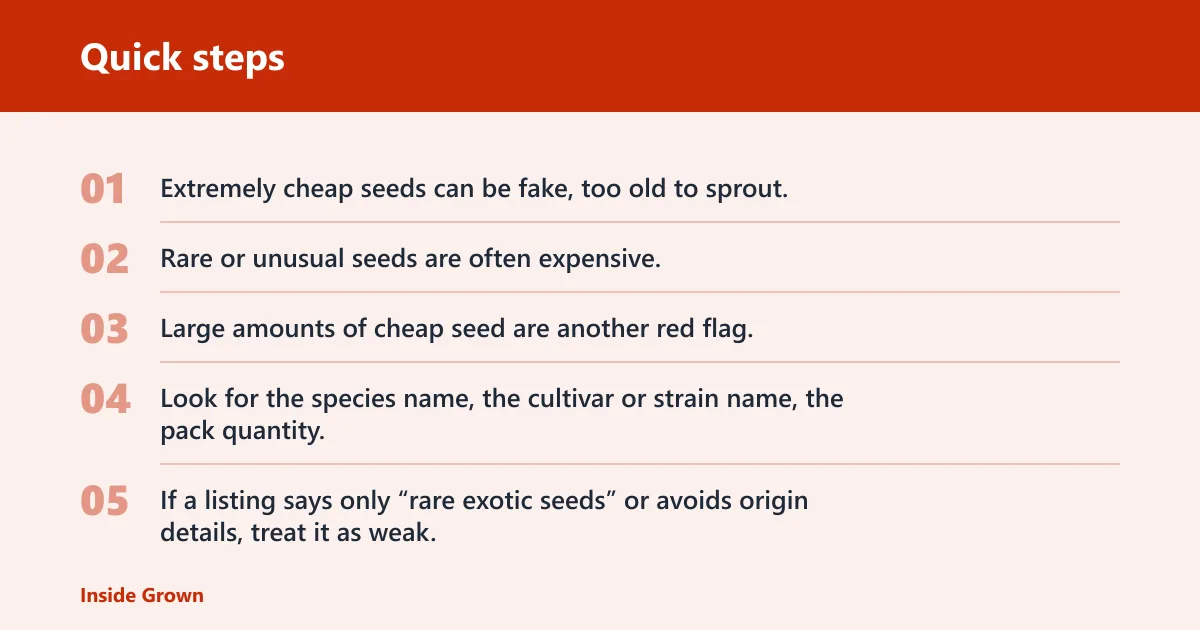
Price is one of the clearest warning signs. Extremely cheap seeds can be fake, too old to sprout, or simply not what the listing claims. Rare or unusual seeds are often expensive, so a strangely low price deserves extra scrutiny. Large amounts of cheap seed are another red flag.
2. Read the listing for cultivar name, quantity, and origin
Look for the species name, the cultivar or strain name, the pack quantity, and where the seed was grown or packed. If a listing says only “rare exotic seeds” or avoids origin details, treat it as weak. A good listing should let you compare it against trusted references and other sellers.
3. Check review volume, recency, and negative feedback
Do not stop at the star rating. Check how many reviews the seller has, how recent they are, and whether bad reviews are easy to find. A seller with only glowing comments from a short period can be harder to trust than one with a steady history and visible complaints that were answered.
4. Ask one direct question before you pay
Ask one direct question before paying about seed origin, lot labeling, or viability window. The answer should be clear and specific. If the seller ignores the question, gives a copy-paste reply, or refuses basic details, move on. A seller who will not answer before checkout is unlikely to help after a problem.
5. Save screenshots before checkout
Save the product page, the refund policy, shipping terms, seller profile, and any messages. If the listing changes later, you still need proof of what was offered. That matters most when the seed arrives wrong, the pack count is off, or the seller tries to deny the original claim.
Should you buy from marketplaces or direct?
Both can work, but the risk profile is different. Marketplaces usually give you a dispute path, checkout safeguards, and visible seller feedback. Direct stores can be fine too, but you need to check their contact details, refund policy, and shipping terms more carefully because you may have fewer platform protections if something goes wrong.
Marketplace protections to look
Use platform checkout when possible. Look for a visible dispute flow, order history, tracking, and a way to report “item not as described.” The seller should have review history on the platform, not only a polished listing. If payment is pushed off-platform, treat that as a hard stop.
Direct-store signals that matter
A direct seed company should show a real return policy, contact method, shipping estimates, and clear product pages. If it offers only a generic contact form, no refund language, and no lot or origin information, you have little protection. Polished design does not make a seller legitimate.
When a seller request should end the purchase
Stop if the seller asks for bank transfer, gift card, crypto, or another off-platform payment method. Stop again if they refuse to answer basic origin questions or refuse to explain refunds. A seller can look professional and still be a bad risk if the checkout path removes your dispute options.
Seeds online table

| What to check | Pass threshold | Fail threshold | Exact action if it fails |
|---|---|---|---|
| Listing price vs market norm | Price is in the same range as at least two similar listings | Much cheaper than comparable seed, especially for rare types | Open two more listings and compare before you buy; if still far lower, skip it |
| Pack quantity | Quantity is stated clearly in seeds, grams, or packet count | Quantity is vague, inflated, or oddly large for the price | Ask the seller to confirm exact count in writing; if they dodge, do not order |
| Species/variety clarity | Species and cultivar name are spelled out | Only a broad label like “rare mix” or “exotic” appears | Compare the name with trusted references; if the name is absent, walk away |
| Origin disclosure | Country or source of packing/growing is listed | No origin is given, or the story changes between pages | Ask where the seed came from; if the seller ignores you, avoid them |
| Seller response time | Reply arrives within a reasonable period and answers the question | No reply, or a vague reply that avoids the question | Do not pay until you get a direct answer in writing |
| Review pattern | Many recent reviews, with mixed feedback that looks natural | Sudden burst of perfect reviews or all reviews from the same period | Check older reviews and third-party marketplace feedback before ordering |
| Shipping transparency | Shipping cost, carrier, and timing are stated | Shipping is hidden until checkout or unclear until after payment | Capture the shipping terms and total cost; if unclear, leave the cart |
| Refund policy | Refund eligibility and complaint steps are written clearly | No refund policy, or only “all sales final” language | Use a payment method with dispute protection or choose another seller |
| Photo-description match | Photos match the plant, packet, and description | Photos show a different plant, seed shape, or mature flower | Save the mismatch and do not buy until the seller explains it |
| Payment method safety | Card or marketplace checkout with chargeback or dispute access | Bank transfer, gift card, crypto, or “friends and family” request | Refuse the payment route and exit the purchase |
| Dispute path | Platform or store explains how to report wrong goods | No complaint path is visible | Do not order unless you are willing to absorb the loss |
| Evidence to save | You can save screenshots of listing, messages, and checkout | No usable record is kept before payment | Take screenshots now and store them before you place the order |
What if the seeds arrive fake?

If the seeds are obviously wrong, contact the seller first, then use the platform dispute process if needed. Save the listing, order page, messages, photos of the packet, and any shipping record before you toss anything. If the seller refuses to help, use the evidence to push for a refund and leave a factual review after the case is resolved.
Contact the seller first
Send a short message that names the problem: wrong species, wrong count, or a mismatch between the packet and the listing. Attach photos. Keep the tone factual. If the seller responds quickly and offers a refund or replacement, save that reply before you agree to anything.
Open the platform dispute path
Use the marketplace’s “item not as described” or refund flow. Upload screenshots of the listing, the payment page, and the received seed packet. If the seller refuses a refund or never answers, the platform record becomes your main proof. Do not wait too long; dispute windows can close.
Save proof before the package is discarded
Keep the envelope, packet, invoice, tracking number, and photos of the seed itself. A common first-timer mistake is throwing away the packet after seeing the wrong contents. That removes lot numbers, return labels, and other details that can support a complaint.
Leave a factual review after resolution
Once the dispute is done, post a plain review with what happened: the listing claim, what arrived, and how the seller handled the complaint. That helps other buyers judge review patterns and negative feedback visibility. If the seller fixed the issue, say that too.
Common mistakes
The biggest mistakes are easy to avoid. They all come from trusting a listing before checking the details that actually matter: price, reviews, origin, shipping, and dispute rights.
- Buying the cheapest listing only. Compare at least two sellers first.
- Ignoring shipping and refund terms. Total cost matters, and so does recourse if the order fails.
- Trusting reviews without checking recency. A burst of old praise can hide a current problem.
- Skipping a quick origin question. A seller who will not answer basic questions is a bad bet.
Say your packet says “Venus Flytrap” but the photo shows a generic fern seed and the price is far below similar listings. That is a mismatch worth stopping on. If the seller cannot explain the origin, do not assume the label is correct.
Suppose a listing for a rare carnivorous plant has 5,000 seeds for a tiny price and no origin, no lot number, and no refund policy. That combination is a stronger warning than any one detail alone. Walk away before checkout.
Frequently asked questions
Is seed.com a scam?
Do the same checks you would use for any seller: domain details, contact options, review volume, recent feedback, and refund terms. If the site hides shipping cost, offers no clear complaint path, or pushes off-platform payment, do not treat it as safe just because it has a clean layout.
Is best seeds online legit?
Legit sellers usually show a real address or support contact, a clear refund policy, and current reviews that are easy to inspect. If those details are missing or contradictory, pause. A strong-looking product page is not enough without clear shipping terms and a way to resolve disputes.
Where can I buy seeds online?
Use established seed retailers, well-known marketplaces with buyer protection, or direct stores that publish clear shipping and refund terms. Before you order, compare at least two sellers for the same variety, then check whether the listing names the species, cultivar, pack count, and origin.
What are the biggest red flags when buying seeds online?
The biggest red flags are extremely low prices, vague variety names, hidden shipping costs, no refund policy, off-platform payment requests, and reviews that look inflated or too recent to be trusted. Also watch for photo-description mismatch, especially on rare or hard-to-propagate plants.
Should I buy from marketplaces or direct from the seed company?
Marketplaces usually give you more dispute protection and a clearer path if the order goes wrong. Direct stores can be fine if they publish refund terms, shipping details, and support contact information. If a direct seller asks for unsafe payment or avoids basic questions, choose the marketplace instead.
What should I do if the seeds I received are fake?
Contact the seller, document the mismatch, and open the platform dispute flow if the seller does not fix it. Keep the packet, screenshots, and tracking record. After the case closes, leave a factual review so other buyers can see the issue and how it was handled.
How do I compare seed listings before I order?
Line up the same variety from at least two sellers and compare price, quantity, origin, shipping cost, refund policy, and review recency. If one listing is far cheaper, far vaguer, or missing a complaint path, treat it as the weaker option and keep looking.
How to get free seeds
Look for seed swaps, community libraries, local gardening groups, and public outreach programs that offer packets at no cost. Free is useful only if the source is credible; still check what species you are getting, whether the packet is labeled, and whether the exchange has any rules for returns or complaints.