How to Plant Grass Seed in a New Lawn
Match the grass seed to your site first, then prepare the top 2 to 4 inches of soil, sow at the label rate, cover lightly, and water often enough to keep the seedbed consistently damp until germination. Skip those steps and you get thin germination, washed-out seed, and a lawn that costs more to fix later. This guide covers seed choice, soil prep, seeding depth, watering cadence, and the first mow.
What you’ll need


- Grass seed matched to your climate, sun exposure, and traffic level
- Soil test kit or extension lab results
- Starter fertilizer with a label rate for new lawns
- Broadcast spreader, drop spreader, or handheld spreader
- Garden rake or leaf rake with a flat back edge
- Topsoil or screened compost, if the site needs minor leveling
- Fine spray hose nozzle, oscillating sprinkler, or similar gentle irrigation setup
- Wheelbarrow, shovel, and a stiff broom for cleanup
📊 Family Handyman says to remove the lawn and reseed if more than 60 percent weeds remain. Source: Familyhandyman.
When should you seed a new lawn?
Seed when your grass type can germinate before stress returns. Cool-season grasses usually fit late summer to early fall, while warm-season grasses are better in late spring to early summer. Avoid seeding when frost is close, because young seedlings can stall or die back before roots set.
Pick the right season for your grass type
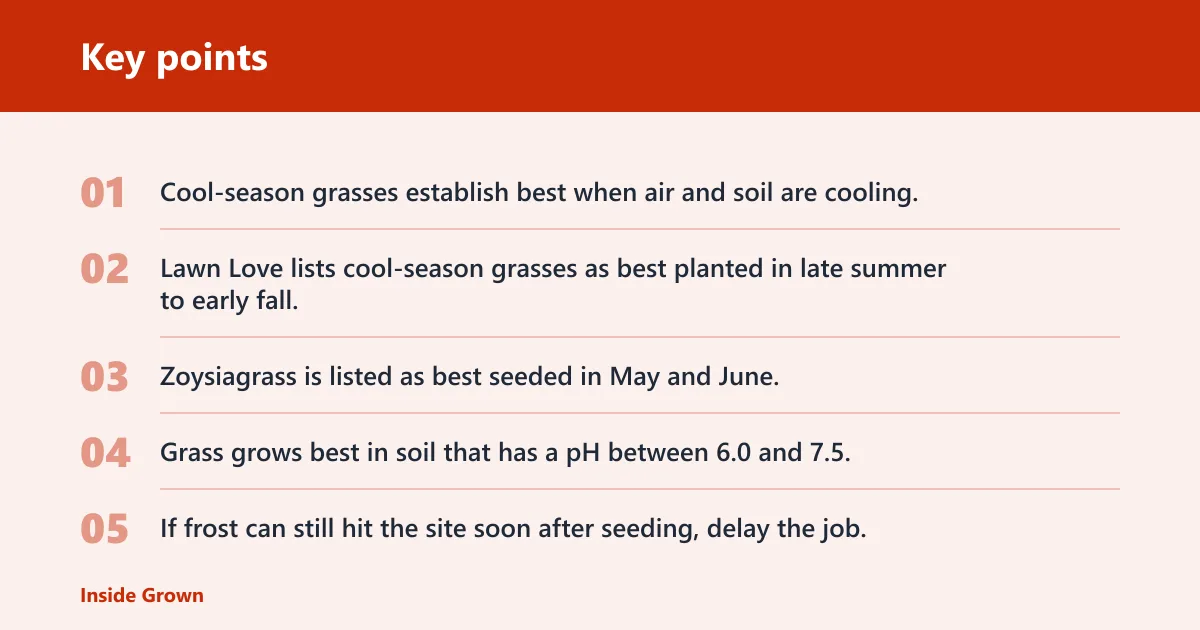
Cool-season grasses establish best when air and soil are cooling, and warm-season grasses want soil that is already warming. Lawn Love lists cool-season grasses as best planted in late summer to early fall, while warm-season grasses in Georgia are best planted in late spring to early summer. Zoysiagrass is listed as best seeded in May and June.
Watch soil temperature and frost timing
Temperature matters as much as the calendar. Grass grows best in soil that has a pH between 6.0 and 7.5, and seedling success drops when soil stays cold, dry, or waterlogged. If frost can still hit the site soon after seeding, delay the job.
Delay seeding if weeds or compaction are unresolved
Do not seed over active weed pressure, tight soil, or poor grading. If more than 60 percent weeds remain, Family Handyman advises removing the lawn and reseeding instead of patching over it. Poor drainage and hardpan should be corrected first, or the new turf will establish unevenly.
What grass seed should you use?
Choose the seed that fits your region first, then narrow by shade, sun, and traffic tolerance. A sunny, high-traffic yard needs a different mix than a shaded side yard. A blend only helps if every species in it suits the site and the same maintenance level.
Match cool-season or warm-season grass to your region
Cool-season grasses fit northern and transition-zone lawns; warm-season grasses fit hotter regions and longer warm periods. If the site swings between deep shade and full sun, choose a mix that tolerates the lowest-light area, because weak shade performance is usually the limiting factor.
Check shade, sun, and traffic tolerance
Read the seed label for shade tolerance and wear tolerance before buying. A play area or entry path needs stronger traffic recovery than a front slope that only gets occasional foot traffic. If irrigation is limited, choose a variety that can handle short dry stretches better than a thirsty mix.
Choose a mix only if it fits the site
Mixed seed can work, but only when every component matches the same mowing height, irrigation plan, and seasonal window. A fine-textured blend can fail on a hot, open lot if one grass in the mix cannot handle the exposure. Keep the blend simple when conditions are uneven.
How do you prepare the seedbed?
Prep the site as a seedbed, not as a quick sprinkle target. Bare soil needs clearing, loosening, and leveling so seed touches the surface evenly. Top Ten Reviews notes that the top 3-4 inches are important for seed establishment, and turned soil should breathe for a few days before moving it around again.
Remove weeds, rocks, debris, and old thatch
Pull weeds, rake out sticks and stones, and strip off thick thatch or dead turf. Family Handyman suggests renting a walk-behind gas-powered sod cutter for big lawns, which helps when the old surface needs to come off before reseeding. Clean soil gives more even emergence.
Loosen the topsoil and level low spots
Loosen the upper layer, then fill dips and knock down high spots. The same source recommends tilling soil conditioners to a depth of about five inches when soil needs rebuilding. Leveling matters because seed and water both move downhill, which creates uneven germination and thin strips.
Create a fine surface for seed-to-soil contact
Break clods, remove larger crumbs, and leave a smooth but not powdery surface. Seed should sit near the surface, where moisture can reach it without burying it too deeply. If the soil crusts hard after rain, lightly rake the top layer again before seeding.
How do you plant grass seed?
Measure the lawn, set the spreader to the label rate, and spread the seed in two crossing passes so coverage stays even. Keep the seed near the surface. The goal is even coverage without striping, clumps, or buried seed. For a new lawn, uniformity matters more than speed, because bare lanes and heavy overlaps both show up later as patchy turf.
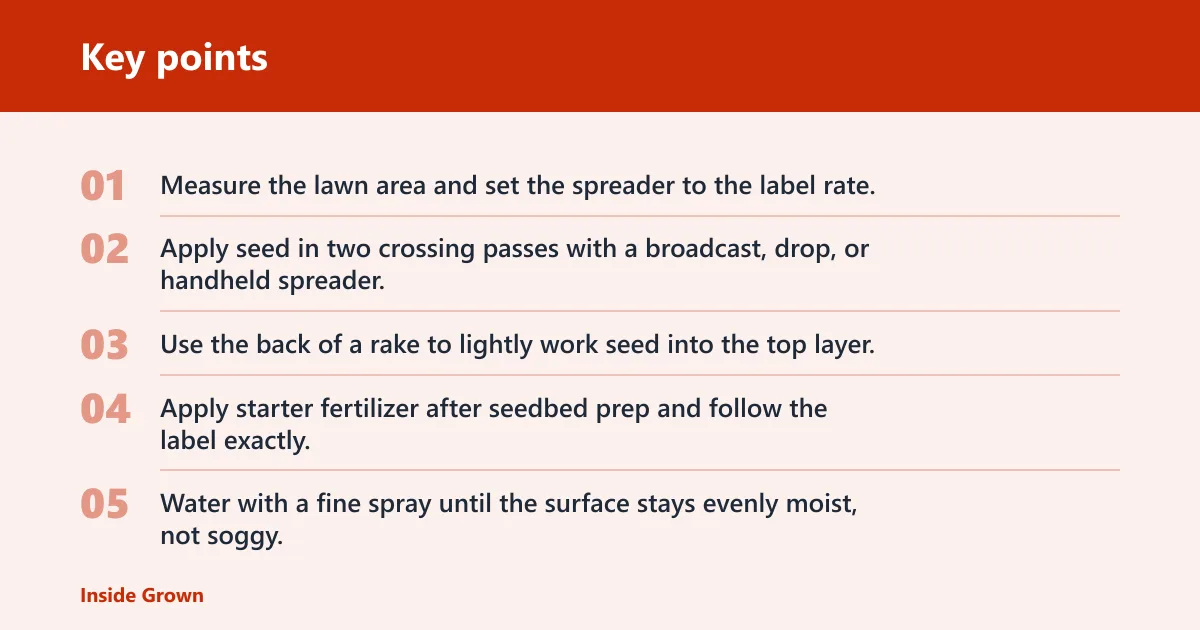
- Measure the lawn area and set the spreader to the label rate.
- Apply seed in two crossing passes with a broadcast, drop, or handheld spreader.
- Use the back of a rake to lightly work seed into the top layer.
- Apply starter fertilizer after seedbed prep and follow the label exactly.
- Water with a fine spray until the surface stays evenly moist, not soggy.
- Keep the first 14 days on a frequent, gentle watering cycle.
Spread seed evenly with overlapping passes
Use a broadcast spreader for larger areas, a drop spreader for tighter control, or a handheld spreader for small patches. Make overlapping passes so no striping appears between lanes. If the label calls for a rate by square foot, split the total in half and apply it in two directions.
Lightly rake or cover seed
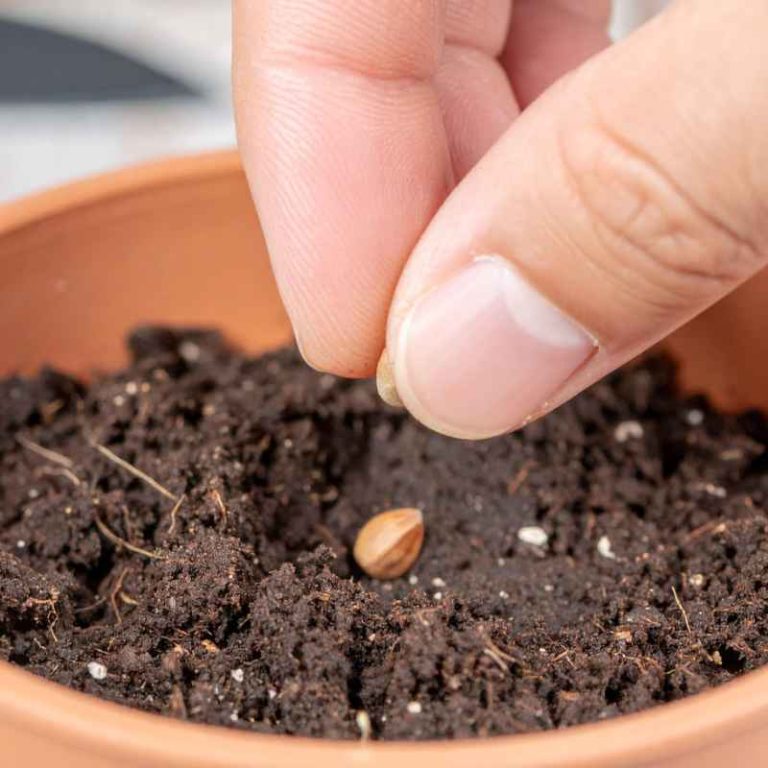
After spreading, use short, light strokes with a large plastic leaf rake. Popular Mechanics recommends that approach, and it keeps seed close to the surface instead of burying it. A heavy rake pass can move seed into low spots and leave high spots thin.
Apply starter fertilizer after prep
Starter fertilizer supports early root growth, but it should follow the product label, not a guess. Apply it after the seedbed is ready and before the first watering cycle starts. Soil test results should guide whether a starter blend is useful or whether the site already has enough nutrients.
Water immediately and keep moist
Use fine spray irrigation so the seed stays in place. Keep the seedbed consistently damp through the first couple of weeks, with more frequent watering early in the schedule and less volume per run. The surface should not dry hard enough to crust, and it should not puddle or run downhill.
Say your front yard is a 900-square-foot slope with a compacted top layer. A heavier sprinkler setting can move seed into the drain line after a storm. A finer spray, shorter cycles, and a light rake-in keep the seed where it was placed.
Common mistakes
The biggest failures come from treating new seeding like oversowing an existing lawn. Bare soil needs more prep, flatter grading, and tighter watering control. If germination is uneven, the cause is often seed movement, crusting soil, or a poor rate, not the seed alone.
- Burying seed too deep: Keep it near the surface and rake only lightly.
- Using too little or too much seed: Follow the label rate and split the application into crossing passes.
- Letting water run off: Shorten each cycle and increase frequency instead.
- Seeding before grading is done: Finish leveling first, or seed will collect in low spots.
- Ignoring weed pressure: Clear active weeds before seeding, or the lawn starts behind them.
If a new side yard gets a heavy rain a couple of days after seeding and the surface forms a crust, the top skin can be gently broken up. Let it dry just enough to walk on, then gently break the top skin with the back of a rake and resume light misting. That keeps the seed near the surface without washing more of it away.
New lawn seeding checklist
This checklist gives a pass/fail standard for each step so you can correct problems before they turn into thin turf. If a step fails, fix it before moving on.
| Task | Pass/fail standard | What to do if it fails |
|---|---|---|
| Soil test | pH is between 6.0 and 7.5, and the report addresses nutrients, salinity, or deficiencies | Send a sample to an extension lab or retest with a reliable home kit, then amend before seeding |
| Seedbed smoothness | The top 3-4 inches are loosened, and the surface is left with no obvious dips, ridges, or clods. | Fill low spots, shave high spots, and rake again until the area is even |
| Coverage check | Seed was applied at the labeled rate with overlapping passes and no visible striping | Apply the missing amount in a second pass, then rake lightly to blend it in |
| First-14-days watering | The top layer is kept consistently moist with frequent, gentle cycles and no runoff. | Shorten each watering cycle, increase the number of daily cycles, and reduce spray output |
| Weed and debris removal | The site is clear of weeds, rocks, sticks, and thick thatch | Remove the debris and treat or cut back weeds before reseeding |
| Site readiness | No active compaction, poor grading, or drainage problem remains | Delay seeding and correct the soil structure or grade first |
Frequently asked questions
How deep should grass seed be planted?
Grass seed should stay near the surface, not buried deeply. Lightly rake it in so it has seed-to-soil contact, then leave it covered by only a thin layer of soil or compost if the label calls for that. Deep burial slows emergence and can reduce stand quality.
How often should you water newly planted grass seed?
Water often enough to keep the top layer damp through the first 14 days, using short, gentle cycles rather than one long soak. If the surface glistens or water runs off, the setting is too strong. If the soil crusts or turns pale, increase the frequency.
Can you add grass seed to existing lawn?
Yes, but overseeding an existing lawn is different from seeding bare soil. You need lighter surface prep, less leveling, and enough seed to reach thin areas without burying the existing turf. If the lawn is more than 60 percent weeds, reseeding the whole area is the better call.
What grass seed should you use for a new lawn?
Start with your region, then match shade, sun, and traffic. Cool-season grasses fit northern timing and cooler weather, while warm-season grasses fit hotter regions and later planting windows. Choose a mix only when every species in it matches the same site conditions and care level.
How do you sow grass seed in a lawn?
Calibrate the spreader to the label rate, apply seed in two crossing passes, and use a light rake to keep it near the surface. Finish with starter fertilizer if the label and soil test support it, then water with a fine spray so the seed does not move.
Can you plant grass seed in new soil?
Yes, if the new soil is graded and settled enough to support seed-to-soil contact. Test the pH first, confirm nutrients and salt levels, then rake the surface smooth before spreading seed. Fresh soil that is still loose, lumpy, or poorly drained should be corrected first.